
The written record
Read the transcript
Read along with the recording · About 14 min to read
Visa, a proud sponsor of Rabbit Ears Radio, thanks Visa cardholders for their support in reaching its goal of having a million stories read and for helping to make possible a donation of more than $1 million to Reading is Fundamental. Welcome to Rabbit Ears Radio from PRI, Public Radio International. Long, long time ago. Quite a long time ago. Many, many years ago. So long ago that most folks forget. But seriously. This is a long, long time ago. Some time passed. Not much, not a little. What am I, a watch? To begin at the beginning, once upon a time. Thousands and thousands of years ago. About 27 centuries ago, actually. But who's keeping track? It's a story. I'm Meg Ryan. Perhaps no one in this country's young history reflects the true American spirit better than the cowboy. The king of the American frontier. Rabbit Ears Radio hits the...
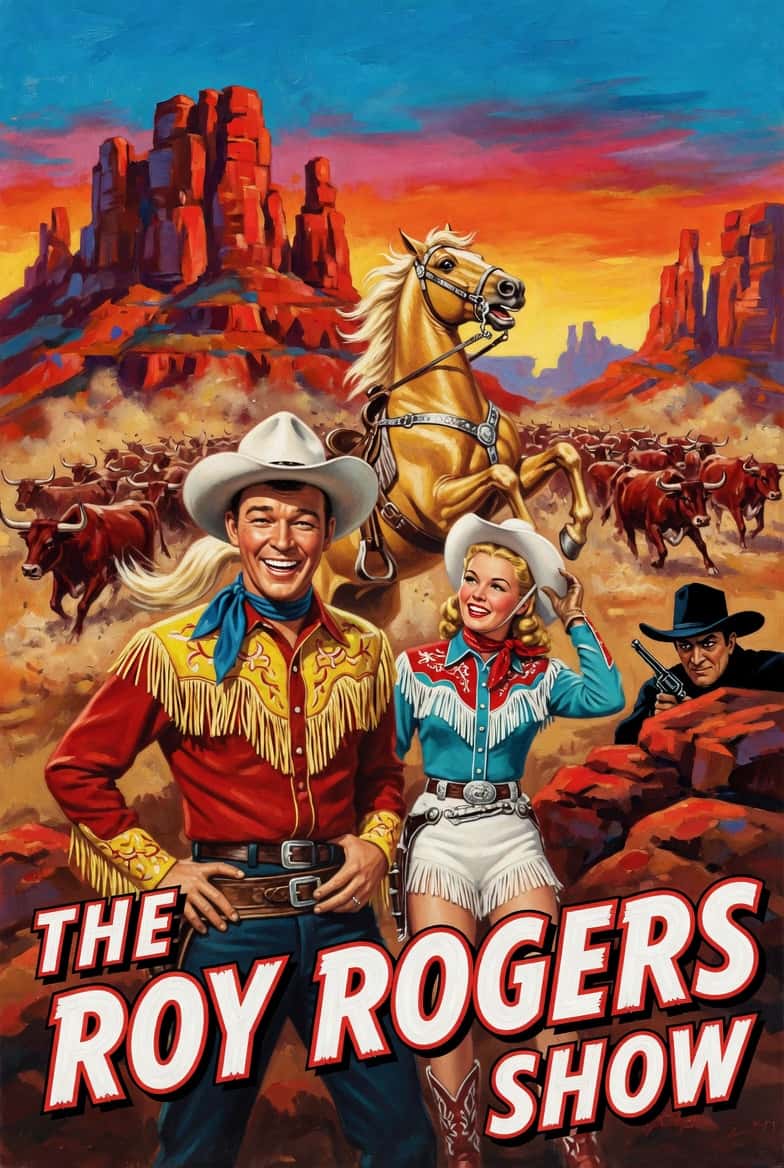
Storytelling Trails today was a tale about one particular cowboy who lived during the peak of America's westward expansion. Our story is entitled Happy Trails, and who better to tell this tale than Mr. Happy Trails himself, the king of the cowboys, Roy Rogers. Now I'm sure you younger listeners out there know the fast food chain that bears Roy's name. But you older kids probably know Roy Rogers as the famous television, radio, and movie star of the 1940s and 50s. Roy was an idol of his generation, a true cowboy hero in every sense. Well-mannered, gallant, loyal through and through, with a voice as sweet and gentle as a cactus flower. Like fine wine or a good pair of boots, Roy's voice has aged to perfection, and he tells today's story as only a classic cowboy can.
It's an original tale about the hard-riding life and times of young Matt Cooley, just one of the thousands of cowboys who pushed cattle and blazed a trail across the country's heartland. The life of a cowboy was filled with grave danger, hard work, and tedium. But around the campfire each night after a hearty chuckwagon meal, storytelling and singing were the cowboy's just reward. Throughout our story, we have many of the same classic cowboy songs first sung by cowpokes and drovers over a hundred years ago. In today's program, these songs are sung by a trio of musicians from Nashville, Tennessee, who have been performing together for over 20 years. Individually, they're known as Woody Paul, Ranger Doug, and Too Slim. But as the group Riders in the Sky, they're the ultimate cowboy crooners.
So gather round the campfire, partners, as Rabbit Ears Radio proudly presents the story of Happy Trails told by Roy Rogers. Where the buffalo roam, where the deer and the antelope play, where seldom is heard a discouraging word, and the skies are not cloudy all day.
Where the deer and the antelope love each other. A discouraging word. And the skies are not cloudy all day. Yes, sir, my home on the range. Land of the purple sage, the six guns, and the big sky. Round the campfire's flickering glow, we'll sing the songs of long ago. After the terrible war between the states, Folks started ranching longhorn cattle down in South Texas, and a new kind of character was born, the cowboy. Young Matt Cooley was just such a one, a private and General Pap Price's Confederate raiders. Matt had fought the Yankees all over Arkansas and Missouri. Three years later, the war was over. When Matt caught his breath, he rode off to Texas looking for a wild, free life. Yee-haw!
Ranching Texas style was a new thing then. You see, it wasn't that long ago that Texas was a wilderness. After the Mexicans got pushed out, a lot of their cattle were left behind to roam the chaparral until they turned half wild. That's why it became necessary to round them up and brand them. Spring of 1866, Matt signed on with the Bar Double T outfit down in Frio County. The cowboy's life was a no-frills, fair necessities deal. He had his horse, his rope, his grub, and his gun, and to drive away the loneliness, why, he sang songs. When night fell on the trail, the man that could drown out those howling coyotes became the pet of the bunch. And that was Matt Cooley all over. Why, he had a voice as slick as persimmons after the first frost. As I was out walking one morning for pleasure, I spied a cowpuncher a-riding on his hat.
Now it's early in the springtime when we round up the doge. We mark them and brand them, bob off their tails, round up the horse, load up the truck wagon, and then throw the doggies out on the long trail. Whoop-de-die-io, get along, you little doggie, with your misfortune and none of my own. Whoop-de-die-io, get along, you little doggie, you know that Wyoming will be your new home. Whoop-de-die-io. Cowboys follow the simple code of the book house and the reins. Do your job well, shoot straight, and ride hard. And to get it all done right, why, they just needed a special kind of a four-legged business partner. The cowboy's horse was descended from the ponies that the Spanish brought to America hundreds of years ago. Some of them got loose, and they roamed the mesquite in wild herds.
Over time, they became the Mustang breed quickest panthers and tough as the cactus they rode through. Matt Cooley had one of these Mustangs. An Indian pony, piebald all over, black and white like somebody flung a paint can at her. That's how he came to call her Old Pink. She was pretty in her way and smart as a scorpion bite. Out on the range, a man's horse was his best friend and no cowboy ever had a better, truer companion. And that's old paint. I ride in old paint. I lead an old day. I'm going to Montana for to throw the hula hands. They feed in the coolies. They water in the draw. Their tails are all matted. Their backs are all raw. Ride around, little doggie. Ride around them clothes.
They're fiery and stuffy and raring to go. Die, die, take my saddle from the wall. Put it on my pony and lead him from his stall. Tie my bones to his back, turn our faces to the west. And we'll ride that prairie that we love the best. Ride around, little doggie, ride around them slopes. On the range, Matt Cooley sometimes yearned for a different sort of company than the four-footed kind. Matt and the boys at the Bar Double T favored the trail towns that had some wild and woolly dances.
The dancing cowboy was off to a comical sight. The front of his sombrero tilted back, huge spurs jingling at every motion, revolvers flapping up and down like sheep's tails. He swung his partner clear off of the floor. There's a yellow rose in Texas that I am going to see. No other fella knows her, nobody only me. She cried so when I left her, it liked me. break my heart. And if I ever find her, we never more shall part. She's the sweetest rose of color this cowboy ever knew. Her eyes are bright as diamonds, they sparkle like the dew. You may talk about your dearest man, sing of Rosalie, but the yellow rose of Texas is the only one for me. Oh, I'm going now to find her, my heart is...
We'll sing the songs together we sang so long ago. We'll play the banjo gaily and sing the songs of yore. And the yellow rose of Texas will be mine forevermore. She's the sweetest rose of color that cowboy ever knew. Her eyes are bright as diamonds, they sparkle like the dew. You may talk about your dearest may and sing of Rosalie. But the yellow rose of Texas is the only one for me. Cow punchers were a footloose breed, though. Seemed like they were always saying farewell. Always moving on. Whenever the cowboys swayed with their girls, it was with bittersweet thoughts of parting and returning to the free life of the range.
There were many trails leading out of Texas. The idea was to bring those cattle on the hoof to the nearest railhead so as to ship them east for beef. America was a hungry, growing land. Matt Cooley's double bar tee outfit favored the Chisholm Trail, which cut a path from San Antone, Texas up to Abilene, Kansas. It was named after Jesse Chisholm, a part Cherokee trader who used to run wagon loads of hides through the native territory that's now the state of Oklahoma. Well, sir, the drovers that rode the Chisholm Trail made up a song about it, and they say it had a verse for every Texas Longhorn that marched each dusty mile. Come along, boys, and listen to my tale. Tell you of my travels on the old Chisholm Trail. Come a-die, I yippee, yippee.
I'm up in the morning before daylight and before I sleep while the moon shines bright. Yippee-yay, yippee-yay, yippee-yay, yippee-yay. It's bacon and beans most every day. We'll soon be eating that prairie hay. Gumbadaya, yippee, yippee, yay, yippee, yay. Gumbadaya, yippee, yippee, yay. Wind began to blow, the rain began to fall, and it looked like we was going to lose them all. Gumbadaya, yippee, yippee, yay, yippee, yay. Gumbadaya, yippee, yippee, yay. Sometimes when a cattle drive was over, a man would take his pay and ride clear down to Mexico, where he could live extra high and lose himself for weeks before resuming the drover's life.
One notorious stop on the way to Mexico was the border town of Laredo. Matt Cooley blew into Laredo one evening, much in need of a bath, a shave, a new shirt, and a good hot meal other than beans. It was on the wood sidewalk that he saw a fellow about his age exactly, left to await his fate outside the Undertaker's parlor. He was beyond doctoring. When that happened, bye. As I walked up in the streets of Laredo As I walked up in Laredo one day I spied a young cowboy Wrapped up in white linen Wrapped up in white linen And cold as the clay I see by your outfit that you are a cowboy. These words he did say as I boldly stepped by. Come and sit down beside me and hear my sad story. I'm shot in the breast and I know I must die. It was once in the saddle.
I used to go dancing. Was once in the saddle. I used to go brave. I first took to drinking and then to card playing. I'm shot in the breath and lie dying today. Now this is how it happened. The young cowboy came riding into town with 50 gold dollars in his pockets. Heading for Monterey. It being 100 miles further along, he figured he'd lay over the night and parade him. His first mistake. Well, after putting up at the hotel, he came over to a social establishment called the Green Cloth Saloon, looking for some refreshment and company. Mistake number two. After enjoying a sip or two of the local beverage called tarantula tonic, he engaged in a game of cards with a traveling fellow named One-Eyed Frank Morris.
Mistake number three. There came to be a difference of opinion concerning the ace of spades and whether Frank dealt it from the top of the deck or from out of his sleeve. And old one-eye put a dead stop to the debate with his .31 caliber pocket ramming. So this young cowboy was now fixing to become an angel riding the plains of heaven instead of riding on to Monterey. Get thick, jolly drover. To deaden the sounds of the clock as they fall. Oh, beat the drums slowly and play the pipe lowly. Play the dead march as you bear me along. Take me to the green valley, there lay the pod or me. For I'm a young cowboy and I know I've done. The west of that nameless boy and Matt Cooley and all the other cowpokes is gone now.
Fences and barbed wire slowly put it in through the cattle drives. Then the farmers and the grangers came along. And finally, some sorry wildcatter struck oil on the range, which put all the horses out of a job, too. The drover's work is done. The trail is at its end. The race is run. But the West lives on in these songs and in the tales they tell of hard life, brave hearts, and wild deeds. If you go to Texas in the spring, you will still find the range of Washington bluebonnets under a big sky. And smell the perfume of the sage and the mesquite and hear the whippoorwills when the curtain of night gets pinned back by the stars. And maybe you will sing one of these songs and have a kind thought for all of us bygone cowboys. Happy trails to you until we meet again.
Happy trails to you Keep smiling until then Who cares about the clouds when we're together Just sing a song and bring the sunny weather Happy trails to you Till we meet Who cares about the clouds when we're together Just sing a song and bring the sunny weather Happy trails, till we meet again. Happy trails. Happy trails. Not a classic or what. Did you know the song Happy Trails is actually written by Roy's wife, Dale Evans? And it's generally regarded as one of the most recognizable melodies ever written, except for when I sing it. Well, the West does live on in the stories and songs we just heard.
Books, music, TV shows, and movies about cowboys in the West are about as common today as flies on a horse. What is it about our fascination with cowboys in the West? By the late 1800s, the occupation of cowboy had been around North America for almost three centuries. But it was the exceptionally long cattle drives from Texas to Kansas that inspired dime novelists and pulp writers of the time to create the romance of the cowboy in the Wild West. Those writers took their inspiration from real-life cowboy legends like Wild Bill Hickok, Billy the Kid, Calamity Jane, and Buffalo Bill Cody, whose own traveling Wild West show radically reshaped the mythology of the cowboy image and the Western frontier. Motion pictures, radio, and television soon replaced the live theatrics of Buffalo Bill's Wild West show, and that's where Roy and his box office buckaroo cronies like Gene Autry, Tom Mix, the Lone Ranger, and Hopalong Cassidy came along. Later generations of cowboy heroes like John Wayne, Gary Cooper, and Clint Eastwood would inherit and reshape the cowboy image yet again. Even today, the mystique of the Wild West and cowboy hero is seen and heard in numerous films, songs, TV shows, books, and poems. Whatever the media has done to reshape the image of the West through the years, one thing is clear. The cowboy remains a strong symbol of the freedom, hard-working values, and simple natural living that many of us wish we could have in our lives today. The mythology of the cowboy in the West possesses strength and wisdom worthy of everyone's attention. I'm Meg Ryan for Rabbit Ears Radio. Happy Trails was told by Roy Rogers and written by James Howard Kunstler. The music was arranged and performed by Writers in the Sky and produced by Joe Misculin. The soundtrack was produced by Ken Hohen and Craig Rogers.
Rapid Ears Radio is produced by Ken Hohn. The engineer is Jeff Sheridan. The coordinating producer is Georgia Bushman. The co-executive producer is Mary Meehan. The executive producer is Mark Sotnick. You are listening to Rapid Ears Radio from PRI, Public Radio International. For more information about Rapid Ears, the number is 1-800-800-EARS. This program is copyrighted by Rabbit Ears Productions, all rights reserved. Visa, a proud sponsor of Rabbit Ears Radio, thanks Visa cardholders for their support in reaching its goal of having a million stories read and for helping to make possible a donation of more than $1 million to reading its fundamentals. PRI, Public Radio International.