
The written record
Read the transcript
Read along with the recording · About 6 min to read
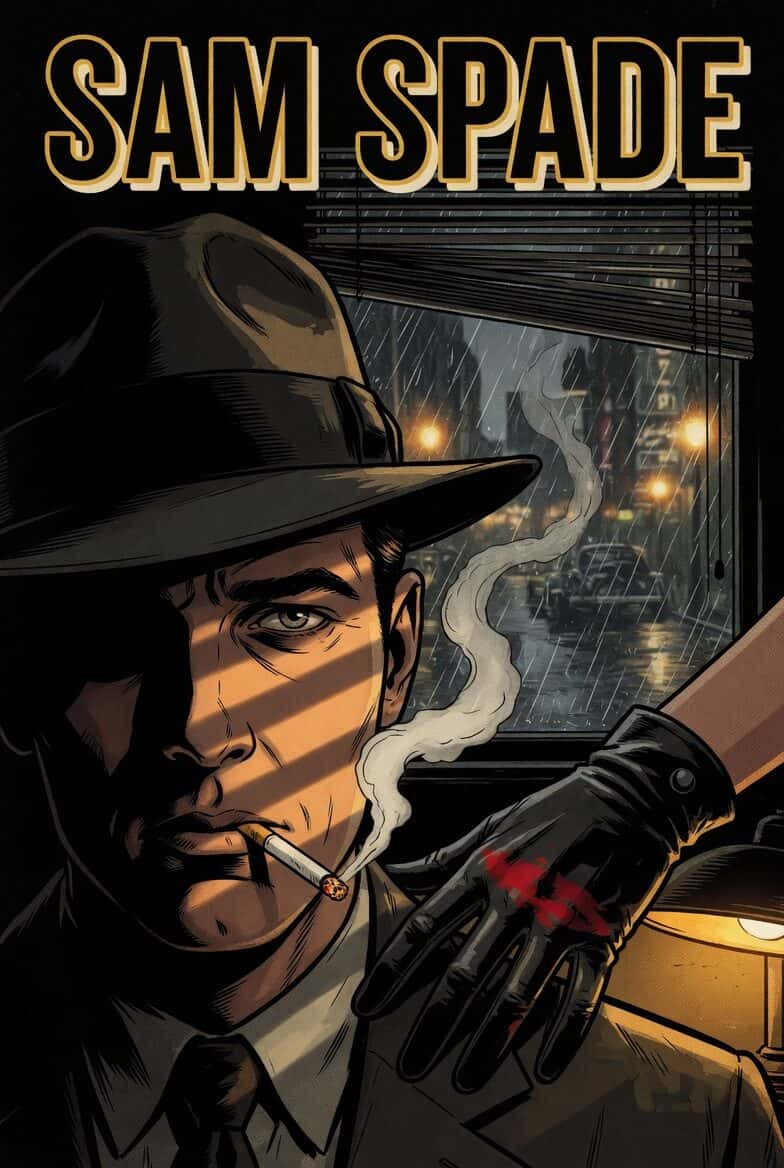
The Adventures of Sam Spade The Adventures of Sam Spade was first heard on ABC July 12, 1946 as a Friday night summer series. The show clicked at once and went into a regular fall lineup on CBS September 29, 1946. From then until 1949, Sam Spade was a Sunday night thriller for Wild Root Cream Oil, starring Howard Duff in the title role. And now, with Howard Duff starring as Spade, Wild Root brings to the air the greatest private detective of them all in The Adventures of Sam Spade. When Howard Duff left the show, NBC took the series. It remained on Sunday, sponsored by Wild Root, starring Stephen Dunn as Sam Spade. This version lasted until 1951, the last year running as a Friday sustainer. Spade's appearance on the air marked an almost literal transition from Dashiell Hammett's 1930 crime classic, The Maltese Falcon, where he first appeared. Spade was a San Francisco detective, one of the most distinctive of the hard-boiled school. His jump to radio was wrought by William Spear, who had already carved out a reputation as a master of mystery in his direction of another highly rated CBS thriller, Suspense.
Join their talents to make your hair stand on end with the adventures of Sam Spade. Presented by the makers of Wild Root Cream Oil for the hair. Spear was editor, producer, and director. A lifelong radio man, he had broken in during the primitive days of 1929 and earned his stripes serving on such pioneering shows as the March of Time. Spear assembled the writing team of Bob Tallman and Anne Lorraine and began putting Spade together. He was impressed by the deep, cynical, tough qualities in Howard Duff's voice. Duff had long experience as an actor, a career that traced back to his high school days in Seattle. He had originally wanted to be a cartoonist, but the sound of applause in a senior play at Roosevelt High changed all that. Suddenly stage-struck, Duff began hitting the boards. He worked in local theater groups and cracked radio as an announcer on a local station. When the war came, Duff went with Armed Forces Radio as a correspondent, a job he held for more than four years. He emerged in Hollywood in 1945, a seasoned but unsung microphone veteran. With his perfect voice and polished delivery, it wasn't long before Duff was playing supporting parts in top dramas of the era. Sam Spade shot him to national fame. The character, as Spears saw it, would have many easily identifiable traits.
The first thing Spade usually wanted to know was how much money you got on you. 200? Okay, I'll take that and you can pay me the rest later. But Spade wasn't a spendthrift. He never threw silver dollar tips all at Johnny Dollar, even if he could have put it on his expense account. Spade's favorite way to travel was by streetcar. It took him almost anywhere for a dime. He disliked cabs and he liked cheap booze. You didn't need more than an occasional subtle reminder. Those glasses clinking every week as Sam opened his desk drawer and began dictation were enough. We knew Sam and Effie weren't toasting each other with sal hipotica. Sam was a man who worked out of his desk, and the thing closest at hand in that top drawer just might be a half-empty bottle of old granddad. His clients got bumped off with startling regularity. Then Sam sent his report, and presumably his bill, to the widows. He dictated his cases to his faithful secretary, Effie, a babbling, man-hungry female.
who might well have been the adult Corliss Archer. Say, Detective Agency. Me, sweetheart. I got it. Got what, my friend? A bank book, Sam. Well, it's advertised in the Lawson family. But it's your bank book, Sam. What? Uh-huh, it has your name on it. Samuel Spade, account number four. It's a forgery. Somebody's trying to pin something. Lock it up and go. Did you make a lot of money on this one, too? Got the check right in my pocket, five. You're making more money than a movie star. Well, almost. And all honesty, too. Each case came out as a report, dated, signed, and delivered. Spade license number 137596 was always included in the report. The cases unfolded in chronological order, the scenes shifting between Sam and Effie and the dramatization of Sam's dictation. Effie, who almost always seemed on the verge of tears whenever Sam became involved, as he did weekly with a curvy client, was played beautifully by Lorene Tuttle. Stand it! Take it straight back first thing in the morning. You'll have to. It'll never find a way itself. You got your book, sweetheart? Yes, I am. I don't understand. Well, it's all right, honey. It doesn't matter. Date, October 5, 1947. To Hillary Exxon Esquire from Samuel Spade. License number 137596. Oh, honey, it's only a memo robot. Subject, the Adam Fig caper.
There, Mr. Exxon. Jerry Hausner played Sam's lawyer, Sid Weiss. Lud Gluskin directed the music, and Dick Joy announced. Soon after the series began, Anne Lorraine dropped her writing duties, and Gil Dowd became Bob Tallman's writing partner. The show ran in its original format through the episode of September 17, 1950. Then Howard Duff quit for a fling at the movies, and Sam Spade languished for two months. On November 17, 1950, it returned on NBC. Duff's absence was handled in usual network form, by importing a new voice. NBC ran the show as though nothing had happened, using Steve Dunn as a boyish-sounding spade. Spear and Miss Tuttle followed the series over, and for a time so did Wild Root. Wild Root and its listeners all got wise around the same time. Dunn was a good radio man, but he sounded like Sam in knee pants. Duff once said that Hammett had done such a great job in The Maltese Falcon, that any actor could have played Sam and become a radio hero. He saw that theory proved wrong, in spades. Information for this audio clip came from your audio series descriptions moderator, Roger Hohenbrink. This audio clip is provided by the Old Time Radio Researchers Group, a group of volunteers dedicated to preserving radio's past. If you are interested in assisting to preserve radio's golden past, so that future generations might also enjoy it, We urge you to look into membership in the Old Time Radio Researchers Group. Visit our home on the web at www.otterprojectonline.info. I'm your announcer, Doug Hopkinson.