
The written record
Read the transcript
Read along with the recording · About 20 min to read
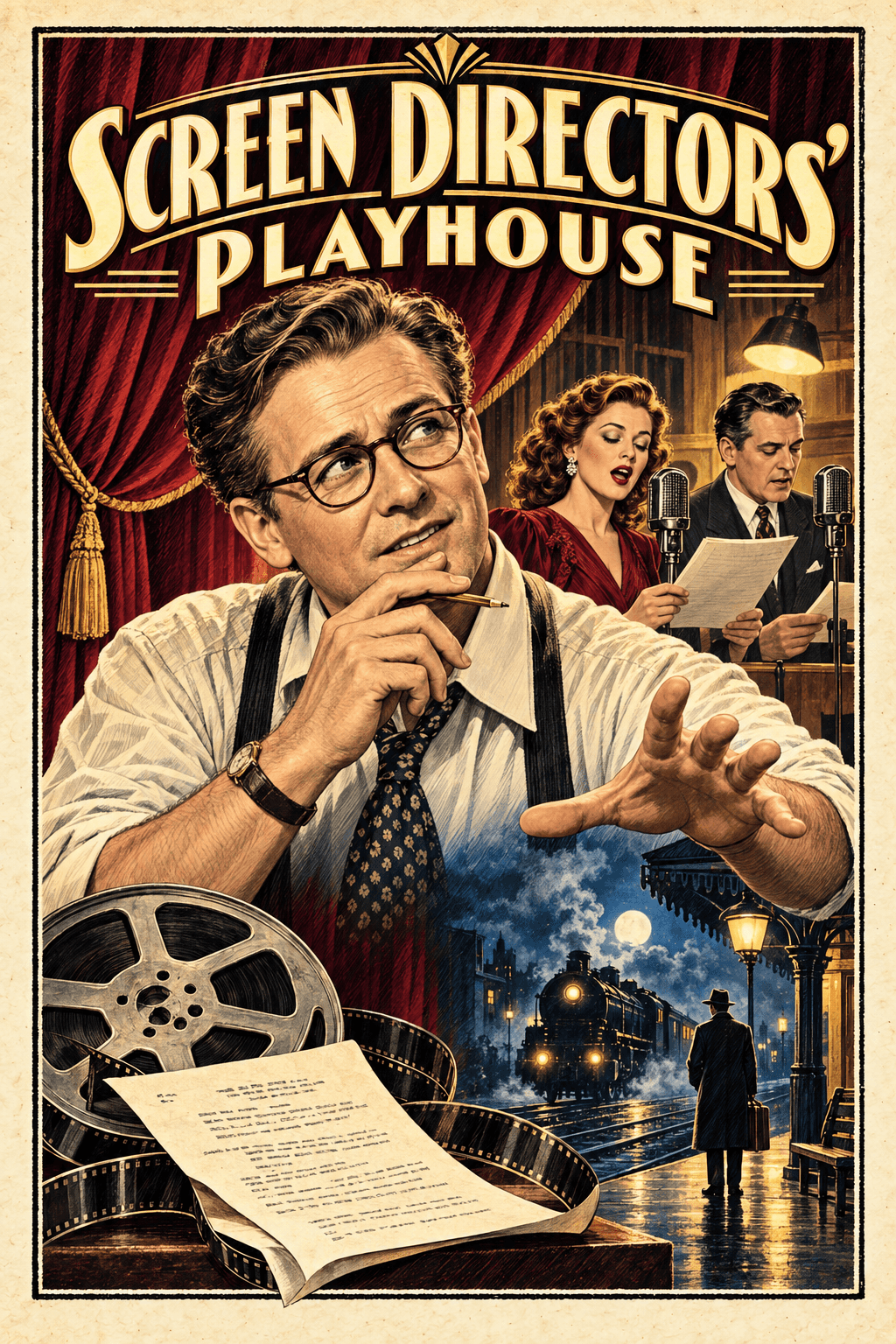
From Hollywood, the Screen Directors Playhouse. Screen Directors Playhouse, star Joseph Cotton, production Love Letters, director William Dieterle. The Hollywood Screen Directors present a tale for the romantic heart. Love Letters, starring Joseph Cotton in his original role of Alan Quinton. Italy, the war. I didn't really hear the explosion and German shells slamming into a squad of British infantry.
I didn't hear it, but as my body lifted, I knew that perhaps I was going to die. And for an instant, I saw a face I'd never seen and heard a voice I had never heard. In that instant, when my soul stretched out before me, I knew my love for Victoria. We had never met, but I loved her. And then the darkness came, and the world was dressed in darkness. Dressed in darkness. Your bandages are dressed for another day, Captain Quinton. Thank you, nurse. Now I have a surprise for you. A letter from your mother and father. Nice. Don't you want to read it? You read it to me. Very well. Our dearest son, this marks the fourth week since you were wounded, and we both hope and pray... A letter from a home sweet, consoling, and so very, very useless. Wouldn't it be nice to receive a letter from Victoria? I'd written her so many, and she never knew. Love letters.
and the Officers' Club in Rome, and Roger Moreland. Good Lord, Alan, you look as if you're writing a last will and testament. Do I, Roger? Look, you're writing my letter over my name to my girl, who's silly enough to like your sort of bilge. So stop steaming and read me that last page. All right, Roger. Victoria, I think of you, my dearest, as a distant promise of beauty untouched by the world. If I never see you again... Well, go on. Roger, I'm sorry we ever started this business. Nonsense. If I'm awkward at love letters, why shouldn't you write them for me? Perhaps she's falling in love with them, Roger. Victoria is in love with me. We met at a dance in England. She knows me well enough. She knows you by the letters, my letters. I won't go on with it. Oh, don't tell me you've fallen for her yourself, Alan. Are you in love with her? Oh, don't be stuffy. Besides, if you're so righteous, why did you start writing her in the first place? As an escape, I suppose. I wrote her all the things I could never say to any other woman. I wanted to say them too.
An unknown girl who wouldn't care. And you did. But Victoria has cared. That last letter, Roger, give it to me. Right-o. Here it is. Listen. My darling, thank you for seeing life not as a burden or a punishment, but as a dream of beauty which we can make real. It is terrible waiting for you, but finding you was such a miracle that anything I suffered... Seems only a small payment in return. Very pretty, but senseless. Roger, don't you see she loves a man who doesn't exist? Oh, well, I'll make a bloody good substitute, you know. Meanwhile, sign my name to the letter and I'll never trouble you again. Word of honor. Right. Here's an end to it, then. Don't forget the address. Miss Victoria Remington, Meadow Farm, Essex, England. Meadow Farm. Once I lived near there, Roger, with an aunt at Beltmarsh. Very interesting. May I have the letter? Here it is. Thank you.
Seems a pity to bother mailing it when I'll be seeing her in a few days. What did you say? Oh, didn't I tell you? They're sending me back to England for training. Sorry, Captain. I don't know what you'll be doing to her. Probably have a jolly good time, that's all. Well, I'm on my way. Don't stop any artillery, Alan. God help you, Roger. And God help Victoria. We leave you with our fondest love. Signed, Mother and Father. Captain Quinton. Oh, yes, yes, nurse. I was just thinking. Oh, there's a postscript in another hand. It's signed Roger Morland. Roger? What's he say? It says, just dropped in on your parents while on my honeymoon. Two weeks ago, Victoria and I were married. So she was Victoria Morland now. Victoria's dream of beauty.
I choked back the memory of the vision that had flashed in the shell burst. For 15 months, I buried it in my loneliness. 15 months of hospitals and hospitals and finally England and home. Alan, dear, I do hope you're not brooding about the war. Oh, no, no, mother. Your brother Derek was a soldier, too. But you're so different. Oh, something besides the war has changed you, Alan. Brother Derek wasn't wounded, Mother. I suggest you leave us to brood together, just a couple of old soldiers. Very well, Derek. Oh, Alan, speaking of soldiers, remember the young man who came to see us when you were hurt in Italy? Roger Moreland? What about him? Well, he's been dead a year. Roger? Killed in action? No, his wife did it. Oh, what was her name? She murdered him. Victoria. Oh, yes, that was it, Victoria. Alan, you look ghastly. Victoria.
What happened? I don't know. Some dreadful business with a knife. Victoria did not kill Roger Moreland. Indeed? And who was the murderer? I was. You're sure I can't help you pack, Alan? No, thanks, Derek. You know, I can't understand what's possessed you to leave home and take old Aunt Dagmar's house at Belkmont. She left it to me when she died, didn't she? Besides, there's a place nearby called Meadow Farm. What about it? Victoria Remington Meadow Farm. Hmm? Oh, nothing, Derek. Just a place. Look, Alan, how about one last fling before you leave? Party? Well, there's a girl I know named Dilly Carson. She has a flat in London. Just a few guests, and then afterwards you can hop the train to Biltmore. All right, Derek, if you want, but I'm afraid I can't promise to have a good time. Well, here he is, Dilly, my redoubtable brother, Alan Quinton. Hello, Alan. I'm so glad you've come. Hello, Dilly. Come along. I'll introduce you to my creatures. This is Janet Campbell. Hello.
And Jean Foley? Jane. And this is Singleton, my roommate. I'm very glad to meet you. Those devils are breaking my bed. Quite scintillating, isn't she? What's your name? I'm Alan Quinton, and you're Singleton. Is that your first name or your last one? Oh, it's the only name I have. Well, that is strange. Not really. One name is fine. You know Singleton. I think we've met before. Have we? Sounds ridiculous, but it seems... We met on the battlefront overseas. Oh, no, I've never been on a battlefront. Here, Alan, I've brought you a drink. Thank you, Dilly. I said, do you mind if I get drunk? Well, just remember we rent the furniture. Unhappy, Alan? Yes, I haven't had a drink since... Well, cheers. Pass me the bottle, Dilly. Here you are, my bunny. Where's Singleton, Dilly? She's gone, Alan. She's very beautiful. Once, once there was a girl. Her name was...
Victoria. Victoria... Moreland. Dilly, I've... I've done an unspeakable thing. I wrote some letters and Roger died and... Victoria... Oh, I... I... I don't know, Dilly. I... I don't know. Always a dream of beauty and... Victoria! Alan, you've been talking to yourself for the past half hour. Dilly. Yes? Where's Singleton? They've all left, Alan. Oh, I'll have to get you a train. I'll take you to the station. But first, Alan, listen to me. I don't know what strange trick of fortune brought you here, but I know the truth about Victoria Morland. Alan, you're still here. Hello, Singleton. Dilly, where is Victoria Morland? No, Alan, I don't want to talk about... Victoria Morland? Is she a friend of ours, Dilly? No, no, Singleton, you don't know her. Dilly, you said you'd... But you must have misunderstood.
Whoever she is, Alan, you're in love with her. Yes, I am. How did you know? The way you talked about it tonight. Have you lost her, Alan? Yes. Then perhaps I can help you find her. But why? Because I like you. Singleton, I'm taking Alan to the station. Good night, Singleton. Good night. I hope you find her. And Alan, please come back soon. I will. Goodbye. Dilly. Yes? Why didn't you want me to talk about Victoria in front of Singleton? Alan, Victoria's dead. Dad. In a manner of speaking, her power to remember is dead. Her past is dead. And so, although her body lives on under a different name, the old Victoria's really gone. A different name? Tell me, Dilly, who is Victoria Moreland? Her name now is Singleton. Are you surprised, Alan? No.
No, I think I knew. She was the girl in the shell burst. I felt it like the shedding of an awful wound. Oh, thank you, Dilly. Thank you. I've found her. I've found Victoria. You are listening to the Screen Directors Playhouse production of Love Letters, starring Joseph Cocker in his original role with Barbara Eiler as Singleton. Singleton was Victoria Moreland. Victoria, whom I knew only through our love letters. But now... Knowing her, having found her, my dream, the dream of beauty, fluttered in my hand. Then as Dilly Carson and I talked at the station, it was gone. There's so much I want to ask Dilly, so many questions. Victoria was a foundling who had been given the name of Victoria Singleton. But she was adopted by Beatrice Remington, a lonely old maid who lived at Meadow Farm. I was raised near there. Beatrice Remington loved the child, bringing her up as a kind of...
Idle, guarding her from the hurt of the world. And then she met Roger Morland and fell in love with those letters. I know. My letters. The others objected, but they eloped. And Singleton became the unhappiest girl I've ever known. Then she... she really killed him. I was at home for the weekend when a laborer from Meadow Farm came and told me that something terrible had happened. Roger'd been drinking. He tried to burn her letters. Beatrice Singleton was there. She saw it all, but the shark had brought on a stroke and the old lady couldn't speak. The last words she said were to me. She told me that Roger had struck Victoria. She tried to tell me more, but the stroke had paralyzed her. And Victoria? Sitting on the floor by the half-burned letters. A large knife in her hand. A white dress stained with blood.
Roger was dead, and so was Victoria's memory. A merciful amnesia had blotted out the past. She didn't know me. What about the police? She was found guilty of manslaughter and sentenced to a few months in prison. Now, even the memory of that has faded. Everything is gone, Alan. All she remembers is the orphanage and the name they gave her there. Singleton. She remembers you? Only because I visited her regularly. Afterwards, I brought her to live with me. And Beatrice Remington? She's in a rest home. She can speak now. But the doctors have forbidden her to see Victoria. No one can ever talk of the past. You see, if Victoria's memory should return abruptly, she might lose her mind completely. I see. Dilly, you know who the real criminal is. You're the man she loves. The man she thought she'd married. But she doesn't know it.
And you can never tell her. You say you love her, but if you go on with this, you may bring back her past and destroy her and yourself. All right, Dilly. She'll want to see you again, Alan. What shall I tell her? Tell her I'm in love with Victoria Morland. As a child, I'd never liked Beltmarsh. But now I gloried in its solitude. I wanted to be alone. First to think and then not to think. All I had of Victoria was an aching memory and the sight of her house at Meadow Farm. One evening when I returned home, Singleton, what are you doing here? I came to see you. Dilly doesn't know. She must be worried to death. I'm taking you back to London on the next train here. You sit down. Now, why did you come here? Because you didn't come to see me. Oh, it's quite all right.
Because I know you're in love with a girl named Victoria Morland. Well, how did you know my address? Your brother Derek spoke of it at the party. You have a good memory, Singleton. Oh, I... It's all right, Alan. I know I have no memory. I suppose Dilly told you. Is that why you're afraid of me? No, I'm not afraid of you, Singleton. In fact, since the war, you're the first person with whom I felt at peace. Then you'll come to see me, Alan, in London? Of course I will. Oh, but don't write me about it. That's something I'm afraid of. It frightens me to receive a letter. Why does it frighten you? Maybe it's because I can't write. I've forgotten. But I remember how to read. Perhaps I'll teach you how to write again. Now, I think we'd better start for the train. All right. Singleton, you've made me very happy by coming here. In your voice, in your eyes, in your heart.
I've found the end of a searching that began a long time ago. You like me, Alan, but you love Victoria. I'm going to kiss your Singleton. Yes. I've returned Singleton to you, but I warn you, I'll want her back. No, Alan. I want you to arrange for me to see Beatrice Remington at the rest home. Tell her everything about me, except the letters. Miss Remington, I love your ward with all my heart. You're proposing to marry two different women at once, Mr. Quinton. Singleton and Victoria Morland. If her memory returned, would Singleton's consent be binding on Victoria? I've thought of those things. I think we can be happy, but I'm asking your permission before I ask Singleton. I don't want to interfere again. I did once, and I live to regret it. You don't understand. No, no, of course not.
Mr. Quinton, I want my ward to be happy. If she loves you, I wish you both happiness. I brought you to the bridge, Singleton, to watch the river. Oh, it's beautiful. See how the water moves, washing away its own wake with no past, no future, just a moving present. We can be better than the river, Singleton. We can have a present and a future. I've forgotten the past, Alan. But Victoria's part of yours. Now, that's gone, gone, finished. But you'll always be looking for her. I've found my love. Oh, Alan, I love you. I love you. Singleton, will you marry me? Darling, what is it? I... I don't know. I knew what you were going to say. I was happy, and yet... yet when you said it, something happened.
Something frightening. No, no, don't, Singleton. Oh, Alan, there's something in my past, something horrible. There is no past. Then say it, Alan. Say it again. Will you marry me, Singleton? Oh, yes, Alan. Yes, yes. We were married, Singleton and I, and went to live at Beltmarsh. It was the happiest time of my life, and Singleton laughed and gasped at the newness of everything, but always flickering darkly across the brightness of our lives.
Mrs. Quentin, you're the most beautiful creature that ever sat before a fire. More beautiful than Victoria Morland, Alan? But I'm afraid of her. Afraid? Sometimes I feel as if she were here. Another person in the house waiting to take you away from me. No, darling, never. Alan, she lived near here, didn't she? Well... When I packed away your uniform, I found an envelope. Victoria Morland, Meadow Farm, Essex. That's just a few miles away. That was long ago, my darling. Now, what about your writing lesson? Oh, I almost forgot. I wrote you a letter today. Good. Here it is, Alan. Oh, that's fine. Let's see now. Dear Alan, there are so many things I want to thank you for. Thank you for seeing life not as a burden or a punishment, but as a dream of beauty which we have made real. I...
What's the matter? Don't you like my letter? You must write me an answer, you know. And I think of you, my dearest, as a distant promise of beauty untouched by the world. Roger. Roger wrote that to me. Singleton. His name was Roger. I love... Darling, darling, now... Oh, Alan, what am I saying? It's all right, Singleton. It's all right. I don't know anyone named Roger. Now, you're upset. I'll... I'll pour you a glass of wine. There you are. Thank you, Alan. I... Oh. You spilled it. Alan, on my dress. It's blood. No, it's only wine. I had a knife in my hand. There was a fire burning. And my dress stained red. I drew it. Singleton. I'm afraid, Alan. Why do I say these things? I don't understand. Singleton's vision passed, and with it, any memory of Victor or Marlin she might have recaptured. I left her asleep, exhausted, and went to London to see the one person who could help me, Beatrice Remington.
I'm sorry. Miss Beatrice Remington went home a week ago. Singleton! Singleton! Where are you? Singleton! She was gone, and lying on the floor, a crumpled letter was signed, Beatrice Remington. Dear Mr. Quinton, I have come back to Meadow Farm because my time is short. I want to die in my own home near Victoria, and I must speak to you about her. I know that you love her as deeply as I do. That was all. And I knew that Singleton had gone to Beatrice Remington and the past. You're Beatrice Remington? Yes, my child. I'm Mrs. Quinton. I read the letter you sent my husband. You know where Victoria Morland is? Yes, I do. I want to find her. My husband's in love with her. How do you know? He loved her once.
Then something happened. He lost her. And now... Now perhaps he can be happy again. With her. What do you know about Victoria Morland? I think that now, my child, you have to know. Victoria Morland was my ward. I loved her very much. Too much. I tried to make her happiness my own. And was she happy? Until her marriage. Then one night, when her husband had been drinking... He told her someone else had written his love letters. He tried to burn them. In that fireplace. Victoria tried to stop him. But he struck her. She fell back. There was a knife. I had a knife in my hand. I killed Roger. No. I'm Victoria Morland. I killed him. He was an animal. He hit you. I took the knife. Afterward, you held it against your dress. Aunt Beatrice. Yes. The stroke. I couldn't speak.
I couldn't tell them the truth in time. And when I could speak, I kept silent to protect your sanity. It wasn't my fault, because I loved a man who didn't exist. The man who wrote the letters. Victoria. Alan, you've heard? Victoria, if you found the man who wrote those letters, would you hate him? I don't know. Then listen, Victoria. Listen. I think of you, my dearest, as a distant promise of beauty untouched by the world. If I never see you again, darling, darling, can you forgive me? It was terrible waiting for you. But finding you was such a great miracle that anything I suffered seems only a small payment in return. The suffering is gone now. The past is in the past. And the future? Ours, Victoria. We'll return in just a moment.
Next week, you'll relive another motion picture thrill on Screen Directors Playhouse, the only program which always brings you the original star of your favorite film stories. Our story next week is Remember the Night, and recreating her original role will be Barbara Stanwyck with screen director Mitchell Lyson. Now, here again is tonight's star, Joseph Cotton. It seems that my past, present, and future are closely connected with the man who directed Love Letters. In the past, he also directed me in Portrait of Jenny, and I'll be seeing you. And in the near future, we'll be finishing another picture, September. As for the present, I'm very, very pleased to introduce you to my director, William Dieterle. Thank you, Joe, and thank you for such a beautiful performance in Love Letters. It was a pleasure to do one of our film stories in a nice, dry studio. What do you mean? Well, if you think back, we've had an awfully damp association.
Hurricanes and sailboats in Portrait of Jenny and floundering around the Bay of Naples in September and that horrible wet marsh country in Love Letters. Wait till you see the script of our next picture. What is it? 20,000 Leagues Under the Sea. Well, if I may paraphrase one of Singleton's lines, finding a director like you has been such a miracle that a few sneezes seem only a small payment in return. Thank you, Joe, and good night. Good night. Good night, everyone. And good night to you, Joseph Cotton and William Veeder. Remember, next week, Barbara Stanwyck and screen director Mitchell Lyson. Love Letters was presented through the courtesy of Hal Wallace Productions, whose current production for Paramount is My Friend Irma, starring John Lund and Diana Lynn, with Marie Wilson and NBC's own Martin and Lewis. Joseph Cotton will soon be seen in the David O. Selznick presentation, The Third Man.
William Dieterle's forthcoming release for Hal Wallace is Bitter Victory, co-starring Robert Cummings, Lisbeth Scott, and Diana Lynn. Included in tonight's cast were Barbara Eiler, Alma Lawton, Dan O'Herlihy, Norma Varden, Eleanor Audley, Ben Wright, Ruth Parrott, and Dan Riss. Love Letters was adapted for radio by Richard Allen Simmons, and original music was composed and conducted by Henry Russell. Screen Directors Playhouse is produced by Howard Wiley. with dramatic direction by Bill Karn. Portions were transcribed. This is Jimmy Wallington speaking and inviting you to listen again next week when we present Screen Directors Playhouse, star Barbara Stanwyck, production Remember the Night, director Mitchell Lyson. There's better listening every night on NBC. Take Tuesdays, for instance. Tomorrow you'll want to hear The Bob Hope Show and your favorites Fibber McGee and Molly on NBC.
Tuesday also is the day for Art Linkletter's People Are Funny, The Cavalcade of America, Big Town, and Me and Janie. For the best listening, tomorrow night and every night, tune to NBC. Now stay tuned for the Ethel Merman Show on NBC.