
The written record
Read the transcript
Read along with the recording · About 22 min to read
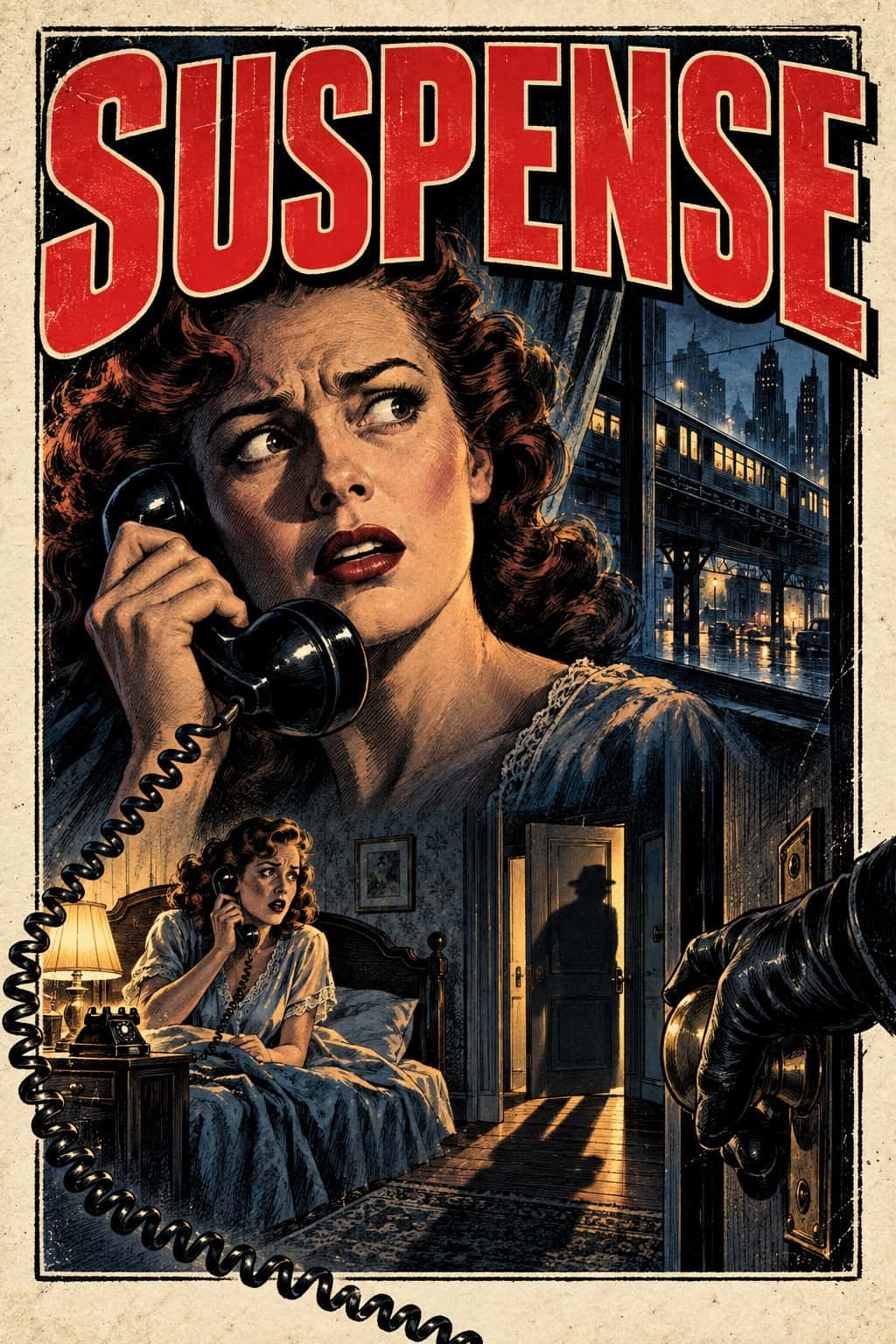
The Columbia Network takes pleasure in bringing you Suspense. Suspense. Columbia's parade of outstanding thrillers produced by William Spear and scored by Bernard Herrmann. Notable melodramas from stage and screen, fiction and radio presented each week to bring you to the edge of your chair to keep you in Suspense.
Tonight's story, by the noted American author T.S. Stribling, deals with a crime of murder on an exotic and atmospheric island with ragged beggars who slept in a Hindu temple and awoke with gold in their pockets and a dead girl lying near them and with a strange and mystical entrance into the life of hereafter, which was the experience of an American psychologist. For your suspenseful listening, we invite you to join us for A Passage to Benares. In Porto, Spain, in Trinidad, at half past five in the morning, Mr. Henry Poggioli, an American psychologist, stirred uneasily, became conscious of a splitting headache, opened his eyes in bewilderment, and then, with a shock, saw where he was. He got up, arranged his clothing, He tried with his neat psychological mind to recapture his dream, to bottle up again the little smoking wisps that still floated about within his aching head. By seven o'clock, he'd found his way back to the house of Mr. Lowe, his host in Port of Spain. Lowe was already about his coffee with an interested spoon poised above the morning paper. Ah, there you are. Good morning, Bagioli. I say, you are cool.
Quiet. Didn't hear you get up at all. Have some breakfast? Oh, thanks. I've been out for a breath of air. What's the news today? Well, the new governor will arrive in Trinidad on the 12th and... Hello. Another native's killed his wife. Tell me, Pajoli, as a psychologist, why do coolies kill their wives? Oh, for various reasons, I imagine. Let's hear some of the facts. Oh, I say this is a coincidence. Really putting on a show for you, Pajoli, on your first visit to Trinidad. How so? Well, you remember that wedding procession you and I watched last evening down at the Hindu temple? The temple? Oh, of course. The cream-colored little bride with the breastplates and the linked gold coins and the anklets and all the finery. And the bridegroom. What did you say his name was? Budman Lal? Yes. Well, do you know what's happened?
Woodman Lal is in jail this morning, and his cream-colored little bride is dead with her throat cut. No. Do they think he did it? No doubt of it. That's why he's in jail now. He always seemed like a sensible fellow, too. One of our best patrons, which only proves my contention, Poggioli. A bridegroom of only six or eight hours killing his wife without any reason at all. Oh, there's usually some reason for murder. Maybe. But I say, old boy, you're missing the point completely. How? Well... Suppose you actually had gone and slept in the temple there last night. You wanted to, you know. Remember? And I said, no white man ever stays all night in a coolie temple. You remember? Yes, I remember. You said it simply isn't done. Well, if you had, Pozzuoli, I say, that would have been a pretty kettle, wouldn't it? Yes. Yes. Well, I'm afraid I'll be mixed up in this. Both Mr. Lal and his uncle, Hiradas, are clients of mine.
Old Hiradas is upwards of five million dollars in my bank. Hiradas? Didn't you tell me he built that temple where the murder took place? Yes. It's what the Hindus call a temple and rest house. Hiradas gives rice and tea to any traveler who comes in for the night. It's an Indian custom to help mendicant pilgrims. A rich Indian will build a temple and rest house just as you Americans erect libraries. Ah. What does it say there about the murder, though? Um... Budman Lal, nephew of the famous Mr. Hirad Das, was arrested early this morning at his home for the alleged murder of his wife, whom he married yesterday. The body was found at six o'clock this morning in the temple where the wedding ceremony took place. The temple attendants gave the alarm. The victim's head was severed completely from her body and all her jewelry was gone. Five coolie beggars who were asleep in the temple when the body was discovered were arrested.
They all claimed ignorance of the crime, but a search of their persons revealed that each beggar had a piece of the bride's jewelry and a coin from a necklace. Mr. Budman Lal and his wife were seen to enter the temple at about 11 last night for the Hindu rite of purification. Mr. Lal, who is a prominent curio dealer, declines to say anything further. Doesn't tell you very much, does it? Oh, not much. What do you make of those beggars? Oh, that's simple enough. Those devils laid in wait inside the temple until the husband went out and left his wife. Then they murdered her and divided the spoil. But she had enough bangles and gee-jaws to give a dozen to each man. Yes, yes, you're quite right, Pozzuoli. That's a fact. Why should they continue sleeping in the temple after they'd killed her if they did murder her? Well, why shouldn't they? They knew they'd be suspected and they couldn't get off the island without capture, so they thought they might as well lie down again and go back to sleep. Hmm.
You may be right, Lowe, but that doesn't look like the solution to me. Well, I'm satisfied that's how it occurred. You mean the beggars killed her? Well, I don't think so. I rather fancy that the actual murderer took the girl's jewelry and went about the temple thrusting a bangle and a coin in the pockets of each of the sleeping beggars to lay a false scent. Oh, come now. That's laying it on a bit too thick, but... My dear Lowe, that's the only possible explanation for the coins in the beggars' pockets. I said, oh, boy, Ian, you've had lots of experience in these things. Come along with me and we'll go up and see Mr. Hiradas and see if we can't help his nephew. I'll be glad to. But we'll go to the temple first. Then we'll call on Mr. Hiradas. Well, here we are. Spider, the police guard at the door. The temple doesn't look sinister in the daylight. No, it just looks dirty. Let's go in and question the beggars. Excuse me, Ian.
Did any of you fellows hear noises in this temple last night? Oh, much sleep, Scythe. No noise. Policeman Pancho's wake this morning makes it still here. What's your name? Shudachan, Scythe. When did you go to sleep last night? When I ate rice and tea, Scythe. Do you remember seeing Budman Lal and his wife enter this building last night? Yes, remember, Scythe. Did you see them go out? No, Scythe. No one remember go out. You were all asleep then, huh? All asleep, Sahib. Did you have any dreams during your sleep? Hear any noises? I dream bad dreams, Sahib. Huh? When policeman punched me awake this morning, I think dream has come true. And me, Sahib. Me too. Me. Did you all have bad dreams? Yes. All have bad dreams. Look here, Pajoli. I don't see where this is getting us. I do think we ought to be getting on to old Haradas's house.
Oh, I think we can now entirely discard the theory that the beggars murdered the girls. On what grounds? They told you nothing except that they all had bad dreams. That's the reason. They all had wild, fantastic dreams. That suggests that they were given some sort of opiate in their rice or tea last night. It's quite improbable that five ignorant coolies would have wit enough to concoct such a piece of evidence as that. Not a fag, but a... I don't believe a Trinidad court would admit such evidence. We're not looking for legal evidence. We're after some indication of the real criminal. Now I suggest that we get on to the house of Hierodas. Please come in, gentlemen. I've been expecting you. Please be seated. Thank you. Thank you. Most mysterious murder in the life of my poor nephew will depend upon your exertions, gentlemen. Tell me.
What do you think of the beggars that were found in the temple with the bangles and coins? Well, I'm afraid my judgment of the beggars will disappoint you, Mr. Haradas. Huh? My theory is that they are innocent of the crime. Really? Why do you say that? Because they told me of dreams they had. All their dreams were very nearly identical. You are not English, sir. No Englishman would have thought of that. No, I'm American with a backlash sprinkling of Italian. My name's Pagioli. What is your profession, Mr. Pagioli? You are a detective? No, Mr. Doss. I'm a psychologist. Ah. Your soul is at least groping after knowledge. However, it gropes as a blind worm, Mr. Pagioli. And we must find the criminal who committed this crime and thus restore my nephew, Budman Lal, to liberty.
You can imagine what a blow this has been to me after I arranged this marriage for my nephew. You did? Arranged a marriage for a nephew who is in his thirties? Yes, Mr. Poggioli. I wanted him to avoid the pitfalls into which I fell. He was unmarried, and he'd already begun to add dollars to dollars. I did the same thing. And now, look at me. An empty old man in a foreign land. What good is this house where men of my own kind can't come and sit with me, and when I have no grandchildren to romp and play? No, I've piled up dollars and pounds. I've eaten the world, Mr. Pajoli, and found it bitter. Now here I am, an outcast. And why don't you go back to India, Mr. Haridas? Why, Mr. Pajoli...
My mind is half English. If I should return to Benares, I'd walk about thinking what the temples cost, how much was the value of the stone set in the eye of Krishna's image. If I would ever be one with my own people again, Mr. Pajoli, I must leave this Western mind and body here in Trinidad. That's very interesting and moving, but... We were discussing your nephew, Budman Lal. Wait. In searching for the criminal, I would suggest you look for a moneyed man. Let me tell you my suspicions, and you can work out the details. What are they? I went out of the temple this morning to have the body of my poor murdered niece brought here to my villa for burial. I talked to the five beggars, and they told me there was a thick sleeper.
in the temple last night. Was there indeed? Yes, Mr. Lowe. A white man. A white man? Yes, Mr. Lowe. All five of the coolies and my man, Cooper, told me it was true. But, Mr. Hierodas, decapitation is not an American mode of murder. American? I... I was speaking generally. I mean a white man's method of murder. That is indicative in itself. I meant to call your attention to that point. It shows the white man was a highly educated man who had studied the mental habits of other peoples than his own. So he was enabled to give the crime an extraordinary resemblance to a Hindu crime. But what motive could a white man have? Possibly robbery, Mr. Poggioli. Or if he were a very intellectual man, he might have...
murdered the poor child by way of experiment. A murder for experiment? Yes, Mr. Lowe, to record this psychological reaction. Why, I can't entertain such a theory as that, Mr. Harada. Oh, no, it is too far-fetched. However, it is worth investigating, is it not? Yes, yes, but I'll begin my investigations with the man Guka. By all means, Mr. Poggioli. And in your investigations, gentlemen, hire any assistance you may need. Draw on me for any amount. I want my nephew exonerated. And above all things, I want the real criminal apprehended and brought to the gallows. What do you think of that, Poggioli? White man in a temple. Sounds like pure fiction to me, to Shilbo Bunlao.
You know, these fellows hang together like thieves. Say, it's a jolly good thing we didn't decide to sleep in the temple that night, isn't it? You know, in my opinion, Low, the actual criminal is Budman Low. Same here. I've thought so ever since I first saw the account on the paper. Somehow these fellows will chop their wives to pieces for no reason at all. Now, what do you know about Budman Low? Well, he was born here and has always been a figure because of his rich uncle. Lived here all his life? Uh-huh. Except when he was in Oxford for six years. Oh, he's an Oxford man, eh? Yes, yes. There you are. That's the trouble. I don't understand. What do you mean, Paolo? No doubt he fell in love with some English girl, but when old Hiradas chose a Hindu child for his wife, Budman couldn't refuse marriage. No man's going to quarrel with a five million dollar legacy. Then he chose this ghastly method of getting rid of the child bride. I dare say you're right. I feel sure Budman allowed to kill the girl. Jones, I'm getting tired of walking.
There's a cab. Let's hop in and ride the rest of the way. Hi, cabbie. A cab. I see. Always. Well, aren't you coming? You know, I don't feel that I can conscientiously continue this investigation trying to clear a person whom I have every reason to believe guilty. But, man, don't leave me like this. At least come as far as police headquarters with me and explain your theory about Guga, the temple keeper, and the rice. Well, I thought I'd go back to your cottage and pack my things. Pack your things? Your boat doesn't sail until Friday. Yes, I know, but there's a daily service to Curacao. It struck me to go there. Oh, now, come, you can't run off like that just when I've stirred up an interesting murder mystery for you to unravel. Why, Poggioli, you ought to appreciate my efforts as a host more than that. Well, all right, then. To the police station. Yes, sir. Chief Vickers, this is my friend, Mr. Poggioli.
Mr. Poggioli, Mr. Vickers is chief of Trinidad's police force. How do you do? How do you do? Chief Vickers, I've asked Mr. Poggioli's counsel in the Budman Lal murder case. He's already developed a theory as to who is the actual murderer of Mrs. Budman Lal. So have I. Now, in this matter, Chief Vickers, I want to be perfectly frank with you. I'll admit we're in this case in the employer of Mr. Hiradaz and are making an effort to clear his nephew, Budman Lal. We felt confident you'd use the skill of the police department of Port of Spain to work out a theory clearing Berman Lyle just as readily as you would to convict him. Our department usually devotes its time to conviction and not to clearing criminals. Yes, yes, I know that, but if our theory will point out the actual murderer... What is your theory? Mr. Pozzuoli's deduction is based on the dreams of the men who were found in the temple.
So Mr. Poggioli's deduction is based on dreams. It would be a remarkable coincidence, Mr. Beckers, if five men had lurid dreams simultaneously without some physical cause. It suggests strongly that their tea or rice was doped. Now, if you find out what soporific was used, then have your men search the sales record of the drugstores in the city to see who has lately bought such a drug. You will find the murderer. Uh-huh. How do you like Trinidad, Mr. Poggioli? I like it very much indeed. You've just arrived, haven't you? Yes. In what university do you teach back in the States? Ohio State. A chair of criminal psychology in an ordinary state university? I'm not a professor. I'm simply a docent, and I haven't specialized on criminal psychology. I quiz on general psychology. You're not teaching now? No, this is my sabbatical year. You look young to have taught in the university six years, but then you Americans start young in your land of specialists.
Now, you, Mr. Poggioli, I suppose you're wrapped up heart and soul in your psychology. I am. You'd do anything in the world to advance yourself in the science. I rather think so. Especially keen on original research work. That's what he is, G. Vickers. Do you know what he asked me to do yesterday afternoon? No. What, Mr. Lowe? Oh, I don't think we ought to burden Mr. Vickers with our household anecdotes. Oh, but I'm really curious. Just what did Mr. Poggioli ask you to do yesterday afternoon, Mr. Lowe? Oh, well... Really nothing, nothing at all. It was just a little psychological experiment he wanted to do. And did he do it? Oh, no, no, no, no. I wouldn't hear of it. Oh, as unconventional as that. Oh, it was really nothing, nothing at all. I think I could guess your anecdote if I tried, gentlemen. About a half an hour ago, I received a telephone message from my man stationed at the temple to keep a lookout for you and Mr. Paglioli. A lookout for us? Yes.
Because one of the coolies under arrest told him that Mr. Pajoli slept in the temple last night. Oh, but that's not true. That's exactly what he didn't do. He suggested it to me, but I said no. You remember, Pajoli, you didn't do it. Did you, Pajoli? Did you? You see, he did. Gentlemen, I had a perfectly valid and important reason for sleeping in the temple last night, and so I can only ask your sympathetic attention to what I'm about to say. Go on. You remember, Lo, you and I were down there watching a wedding procession. Well, just as the music stopped and the procession entered the building, suddenly it seemed to me as if... as if they'd vanished. Naturally, they'd gone into the building. No, no, I don't mean that. I'm afraid you won't understand what I do mean. That the whole procession had ceased to exist, melted into a nothingness. You see, that's really the idea in which the Hindus base their notion of heaven, oblivion, nothingness. Yes, I've heard that before. Well...
Our medieval Gothic architecture was the conception of our Western heaven, and I thought perhaps the Indian architecture had somehow caught the motif of the Indian religion, you know, suggested Nirvana. That's what amazed and intrigued me. That's why I wanted to sleep in the place. I wanted to see if I could further my shred of impression. Does that make any sense to you, Mr. Vickers? We are not interested why you went, Mr. Poggioli. We know a murder took place in the temple. You don't... You can't think that I committed a horrible murder. An experiment. You intellectual chaps do some pretty weird things, Mr. Paggioli. Why, only the other day I was reading about two young intellectuals... What? Yes, these fellows I read about also tried to turn an honest penny by their murder. I don't suppose you happened to notice yesterday that the little bride, Mayela Ran, was almost covered with gold bangles and coins? Of course I noticed. But I had nothing whatever to do with her. I...
I did sleep in the temple, but... By the way, you say you slept on a rug, just as the Cooleys did? Yes, I did. And you didn't wake up either, Mr. Pajoli? No, no. Then did the child's murderer happen to put a coin and a bangle in your pockets, just as he did the other sleepers in the temple? I don't know. I haven't looked in my pockets since then. Then please do so now, Mr. Pajoli. Oh, yes. Here they are, Mr. Vickers. You don't happen to have any more, do you? No. I've already been through all my pockets, and I haven't any more. Well, that's something. Of course, you might have expected just such a questioning as this and provided yourself with these two pieces of gold, but I doubt it. Somehow, I don't believe that you're an experienced enough man to think of such a thing. However, we shall see. I suppose you have no objection, Mr. Pajoli, to my accompanying you over to have a little search of your baggage in Mr. Lowe's cottage? Now then, Mr. Pajoli, be so kind as to open your trunk. Good heavens. Mm-hmm. Just as I thought.
A trunk tray full of bangles and coins. I'll say one thing for you, though, Mr. Poggioli. Your nerve almost got you by. But you... you can't believe that I did it. Well, you don't believe I did this, do you? I... I... I don't. In your trunk, Poggioli. If I did it, I was sleepwalking. God, to think that it's possible that right here in my own trunk... Well, we might as well start back, I suppose. This is all. I'll... I'll go back with you, Poggioli. I'll see you through. Somehow I can't. I won't believe you did it. You know, Pajoli, you set out to clear Budman Lal and, well, dash it all. It looks as if you have. No, he didn't. Budman Lal was out of jail at least an hour before you fellows came into police headquarters to see me. Out? You mean that you turned him loose? Yes. How's that, Chief Vickers? Because, Mr. Lowe, he didn't go to the temple at all with his wife last night. He went down to Queen's Park Hotel and played billiards till one o'clock.
He called up a few friends and proved that easily enough. My word, that leaves nobody but... Yes, Paggioli. I don't know anything about it. If I did commit the murder, I was asleep. I don't know anything about it, that's all I can say. I don't know anything about it. Perhaps a rest in jail will help restore your memory. Well, we'll see. Come now, Paggioli, old man. Don't be too downhearted. I promise you, I'll do everything I can.
In the case against Henry Poggiolo, having been duly tried by a jury of your peers who have been found guilty and by the powers invested in me, I herewith sentence you to be hanged by the neck until you are dead. To recall a lost dream is the most tantalizing task ever a human brain was driven to. But if I lie still long enough on this bunk, perhaps I can recapture the dream I had in the temple last night. Yes. It seems to me that the image on the altar moved. And suddenly the dome overhead was opened and left me staring upward into a vast abyss, where I was alone in endless space, where all creatures and all matter that had ever been or ever would be were wrapped up in me, Parcioli. That's an odd thing. Six men dreaming the same dream in different terms. There must be a physical cause for such a phenomenon. I've got it! Vickers! Flo! I know who killed the girl!
What is it, my friend? I know who murdered the bride. Old Hierodas did it. Now listen. Listen. Go tell Vickers to take the gold he found in my trunk and develop all the fingerprints on it. He'll find Hierodas' prints. Also tell him to follow up that opiate clue I gave him. He'll find Hierodas and a man to put the gold in my trunk. See if they don't find brass or steel filings in my room where the scoundrel sat and filed a new key. But they've already done that long ago. I have. But... Certainly. And old Hierodas confessed everything. Though why a rich old man like him should have murdered a pretty child is more than I can see. But why did he pick on me as a scapegoat? Oh, he explained that to the police. He said he picked on a white man so the police would make a thorough investigation and be sure to catch him. He did? Aye. But what I can't see is why the old boy wanted to be caught and hanged.
Why didn't he commit suicide? Why? I know why. Because according to his religion, in that case his soul would have returned in the form of some beast. He wanted to be slain because he expects to be reborn instantly in Benares with little Maeloran as his bride instead of his nephew's. He hopes to be a great man with wife and children. All the things he was not here in Trinidad. Yes, yes. You must be right. Why didn't you come and tell me of old Hierodas' confession the moment it occurred? What do you mean, keeping me here when you know I'm an innocent man? Why didn't you tell me before this? Because I couldn't. Old Hierodas didn't confess until a month and ten days after you were hanged. So ends a passage to Benares, T.S. Stribling's tale of mysterious death and death mysterious. This was tonight's story of... Suspense.
Suspense is produced by William Speer. John Dietz was our guest director this evening. Tonight's radio drama was written by Carol Case and scored by Bernard Herrmann. Paul Stewart was Poggioli. Barry Kroger was Mr. Hiradas. And Horace Bram played Mr. Lowe. Others in the cast were Alan Hewitt and Guy Repp. Next week at this time, Columbia will bring you another selected story from the world's great literature of thrills. Another study in suspense. This is Barry Kroger and this is the Columbia Broadcasting System.