
The written record
Read the transcript
Read along with the recording · About 38 min to read
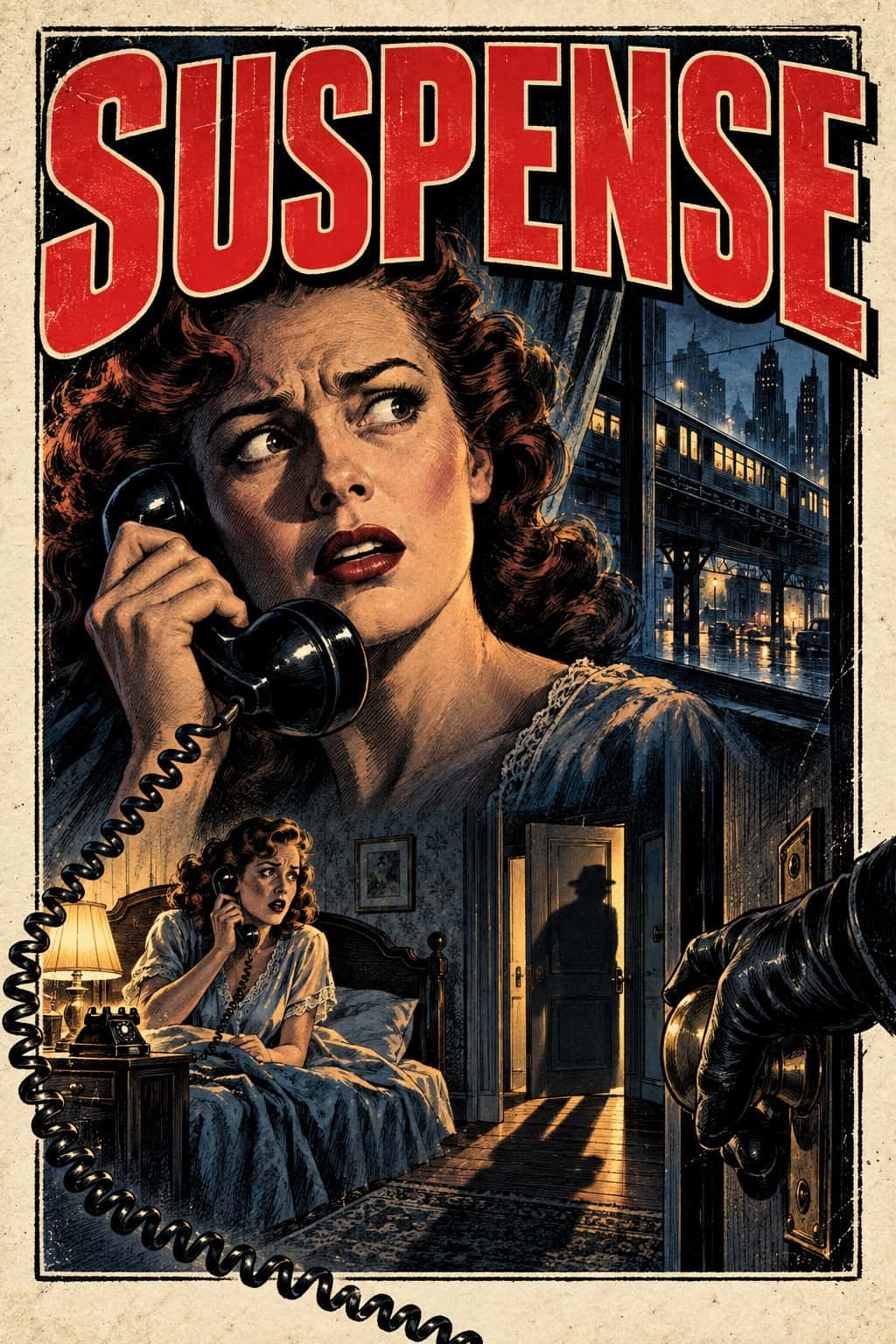
Suspense. Radio's outstanding theater of thrills bring you an hour, a full 60 minutes of suspense. Directed by Anton M. Leder and produced by Robert Montgomery. Tonight, two great suspense dramas. John Collier's Wet Saturday and W.F. Harvey's August Heat. Performed by two distinguished casts of radio actors. Two complete stories joined in one hour of suspense.
This is Robert Montgomery with a forecast, a weather forecast. If you doubt my qualifications as a meteorologist, I don't blame you. I have none. But I do have more specific information than the chap in Walt Mason's poem, The Statesman. Perhaps you remember. The statesman throws his shoulders back and straightens out his tie and says, My friends, unless it rains, the weather will be dry. Yes, I can do much better than that. Even with the same elements, rain and dry weather, I can improve on that forecast. For the next hour, I predict rain, followed by a sudden hot spell. Further, and you can check me on this, I predict that the rain will fall in the first half of the hour, and that the second half will be given over exclusively to heat. I guess you could say I predict weather in two acts. Unusual weather, too. A unique combination of wet Saturday and August heat.
Each of these dramas is set in England, each is complete in itself, and each is conditioned by its own weather and by its own suspense. Because these plays exemplify two classic studies in radio suspense drama, we have selected established radio stars to interpret them. Dennis Hoey as Mr. Princey in Wet Saturday, and Barry Kroger as James Clarence Withencroft in August Heat, with supporting casts of distinguished radio players. Next week, when we present the suspense version of the screen drama Night Must Fall, we shall feature a cast of motion picture actors. As Danny, I will be joined by Dame May Whitty in her original role of Mrs. Bramson, together with Heather Angel and Richard Ney. But now to the first half of our show, and my prediction for Rain. With the performance of Dennis Hoey as Mr. Princey, and with John Collier's English classic Wet Saturday, We again hope to keep you in... Suspense! On this rainy afternoon, we should like you to meet the Princey family and their visitor. They are, of course, at home. Mrs. Princey, daughter Millicent, George, the sun and air, sprawled on a couch, and finally, Mr. Princey, biting on a dry pipe. Their living room is dull and overstuffed. Rain beats at the windows.
They are any middle-class family at home on a wet day, except for one small item. As you sit with them in the living room, you can see through the door to the sun porch a pair of man's feet encased in black boots. They look like the feet of a curate. There is a tenseness in the room. The air is charged with excitement, but the feet are very still.
Don't keep staring at them. Listen to me, all of you. Don't you see? They'd hang her. That's what they'd do. They'd hang her. Oh, Fred, it's too awful. Awful? It's catastrophic. A supposedly sweet, gentle, intelligent girl, respected, loved by the whole village doing a thing like this. Think of the publicity, the disgrace. You think I'm going to resign from the bench, the vestry, sell out, live in some foggy hotel abroad? Oh, no. No, I'll... Don't be a fool. Any more than you have been, my governor. Be quiet. It would be so bad if it were you, George. Everybody in the village knows you're not responsible. George. Yes? Get off that couch. Sit up on your spine. You might be of a little use here, if you could think. Oh, but I say, governor, this isn't my funeral. Shut up. As long as I can remember, George.
You've been a trial and a tribulation to me. Oh, I can't stand it. I can't stand it. You've got to stand it, my dear. Keep that hysterical note out of your voice. Do you hear? Yes. We are... We are talking about the weather. Now, George. Hmm? George, if he fell down the old well, say, striking his head several times, what about him, hmm? I really don't know, Governor. What about? Don't be an ass. I'm asking you to think. He'd have had to hit the side several times. 30 or 40 feet. And at all the correct angles. I'm afraid not. I'm afraid not. We'll have to go over it all again, Millicent. Oh, no, Father. No, I couldn't. Millicent.
We must go over it all again. Fred, you're torturing her. Face facts, Mater. With him lying there, it's no use pretending it's a picture. They might hang you, Millicent. Oh, stop that shaking. Stop it here. You must stop it. You must keep your voice quiet, Millicent. Millicent! We are talking of the weather. Now, we will proceed. I can't. I can't. Not with those boots. They're... Should have thought of that, Millie. I'm not moving. Sit up, George, and stop shuffling your feet. Now, Millicent, look at me. Answer me truthfully. You hear? Answer me. You were on the croaky court. Yes. You... Who knew you were in love with this wretched kid? Oh, the whole village knows. They've been sniggering about at the pub for three years. Shut up, George. Millicent, we continue. You were on the croaky court.
Yes. You were putting the croquet set in its box? Yes. It was starting to rain. I was carrying the balls and the mallets into the sun porch. The box was there. You heard someone enter the garden gate and come across the yard? Yes. Could you see who it was? Not at first. I was going into the sun porch. I threw down all the mallets but the red one and turned around. It was Withers? Yes. So you called him? Yes. Loudly? Did you call him loudly? Could anyone have heard? No, Father, I'm sure not. I didn't really call him. I just spoke his name. He saw me when I went to the door. He just waved his hand and came over. How can I find out whether there was anyone about? Whether he could have been Sam? I'm sure not, Father. I'm quite sure. Right, so you went onto the sun porch. Yes, it was raining hard then. What did he say? He said, hello, Millie.
An excuse is coming in the back way, but he'd set out to walk over to Lyston. Yes? And he said, passing the park, he'd seen the house and suddenly thought of me. And he thought he'd just look in for a minute. He had something he wanted to tell me. Go on. He said he was so happy and he wanted me to share it. He'd heard from the bishop that he was to have a vicarage. And it wasn't only that. It meant that he could marry. And he began to stutter and... Get all confused. And, of course, I thought he meant me. Don't tell me what you thought. Tell me exactly what he said and nothing else. Well, well... Oh, stop crying. It's a luxury you can no longer afford. Tell me what happened. He said, he said, no. Ella bragged in Davis. And he was sorry and all that. And then he went to go. And then?
I went mad. He turned his back. I had the red mallet of the croquet set in my hand. I'd forgotten to drop it when he came in. I... I... I went... Did you shout or scream? I mean, as you hit him. No, I'm sure I didn't. Did he? Come on, speak up. No, Father. And then? I threw it down. I came straight in here. I went to look for Mother, that's all. Oh, my poor baby. And you're sure no one else was about? No, no one. Leave the child alone, Fred. Oh, not such a child, mate. Oh, Millie, I had no idea. Keep quiet, I'm thinking. You see, George, he probably told people he was going to Leicester. Certainly no one knows he came here. But he didn't decide until he crossed the park. He might have been attacked in the woods. Just consider every detail. A curate with his head battered in. Don't!
Accurate with his head battered in. Who would want to kill with us? Who'd kill with us? Well, I would. With pleasure. How do you do, Mrs. Prince? Captain Smollett. Captain Smollett. Well, well. Oh, sit down, pray. Mustn't get up for me, Mrs. Prince. You are the medicine. My word. Just being neighborly on a bad day. I wanted to ask you about those dahlia bulbs, Princey. Took a shortcut on account of the rain and walked right in. Knew you wouldn't mind. He heard you, Father. My dear, we can all have our little jokes. Don't pretend to be shocked. This way, Smollett. This chair facing the fireplace. Sit down, Mother. Just cranking the curtains on the sun porch, dear. It looks so gloomy out there. Might as well shut...
The rain out? Yeah. We were just talking about a little theoretical parson killing, Smollett. Young people these days like thrillers. Parsonicide. Justifiable parsonicide. Have you heard about Ella Bragdon Davis? I shall be most properly laughed at. Why? Where should you be laughed at, Smollett? Oh, had a shot in that direction myself. See, half said yes, too. Hadn't you heard? She told most people. Now it'll look as though I got turned down for a white rat in a dog collar. Too bad. Oh, well. Fortune of war, you know. Yes, that's fortune of war. Odd how it happens, isn't it? Sit down, Smollett. Mother Millicent, console Captain Smollett with your best-like conversation. George and I have something to look at outside. History, you know, bad, very bad. Come on, George, come on, come on. Oh, right-o, Governor, right-o. Perhaps we'll need red, Colonel. Oh, no, no, no, no, no. Just make yourself at home, Smollett. Make yourself at home. Uh, a cigarette, Captain Smollett? Oh, thank you, thank you. Nasty dude, and they're going out. It's, uh, something about the old well. Just off the sun porch door, you know.
This terrible, sodden weather seems to have loosened some of the stones. Too bad. Dash, too bad. Spoils the tennis in Croquet. I mean, a day like this. Doesn't it, Millie? Yes, it does. She was practicing out in the Croquet quite earlier. But do pull your chair near the fire, Captain. It was so damp we thought it would be cozy to light it. Oh, thank you. I'm quite comfortable. I hope you don't feel too bad about Ella Bragdon Davis. Well, can't always win, you know. Can't understand, though, what you women see in these bloodless clerics. Oh, I always thought Mr. Withers was... is a very charming man. Oh, yes, quite agree. But why should anyone want to marry him? You wouldn't want to marry him, would you, Minnie? Not now. That is, I... I used... Oh, no, no, of course not. Smollett. Yes? Oh. Fancy?
Oh, good Lord, then. You do come in on a fellow suddenly. Yes, I do. Oh, don't mind this old double-barreled shotgun. I've been working on it. Smollett, may I have your attention for a minute? There's something on the sun porch I'd like to show you. I am. Yes. Yes, of course. Smollett, George and I went out to see if we could shoot some rats which had been driven out of the old well by the high water. Afraid they might get into the house from now. Now, you must listen to me very carefully. Very carefully. Or you will be shot by accident. Um, I'm sorry. What's gotten into you? Well, you heard me ask as you came in who would kill Withers. You also heard Millicent make a comment. An unguarded comment. Well, then what of it? Very little.
Unless you were to hear that Withers had met a violent end this afternoon. And that, my dear Smollett, is what you are going to hear. What? Withers? Ben? Yes. Well, who killed him? Millicent. Good Lord. Yes, it's a mess. And, of course, you would have remembered and guessed. Maybe. Yes. Yes, I suppose I shouldn't. Therefore, you constitute a problem. Yes, but why did she kill him? It's one of those disgusting things, you know, pitiable, too. She deluded herself that he was in love with her. Good heavens. Really? Oh, yes, of course, I see. He told her about the Davis girl, Ella Brandon Davis. I understand.
I've no wish, as you will comprehend, that you should be proved either a lunatic or a murderess. I could hardly go on living here after that. Besides, I'm rather fond of Millie. Correct. On the other hand, you know about it. Yes, I see. That makes me a problem. You're wondering if I could keep my mouth shut, if I promised. I'm wondering if I could believe you. But if, I promised. If things went smoothly, yes. But not if there was any sort of suspicion, any questioning. You would be afraid of being an accessory. I don't know. I do. What are we going to do? Well, I can't see anything else. You'd never be fool enough to do me in.
Can't get rid of two corpses, you know. I regard that as a better risk than the other. Could be an accident, you know, or you and Withers could both disappear. There are possibilities in that. Oh, see, here, you can't... I can, but there may be a way out. There is, Smollett. You gave it to me yourself. I? I did? Mm-hmm. What? You said you would kill Withers. You have a motive. Oh, look here. I was joking. Listen, Smollett. I can't trust you. You must trust me. Else I will kill you now in the next minute. I mean that you can choose between dying and living. Oh. Go on. There's the old well just outside the sun's porch door. That's where I'm going to put Withers. No one outside knows he's come up here this afternoon.
No one will ever look in there for him unless you tell them. Now, you must give me evidence that you have murdered Withers. I murdered him. Why do you want that? So that I should be dead sure that you will never open your lips on the subject. Ah, I see. What evidence? George, hit him in the face. Sure. Oh, don't! Don't! Captain, you should be more careful. Look what your teeth did to my knuckle. Again, George. Okay. Oh, I can't stand it. Father, how can you? Keep quiet. I'm sorry, Smollett, but there must be traces of a struggle between you and Withers. Then it will not be altogether safe for you to go to the police. George, get the croquet mallet. Take your handkerchief to it. There it is on the some porch floor.
There, Captain. There's your weapon. As I told you, Smollett. Now you'll just grasp the end that mashed with his head. I shall shoot you if you don't. Yes, but good Lord, you can't... All right. That's it. Now deposit it by the side of the house, outside. Out of the rain, of course. Oh, wait, George. First, you'd better pull a few hairs out of his head and put them under the nails of Withers' right hand. Sorry to mess up your haircut. Shut up, Smollett. That's all we need. Enough, Mr. Withers. I'll be right with you. Smollett, you may turn round. Withers is just there on the sun porch. Draw back the curtain. Good Lord. Yes, messy. Now, you, Smollett, You've just got to drag him through the door and dump him in the old well. Just beyond the door, Captain. I won't touch. All right, stand aside out of range, George. Any place where I want this shot to go, only one place. Keep out of this. My aim is none too sure. Wait a minute. That's better, Smurit. Much better. Go on now. Go ahead. You have to take him outside. By the shoulders, what to do, Captain. Keep quiet, George.
Go on, Smollett. Go on. You've seen a dead man before. Drag him. Drag him. I'll just hold the gun here to make sure everything goes all right. Come away from the window, dear. Don't look. Mr. Captain Smollett. Your father is a very resourceful man, Madison. I'm sure what he's doing is... Mr. Captain, I... I can't stand it. Oh, you must question it, dear father. It's enough trouble round here without your blubbering. Don't you call me blubbering, George Princey. Everything is perfectly safe. Remember, no one knows that Withers came here. Everyone thinks he walked over to Leicester. That's five miles of country to search. They'll never look in our well. Do you see how safe it is? I guess so. Good heavens, man, you're dripping wet.
Why didn't you slip on your raincoat? Tea ready, my dear? In just a minute, dear. I'll bring it to you. Exactly what you need, Smollett, a cup of tea. Best thing in the world to ward off a cold. Sit down, won't you? Sit down. Don't mind getting the chair wet. Thank you. Cigarette? Help yourself. I stick to my pipe. Funny how you get attached to them. My wife always says... Everything's hot now. Oh, yes, Bridget. Put the tray in front of me. Here, you're on the table. I say, Captain, you've cut your lip. I just knocked it. Oh, wow. How dreadful. Here, Bridget. Here, give the Captain this cup. No, thank you. I think I'll be running along if you don't mind. Why, Captain Smollett, without any tea? If you don't mind, Mrs. Princey, if I could just have my raincoat. Oh, I'll get it for you, Captain.
This is very distressing, Smollett. Very. Yes, well. I'll be all right presently, I'm sure. Here you are, sir. Let me help you. Thank you, young man. There. Better go out the front way, Smollett. Walk is dry. Let me hold the door. And don't worry, old fellow. Don't worry at all. Now, I won't. Well, good afternoon. Nothing serious, I imagine. A little rest and you'll be as right as rain. By the way, Millicent, you're not looking any too well. Oh, not well at all. I'm sure it was the croaky court. Being outdoors in weather like this is simply foolhardy. The Major's right, Millie. You saw what happened to Captain Smollett. Come along, dear. I shall give you a hot foot bath and put you to bed. A couple of days in bed. Get plenty of rest, Millicent, and don't worry about a thing. That's the best cure.
I guess I'll have a little rest too, Governor. It's a fine afternoon for a man. Indeed it is, sir, indeed it is. Well, enjoy yourselves. See you later. I'll see you all later. Oh, would you get me the police station? Station? Right away, sir. Order, Sergeant. Oh, hello, Sergeant. This is Princey of Abbots Road. I believe you know me. Indeed I do, Mr. Princey. Um, Sergeant, a rather horrible thing has just occurred. Quite extraordinary. Murder, in fact. Murder? Mm-hmm. I'm afraid it looks rather bad for... Well, for a close friend of ours, unfortunately. We saw him do it. I think you'd better send someone over right away. Our man should be there right about now, Mr. Prince. I beg your pardon? I say our man should be there now. Constable Martin has his post right below your house there. I just rang him. Seems Captain Smollett was with him. Captain Smollett? He reported some rather...
queer goings-on at your place, but I certainly didn't understand it was murder. Now, uh, just don't touch anything, Mr. Princey, and don't worry. Don't worry at all. No. I... I won't, Sergeant. Thank you. Where are you going? Right here. Stop shouting. We have some visitors, Governor. Yes, I can see that. Well, Constable, uh, good afternoon, Mr. Princey. And Smollett, I say, what a remarkable fellow you are, coming back like this. Here to reenact the crime? Only the one against me, Prince. The one against the curate I leave to you people. Extraordinary sense of humor. Mr. Prince, I just had a look at what's in your well. Not a pretty sight, that. Not pretty at all. Yes, Constable, Captain Smollett was thorough, if nothing else. You saw him when he did it, sir? Out in the back? Oh, quite. We were just returning from a walk.
Smollett evidently had been laying for the curate, hiding out there in those bushes by the road, I imagine. He was never inside this house? No, never. And you say, Captain? I say that while I was inside this house, a guest of the family, I was coerced into dragging the curate's body outside and dumping it into the well. Well, there we are. No, not entirely, Constable. I'll just remove my raincoat. And, um... demonstrate how damp I got my clothes when I went outside without it. That's interesting, isn't it? It is quite. He undoubtedly removed his coat at some point between here and your post. I might as well tell you that his weapon, a red croquet mallet, is out by the side of the house. I shouldn't be at all surprised, but you might find his fingerprints all over it. All over the end of the mallet, Constable. The end that mashed wither's head.
Not the end I'd have to grasp in order to do the mashing. Governor... That's a decent try, Smollett, but it won't work. There must be other evidences. Constable, you'll undoubtedly find them when you examine the body. He means my hair under Withers' fingernails. Well, sir, you know, I happen to notice something when young George there opened the door for me. If you'll look carefully... I believe you'll find a few of my precious hairs under his nails, too. What are you trying to suggest? Constable, this is an utter waste of time. So far as Byron's struggle between Smollett and Withers is concerned, Smollett's face speaks for itself quite eloquently, I believe. Oh, yes, but no more eloquently than your son's knuckle. As you see, Constable, look here. A fresh abrasion. He did that on my teeth. Or, um, did he? What? I say, or.
Did he? You know, he might have done that on Withers' teeth. I see what you mean. But I didn't, Governor. He said that I... Keep still, you nitwit. Let me think. Let me think. As a matter of fact, George, the more I think of it, the more I'm convinced it was your voice I heard. Quite a vigorous quarrel. Something about the, um... You're a jolting your sister. Don't be ridiculous, Smollett. Very well, Princey. If he didn't do it, who did? That's what I'd like to know. How about it, Mr. Princey? That, uh, that is a sticker, right? George, my boy. Looks like you're elected. Elected? What do you mean I didn't do it? Keep your mouth shut. I won't. I'm not going to take the blame for her. Millie did it. She did it with that mallet. I saw her do it. Prove that. Prove it. Oh, yes, her fingerprints on the mallet, on the handle. Why, George, don't you remember when you made me touch the mallet? When you picked it up with your handkerchief? George, I'm sure you wiped that handle clean. Oh, well, yes. I could hardly expect you to remember that if you, um...
Can't even remember killing the curate. Governor... I told you to keep still, George. I'm thinking. Governor, you're not going to stand there and let him say that I... As long as I can remember, George, you've been a trial and a tribulation to me. You shouldn't have done it, George. You really shouldn't have done it. Now, let's all have a cup of tea. Nothing like it in weather like this. So ends Wet Saturday, the first of two half-hour stories combining dramatic weather and dramatic suspense. Our thanks to Dennis Hoey for an excellent performance and to Harold Medford who adapted John Collier's story. True to our prediction, we will return in a moment with August Heat, a second study in suspense. This is CBS, the Columbia Broadcasting System.
And now, back to our Hollywood soundstage and to our producer, Mr. Robert Montgomery. The rains of wet Saturday are gone. In their stead, a blazing sun burns down on the damp earth of the English countryside, steaming the atmosphere with a heat that's humid and smothering, like a tight outer garment, like a shroud which cannot be loosed and cast aside. Such a heat weighs upon your entire being and saps from you the last strength of hope and freedom. This is the setting for the companion piece to our first drama, Wet Saturday. This, then, is August Heat, the second of two suspense dramas complete in this hour. And now, with the performance of Barry Kroger as James Clarence Withencroft, and the reappearance of Dennis Hoey as The Man, and with W.F. Harvey's August Heat, we promise a narrative well-calculated to keep you in... Suspend! Fennestone Road. Clapham.
August 20, 1947. I have had what I believe to be the most remarkable day in my life. While the events are still fresh in my mind, I wish to put them down. on paper as clearly as possible. Let me say at the outset that my name is James Clarence Withencroft. You must remember that in order to have the full implication of my story. James Clarence Withencroft. I'm 35 years old, in perfect health, never having known a day's illness. By profession, I'm an artist. Not a very successful one, but I earn enough money by my black and white work to satisfy my necessary wants. My only near relative, a sister, died five years ago, so that there is no one in particular to whom I address this manuscript. Only you, who might by chance read it someday. For, because of the peculiar circumstance about which you will soon hear, I have the strong premonition that I shall never live to tell anyone about it. I breakfasted this morning at nine, as usual time.
It was no different from any other morning, and after glancing through the morning paper, I lighted my pipe, and I proceeded to let my mind wander, in the hope that I might chance upon some subject for my pencil. The room, though door and window were open, was oppressively hot, and I just made up my mind that the coolest and most comfortable place in the neighborhood would be the deep end of the public swimming bath, when I was suddenly shaken. A feeling swept over me such as I'd never experienced before. I attempted to rise to my feet. Meanwhile, it seemed as though I'd suddenly been fastened to my chair. My hand went out in an effort to brace myself. And then, before I knew what I was doing, my pencil was in my hand, and I began to draw. It was as though someone had taken my hand and was moving it across the paper, swiftly in bold strokes. Then, I seemed to take over. My hand, under its own power, began to draw.
So intent was I on the sketch which began to appear before me. I soon forgot the oppressive heat, the roughness of the table. Everything was forgotten. This frantic feeling. The sketch must be finished as soon as possible. No idea how long I worked until I heard the clock of St. Jude's in the distance. It was four o'clock, and I had started just after breakfast. Now, for the first time since I'd begun, I actually seemed to see what I'd been sketching. I was surprised. The final result was, I felt sure, the best thing I'd ever done. It shot a criminal in the dark, immediately after the judge had pronounced sentence. The man was fat, enormously fat. The flesh hung in rolls about his chin. They'd creased his huge, stumpy neck. He was clean-shaven.
Perhaps I should say a few days before he must have been clean-shaven, and he was almost bald. He stood there before the judge, his short, clumsy fingers clasping the rail, looking straight in front of him. The feeling that his expression conveyed was not so much one of horror as of utter absolute. There seemed nothing in the man strong enough to sustain that mountain of flesh.
And then I saw that the sketch was not complete, for the man's other hand seemed to be clutching an instrument of some kind, a weapon, but had not been completed. I had made this sketch, yet I had no recollection of what I'd intended the man to carry in his other hand. I took out my pencil again, and I attempted to fill in the fuzzy outline. It was useless. It was as though my fingers had suddenly turned to lead. I sat down. I felt the moisture slowly forming on my forehead. I was conscious of the oppressive heat again. And then I knew that there would be no finishing of the sketch. At any rate, not for the moment. So, I rolled up the sketch, and without quite knowing why, I placed it in my pocket. In spite of my peculiar inspiration, I was filled with the rare sense of happiness which the knowledge of a good thing well done gives.
I believe that I set out with the idea of calling upon Trenton, for I remember walking along Lytton Street and turning to the right along Gilchrist Road, the bottom of the hill where the men were at work on the new tram lines. From there onward, I've only the vaguest recollection of where I went. Through parks, along crowded streets, always fully conscious of the awful heat, came up from the dusty asphalt pavement as an almost palpable wave. And I remembered, too, the hollow sound of my footsteps as I moved along. Although walking aimlessly, I somehow knew that there was a goal, a something to which I was drawn. I longed for the thunder promised by the great banks of copper-colored clouds that hung low over the western sky. I must have walked five or six miles. I've really no idea how far I walked. When a small boy roused me from my reverie...
Twenty minutes to seven. What, isn't it? Yes. When he left me, I began to take stock of my bearings. I found myself standing before a gate that led into a yard bordered by a strip of thirsty earth. There were flowers, purple stock, and scarlet geranium, and great numbers of bees droned over them. I stood looking down at them a moment, and then for some reason I looked up. Over the entrance to the place... There was a board with the inscription, Charles Atkinson, monumental mason worker in English and Italian marble. From the yard itself came a chilly whistle, the noise of hammer blows, and the cold sound of steel meeting stone. A sudden impulse made me enter, and I went in the direction of the noise. There was a man sitting with his back towards me. He was busy at work on a slab of curiously veined marble.
He was not conscious of my presence as I stood there, watching him for some time. Then, without turning, his hammer stopped in mid-air as he was about to bring it down on his chisel. He looked up, and then he held his position a moment before turning, but I knew that he was aware of my presence. And when he turned, I saw his face. It was, although I had never seen him before, it was the face of the man I'd been drawing. Yes. It was the face of the man whose sketch was in my pocket. He sat there on his low stool, huge and elephantine, the sweat pouring from his scalp, not speaking. Then he took a red silk handkerchief and he mopped his brow. Although this face that looked up at me was the same as my sketch, the expression was absolutely different. And suddenly the puzzled expression left his face and he smiled as if we were old friends. And he walked over and he took my hand.
Good day, sir. Good day. I'm sorry to intrude. Not at all. Everything's hot and glary outside. This seems as an oasis in the wilderness. I don't know about the oasis, but it certainly is hot. Take a seat, sir. He pointed to the end of the gravestone on which he was at work, and I sat down. Very hot. That's a beautiful piece of stone you've got hold of there. In a way, it is. The surface is as fine as anything you could wish. But there's a big floor at the back, though. Don't expect you'd ever notice it. I shouldn't think so. Nah. I could never really make a good job of a bit of marble like this. It'd be all right in the summer like now. I wouldn't mind a blasted heat. But wait till the winter comes. Winter? Yes. There's nothing like a bit of frost to find out the weak points in stone. Gravestone, you see. Oh, I see. Then what's this one for? You'd hardly believe me if I was to tell you it's for exhibition.
But it's the truth. Artists have exhibitions, so do grocers and butchers. Well, we has them too. All the latest little red stones, you know. He went on to talk of marbles. Which sort of marble best withstood wind and rain, and which were easiest to work. Then of his garden, and new sort of carnation he'd bought. At the end of every other minute, he would drop his tools, wipe his shining head. This eat. This heat's bad. A man's not responsible for what he does in this heat. I said little, for I felt uneasy. There was something unnatural, uncanny in all of this. The feeling that I'd experienced it all before, exactly as I was experiencing it now. The oppressive heat, the fragrance of the purple stock in the air, the conversation about the marble, the flowers, everything.
as though I'd experienced it before, and yet I knew that I'd never even been in this section of the town before. I tried to persuade myself that at least I'd seen him before, that his face unknown to me had found a place in some out-of-the-way corner of my memory, but I knew that I was practicing little more than a plausible piece of self-deception. As I sat there quietly watching him, he looked up at me, and he said, Here, what do you think of that? He said it with an air of evident pride, of a job well done. I could sense that he was experiencing the same feeling I had experienced when I'd finished my sketch. Then he got up with a sigh of relief. What? What ain't it? I was seated in such a position that I was unable to see his work, and for some reason I didn't move. Suddenly he began to read what he'd carved on the tombstone. He spoke deliberately.
and with a flat voice. In the midst of life, we are in death. Born January 18th, 1912. I looked up with a start. This man had read my exact birth date. He passed away very suddenly on August 20th, 1947. That's today. I usually use the present date on these exhibition stones. Adieu. You usually put a name on them, too? Yes. Sacred to the memory of James Clarence Wivencroft. I just sat there in silence. The sound of birds and crickets seemed loud in my ears as we stood there, looking at each other, saying nothing. And then he mopped his brow again. What? I was finally able to speak. Where... Where did you see that name? I didn't see it anywhere. I wanted some name and I put down the first one that came into my head. It's a strange coincidence, but it happens to be mine. It's your name? You're James Clarence? Withincroft, yes. Well, and the dates? I can only answer for the birth date. It's correct. It's a... it's a run-go. I made a sketch this morning.
Of you? Of me? What, you've never seen me before? No. Oh. I took my sketch from my pocket, and I showed it to him. As he looked, the expression on his face altered, and it became more and more like that of the man I had drawn. It was only the day before yesterday that I told Maria there was no such things as ghosts. Neither of us had seen a ghost. But I knew what he meant. Then I spoke to him. You probably heard my name someplace. Yes. You must have seen me somewhere and forgotten it. Yes. Were you at Clacton-on-Sea last July? No. No, I've never been to Clacton in my life. Then we were silent for some time again. And we stood there, looking at one another, and at the two dates on the gravestone. And the birth one was right, and the other...
was today. Come inside and have some supper. His wife was a strange little woman, who was pallid with the look of those who live their lives indoors. Her husband introduced me as a friend of his who was an artist, and informed her that I was staying to supper. I spoke, making some comment that I hoped I would not be an intrusion, and she looked up at me. She said, You have a pleasing voice, Mr. Withencroft. And you're welcome in my home. I'm sorry Charles has not brought you here before. Very little was said during the meal, and after the sardines and watercress had been removed, she walked over to a cupboard. She took down a thin black book, and as she handed it to me, she spoke. Would you read aloud, Mr. Withencroft? Puzzled.
I looked down at the book which she'd opened and placed before me. It was a very tiny book. A prophet, it was called, by an author unknown to me, with a strange eastern name, Khalil Gibran. My eyes fell across the page, and suddenly I was reading, aloud, as she'd asked me to. Then Almitra spoke, saying, We would ask now of death. And he said, you would know the secret of death. But how shall you find it unless you seek it in the heart of life? The owl whose night-bound eyes are blind unto the day cannot unveil the mystery of life. If you would indeed behold the spirit of death, open your heart wide unto the body of life. For life and death are one, even as the river and the sea are one.
In the depth of your hopes and desires lies your silent knowledge of the beyond. And like seeds dreaming beneath the snow, your heart dreams of spring. Trust the dream, for in them is hidden the gate to eternity. Your fear of death is but the trembling of the shepherd when he stands before the king whose hand is to be laid upon him in honor. Is the shepherd not joyful beneath his trembling? that he shall wear the mark of the king. Yet is he not more mindful of his trembling? For what is it to die, but to stand naked in the wind, and to melt into the sun? And what is it to cease breathing, but to free the breath from its restless tides, that it may rise and expand, and seek God unencumbered? Only when you drink from the river of silence.
shall you indeed sing. And when you have reached the mountaintop, then you shall begin to climb. And when the earth shall claim your limbs, then shall you truly dance. Mr. Atkinson had gone, but his wife stood before me. And as she took the book, she spoke. Oh, thank you. Then I went outside, and I found Atkinson sitting on the gravestone and smoking. He looked up at me.
A man's not responsible for what he might do in this heat. She never asked anyone to read aloud before. And then we talked about the sketch again. He looked at it. The likeness is me, all right. On trial. You must excuse my asking, but do you know of anything you've done for which you could be put on trial? I've done nothing. Not yet. He got up. fetched a can from the porch, and he began to water the flowers. Twice a day regular in the odd weather. And then he'd sometimes guess the better of the delicate ones. And ferns? Good Lord, they could never stand it. Where do you live? I told him my address. It would take an hour's quick walk to get back home. Then he stopped watering, and he faced me squarely. It's like this. We look at the matter straight.
If you go home tonight, you'll take your chance of accidents. A cart may run over you. Always banana skins and orange peels. To say nothing of falling ladders. He spoke of the improbability with an intense seriousness that would have been laughable six hours before. But I did not laugh. The best thing we can do is for you to stay here till twelve o'clock. And it'll be tomorrow, do you see? We'll go upstairs and smoke. It may be cool out inside. To my surprise, I agreed. We are sitting in a long, low room. Beneath, Kinson has sent his wife. He himself is busy sharpening some tools and a little oilstone, smoking one of my cigars the while.
And as I look at my sketch before me, I suddenly see the fuzzy outline of what the man in the picture holds in his hands. While I had not been able to sketch it before, I am able to do so now. It is a chisel, and it is stained with dark liquid. The sketch is completed now. The air seems charged with thunder, and I hear it in the distance. It is ominous, but it carries the hope of rain. Perhaps this damnable heat will be broken soon, and the day will soon be over. It is close to twelve. In seconds, the day will be over. I am writing this at a shaky table before the open window. The leg is cracked, and Atkinson, who seems a handyman with his tools, is going to mend it.
As soon as he has finished putting an edge on his chisel, twilight is over. I shall be going. The heat is heat is enough to send a man mad. This is Robert Montgomery again, with thanks to Barry Kroger and Dennis Hoey for superb performances in August Heat. and to Mel Donnelly, who adopted W.F. Harvey's story. Our appreciation and our applause, too, goes to the cast of both plays who made our weather experiments so very successful. Next week, we'll turn a full hour's attention again to the English scene and to Emlyn Williams' great play, Night Must Fall. You'll meet Mrs. Bramson, Olivia Grain, and Hubert Laurie. And you'll meet Danny. Danny with the quick smile. Happy, cheerful Danny.
whose appearance is as pleasant as the melody that's always with him. Mighty like a rose. That's Danny. Yes, that's Danny. Next week, with Dame May Whitty, Heather Angel, Richard May, and myself, and with Night Must Fall, we'll again hope to keep you in suspense. Good night. Mr. Montgomery may currently be seen in the Universal International Production Ride the Pink Horse. Wet Saturday by John Collier was adapted for suspense by Harold Medford. August Heat by W.F. Harvey was adapted for suspense by Mel Dinelli. Both were directed by Anton M. Leder and produced by Robert Montgomery. Lud Gluskin is our musical director and conductor, and Lucian Morrowick composes the original scores. Next week, hear Night Must Fall, starring Robert Montgomery with Dame May Whitty.
Heather Angel and Richard Nay on radio's outstanding theater of thrills. One hour of... Suspense! A program you won't want to miss. That's Report Card, the next production of the famed CBS documentary unit. Overcrowded schools, out-of-date equipment, and a shortage of trained teachers. All of these are contributing to a breakdown in American education. For a dramatic report, hear Report Card Wednesday, March 24th over many of these stations. This is CBS, where 99 million people gather every week. The Columbia Broadcasting System.