
The written record
Read the transcript
Read along with the recording · About 19 min to read
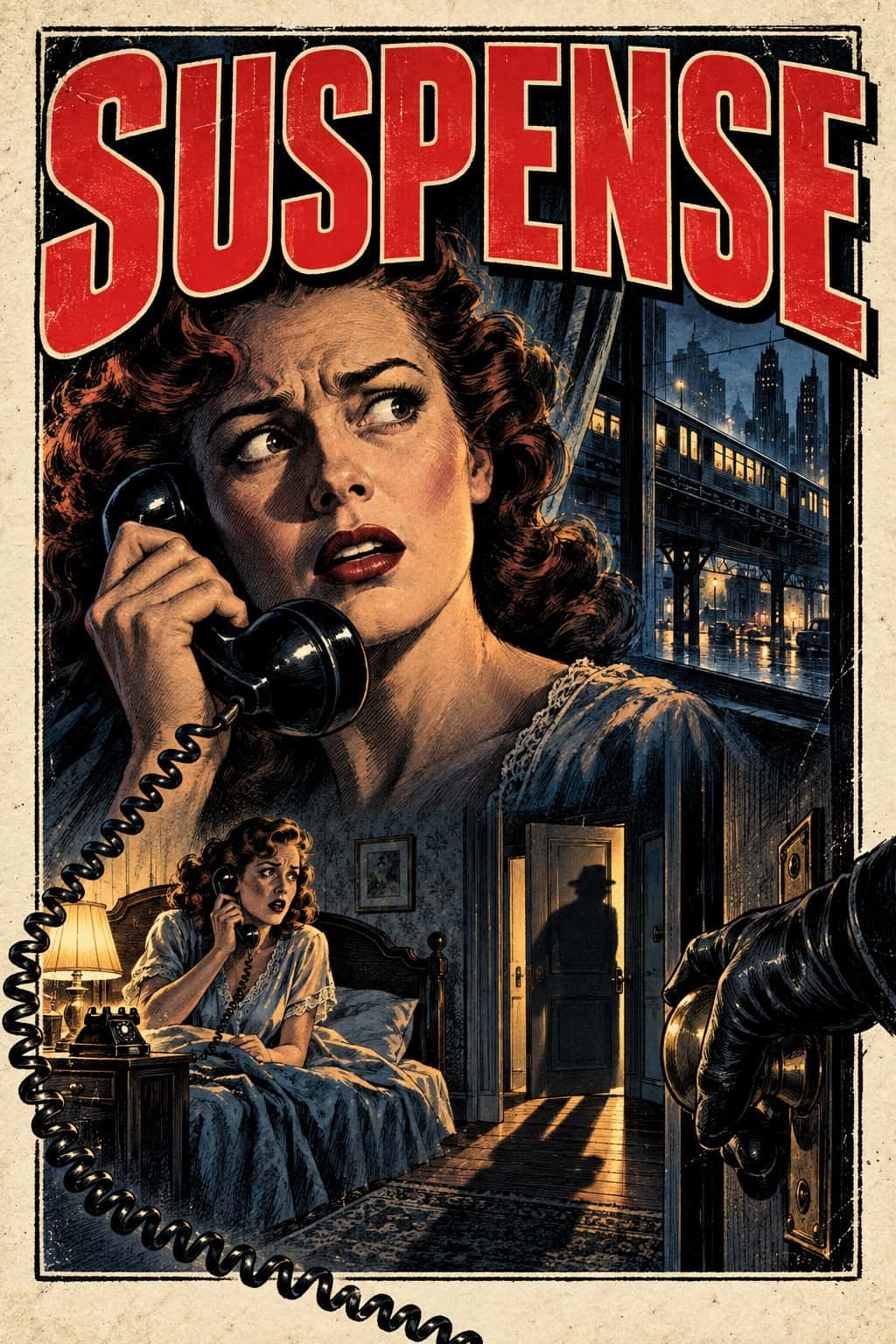
And now, tonight's presentation of radio's outstanding theater of thrills, Suspense. Suspense brings you what we feel is a particularly unusual and absorbing story. No actors other than Mr. William Conrad will appear in its presentation. It's a study in terror which has few equals. So now, starring Mr. Conrad, here is tonight's suspense play by A.M. Burrage, The Waxwork.
While the uniformed attendants of Mariner's waxworks were ushering the last stragglers through the great glass-paneled double doors, the manager sat in his office interviewing Raymond Hewson. The manager was speaking. Oh, there's nothing new in your request, sir. In fact, we refuse it to different people, mostly young bloods who've tried to make bets about three times a week, I should say. We have nothing to gain and something to lose by letting people spend the night in our murderer's den. If I allowed it and some young idiot lost his senses, what would be my position, eh? But your being a journalist somewhat alters the case. Hewson smiled. I suppose you mean that journalists have no senses to lose. No, no, of course not. But one imagines them to be responsible people. Besides, we have something to gain here. Publicity and advertisement. Yes, exactly, said Hewson.
And there I thought we might come to terms. The manager smiled. Yes, I know what's coming. You want to be paid twice, do you? You know, it used to be said years ago that Madame Tussauds would give a man a hundred pounds for sleeping alone in the Chamber of Horrors. Well, I hope you don't think that we've made any such offer. What is your paper, Mr. Hewson? Well, I'm freelancing at present, sir, working on space for several papers. However, I would find no difficulty in getting the story printed. I'm sure the morning echo would use it like a shot. A night with Mariner's murderers? No live paper could turn it down, sir. Yes. How do you propose to treat it? Well, I shall make it gruesome, of course. Gruesome with just a saving touch of humor. The manager nodded and offered to use him his cigarette case.
Very well, Mr. Hewson. You get your story printed in the morning echo and there'll be a five-pound note waiting for you when you care to come and call for it. But, uh, first of all, you realize it's no small ordeal that you're proposing to undertake. I'd like to be quite sure about you. I'd like you to be quite sure about yourself. I own I shouldn't care to take it on. I should hate having to sleep down there alone among them. Why? asked Hewson. Oh, I don't know. Isn't any reason, I suppose. I don't believe in ghosts. If I did, I should expect them to haunt the scene of their crimes or the spots where their bodies were laid instead of a cellar which happens to contain their waxwork averages. Well, it's just that I couldn't sit alone among them all night with their seeming to stare at me in the way they do. After all, they represent the lowest and the most appalling types of humanity.
The whole atmosphere of the place is unpleasant. And if you're susceptible to atmosphere, sir, I warn you that you're in for a very uncomfortable night. Hewson had known that from the moment when the idea first occurred to him. His soul sickened at the prospect. But he had a wife and a family to keep. So here was a chance not to be missed. The price of a special story in the morning echo with a five-pound note to add to it. Besides, if he wrote the story well, it might lead to an offer of regular employment. The manager smiled at him and rose. Well, I think the last of the people must have gone by now. Oh, there is one condition I'm afraid I must impose upon you, sir. I must ask you not to smoke. We had a fire scare out on the murderous den this evening. I don't know who gave the alarm, but whoever it was, it was a false one.
Fortunately, there were very few people down there at the time, or there might have been a panic. Now, if you're ready, we'll make a move. He led the way through an open barrier and down ill-lit stone stairs, which conveyed a sinister impression of giving access to a dungeon. In a passage at the bottom were a few preliminary horrors, such as relics of the Inquisition, a rack taken from a medieval castle, branding irons. thumbscrews, and other mementos of man's cruelty, the man. Beyond the passage was the murderer's den. It was a room of irregular shape, with a vaulted roof and dimly lit by electric lights, burning behind inverted bowls of frosted glass. It was, by design, an eerie and uncomfortable chamber, Whispers. The waxwork murderers stood on low pedestals with numbered tickets at their feet. Recent notorieties rubbed dusty shoulders with the old favorites. Fertel, the murderer of Weir, stood as if frozen in the act of making a sharp-windowed gesture to young bywaters. And there was Lefroy, the poor half-baked little snob who killed for gain so that he might ape the gentleman.
Within five yards of him sat Mrs. Thompson, that erotic romanticist hanged to propitiate British middle-class matronhood. Charles Peace, the only member of the vile company who looked uncompromisingly and entirely evil, sneered across a gangway at Norman Thorne. Brown and Kennedy, the two most recent additions, stood between Mrs. Dyer and Patrick Mayen. The manager, walking around with Hewson, pointed out several of the more interesting of these unholy notabilities. That's Cribbin. I expect you recognize him. Insignificant little beast who looks as if he couldn't tread on a worm. Oh, and that's Armstrong. Looks like a decent, harmless country gentleman, doesn't he? And there's Solvacchia. You can't miss him, of course, because of his beard. And this one... Who's that? Hewson asked in a whisper.
Here, come here, have a good look at him. This is our star turn. He's the only one of the bunch that hasn't been hanged. The figure which Hewson had indicated was that of a small, slight man, not much more than five feet in height. It wore little waxed mustaches, large spectacles, and a caped coat. There was something so exaggeratedly French in its appearance that it reminded Hewson of a stage caricature. He could not have said precisely why the... Mild-looking face seemed to him so repellent, but he'd already recoiled a step, and even in the manager's company it cost him an effort to look again. But who is he? he asked. That, said the manager, is Dr. Baudet. Hewson shook his head doubtfully. I think I've heard the name, but I forget in connection with what. The manager smiled. You'd remember better if you were a Frenchman. You know, for some long while, that man was the...
terror of Paris. He carried on his work of healing by day and of throat-cutting by night. Why, he killed for the sheer devilish pleasure it gave him to kill, and always in the same way, with a razor. After his last crime, he left a clue behind him which set the police upon his track, but he was much too clever for them. When he realized that the coils were closing about him, he mysteriously disappeared. and ever since, the police of every civilized country have been looking for him. There's no doubt that he managed to make a way with himself, and by some means, which has prevented his body coming to light, one or two crimes of a similar nature have taken place since his disappearance, but he is believed almost for certain to be dead, and the experts believe these recrudescences to be the work of an imitator. It's queer, isn't it, Mr. Hewson?
How every notorious murderer has imitators. Hewson shouted and fidgeted with his feet. I don't like him at all. What eyes he's got. Yes, this figure's a little masterpiece. You'll find the eyes bite into you, huh? Well, that's excellent realism, then, for Boudet practiced mesmerism and was supposed to mesmerize his victims before dispatching them. Indeed, had he not done so, it's impossible to see how so small a man could have done his ghastly work. There were never any signs of struggle. I thought I saw him move, said Hewson with a catch in his voice. The manager smiled. You'll have more than one optical illusion before the night's out, I expect, sir. Well, I'm sorry I can't give you any more light because all the lights are on. For obvious reasons, we keep this place as gloomy as possible, eh? Well, Mr. Hewson, good night. Hewson wheeled a swivel chair.
a heavy one upholstered in plush a little way down the central gangway, and deliberately turned it so that its back was toward the effigy of Dr. Baudet. For some undefined reason, he liked Dr. Baudet a great deal less than his companions. Busying himself with arranging the chair, he was almost lighthearted. But when the manager's footfalls had died away, and a deep hush stole over the chamber, he realized that he had no slight ordeal before him. The dim, unwavering light fell on the rows of figures which were so uncannily like human beings that the silence and the stillness seemed unnatural and even ghastly. He missed the sound of breathing, the rustling of clothes, the 101 minute noises one hears when even the deepest silence has fallen upon a crowd.
And the air was as stagnant as water at the bottom of a standing pond. It must be like this at the bottom of the sea, he thought. He faced the sinister figures boldly enough. They were only waxworks. So long as he let that thought dominate all others, he promised himself that all would be well. It did not, however, save him long from the discomfort occasioned by the waxen stare of Dr. Boudet. which he knew was directed upon him from behind. The eyes of the little Frenchman hearted and tormented him, and he itched with a desire to turn and look. My nerves have started already, he thought, and then another voice in his brain spoke to him. It's because you're afraid that you won't turn and look at him. The two voices quarreled silently for a moment or two, and at last, Hewson slewed his chair around a little and looked behind him.
Among the many figures standing in stiff, unnatural poses, the effigy of the dreadful little doctor stood out with a queer prominence, perhaps because of a steady beam of light beat straight down upon it. Gilson flinched before the parody of mildness which some fiendishly skilled craftsman had managed to convey in wax, met the eyes for one agonized second, and then turned again to face the other direction. He's only a waxwork like the rest of you. Yosen muttered defiantly. You're all only waxworks? They were only waxworks, yes. But waxworks don't move. Oh, not that he had seen the least movement anywhere, but it struck him that in the moment or two while he'd looked behind him, there had been the least subtle change in the grouping of the figures in front. Crippen, for instance, seemed to have turned at least one degree to the left.
Hoare thought Hewson perhaps the illusion was due to the fact that he had not slewed his chair back into its exact original position. Oh, but there were Brown and Kennedy, too. Surely one of them had moved his hands. Hewson held his breath for a moment and then drew his courage back to him as a man lifts a weight. He took a notebook from his pocket and wrote quickly, Memo, Deathly silence and unearthly stillness of figures. like being at bottom of sea. Hypnotic eyes, Dr. Baudet. Figures seemed to move when not being watched. He closed the book suddenly over his fingers and looked round quickly and awfully over his right shoulder. He had neither seen nor heard a movement, but it was as if some sixth sense had made him aware of one. He looked straight into the vapid countenance of Lefroy, which smiled vacantly back as if to say, It wasn't I. No, of course it wasn't he or any of them. It was his own nerves. Or was it? Then why all that silent unrest about him? A subtle something in the air which did not quite break the silence and happened whichever way he looked, just beyond the boundaries of his vision. He swung round quickly to encounter the mild but baleful stare of Dr. Baudet.
and then without warning he jerked his head back to stare straight at Crippen. He'd nearly caught Crippen that time. You'd better be careful, Crippen, and all the rest of you. If I do see one of you move, I'll smash you to pieces. Do you hear? He ought to go, he told himself. Already he'd experienced enough to write his story, or ten stories for the matter of that. Well then, why not go? The morning echo would be none the wiser as to how long he'd stayed. Nobody'd care so long as his story was a good one. Yes, but the manager... One never knew, perhaps the manager would quibble over that five-pound note which he needed so badly. He wondered if his wife were asleep or if she were lying awake and thinking of him. She'd laugh when he told her that he'd imagined... That he'd imagined... This was a little too much.
It was bad enough that the waxwork effigies of murderers should move when they weren't being watched, but it was intolerable that they should breathe. Somebody was breathing. Or was it his own breath which sounded to him as if it came from a distance? He sat rigid, listening, straining, until he exhaled with a long... his own breath, after all. Or, if not something... It divined that he was listening and had ceased breathing simultaneously. Hewson turned his head swiftly around and looked all about him out of haggard and hunted eyes. Everywhere his gaze encountered the vacant, waxen faces. And everywhere he felt that by just some least fraction of a second he had missed seeing a movement of hand or foot, a silent opening, a compression of lips, a flicker of eyelids, a look of human intelligence now smoothed out.
They were like naughty children in a classroom, whispering, fidgeting, and laughing behind their teacher's back, but blandly innocent when his gaze was turned upon them. No. No, this would not do. This distinctly would not do. He must clutch at something, grip with his mind upon something which belonged essentially to the workaday world, to the daylight London streets. He was Raymond Hewson, an unsuccessful journalist. A living and breathing man, and these figures grouped around him were only dummies, so they could neither move nor whisper. Well, what did it matter if they were supposed to be lifelike effigies of murderers? They were only made of wax and sawdust and stood there for the entertainment of morbid sightseers and orange-sucking trippers. Oh, that was better. Now, what was that funny story which somebody had told him in the Falstaff pub yesterday? Oh, yes. You recall part of it, but not all.
For the gaze of Dr. Baudet urged, challenged, and finally compelled him to turn. Hewson half turned, and then swung his chair so as to bring him face to face with the wearer of those dreadful hypnotic eyes. His own eyes were dilated, and his mouth at first set in a grin of terror, lifted at the corners in a snarl, and then Hewson spoke and woke a hundred sinister echoes. Then he sat quite still. staring straight before him, like a man found frozen in the Arctic snows. Dr. Baudet's movements were leisurely. He stepped off his pedestal with the mincing care of a lady alighting from a bus. The platform stood about two feet from the ground, and above the edge of it a plush covered rope hung in arc-like curves. Dr. Baudet lifted up the rope until it formed an arch for him to pass under, stepped off the platform, and sat down on the edge.
facing Hewson. Then he nodded and smiled and said, Good evening. I need hardly tell you that not until I overheard the conversation between you and the worthy manager of this establishment did I suspect that I should have the pleasure of a companion here for the night. You cannot move or speak without my bidding, but you can hear me perfectly well. Oh, something tells me that you are, shall I say, nervous. My dear sir, I have no illusions. I am not one of these contemptible effigies miraculously come to life. I am Dr. Bourdette himself. He paused, coughed, and shifted his legs. Pardon me, but I am a little stiff. Please let me explain.
Circumstances with which I need not fatigue you have made it desirable that I should live in England. I was close to this building this evening when I saw a policeman. Regarding me, I thought a little too curiously. I guessed that he intended to follow and perhaps ask me embarrassing questions, so I mingled with the crowd and came in here. A coin brought my admission to the chamber in which we now meet, and... and inspiration showed me a certain means of escape. I raised a cry of fire, and when all the fools had rushed to the stairs, I stripped my effigy of the caped coat which you behold me wearing, donned it, hid my effigy under the platform at the back, and took its place on the pedestal. The manager's description of me, which I had the embarrassment of being compelled to overhear, was biased but not altogether inaccurate clearly i am not dead although it is as well that they will think otherwise no is a account of my abbey which i have indulged for years although through necessity less frequently of late was in the main crew for you see the world is divided between collectors and non-collectors with the non-collectors we are not concerned The collectors collect anything according to their individual tastes, from money to cigarette cards, from mouths to matchboxes. Collect throats. He paused again and regarded Hewson's throat with interest, mingled with disfavor. I am obliged to the chance which brought us together tonight, and perhaps it would seem ungrateful to complain.
From motives of personal safety, my activities have been somewhat curtailed of late years, and I am glad of this opportunity of gratifying my somewhat unusual whim. But you, sir, you have such a skinny neck. If you will overlook a personal remark, I should never have selected you from choice. I like men with thick necks, thick red necks.
He fumbled in an inside pocket and took out something which he tested against a wet forefinger and then proceeded to pass gently to and fro across the palm of his left hand. This is a little French razor. The blade you will observe is very narrow. They do not cut very deep, but deep enough. In just one little moment you shall see for yourself. Now, I shall ask you the little civil question of all the polite barbers. Does the razor suit you, sir? He rose up, a diminutive but menacing figure of evil, and approached Hewson with a silent, furtive step of a hunting panther. You will have the goodness to raise your chin a little, eh? Oh, thank you. And a little more, just a little more. Ah, thank you. Merci, monsieur. Merci, merci. Ah, merci.
Over one end of the chamber was a thick skylight of frosted glass, which by day let in a few sickly and filtered rays from the floor above. After sunrise, these began to mingle with the subdued light from the electric bulbs, and this mingled illumination added a certain ghastliness to a scene which needed no additional touch of horror. The waxwork figures stood apathetically in their places, waiting to be admired. or execrated by the crowds who would presently wander fearfully among them. In the midst, in the center gangway, Hewson sat still, leaning far back in his swivel chair. His chin was uptilted as if he were waiting to receive attention from a barber. And although there was not a scratch upon his throat, nor anywhere upon his body, he was cold and dead.
Dr. Baudet, on his pedestal, watched the dead man unemotionally. He did not move, nor was he capable of motion. But then after all, he was only a waxwork. Suspense. In which William Conrad starred in tonight's presentation of The Waxwork. The music for tonight's program was composed by Lucian Morawieck. Next week. We bring you a story based on fact. A man's last hours in a death cell awaiting execution. We call it The Phones Die First. That's next week on Suspense. Suspense is produced and directed in Hollywood by Anthony Ellis. Tonight's story was written by A.M. Burrage. The orchestra was conducted by Wilbur Hatch. Stay tuned for five minutes of CBS News to be followed on most of these same stations by my son, Chief.
America listens most to the CBS Radio Network.