
The written record
Read the transcript
Read along with the recording · About 20 min to read
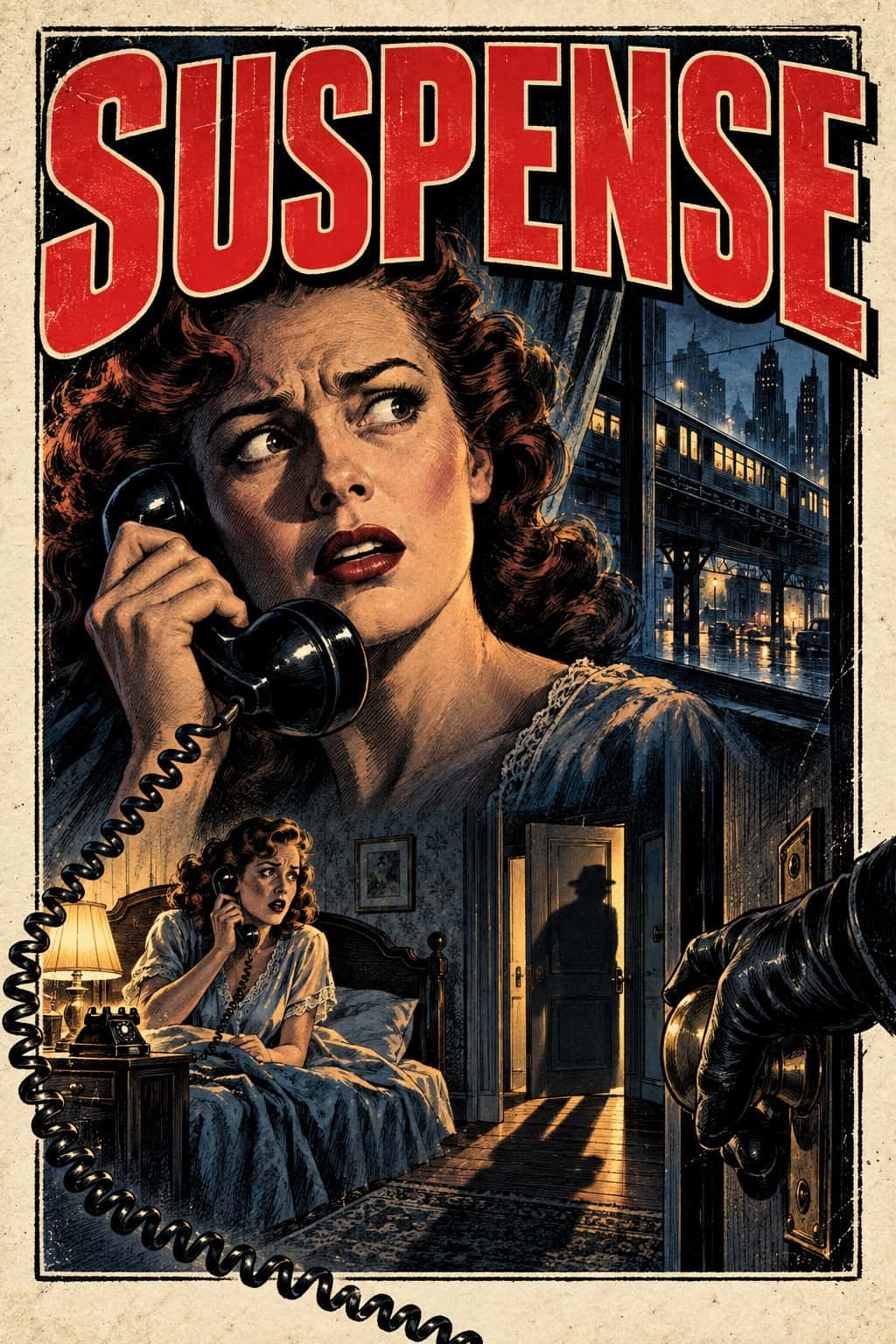
And the producer of radio's outstanding theater of thrills, William N. Robeson. The story you're about to hear is unique. It is horrible. It is filled with terror. And it may or may not be true. In any case, every time a world's fair is held in Paris, it reappears in the papers and magazines around the globe as a news story and travels by word of mouth to the ends of the earth as a true story. True or false? Heard for the first time or twice told, we believe this great classic of terror will keep you in suspense. Listen then, as Miss Vanessa Brown stars in The Vanishing Lady, which begins exactly one minute from now. Sometimes a man can have too high an opinion of himself. Sometimes that opinion can drive him to great deeds. Here now is one of America's legendary heroes to tell you of some of his unique characteristics. If his adjectives seem a bit outlandish...
Remember that his image was an inspiration to a pioneering people, and he still affects a nation addicted to TV. I'm that same David Crockett, fresh from the backwoods, half horse, half alligator. A lethal touch with the snapping turtle. Can wade the Mississippi, leap the Ohio, ride upon a streak of lightning, and slip without a scratch down a honey locust. Can whoop... my weight in Wildcats. And if a gentleman pleases for a $10 bill, he may throw in a Panther. I can hug a bear too close for comfort and beat any man opposed to Jackson. Folklore belongs to every nation's legendary past. And I guess we Americans have our share of some tall ones. The story you are about to hear first appeared in the pages of the Detroit Free Press in the summer of 1889.
at the time the Paris World's Fair was celebrating the 100th anniversary of the fall of the Bastille and the beginning of the French Revolution. It reappeared in the London Daily Mail in 1911. Two years later, Mrs. Bellock Lounge used it as the basis of her novel, The End of Her Honeymoon. And sometime after that, it became the storyline of another novel, She Who Was Helena Cass, by Lawrence Rising. As recently as 1951, it cropped up again as a British motion picture, So Long at the Fair. It is a hardy tale, a sort of modern folk tale. It has never been proved. It has never been disproved. And one can only wonder if in the dread secret archives of the police judiciaire in Paris, the real facts are recorded in fading ink on yellowing paper, locked forever from a curious and intrigued world. No one knows. Perhaps no one ever will know. But we can guess. And this, we guess, is what might have happened to lovely young Cynthia Winship and her mother.
As they arrived at the Hotel Creon one beautiful summer day, the day of the great Paris World's Fair opened. Bonjour, madame. Puis-je vous aider? I don't understand French. Is there anyone here who speaks English? Bien sûr, madame. What can I do for you? My daughter and I have just arrived from Marseille. We're on our way home from India. Oh, I am afraid, madame, we cannot accommodate you. But you must. You're feeling tall, well. And I telegraphed ahead for a reservation. Ah, c'est différent. The name, please. Oh, Winship. Mrs. Winship, my daughter. Mrs. Winship. Ah, yes. And it is indeed most fortunate you did telegraph, madame. For you, I have reserved the last room in the hotel. I'm so relieved. Would you be so kind as to register? Yes, of course. Here, Cynthia, my dear. You might well learn how to do this for yourself. Yes, maman. Where do I write? There.
In that line? Oh, I see. Voilà. You are fatigued from your journey, yes? I shall have the boy show you to your rooms at once. Chasseur? Chasseur? Oui, monsieur. Madame et mademoiselle Winship and numéro 342 tout de suite. Tout de suite, monsieur. These are your baggage, madame? Yes. These six. Voilà le bagage. Six pièces. Yeah, this way. Keep an eye on that porter, Cynthia. Don't trust these Frenchmen. I don't think you'll make off without things, maman. Here we are. Room three, door two. Entrez, madame. Oh, what a lovely big room. Look, and the park out there. Square with the statues in it. The ladies desire quelque chose encore? No, thank you.
Here. Ah, merci, madame. Thank you, lady. Oh, mama, it's like something out of a book. Yes, my dear, that's just the trouble with Paris. On the surface, it's so attractive, but underneath, it's evil. The furniture, the gilt clock, all this lovely marble table. Oh, mama, everything is so French. Now, they're very glad to me, for everything's so English by this time tomorrow. Now come away from that window and help me get him to something comfortable. There's a deer. Yes, Momo. Don't know when I've been so tired. I seem to catch my... Here, I'll get you up in the bed. There. And I'll loosen your corset. Here, Momo. Here, here are the smelling salts. Now breathe deeply, Momo. The telephone. I've got to get a doctor. The operator. Will you please send a doctor up to room number...
Now, let's see. Number 342. Send a doctor to room number 342. A doctor. A doctor. I'm quite sure it wasn't long, although it seemed like an eternity before the doctor arrived, accompanied by the manager of the hotel. To my great relief, the doctor spoke English. He felt Mother's pulse, took her temperature, and did the usual things doctors do. And then he turned to the hotel manager. While they talked in these languages, I couldn't understand. I looked from one face to the other, trying to read from their expression how serious my mother's illness was. They were as casual as though they were ordering dinner. Finally, I could stand it no longer. They must...
You must, you must tell me, what is the matter with my mother? Mademoiselle, your mother is ill. Yes, seriously ill. It is a collapse due perhaps to the strain of traveling. However, a week or two of absolute rest and she will... A week or two? Oh, no, but we're going on to England tomorrow. That would be out of the question. She cannot be moved for at least several days. The next 24 hours will be critical. Oh, Mama. Oh, my poor mother. Oh, mademoiselle, mademoiselle. You must not break down, too. I need your help. Yes. Yes, doctor. Immediately. I need some medicine. Will you fetch it for me? Oh, but... I must not leave your mother for a moment during these critical hours. Here. I will write down this address and a little message to my wife. Your wife? Yes. I have the medicine already prepared at my home. It will be much faster to go there for it than to a pharmacy.
There are very few chemists who have the ingredients. But couldn't you telephone? Alas, mademoiselle, I have no telephone. A messenger, perhaps? Mademoiselle does not know Paris, en fait. With the exposition opening, nowhere can you find a reliable messenger. They are all selling souvenirs. No, mademoiselle will accomplish the errand more rapidly herself. Here is the address, mademoiselle. 24 Bice, rue Val-de-Grâce. and here is the message to give to my wife. But I don't know Paris at all. I'm a total stranger. I am sure the manager here will give the necessary instructions to the coachman, but certainly if mademoiselle is ready. So I quite knew what was happening. I was seated in a rickety carriage outside the hotel with the doctor's message clutched in my hand while the hotel manager gave valuable directions to the coachman.
Yes, I understand. Go on, baby. I felt completely helpless. Alone in a foreign city where no landmark was familiar and the language a gibberish to my ears. In the charge of an evil-looking coachman driving an ancient carriage at snail's pace, up and down endless wide boulevards, across traffic-choked squares, knowing that my mother's life might well depend on the speed with which I accomplished my errand. Driver, can't you go any faster? This is a matter of life or death. When we left the hotel, we had crossed a huge square with statues around it and turned into a wide avenue which led up a gentle incline at the top of which was a huge arch. But before then, we turned off into narrower streets. It must have been 20 minutes later when we turned into another wide boulevard and I saw another huge arch up ahead. Or was it the same arch? Coachman! Yes, mademoiselle? Haven't we...
past that arch before. Look, I don't want a sightseeing tour. I want to go to this address directly. Don't you understand? Now, please, take me there at once. The last who turned into a narrow street and pulled up before a grim, grey house. The blue enormous sign on the wall read, 24 beasts. I jumped out of the cab almost before it stopped, rushed up the three stone steps and pulled at the bell, Mom. Oh, hurry, hurry, hurry. Bonjour, mademoiselle. The doctor sent me for some medicine. Monsieur, le docteur n'est pas ici. Here, here, read this. Retenez cette jeune femme aussi longtemps que possible. C'est de la plus haute importance pour l'avenir de Paris et même de la France. Entrez, mademoiselle. Thank you.
The duck swats took their reading and re-reading, the note as though she didn't understand it until I thought I would scream. Please, please, hurry. Get me the medicine. Look, it's my mother. She may be dying. I must get back to her. Please, hurry. She pointed to a chair and slowly walked down the hall and closed the door behind her. I waited and waited, and I began to wonder. I wondered about the time the cab had taken to get here. About that arch that looked so familiar. And I was torn by the hundred nameless anxieties that torture you when your nearest and dearest are ill. And then I heard something that froze my blood. A telephone. A telephone. Clearly ringing somewhere in the house. Now, the doctor had said he had no telephone. That was the reason why I must come all this way for the medicine. Oh.
Oh, no, no, it wouldn't be in this house. It must be next door or across the street, of course. Of course, that was where the sound was coming from. No, it was the voice of the doctor's wife answering the phone. Oh, no, no, what monstrous plot was this? I felt my scalp crawl with terror. My brain pounded. My head felt as though it were burst. I wanted to scream. To run out of this awful house, to run all the way across Paris to the bedside of my mother. Voilà, mademoiselle. La médecine. Thank you. Au revoir, mademoiselle. Thank you. Now, driver, please. Please, in the name of your own mother, hurry. Back to the hotel as fast as possible, please. Nous on fait ce qu'on peut, mademoiselle. Allons-y, bébé. The moment we continue with. Yes, thank you.
Do you know the Social Security benefits to which you will be entitled when you separate from the service and take a civilian job? Here's a tip from Social Security. Roger Clark had a Social Security card, sure enough. But Roger lost it. It's not important, said Roger. I don't need the card. I'll never forget that Social Security number as long as I live. So, as Roger worked here and there, he rattled off his number incorrectly. And there was all kinds of trouble getting things straightened out so Roger's earnings could get on his Social Security account. Don't be like Roger. If you have lost your card, write to Social Security, Department 15, Hollywood 28, California. And ask for form SS5 to replace your lost Social Security card. And now, we continue with The Vanishing Lady starring Miss Vanessa Brown.
A tale well populated, keeping in suspense. I pleaded with the coachman. I begged him to hurry. I explained to him in tears that my mother was desperately ill. But the carriage never increased its speed. We crept across Paris just as slowly as we had come, and I was sure as I saw that same white arch three times. But at last, we crossed the great square with the statues in it. And I knew we were close to the hotel. Oh, please, please hurry. Just beyond the great square, we turned up a narrow street which shortly entered a wide circle in the middle of which was a tall, slender monument. The driver swung around the monument and pulled up before the entrance of the hotel. I jumped out of the cabin and I saw the sign over the hotel entrance. It said, Hotel Ritz. Driver!
You've taken me to the wrong hotel. I'm staying at the Hotel Creole. Look, I don't understand what you're saying, but I want you to take me to the Hotel Creole. He's a stupid man. Can't you understand? My mother's sick. You've taken more than two hours to get me to that doctor's house in Bath. Can't you understand? I looked around me. A small group of passersby had trapped and were listening curiously to the argument. And then they joined in, taking sides. Everywhere I looked were foreign faces, strangers, enemies. And then, shouldering through the cloud, I saw a young man in tweed with a pipe clamped in his teeth. And before he had a chance to speak, I knew help had come. I say, are you having some trouble? Oh, thank heavens, an Englishman. Yes, that's right. Now, what seems to be the matter?
I told him as rapidly as I could. He paid the newish cab driver, parked me into another cab, and five minutes later we walked into the lobby of the Hotel Creon. The manager was behind the desk. My mother, is she all right? I beg your pardon? My mother, Mrs. Winship, in 342, is she all right? There is no Madame Winship in 342. What? 342 is occupied by Monsieur Auguste Noy, a permanent guest. Oh, no, no. No, you don't understand that. I'm Cynthia Winship, don't you remember? Two hours ago, you put me into a carriage to go to the doctor's house for some medicine for my mother. I am afraid Mademoiselle is mistaken. I have never seen her before in my life. I say, look here, what is this? I swear to you, it is as I say. We signed the register less than three hours ago. We got in on the train from Marseille. Right, well, we'll have a look at the register. Yes, I'll show you. I'm in 342. Where's the register? It is here, Mademoiselle. You may see for yourself.
See, today is day. Fourteen guests registered, but I do not see any Mademoiselle or Madame Winship. Do you? No. Well, perhaps Mademoiselle is mistaken. Perhaps she is registered at some other hotel. No, no, this is the hotel, the Creon. You were standing there when we arrived. You came to the room with the doctor. You put me in a carriage. But I assure you, Mademoiselle, these are fantasies. Oh, now, wait, wait. What is it? The bellboy there, he carried our baggage. He'll remember. Garçon. Yes, monsieur. Do you recall carrying this young lady's luggage up to room 342 this afternoon? No, monsieur. But you were. There were six pieces. Don't you remember? No, mademoiselle. Je l'ai pas vu dans ma vie en chair. He said he never saw you in his life before. But this is monstrous. And it's impossible. My mother is somewhere in this hotel.
What have you done with her? What have you done with her? Well, now, how do you feel, Miss Winchard? Oh, better, thank you. The soup was very nourishing. Well, won't you have something else? A salad, a little roast? No, no, thank you. Just a cup of tea, please. Oh, certainly. Gaffer? Yes? Just a tea, poor mademoiselle? Je suis, monsieur. I don't know how to thank you, mister. Oh, do you realize I don't even know your name? Oh, well, it's Stanley. Bruce Stanley. I'm glad to meet you, Mr. Stanley. Well, it's a pleasure. Mr. Stanley, you believe me, don't you? Of course I do, Miss Winship. We did register at that hotel. We were in room 342. I can't even describe the furnishings. There was a big window that went from the floor to the ceiling. Well, I'm afraid every hotel room in Paris has windows like that. No. Really? Yeah. Well, in this room...
The drapes were plum-colored, and there was a marble-topped table. Black marble, it was, and a gilt clock. It had run down. The hands had stopped, I remember, at twenty minutes past three. The walls were covered in rose brocade, and the bedspread was a washed-out yellow. If I could get into that room, you would see that I'm not making this up. No, I'm sure you aren't. Perhaps I can find a way to make them let you in the room. Oh, can you? Yes, I'm with the embassy, you know, undersecretary sort of thing. I believe that the British Empire has enough influence to change the mind of an obstinate palace innkeeper. Oh, then let's do it right away. Well, I don't think that the might of Britain can move quite that fast. It's past dinner time, you know, but tomorrow we'll see. I can't wait until tomorrow. Well, I'm afraid you'll have to. We can do nothing with the people at the hotel. You saw that. We'll just have to be patient until tomorrow. I'll get a room for you tonight in the pension near the embassy. You are very kind, Mr. Tennant. Not at all. Oh, no. Oh. What is it?
I just thought of something. The doctor. The doctor? Yes. Yes, the one the hotel manager brought in to look after my mother. I still have his address somewhere here in my purse. Here. Here it is. Now, we must go there immediately. He can tell us about my mother. How long would it take to get there? Oh, about 20 minutes. 20? 20 minutes? It took over an hour this afternoon. Well, here we are. Yes. Yes, this is the place. Attendez une minute. D'accord. The house is dark. Well, it is quite late. I don't care. We've got to find out tonight. Where is he? He's there at the upstairs window. Monsieur le docteur, c'est mademoiselle Winship. Elle veut vous questionner de sa mère.
He says he doesn't know you. Oh, but he must. He must. Doctor, don't you remember? It's afternoon. You sent me here to your house for medicine for my mother. He says he doesn't understand English. Oh, the liar. The liar. He does. He speaks perfect English. I'm sorry, Cynthia. Oh, Bruce. Bruce, what am I going to do?
If it hadn't been for Bruce, I'm certain I should have gone out of my mind. He found a room for me at the pension near the embassy where I spent a sleepless night. I tossed and I tanned and I worried myself into an agony almost beyond endurance. Where was my mother? What had they done to her? Bruce called for me at half past ten in the morning and took me back to the hotel. To my surprise, the attitude of the manager had... Changed completely. But of course, mademoiselle, may Inspector Room 342. We are only too glad to convince mademoiselle that her mother is not, never was, in the Hotel Crayon. I personally will escort you to the room. This way, please, to the ascenseur. Oh, but that terrible man, that horrible man. Now, Cynthia, don't worry. We'll get to the bottom of this. Regarde, monsieur. Blanc. Now, remember this, what I told you last night. Go soon. Blanc-colored drinks.
Black marble cup table. Rose wall. And a gilt clock with the hands stopped for 20 minutes past three. You'll see. Yes, Andrea. Voila, le troisième étage. This way. It was room 342. You wish to see, mademoiselle? Yes, that's right. Third door to the right. So, here we are. You see, Bruce, I know where it is. Yes, my dear. Voila. Enter, please. Now, Bruce. You'll see the yellow bed spreading. Oh. Oh, no. Not quite the room you just described in the elevator, mademoiselle. The drapes are royal blue. No. A little dusty, I feel. I must have this room renovated. There is no marble top table. No. The clock, as you notice, is running. No. And right on time, it seems. The walls are not rose-blocked.
but yellow floors were all paper. Now, my dear mademoiselle, you see how thoroughly mistaken you are. No, no, no. Oh, that's the story as it may have happened. The lady, Mrs. Winship, had vanished, the room completely redecorated overnight. A gigantic conspiracy of silence, so cruel as to cause a young girl to take leave of her senses. But the stakes were higher than the sanity of a pretty English tourist. Mrs. Winship was suffering from bubonic plague. which she had caught before leaving India. The doctor had recognized the symptoms at once, recognized, too, that she had no more than an hour to live. He had purposely sent Cynthia on a fool's errand. The hotel manager was in on the conspiracy, and the cab driver, and soon the British embassy, the Quai d'Orsay, and the police judiciaire. For had it become known that there was a case of bubonic plague in Paris, the city would have been emptied of visitors. The World's Fair would have been a failure.
the French flank would have fallen and the very stability of the pound sterling would have been threatened. That's the whole story. Some years ago, Alexander Wolcott tracked down the man who first reported it in the Detroit Free Press in 1889 and asked him whether he had invented it or had heard it somewhere in his travels. And the Detroit reporter replied that he could not remember. Which, as far as Mr. Wolcott was concerned, left the question still open. For, as he wryly observed, He doubted if any man could have invented a tale like The Vanishing Lady, and then forgot that he had done so. What do you think? Suspense. In which Miss Vanessa Brown starred in William N. Robeson's production of The Vanishing Lady, based upon Alexander Wolcott's version of the legend, and adapted for radio by Mr. Robeson. Listen. Listen again next week, when we bring you another tale well calculated to keep you in suspense.
Supporting Miss Brown and the Vanishing Lady were Diana Bourbon, Virginia Gregg, Ben Wright, Ramsey Hill, John Boehner, and Edgar Barrier.