
The written record
Read the transcript
Read along with the recording · About 42 min to read
Your hit parade, starring Frank Sinatra! Who knows what evil lurks in the hearts of men? Smile a while with Lorenzo Jones and his wife, Belle. Here's the Manhattan miracle round that brings you the bright side of life, that whirls you in music to all the big night spots of New York town, to hear the top songs of the week sung so clearly you can understand every word and sing them yourself. This is the Golden Age of Radio. I'm Dick Bertel, and tonight we'll take you on another audio excursion back to radio's formative years. You'll hear the programs that made the era golden and meet people who made those broadcasts a reality. The Golden Age of Radio is brought to you by WTIC and the Cromwell Savings Division of Farmers and Mechanics Savings Bank, hometown friends serving your best banking interests in every way. Now, here is your host, Dick Bertel.
Good evening, and with me once again is radio historian collector Ed Corcoran. Well, Ed, who's our guest tonight? One of the real giants of radio, a man who served as a producer, director, a writer, and sometimes narrator, a five-time Peabody Award winner, and now for the past 14 years with the Voice of America. It's my very great pleasure to introduce to you all Bill Robeson. Well, I'm very glad to be here in your Balliwick. Coming from Pittsburgh, I was told to enter the class of 28 at Yale. I was told by a friend of mine who was graduating from the class of 25 that I would always be a second-class Yale man because I had never gone to a New England.
Prep school. I went to Allegheny High School in Pittsburgh, Pennsylvania. You know, he was quite right. And now Yale is full of second-class Yale men of all colors and sexes. Yes, I imagine to an old Eli, you must feel a little disturbed about the fact it's co-ed now. I'm not disturbed at all about it. I don't have to go through it. Weren't you close to... being a classmate of Rudy Vallee when you were going there? Yeah, I was pretty close. He lived on the floor below me. For goodness sakes. And he graduated a year ahead of me. Well, so you both made it pretty big in radio, both you and Rudy. Any other members of your class or that group that also made it in radio? Oh, yes. Lanny Ross was a classmate of mine. Oh, yes. Well, certainly he's very well known.
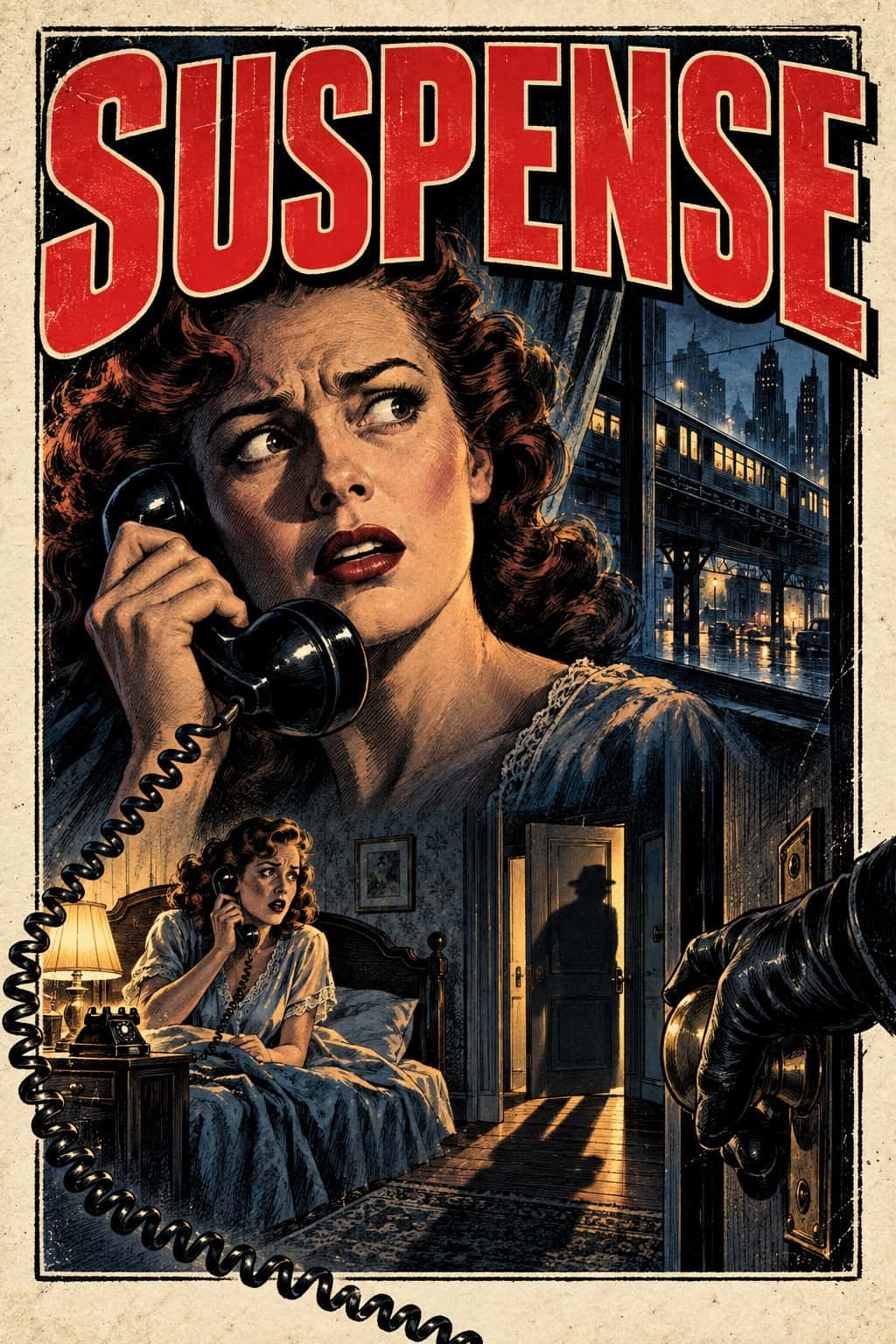
I just thought before we went on too much further, Bill, I'd mention a few of the shows that you were associated with just to put your career in more perspective, and I'd like to just name a few. I know this embarrasses you. Not at all. I love to hear it. Well, of course, I think the number one show was Suspense because of its longevity, but there was also Escape, the CBS Radio Workshop, Big Town, The Man Called X, The Man Behind the Gun, Calling All Cars, The Reader's Digest, and many, many more. And, of course, I think suspense is the one that stands out in a lot of people's mind because it was on for, I guess, almost 20 years, wasn't it? Yes, but you see, you ended with the end of suspense and the end of my radio career, and those things weren't important at all to the radio audience or to me. Suspense was a very, very important show. I must say that I was not the director of suspense in its heyday.
Bill Spear was. And Bill Spear did not create suspense, but made it the great show that it was. I came along at a time when radio was paring down all of the adjuncts to great production in terms of money for stars, money for cast, money for orchestra, et cetera, et cetera. And to give you an example of how grim it was out in 1959, They removed suspense from the West Coast to New York for production in New York in order to save $80 in sound effects technicians. Isn't that something? And they changed producers. Bruno Serrato Jr., I believe, was the New Yorker. I have no comment on the quality of the show from then on. I wrote it at Ford after that. At Yale, you were a drama student. Did you have aspirations to go on stage, or were you more interested in writing at that time, Bill? Well...
And before I matriculated at Yale, no, I didn't matriculate. I transferred from the University of Pittsburgh. I had been a newspaper reporter, a cub reporter. I nearly said cub scout. A cub reporter on the Pittsburgh Gazette-Times. And it followed that I would work my way through school with what newspaper work I could get. And I got a sufficient amount of it, plus dishwashing, et cetera, to work my way through. But when I made up my mind to go to Yale, my father said, what the hell are you going to Yale for? And I said, well, I just read in the New York Times that George Pierce Baker's been moved down from Harvard to Yale. They bought him away from Harvard. He said, all right, you go to Yale and you study with George Pierce Baker. I didn't even know who Baker was. And so I went to Yale and I studied with George Pierce Baker, the great coach of playwrights. And from then...
The twig having been bent, the tree was inclined towards drama. I must say, I recall that the scenario that I wrote for a three-act play in Baker's 47 workshop was commented on by the professor in front of the class that Mr. Robeson has here written a motion picture script, a radio script. but not a play. Now I suggest you write a play. And subsequently I ran into the professor some years later and reminded him of this, which of course he forgot. And I said, well, you were a great prognosticator because I left you to go into motion pictures, left motion pictures to go to radio, and here I am. Yeah, I was hoping you might trace your career. You were a drama student, and they didn't teach radio drama in those days any more than they taught television drama, say, back in 1938 or something like that. So what were the events that led you into radio then after having graduated from Yale? I was broke. Yeah, a lot of people have told us that. There wasn't any place to go. I'd been a picture writer of very, very little success in Hollywood. And then...
The president closed the banks, President Roosevelt, just after his inauguration in 1933. I went to a party at a friend's house, and a fellow I just met says, I understand you're a writer. I said, yeah, I'm a writer. He said, what can you write? I said, anything. That's what you say when you're hungry. And he said, can you write radio? I said, sure. I didn't tell him I had nothing but a contempt for radio because I was a picture writer. He said, well, go see this fellow, Don. So I went downtown and met this fellow. This fellow had a derby hat on. His name was Don Lee. And he owned the Cadillac distributorship in California. And he also owned KFRC San Francisco, KSJ Los Angeles, and a whole string up the... Yeah, Don Lee Network. I remember that. Don Lee Network. Right. And he took me to lunch at a health food restaurant.
with Smiley Wiley, his sales manager, always Carnation Wiley, we call him. Always wore a carnation in his buttonhole. And he said, young man, what can you offer the radio? And I said, well, I think, I just finished this assignment at Universal Studios. I said, well, I think a dramatization of World War Flyers. I almost said World War I, but I didn't say that in those days. World War Flyers. There's Frank Luke, the balloon buster. There's von Richthofen. Oh, so many of them. And all the boys in the Lafayette Escort. Just off the top of the head. And he said, that sounds very interesting. You want to come in tomorrow and start writing? See if we like you and you like us? And I said, sure. So I went in with the brashness of 26 and 7 years old and wrote it, and it was on the air.
I never knew how much money I was being paid until I got a check, and I found out it was $46.50 a week. What was the name of the show? Conquerors of the Sky. Conquerors of the Sky. That was done out in the West Coast primarily, no? Oh, yes. It was done in the network. Yes. So any pioneer broadcaster from those days, and only about six of us left, will remember that show because in the very first episode, Frank Luke the Balloon Buster, I didn't know how to do anything. I didn't know how to use music. I just knew that there were words, and I didn't have a camera, so I used words. And the line was, slanting down a sunbeam at 250 miles an hour, saying, 250 miles an hour, Frank Luke went to the attack. Now, you know, that's pretty heady stuff for 1933. Well, those were the early days. Was there one thing that turned your career into what might be called the big time?
Was there any particular show that turned things around for you? Yeah, Calling All Cars, which dramatized the exploits of the Los Angeles Police Department and had as its continuing guest the chief of the Los Angeles Police Department, who by a curious coincidence was named Davis, and still is. And I knew a girl who was... sister of a friend of mine. And one night, I had a date with this girl. And I knew that she was a left-winger. I knew she was a communist, or so her brother had told me. And I was sitting around her apartment, we were having a glass of wine and whatnot, and a fellow rushed in and she said, how did you do? And she said, well, we had the meeting at the corner of...
Eagle Rock Avenue and Sunset Boulevard or whatever it was. And everybody, the police were all around and everybody put on the radios and the apartments around full on. And it was awfully difficult to be heard, but we held the meeting. And this girl said, we won the Sears Roebuck Corner on Santa Monica Boulevard. And we'll win that corner too. And I thought to myself, I am making heroes of the police department. This was the year after Upton Sinclair couldn't get elected in California, the governor of California, because he was a Democratic candidate and the Republicans accused him of being a communist candidate and screwed up the whole campaign the way they subsequently screwed up Pat Weaver's campaign for subscription television years later. This is the way politics were in California. And I said, I will have nothing more to do with this kind of dirty protection for people who will not allow individuals to stand in a street corner and say what they believe. And so I left, resigned from the show, turned it over to the brother of this girl, and went to New York.
Well, in New York, was your reputation established at that time? No, not at all. Not at all. Vice President of CBS had been out to California, knew about me. Bill Lewis, program vice president. And he knew about me and he offered me the opportunity to go to Chicago, get my feet wet in network operations, which I did. And what might build up to, say, Suspense or Escape or some of the other shows which you are... Well, you're going backwards, don't you see? I am. Yes, you are. The great period of radio was from the time when I very fortuitously, and you didn't know this at the time, obviously happened to fall into New York, from that to the war. From 1937, 38 really, through the war.
It was only seven years. The golden age of radio. If you talk about escape suspense, those are things that one doesn't later because one has all the skills at his fingertips. At this time, we were trying to find out how to do it. We were learning skills. We were sharpening and honing our abilities. If you saw that wonderful recreation of the Orson Welles, well, this was a magnificent thing. Thanks to Paul Stewart. Yeah, he was the technical director. He was the technical director. He directed the original. That's right. You know that. But it was that kind of a period, good heavens, predating the War of the Worlds by a year.
When Irving Reese did The Fall of the City, a year and a half, spring of 37, The Fall of the City by Archibald MacLeish, a verse play by one of America's outstanding poets, a man who was so impressed by the medium of radio that he submitted to Irving Reese in the Columbia Workshop a verse play for radio. And who directed that? Irving Reese with all of the directorial staff of CBS. Assisting him. Yeah, that was a mammoth. Earl McGill, Brewster Morgan, myself, Bill Spear, all assisting. Orson Welles as narrator, Burgess Meredith as chief orator. Names that we conjure with now that were just kids then, were just kids.
That was the time. Yeah, Orson Welles was probably about 22, 23 at the time. 22 and 37 was 23 at the time of the other show. And didn't you use a big mammoth studio or you rented a National Guard hall or something to get special effects? Regiment Armory on Park Avenue. So that was remote. It was done live, the whole show. It was done live, but it was remote from the Armory. And that was to get the effect of the crowd or something? Whatever we wanted to get was an outdoor... An outdoor perspective, dead air, outdoor, no reverb. So he put his cast in this vast armory. Now, my responsibility was crowd direction. We had a crowd of 150 people. But as MacLeish wrote the play, the crowd was a character in the play as the Greeks wrote for the chorus. They had no words, but they had reactions. And I was the cheerleader for the crowd.
But to limit that, to control a small orchestra, but with very piercing primitive instruments, I mean, woodwinds and tambours and so on, to control that, to control the narrator, Wells worked in an isolation booth, which were quite new in those days. All of this to give an impression of great space without reverberation, because Irving was a genius. at this kind of conception. Unheard of in those days. Unheard of today. What television producer gives a damn about sound? They pump all this $250,000 production through a four-inch speaker. Yeah, that's about right, yes. That's ridiculous. I thought we might listen to this because, you know, people are curious as to how the fall of the city sounded. I have a recording, so why don't we hear what it sounded like, this great production, 1937, is that right? April of 1937. On the CBS Radio Workshop.
You, are you free? Will you fight? There are still ages for fighting. There is still an age in the streets. You can stand on the stairs and meet him. You can hold in the dark of a hall. You can die. All your children can crawl for him. They won't listen. They're shouting and screaming and running. The square is full of deserters with more coming. Every street from the bridge is full of deserters. They're rolling in with the smoke blowing behind them. The plazas choke with the smoke and the struggling of dragglers. They're climbing the faquam, driving the ministers, shouting. One speaks and another. But then he is doomed! There's no holding it! Let the conqueror have it! It's his hill! It's his sanctuary! He's one man! He's here for thousands!
Who can defend us from one man? Bury your arms. Break your standards. Give him the town where the town stands. They're throwing their arms away. Their bows are in bonfires. The plaza is littered with torn plumes. Spear handles. Masterless men. Masterless men must take a master. Order must master us. Freedom's for fools. Of course. Freedom has eaten our strength and corrupted our virtue. Men must be ruled. Fools must be mastered. Rigor and fast will restore us our dignity. Chains will be liberty. The last defenders are coming. They whirl from the streets like wild leaves on a wind. The square gathers them. Now they are fewer. Ten together are five. They come with their heads turned, their eyes back. Now there are none. The street's empty, in shadow. The crowd is retreating, watching the empty street. The shouts die. The voices are silent. They're watching. They stand in the slant of the sunlight, silent and watching. The silence after the drums echoes the drumbeat.
Now there's a sound. They see him. They must see him. They're shading their eyes from the sun. There's a rustle of whispering. We can't see for the glare of it. Yes? Yes? He's there in the end of the street in the shadow. We see him. He looks huge. A head taller than anyone. Broad as a brass door. A hard hero. Heavy of heel on the brick. Clanking with metal. The helm closed on his head. The eye holes hollow. He's coming. He's clear of the shadow. The sun takes him. They cover their faces with fingers. They cower before and they fall. They sprawl on the stone. He's alone where he's walking. He marches with rattle of metal. He tramples his shadow. He mounts by the pyramid. Stamps on the stairway. Turns. His arm rises. His visor is opening. There's no one. There's no one at all. No one. The helmet is hollow. The metal is empty. The armor is empty. I tell you, there's no one at all there.
There's only the metal, the barrel of metal, the bundle of armor. It's empty. They don't see. They lie on the pavement. They lie in the burnt spears, the ashes of arrows. They lie there. They don't see or they won't see. They are silent. The people invent their oppressors. They wish to believe in them. They wish to be free of their freedom. Released from their liberty. The long labor of liberty ended. They lie there. Look. It's his arm. It is rising. His arm's rising. They're watching his arm as it rises. They stir. They cry. They cry out. They are shouting. They are shouting with happiness. Eat him. They're shouting like troops in a victory. Eat him. A city of masterless men has found a master. You say it was they with the counterweights.
An excerpt from the CBS Radio Workshop. 1975 has been a year of growth for two hometown banking friends and neighbors who have now joined together to better serve you. During this year, the Cromwell Savings Bank has joined with Farmers and Mechanics Savings Bank to offer even greater convenience to customers at any one of their six locations. An account at either bank is now an account at both. This means that these two hometown friends can now serve your best interest in every banking way. In addition to a number of savings plans designed to suit your individual needs, personal loans, home improvement loans, personal checking accounts will also be available starting January 1st. So stop in soon and apply for your personal checking account. The Cromwell Savings Bank Division of Farmers and Mechanics Savings Bank has two convenient locations at the corner of Main and West Streets and the new Cromwell Plaza office near Kmart.
Farmers and Mechanics has offices in Middletown at Main and College Streets and also on Washington Street. Other locations include Montville and Colchester, member FDIC and Equal Housing Lenders. As 1976 approaches, they look forward to providing even better service to you and your family. Now, once again, back to Dick Bertel. Our guest tonight on the Golden Age of Radio is William M. Robeson. I'd like to, you know, keep going on this period and maybe go into some of the technical aspects of putting some of these shows together. Now, you went through the whole period of sound effects where they were all simulated in the studio as opposed to recorded outside, let's say, on disc. And I just wonder, you know, how that affected the quality of your shows, whether you really had some real tough problems simulating sounds that couldn't be recorded live, that sort of thing.
Well, at the beginning, in 1933, when I started with Caucus in the Sky, in order to get a machine gun effect, we had what was called a shot pad, and it was a leather pillow and a slat, and the sound effects man would hit this very fast. That was a machine gun burst. I wanted the whine of a shell approaching. its target, and they didn't have any such effect. And here again, you extemporize. And I said to Gino Severi, the first chairman in the orchestra, can't you give me a glissando on the G string? And that's what he did, and he went down like that. We want the diving of an airplane, the trombone took it. It was that rudimentary in California in 1933.
The audience believed it, though, didn't they? Yes, I don't think one would today, but in that time, they had no basis of comparison. Now, later, by the time we got around to, well, within two or three years, we were using recorded sound effects. We could use recorded sound effects. Automobiles starting, stopping, car door, very rudimentary, very bad. But again, no basis for comparison. Then we learned to use variable turntables so you could speed up or slow down and get a differentiation that way. Now I'm going to skip to Man Behind the Gun in 1942. I was hoping you were going to do that because that was the epitome of sound effects, that show, wasn't it? You said it, and I agree with you.
The challenge there was quite something, because here we were, sitting in New York, attempting to dramatize to the American public the kind of military activities their sons, husbands, brothers were involved in around the world. But we had no sound effects. Nothing was recorded of B-17 bombers. This was secure stuff. You couldn't get any sounds of this stuff. So we had to imagine and we had to create. And this involved use of recordings principally, but you'd have a recording of a two-engine plane and you'd double and quadruple it. off of turntables with two arms on each table. You would fool around with filtration and levels on gunshots. You would take a rifle explosion. I'm not sure that we did this, but this is an example. You'd take the explosion of a rifle, slow it down, take the highs out, it becomes a mortar shell.
This sort of thing you do. Now, however something was missing, the fellows were in there saying, pilot to Billy Gunner, pilot to Billy Gunner, Billy Gunner here, and they're here, and the guns are over here. So I remember having read something about the threshold of hearing someplace, and I put on either side, on the dead sides of the cast mic, two 18-inch speakers and i fed every sound effects that we were handling going to the network live i mean full level into the ears of the actors full level and they had the shout over it that's one of the qualities that that that gave that show such a verisimilitude so that you know you're running the naval officers say were you aboard the boise or something you've been flying over england well ed you uh you have an excerpt from uh this show that I'm sure Bill will remember, Prep Joe. Oh, no, Prep Joe, yes. Oh, this is something I must interpolate here. I had never been on a PT boat, obviously, and I made arrangements through the Navy to board one in the Brooklyn Navy Yard on a very, very cold winter day. We went up through Hell's Gate and the Long Island Sound and back, and they put this thing through all of its maneuvers, excepting firing torpedoes, of course.
And I was fascinated because they go forward on muffled half-speed engines and suddenly throw a command, and this thing would leap out of the water. Wow! Well, this became a challenge. You'll hear it on this disc. They go into attack. You can't believe it. When they give the order, that thing shoots forward, shoots into your ears, shot into the ears of the actors, and the result you're about to hear. Hackett is already aboard the Long Tom. He waves at you briefly and impersonally. You wave back the same way and then get down to business. Wind him up. Stand by to get underway. Wind him up. Stand by to get underway. Now your exhausts are spitting blue smoke, rippling the oily water. You look over at the long tom as it moves slowly away from the dock, churning up a white, creamy weight. You're next. Stand... Hard right runner. Hard right runner it is, sir.
Steer on the lead boat. Aye, aye, sir. Following the lead boat. Slowly, you wind your way down the river behind the long tom to the open sea. It doesn't take long, and just as the night comes down like somebody pulling a shade, you reach deep water. The long tom up ahead digs her stern down and begins throwing up a bow wash. Hackett is opening up. Open her up, Grab. Aye, aye, Skipper. You're on your way now. You smell the heavy night air, and it's like perfume. The offshore wind brings you an intoxicating scent of flowers. The huge blossoms that cover the tops of the trees like a blanket. So far, it's the best war you've ever been in. ...first go by. You're about 100 miles from your base now, cruising up and down behind the long tom. You haven't seen anything, and you've got an idea Hackett is deliberately avoiding trouble because you're new on the patrol. You're debating with yourself whether or not you should call him on the TBS, the interboat radio, and ask him about it point blank. When your radio man comes up and pulls your trouser leg to get your attention. What is it, Sparks?
Long time on the pipe, Skipper. Want to talk to you. Okay, give me the can. You clamp the earphones over your cap and grab the mic. Hello, long time from Prep Joe. Acknowledge. Prep Joe, this is Hackett. Yeah, Hackett, go ahead. I'm about four or five miles ahead. Certainly. Shall I muffle up? Yeah, good idea. Okay. Right. Roger. Okay, Sparks, I'm through. Better get to your gun. We're going in. Aye, aye, sir. Stand your battle stations. All hands, put on life jackets. Pass the word. Stand your battle stations. Take your door, hands, life jackets. Heldman. Aye, sir. Signal engine room to close mufflers. Aye, aye, sir. Now the PT's motors are muffled as it tracks the enemy. You're trying to bore a hole through the darkness ahead for the first glimpse of him. It's tough. It's as black as the inside of a motorman's hat. The long time shears off now and the two boats run along through the night about 200 yards apart. The machine guns are manned now and their ugly snouts move rhythmically this way and that as the men limber them up. An excerpt from Prep Joe from the...
CBS series Man Behind the Gun. One and one usually makes two, but sometimes two things join together and become one. This isn't new math. It's the all-new combination of Cromwell Savings and Farmers and Mechanics Savings Banks. In an age of expanding and changing bank service, these two old friends and neighbors have joined to maintain the greatest customer convenience for thousands of lucky customers. An account at either bank is an account at both. which means these hometown friends can now serve your best interest in every banking way. Full personal banking service, including checking accounts, available January 1st. But you can begin right now with savings and loans at both, because an account at one means an account at both. So one plus one equals a bigger one. The Cromwell Savings Bank Division of Farmers and Mechanics Savings Bank has two convenient locations. At the corner of Main and West Streets, and the new Cromwell Plaza office near Kmart. Farmers and Mechanics Savings Bank have offices in Middletown at Main and College and also on Washington Street. Other locations include Montville and Colchester. Member FDIC. Now back to Dick Bertel. Our guest tonight is William M. Robeson. I do have to go into your latter period, even though you feel that your career was already at its zenith at that time. Not at all. I became a big man later. But what made it all possible was what happened in the 60s and 40s.
You made money in the 50s. Well, of all the shows, the anthology series, there were a lot of them. They were like Inner Sanctum Mysteries and The Mysterious Traveler and The Whistler and Suspense. I think the one that everybody seems to feel is the top was Escape. And I'd like to just play the introduction to this by Will Conrad, just the mood of the introduction, I think, kind of gets people, they know it's going to be a good show. You are isolated on a remote plantation in the crawling Amazon jungle. and an immense army of ravenous ants is closing in on you, swarming into each of your lives, a deadly black army from which there is no escape. We offer you escape, designed to free you from the four walls of today for a half hour of high adventure. Tonight, we escape to the Amazon jungle and to a creeping, crawling terror, as Carl Stevenson told it in his famous story, Line Engine vs. the Ants.
Now, after that introduction, what else can you have but a great show? But I think there are two things that I think most historians, or fans, if you will, feel about this, was the exceptional choice of stories, all great stories, all very well adapted, and extremely well, very good technical effects as well, as well as acting. But I think the stories made the difference in this series. I don't recall a single weak script in the whole series. I do. Which one? I couldn't remember. No, I think that's very interesting, and I'm glad you brought that up, because the story editor first, the first story editor on Escape was a man named John Meston. John Meston went on from being story editor at CBS out on the coast to being creator of Gunsmoke. Gunsmoke, oh yes. And John Meston was followed by John Dunkel, a very, very...
intellectual type fellow. And it was John Meston and John Dunkel who were principally responsible for the selection of the material and the acquisition of it. But they still were under your direction. The producer had the final say. The final say on acceptance. But here I want to stress this fact. Their contribution was superb. Practically never did I disagree with them. So if you were complimenting the quality of the material on Escape, those were the two men who were responsible for it. The quality of the production was mine when I was doing it. Other people also did the show through the years. What about casting, Bill? Was there an inner circle, so to speak, such as Larry Haynes, Stotz Cotsworth, Frank Lovejoy, people like that? How did you go about casting parts? Did you always have...
Familiar names in mind. I'm sure you were constantly bombarded by people wanting to be on the show. Well, I don't know what you're after, but... Well, we heard it from the actors. We'd like to hear it from your end as far as how you went about it. You've just said it. You're constantly bombarded, and you get so tired of nonsense, incompetence, no talent, and this sort of thing. I remember shortly after I went to New York, from California back in 36 or 37, when I first started to do the workshop, an actor coming in for an interview. And I said, what have you been doing? He said, well, I've been here from the coast about a year. And I said, what did you do on the coast? He said, oh, I was one of the leading actors on Calling All Cars. And I said, oh, you were? Where were you? What time? And he gives me the time I was doing that. All right, then there's the other one. My son Christopher, who is now old enough to vote and much more, was in a nursery school back in 1947 or 8. And he brings home his first finger painting. And like all proud fathers of small children, I had it framed. And I hung it in my office wall. And in comes an actor for an interview. And he says, oh, what is that? Oh, what is it? I said, that's an early Christopher. He said, Christopher, I love Christopher. So we got rid of him.
I am not one who suffers fools gladly nor accepts much brown nosing. I want talent. I want ability. And I will go to lengths to find it and I will also go to lengths to put up with it as sometimes as necessary. Well, these people I mentioned were all terrific. They could come in and do a cold reading and still sound like they read it 20 times. Don't you believe it. Well, at least they told me they could. I know. The only one I ever knew who could do that was Orson Welles, and he proved it. But a director doesn't want that kind of talent because a director has got to mold the show. That kind of talent, then you become Orson Welles and you direct the Mercury Theater. I don't think I've ever revealed this. It doesn't make much difference, and it certainly is not told in criticism about a very, very talented man who is now dead.
My first choice for narrator of Man Behind the Gun was Everett Sloan. Everett did the first show. That show required six or eight hours rehearsal, overall with dress and air maybe ten hours. Everett came to me the next week and said, Bill, I can't do it. I've got all these conflicts. I've got other shows. And furthermore, Bill, I don't need that much rehearsal. And I said, Everett, I agree with you. You don't, but I do. And he understood what I meant, and we were friends till the day he died. But there's something that, and it's very costly when you get into long rehearsals, but there's something that the director needs to put these things together. Now, that also is the insecurity of youth.
I can do the same things now and one third the time. And I'm looking at some people in the booth there who see me do it. But that's when you're relaxed and you're so old and radio is no longer a medium that counts and you're sitting around talking about the golden age. But when you're pushing it, when you're pushing it, when your career's on the line, my God, it's... So I surrounded myself with those people who... Who delivered? I don't mean that Irving Sloan did. Everett. Everett Sloan did not deliver. He certainly did, but I needed more time than he could give me. But people like Frank Lovejoy, Larry Haynes, Bob Dryden, Bill Quinn, Jackson Beck, who succeeded Everett as a narrator, and these people, they worked their heads off, and they became a small group of superb performers.
And all we were after was realism. So each man contributed his own realism. And so I got to the place where I'd say, look, we need a talk-up here of about 35 seconds while the sounds are coming in, and you know what to do, and they'd go right into it. They knew their characters. It was fine. And you know that's what killed Man Behind the Gun? Because the other directors in New York doing war and action plays would get these same actors in and say, do for me what you did for Roots. Yeah, that's right. So my originality became a platitude. Well, I'd say that's the difference between you and other directors. We heard so many cases where you go on the air with virtually no rehearsal. They'd mark up the script, they'd time it, you'd say, let's go, and that's it. Sometimes they'd have a stand-in most of the time. I know who you're talking about, and I'm not going to mention his name. So that's the difference between, that's why you made it and some of these other guys didn't. I didn't make it. No, no, no, no. No, you've got me wrong. The man you're talking about...
who is on the air, and it's five or seven nights a week, an hour every night, is still doing the same thing. And he didn't make it. He finally made it by God last year. He got a Peabody after I had five. But he made a million dollars. I hope he's happy. Well, Ed, we've talked about suspense. And, of course, I think as far as our audience is concerned, the name William M. Robeson is most closely associated with suspense. Let's turn back the clock and listen to one of those great shows now. Outstanding theater of thrills, the master of mystery and adventure, William N. Robeson. Those who know about such things tell us that an engine delivers little more than 50% of the energy potential of its fuel. The rest is dissipated in waste, waste motion, waste energy, gases, ash. The same can be said of man, has been said in fact.
Getting and spending, we lay waste our powers. If an average man were trained to use his faculties to the utmost, he could be a superman. If a superior man were so trained, what could he not accomplish? The answer is implied in the upcoming story. Listen. Listen, then, as Mr. and Mrs. Frank Lovejoy star in Man from Tomorrow, the last radio play written by the late Irving Reese. Starring Mr. and Mrs. Frank Lovejoy. Calculated to...
Even in these days of so-called full employment, you'd be surprised how few job opportunities come up for an ex-jet jockey. So it was with more than passing interest that I read this ad while I was scanning the classified section of the Sunday paper. It said, wanted ex-jet pilot. Unmarried, without family obligations, must be in perfect health and prepared for rigid tests. Successful candidate will receive good pay and be given opportunity to contribute to daring experiment and world betterment. Apply Tuesday at 10 a.m., Science Associates, 126 West Street. Well, Science Associates, you just got yourself a boy. It turned out there were quite a few boys with the same idea. By 10 o'clock Tuesday morning, nearly 50 of us were crowded in a windowless air-conditioned room in the windowless, ultra-modern building of Science Associates. Oh, hi. Hi, Major. Oh, hi, Randy. It's been a long time. Yeah.
Some of the faces were familiar, guys that had been in the Air Force with me in Korea and afterward. We sat there and waited. An hour, two hours, nothing happened. I don't know about the rest of you guys, but this place is beginning to give me claustrophobia. I'm getting out. Open that door. Hey! Hey, it's locked! Hey, we're locked in here! Even before this had a chance to sink in, another door opened on the far side of the room. A guy with a white mask on his face came in carrying a Thompson submachine gun. Everybody flattened on the floor and tripped me. I made a dash for the man in the mask, but he disappeared as quickly as he'd come. Hey, Major. Major, how come you didn't hit the floor? You tired of living? Well, he was shooting blanks. He was shooting blanks? Couldn't you see that? There weren't any bullets chipping anything.
Besides, I know it was a gag from the way he held that machine gun. When those babies are loaded with live ammo, you gotta fire them from the waist. Well, I don't like this. Come on, guys, let's crash the door and get out of this rat hole. Ah, David, Randy, that won't do you any good. That door's as thick as a bank vault. And then, something else. Thick, black, acrid smoke pouring out of the air conditioning vents. And a sound from somewhere. Of an airplane diving. Every pilot remembers with horror the smell of burning oil from a plane out of control. It hit us way back and deep down, and some of the guys got panicked. And then the blowers reversed and the smoke was sucked out quickly. Attention, please. A loudspeaker cut in from nowhere. For the past two hours, you have been under close observation as a necessary part of this test. You were warned in advance the test would be rigid. As you file out past the guard...
You will receive a token compensation for your time and discomfort. We now ask you all to leave. Except the man who ran for the gunner. The door is now open. Thank you. You're welcome, boy. Well, Major, looks like you got the job. Also looks like I'm going to shove it right back in their faces. Well, I don't blame you. Well, so long. So long, Randy. Take it easy. For a moment, I was alone in the empty room. And then, an inner door opened. And I wasn't so sure I wanted to shove the job in their faces. Not in this face, anyway. Your name, please. Well, well. I hardly expected to find a blonde at the bottom of this. You will come with me, please. Well, I'll do nothing of the sort. Now, don't give me orders, Blondie. I want to see the guy responsible for this, and then I'm getting out of here. I take it you have lost interest in contributing to world betterment.
Oh, yes, that's what it said in the ad. Well, whatever your lofty purpose, I don't like cold-blooded cruelty. Unfortunately, we cannot allow personal feelings to interfere with our objectives. Well, then your objectives are wrong. You will be better able to judge that when you know what they are. Well, I don't think I'm interested. And if I may indulge a personal feeling, callousness is unattractive enough in a man, but in an attractive girl... Neither your feelings nor mine will matter in this project, Major. I believe you were addressed. It was just... Plain Mr. Mr. Kentman. The war has been over for some time, Miss, uh... Dr. Frost. Uh, that's appropriate. I beg your pardon? Oh, nothing, nothing. I sometimes mutter to myself, the last thing I said to you, Doctor, is that the war is over. If it is possible for you to unlock your quite superior intelligence from emotional reactions common to schoolgirls and housewives...
My senior colleague, Professor Baird, and I will attempt to convince you on the only basis that should appeal to the mature mind. Facts. Well, you go ahead and try, but I doubt you'll be successful. An excerpt from Suspense with director, producer, and our guest tonight, William M. Robeson. Old friends, hometown neighbors. Cromwell Savings Bank is now a division of Farmers and Mechanics Savings Bank. and together they serve your best interest in every banking way. Open an account in either bank, and you have an account at both. And beginning January 1, 1976, you'll get full personal banking service, including checking accounts. Join the family in the main office in Middletown at the corner of Main and College Street, at 846 Washington Street in Middletown, the Midway Shopping Center in Montville, Colchester Shopping Center, Colchester, 327 Main Street, Cromwell.
or at the Cromwell Plaza near Kmart. In an age of expanding and changing bank services, Cromwell Savings Bank and Farmers and Mechanics Savings Bank have joined together to serve your best banking interests in every way. Member FDIC. Our guest tonight is William M. Robeson. And we're talking about some of the shows that you, Bill, have been associated with through the years, through those so-called golden years of radio, the late 30s and the early 40s. In your opinion, Bill, what brought about the demise of radio as it was known? The American people got a new toy. And the men who owned the toy knew it was going to cost a great deal of money. And so they phased out radio. I told you earlier the story of the...
$80 savings they would make by moving Suspense to New York. They got down to that. They got down from a 13-piece orchestra to an 11-piece orchestra to an 8-piece orchestra to a trio and finally to the organ. So it was that kind of attrition that occurred. And they killed it because you can spin records, you can automate the whole day's programming, you have a newsman and a disc jockey, and you operate. Because people went home and looked at their new toy. They weren't listening to radio. And now, as I think I said, you have a generation of people who don't know how to listen, who must have a picture to bolster. And they miss the beauty of the human voice, which is something I think you always... Well, they miss the beauty of their own imaginations. It's too much effort to think.
When that tube is up there, you don't have to think at all. You just sit there and eat that stuff and drink that beer and get fat. But, you know, we're never going to pull those men off the moon. No, we got to go now to Mars. I don't know why. You know, you kill a lot of men that way eventually. But once you've made that step, you can't go back. You made the step to television, you can't go back to radio. A lot of us old poops will talk as we're talking now, but my 10-year-old son couldn't care less about that. Well, I always thought that they could coexist, but I guess it's pretty tough to stay in age, especially the way TV is today. All right, but where's the sponsor who will put, now get this, I'm talking about 20-year-old figures, who will put $5,000 into a superb super production. That's all it would cost on radio.
There isn't a sponsor in this country but $5,000 a week. He'll put $250,000 into a film. He won't put $5,000 into a radio show. Let him get me the $5,000 and see what happens. You won't get any audience. But those you get will buy your product by the barrel. They'll be so grateful. Well, I hope somebody's listening that has the $5,000 because I'd love to see it. Never happen. I'd like to see you doing it too because I know it would be done right if you were doing it. Well, I agree with you on that. Yeah, I'm saying a lot of things to agree with. I appreciate that. Thank you very much, Bill, and I hope we have the opportunity to get back here again and talk some more about your many-faceted career. Anytime the subject is me, I'll be here to discuss it. Thank you very much, and this is Ed Corcoran. And Dick Bertel. Good night. The Golden Age of Radio has been brought to you by WTIC and Cromwell Savings Division of Farmers and Mechanics Savings Bank. Hometown friends, serving your best banking interests in every way.
The Golden Age of Radio was produced by Bob Cherego and Dick Bertil. Benny Goodman Swing School. The Tuesday evening rally of everybody everywhere who gets a lift from the new pulsating music of youth, swing. The Lux Radio Theater brings you Rita Hayworth and Charles Corbin in...