
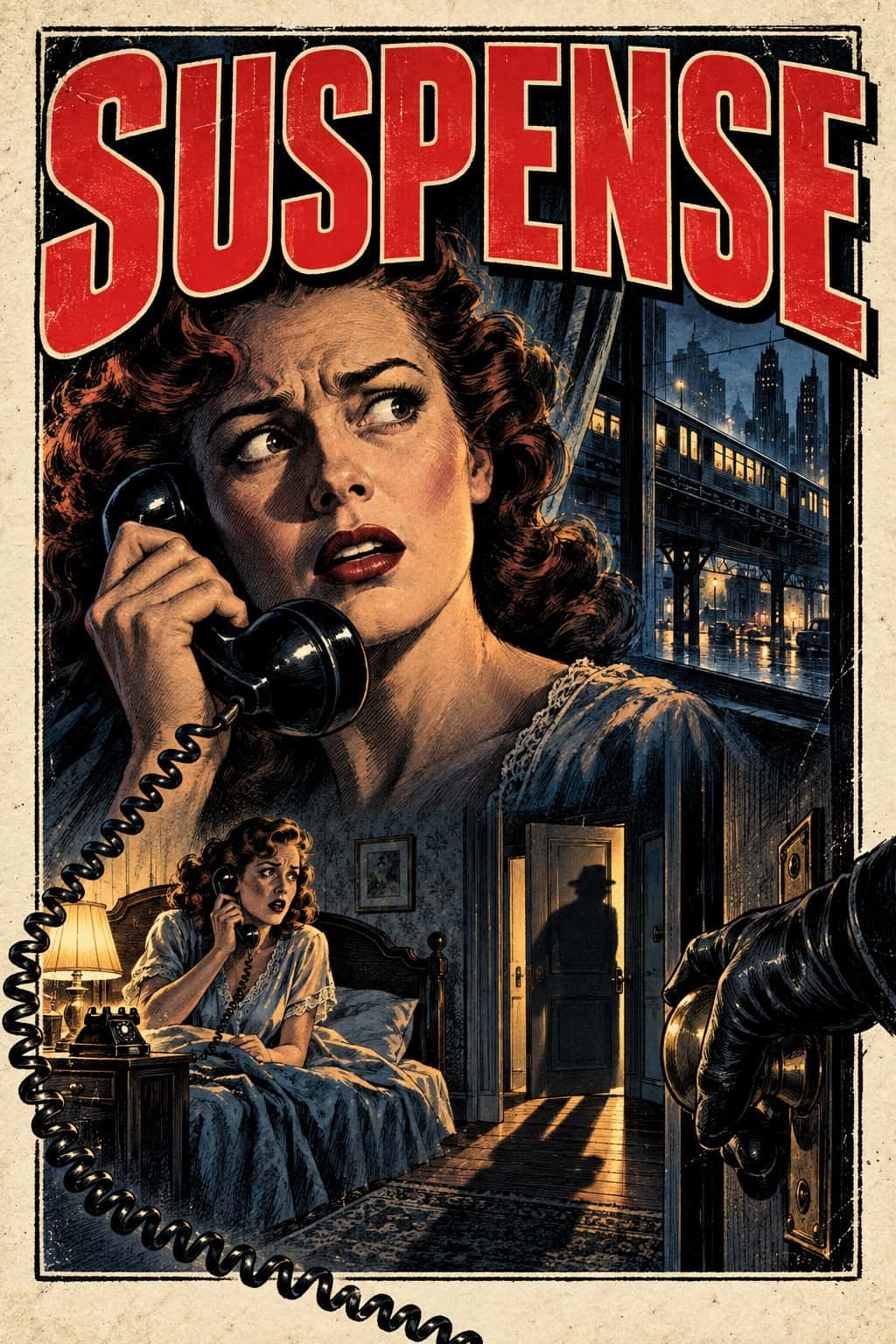
The written record
Read the transcript
Read along with the recording · About 17 min to read
What'd you want to see me for? Chris, come here. Sit down. Did you get to hear the show Sunday? I don't like to listen to the show. Why not? Because I don't, that's all. Hey, Mr. Goodwin, I put some zip in that closing scene. I want you to hear it. Got the playback ready. Hand me that record mark part two, will you? I don't know, Chris. I don't make you come to rehearsals. You don't have to sit in the control room all day. The least you could do is listen to the show at home. Well, listen to this now.
George. Honest, I didn't mean it, George. Get this, Chris, get this. Do you mean to say that you didn't really mean it when you told my brother you didn't love him? You forget, Doris, that I heard you every word while I was hiding behind the Davenport the night my mother was here. George, I beg you, don't do this thing. Put down the gun, George. This is only what you deserve. You tricked me for the last time, Doris. You tricked me for the last time. I'll just shut this up. What did you change it for? What was wrong with the ending the way it was? Why did you change it? Just take it easy, Chris. I'll tell you why I changed it. Because it was wordy and repetitious. It didn't tell the story. The boys upstairs said... The boys upstairs, yeah. That's just what I thought. The boys upstairs. They do everything but breathe for you. Did it ever occur to you that maybe people are wordy and repetitious?
Chris, I'm trying to tell you the scene the way you wrote it just didn't play. Just didn't play. That's right. All the trade clichés. Drag him out. It didn't live. It didn't play. It didn't make the right goosebumps come out of your left elbow. How did you ever get into this business? Who ever let you into a radio station anyway? I'll tell you what's wrong with you. What you need is a good psychiatrist. Don't you tell me I need a psychiatrist. Don't you tell me. Let go of me. I said let... You're not listening to me. For two years now, I've turned out a murder a week for you. Week in and week out. A murder a week. I eat murder, talk murder, dream murder. And for what? Every time I turn in a decent script, you chop the heart out of it. Your contract is up next week, Chris. You've got only one more script to do. Write it and get out. You'll get better than a script. You'll get everything you deserve. I'm going to show you what a real murder sounds like. I'm going to show you if I have to kill you to do it.
Good evening. This is a recording of an actual murder. The first, as far as I know. Not written, not rehearsed, but well planned. It is respectfully dedicated to Mr. Ken Avery, editor and producer of the radio program Murder, Please. This is my last show, Mr. Avery. I'm delivering it to you in its entirety. Cast, music, everything. The events and persons are absolutely real. It's going to be a great show, Mr. Avery. You will hear everything but the climax. I am speaking into a microphone in my desk, concealed with the other recording equipment I've rented for the occasion. A special microphone is attached to my telephone to enable the listener to hear both ends of any conversation. The music you hear is coming from a high-fidelity phonograph at my side. This program is produced, edited, directed, narrated, engineered, and plotted by Christopher Turner.
whose only claim to immortality is this single half hour. And now, Mr. Avery, the leading characters in order of appearance. The murderer, Christopher Turner. The catalytic agent, your daughter, Lois. The victim, yourself. And now, please to begin. Murder, please. Dan, this is Chris. I hate to bother you at home, but I wanted to apologize for the way I acted. Why don't you drop over to my office right away? Sorry, Chris, no go. A little insanity, but we answered that one's plenty. I see. You won't change your mind. Not a chance. Thanks, Ken. Thanks a lot. Lovely opening scene, Mr. Avery. Thank you. You did exactly what I wanted you to do. You just threw away your last chance to save your life. Good work. An excellent performance. I kill you in the name of the parasitical breed you represent.
The stupid, arrogant men of high places who milk the talent of others and claim it as their own. To you, Mr. Avery. If you won't come up to my office by invitation, which I suspected you wouldn't, there's still another way. The telephone book. Listen, Mr. Avery. The sound of the flipping of the pages. Your daughter's phone number. Ah, here we are. Hello, Lois. It's been a long time. I bet you don't even know who this is. This is Christopher Turner. Fine, just fine. How do you like living alone? Rather be living with the folks? How's the writing coming? Well, the reason I called was your dad and I had a talk this afternoon about you. He thought maybe I could pass on a few tips. Now, this isn't an obligation on my part, Lois. I like to help young people. Besides, it's been a long time. Say, what are you doing this evening? I'm going to wash my hair. Well, why don't you wash your hair tomorrow evening and come down to my office right away, huh?
Well, I told a girlfriend I'd be home tonight. Why can't you call her and tell her to make it some other night? Here's the point. This is the only free night I'll have this week. Things are sort of piling up, and I'd like to see you get something out of your writing the next week or two. Maybe you're doing some little thing, and I could sort of straighten you out in the evening. Fine. You know where my office is? It's right across from the broadcasting studios, the Brown building, room 208. Fine, and bring your scripts with you. I will. Certainly appreciate this. Not at all. Goodbye. Bye.
I'll be over in 45 minutes and bring your scripts with you. I certainly appreciate this. Not at all. You see? That's how people talk, Mr. Avery. Now, let's see. What else? Oh, yes. Sound drawer opens. Gun taken out. Click of breach. Whirl of chamber. Bullets inserted in chamber. Three, five, and thick. Gun in drawer and drawer closed.
And now we must wait and see. You see, Mr. Avery, fate is a better dramatist than either of us. Just when things start getting dull, the phone rings. Hello? What's up? I tried your place all night. I tried your sister's place. I can't help myself believe it, but here you are slinging away for old man Avery again. Are you going to tell him to go to... I did just that today. No kidding? Well, congratulations. You're not in nothing but bigger... Yeah. What's the game going on over here? Just room for one more sucker. What do you say? I can't tonight. I'm doing my last show. Oh, forget it for one night. Why don't you live a little? Thanks, Hank, but I can't. I'm coming over there to get you away from that typewriter if I have to use force. I can't, Hank. The show's Sunday. I've got a script due tomorrow. You don't see me knocking myself out. Let him wait. Listen, Hank, you can't come over here. Don't you get it? The next time be sharper, will you? A story conference, that's right. You bet.
Bye. That was close. Good scene, though. Lois Avery has just driven up in front of the building. She's getting out of the car carrying her scripts. She wears a cardigan sweater, tweed skirt, flat shoes. She's young and very pretty, a girl with everything to live for. Now she's disappeared into the building. In a moment, she'll knock on my door. Then you'll see for yourself how youth resists the threat of death. And this, Mr. Avery, would be the proper dramatic moment. To end Act One. May I suggest at this point you insert one of your beloved commercials? Two. This is Christopher Turner once again, Mr. Avery, bringing you by transcription the first recording of an actual murder ever made specifically for broadcast. The setting? My office. The music? Recorded. The time? Night. The victim? Yourself. Your daughter has just entered the building, and in a few seconds I'll ask her in.
I'm sorry I have to go to such lengths to get you into my office. I'd gladly have killed you in the street, but it's so much more difficult to make a recording there. So concludes the usual resume with which we begin the second act of every murder-please program. I hear her footsteps in the hall. Your cue, Lois. I hope I'm not putting you out. I always tell Dad to stop imposing on my behalf, but I guess he'll never learn. You're here because I want you here and for no other reason. Cigarette? No. No, thanks. This is a nice office. It serves. Just a hole in the wall, but quiet. Nothing fancy. I like it. How long have you been scribbling? Six months, Mr. Turner. Let's just make it crisp. What sort of things? Murder, mostly. Somebody told me that's what sells best. True, true. Well, let's just start talking about murder. Maybe something interesting will come out. Question number one. Why do you think people kill? Oh, lots of reasons, I guess.
Money? Love? Revenge? Not really. Only for survival. They kill for money only when money means life. Their idea of life. They only kill for love when life depends upon that love. They only kill for revenge when life is intolerable without it. You see? That's very interesting. Could you kill? I don't think so. Maybe you could. Here. See? Gun. And loaded. Please put it away. Take it. No, I'd rather not. It's very obedient. It won't fire unless you press the trigger. Take it. That's it. Now, point it at me. Please, I... Think now. One touch of your finger and you kill me. One little touch. A very delicate instrument, the trigger. There's a sense of power there. Feel it? I'm afraid. Fear, yes, but exhilaration, too. Like the second drink. I feel it, yes. You can give it back to me now.
I never held one before. Ever kill anything before? A few flies around the house. The fly, yes. Here you see it rubbing its hair-like legs together in the white tablecloth. You pick up the swatter slowly. You stand directly over it. You slap it as hard as you can. You lift the swatter, and there it is, lying on its side, twitching its broken wings. You make it sound like murder. It is. So much for the murderer. What about the victim? Afraid of death? Sometimes, when I think about it. Ever go to a horror picture and have to walk home alone down a dark side street path and alley? You were afraid? Yes. That's merely the terror you imagine. But have you ever met death eye to eye? Once, in the car. Dad was driving. We rounded a curve on the highway. It was raining very hard. We started to skid. We just straightened out in time or we would have gone over the cliff. Go on.
I was helpless. I didn't want to die. What is death to you? Death? I don't know. No idea? Emptiness. Blackness. Nothing. Is that so terrible? Yes. Because you really don't know. Like the dark. That's it. Do you know any more about death than you do about me? You? Yeah. Oh, I... No, you work for Dad. But you've never spent even one hour with me. Once at lunch, you and your father sat down with me, yet you came up here alone. How do you know you can trust me? I suppose I don't, really. Look at this. Please put it down. It makes me terribly nervous. Do you have any money? A little. How much? Ten dollars, maybe. Some change. Give it to me. Here. Why did you give me the money? Because you asked me for it. Because you were hoping I'd put down the gun.
And if I'd said a kiss, one kiss, and I'll put down the gun, what would you do? Suppose I... I suppose I'd give you... But a kiss? That would be harder to give, wouldn't it? Yes. Kiss me. There. Thank you. Now put down the gun, please. I know it's a lesson in writing and all that, but it scares me. No. But you said you would. I said nothing of the kind. And if I had said it, you would have been foolish to believe me. You can't trust a man with a gun. You feel helpless, don't you? Yes. Well, you could give me money, there was hope. Well, you could give me love, there was hope. But if all I wanted was revenge, there would be nothing you could do to save yourself. And if I told you that right now, this moment, I'm going to pull this trigger and blow you to bits, tell me, what would you say? I'd try to talk you out of it. What would you say? I wouldn't know what to say. Then I'd shoot. I'd tell you about the electric chair.
threat to a man about to kill. Later, perhaps, when he's running away, then he'll think about consequences, but not now. Now it's only kill. What else? What else would you say? I'd beg him. He wouldn't listen. I'd plead with him. I'd say, please don't kill me. And if he still wouldn't listen? Then I'd die. I can't place the voice. I haven't the slightest idea. Vaguely. Who is this? I hate guessing games. I know at least 18, Harry. It's Harriet Who. Oh. I've been working. What do you want, Harriet? How did you happen to call here? Hank, huh? Bless his heart. I said bless his heart. You do that. I guess I'd better get going. Well, if you don't put down that gun, I'm going. I don't like it. Now listen, I...
This is just a sample plot. You can have it if you want it. It's about a writer who had great novels in him, great plays, but he was broke. And for the sake of a place to stay and a meal to eat, he started turning out radio mysteries. He turned them out until every drop of originality was squeezed out of him. And all the greatness he might have been ate into him because he would leave nothing to the world, nothing but scripts to be swept up by studio janitors after the broadcast. Well, the writer made his decision one day. He would do a last radio play, a radio play with an actual murder, the only chance he had for permanent survival. And he selected as his victim the man who had ground him into the dust. He selected his editor and producer, Ken Avery. Please. I like you. I like you very much. I wish this could be happening to almost anyone but you. Get to the phone.
What? The telephone. What for? You're going to call your father. No. No, I won't do it. You'll call your father and you'll tell him to come up to my office. Now pick up the receiver. I'll do it. Take the phone. Tell him. It's ringing. Take it. Dad? No, nothing. You want him to take you home. You don't feel well. I... No, I... I'm at Mr. Turner's. His office. I don't... Come and take me home. Come and take me home. I don't feel well. Hello, Ken. Yes. Lois came up tonight to discuss some scripts she wrote, but she doesn't feel very well. You better come and get her. Sit down. We haven't got very long to wait. Twenty minutes have gone by. Lois sits with folded hands in a straight-backed chair. Her face is white. Her eyes stare at me as if I were the devil himself. Well, perhaps I am. I hear the steps in the hall, the sure, plodding steps of her father, Mr. Ken Avery.
The climax, ladies and gentlemen of the listening audience, I address to you. Mr. Avery will never hear this portion of the entertainment. Come in. Lois, are you... What is this? Sit down. There's a chair reserved for you. Lois, what's been going on? Tell him, Lois. He's going to kill you. He's going to kill both of us. Close the door. Chris, put that thing down. Somebody's liable to get hurt. What's the matter with you? Drinking again? Nothing to drink. Very sober. Sit down. Chris, are you crazy? Good line. Perfectly in character. The inane cliche from the mouth of a great producer. You see, Ken, everything is being recorded right now. Your voice. Lois's. Mine. Sit down. Recorded for what? For posterity. For the show next week. You'll have the honor of appearing on your own program as the murder victim. Let me show you here in the desk. You see?
A recording machine. I've stopwatched every second. It's been running exactly 25 minutes. You always made it a rule to plan the climax for 2630 so you could have room for a final commercial. Well, that's just what I'm doing. According to my timing, you have about one minute and 30 seconds to live. All right, Chris, that's enough of the phony dramatics. Give me that thing before somebody gets hurt. Stand back. I wouldn't want to mistime the climax of the show. This won't make a show. You won't have much editorial power, Mr. Avery, after a few seconds. There's the agency. They wouldn't put this thing on the air. Why not? You planned to kill me from the beginning. There's the trouble right there. There's no twist. Oh, yes. The twist. Yes. The surprise ending. You told the audience to expect the murder to be successful. But our shows have to have some kind of surprise for the audience, Chris. You know that. Where's the twist? Still the editor right to death's door. All right, Ken. Perhaps...
Perhaps you can provide the surprise ending that's going to save your life. I don't have to. Oh? You provided the twist yourself, but you didn't know it, and yet the twist was part of the story all the time. Where, Mr. Editor Avery? You, you, Chris. You're the twist. Me? You're a flop, Chris. Being on paper, you can't live anymore. You wrote about love because you never had it. You wrote about fortunes, and you're still two bits. You wrote about murder, but you haven't got the guts to pull the trigger. Now give me that gun. You think I won't shoot. I know you won't. Give me that gun, you hack. What did you say? I said you were a hack. Now give me the gun. Stay away. Give me that gun, you hack. No, I am not. Let go. Let go of my hand. Drop it. Drop it. Let go. Drop it. Chris. Chris. Change the ending. All right, Lois. Dad, take me home. The record.
Take me home, please. As soon as I see what's on those records, this must be part one. Bye, dear. Nice to work with you.