
The written record
Read the transcript
Read along with the recording · About 22 min to read
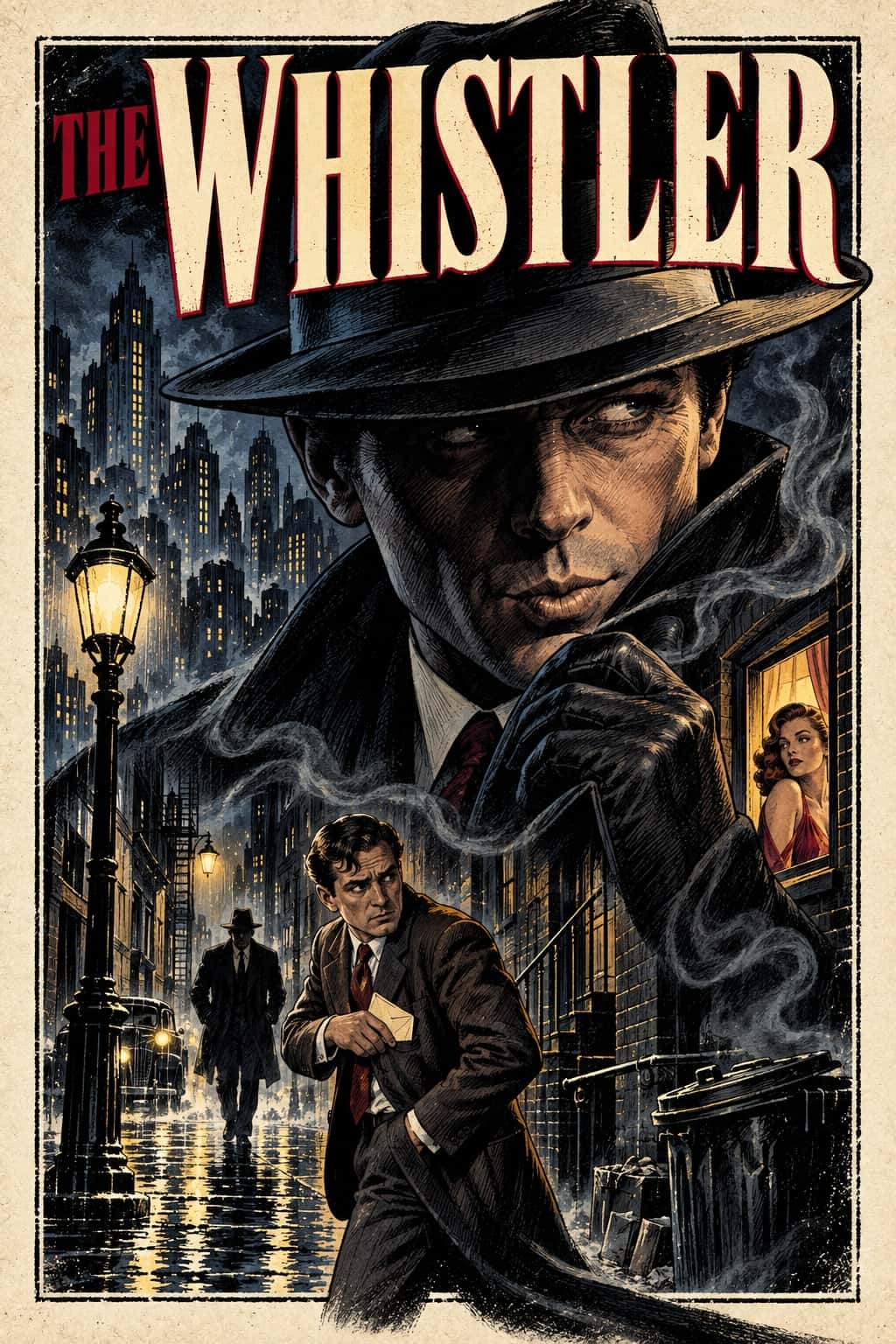
The signal oil program, the whistler. That whistle is your signal for the signal oil program, the whistler. I am the whistler, and I know many things, for I walk by night. I know many strange tales, hidden in the hearts of men and women who have stepped into the shadows. Yes, I know the nameless terrors of which they dare not speak.
Yes, friends, it's time for the Signal Oil Program, the Whistler. Rated by Independent Research, the most popular West Coast program. In gasoline, you know, it takes extra quality to go farther. And Signal is the famous go-farther gasoline. So look for the Signal circle sign in yellow and black that identifies Signal service stations from Canada to Mexico. And now the Whistler's strange story, Seven Steps. to murder. The Atkins-Clayton affair was unusual for two reasons. In the first place, of course, it involved a pair of famous newspaper men, Archer Atkins, the dean of New York drama critics, and Everett Clayton, a syndicated columnist. But more than that, it was interesting in its structure. Yes, there were seven distinct steps between an apparently cordial relationship between two newspaper men and a murder.
The opening night of Clayton's first play, The Whirlwind, was step number one. Atkins had attended, of course, with the rest of the critics, and shortly after the final curtain had walked out to a waiting taxi with Murchison, his editor. Wasn't Diana Brooks fine enough? Going back to the office, Murchison? Yeah, I guess I'd better. Got a couple of things to finish up. Yes, sir. Globe building driver. Right. Well, Atkins, I must say, your friend Clayton gave me quite a surprise. You never told me he was a dramatist. Oh, full of hidden talents, the boy. When he was a kid, he could stand on his head and wiggle his ears at the same time. You've known him for a long time, haven't you? I grew up with him. Seems to me I heard somebody say you were once engaged to his sister. Absolutely correct. I was quite fond of her at one time. Where is she now? In Texas, devoting her talents to some respectable school teacher or something. Then you and Clayton... Yes, Murchison, we came east to school together.
Then college. Came to New York together after that. Anything else? Chief? Yes. One other thing. Why are you annoyed? Annoyed? More than that. I know the signs. You're furious. Come now, Murchison. You didn't go backstage. I have a deadline to meet. You know that? You've been late before. Not tonight. It's Clayton's first play, you know. It's only right that I give him a real send-off. He deserves it. He certainly does. Let's see now. Everett Clayton's new play, The Whirlwind, opened last night at the Brighton Theatre with Diana Brooks and Paul Strand. Oh, Murchison. I've been banging away there for an hour. There it is. Take a look. Thanks. Let's see. Everett Clayton's new play, The Whirlwind, opened at the... Huh? Wait a minute. Obviously, a sophomoric attempt at a drama in the manner of O'Neill.
The whirlwind is not only afflicted with a deadly brand of dullness, but is utterly lacking in originality, imagination, or even ordinary playability. The death rattle was audible before the first act was five minutes old. Listen, Atkins, you can't get away... Why can't I? It was a bad play, and I owe it to my re... Yes, it was a bad play. You? Is it up to you? Right. It's up to me. That's what I'm paid for. You know what you're doing, don't you? This review will kill Clayton's play before it even gets a start. You have no right to take that kind of responsibility. Then why don't you fire me? You know, Atkins, one of these days you'll stick your neck out too far and I'll chop it off. But at the moment, I'm money in the bank, huh? Well, suppose you trot back to your glass-walled sanctum and let me get this to the copy boy. Our deadline, you know. And that was step number two, Archer. Your review of Everett Clayton's play.
You wait now in the coffee shop of the Stratford Club where both of you live. It's 20 minutes since the morning papers hit the streets, and you know exactly what will happen. Then, just as you expected, Clayton walks into the coffee shop, over to your booth, his face tense and expressionless, the paper folded in his pocket. Well, Everett, good to see you. Sit down. Thank you. Waiter. Yes, sir? Coffee, please. No coffee for me. Milk. Yes, sir. Your stomach again. It's getting worse, I'm afraid. That's not why I came. Is it, Archer? I suppose not. That review, Archer. Nice of you. You're not a playwright, Ebert. You, uh, at least saw the play, I presume. Oh, of course. Hmm. A sophomoric attempt at a drama in the manner of O'Neill. An author spends a year writing a play, and that's the consideration he gets. Any of your money in it? Everything I've got.
Too bad. Why didn't you consult me before? Let me read it. Because I thought and still think it's a good play. I didn't take it to you, Archer, because I knew what I'd get. Sarcasm, smart cracks, not one bit of constructive criticism. There's a small item you've forgotten. And what's that? Talent. No one has yet succeeded in drawing milk from an elephant. Nor kindness from a critic. If you wanted charity, you should have said so. Honesty is not charity. Do you want me to go over it scene by scene and show you how bad it is? No, because you couldn't. That's the trouble, you know. The people don't decide what's good or bad anymore. They wait for the critics to tell them. You're a fake, Atkins. You've been a phony all your life. Why, if the Rover boys in Switzerland had Edgar Allan Poe's name on it, you'd call it great. That easy old boy you're getting carried away. You picked on the wrong guy, Archer. I've got 20 million readers, too. Before this thing is over, I'm going to make you look like the village idiot. Just do me a favor, Atkins. Check my column tomorrow. It'll interest you.
With the prologue of Seven Steps to Murder, the Signal Oil Company brings you another strange tale by the Whistler. But now, let's suppose this were a quiz program. You ready? I have a man in a signal station, Dr. Miller. A great place to be. And now for the first question. In gasoline, what does it take to go farther? Oh, that's easy. In gasoline, it takes extra quality to go farther. Right you are. In gasoline, it does take extra quality to go farther. And now for your second question. What is the famous go farther gasoline? Why, signal is the famous go farther gasoline. Right again. Signal is the famous go farther gasoline. And you win the signal prize. Extra mileage plus extra driving pleasure. And now may we close our little quiz program with this tip for drivers. To get more mileage, a gasoline must naturally get more efficiency from your motor. And motor efficiency means quicker starts, faster pickup, and smoother knock-free power.
That's why Signal says your speedometer is the best yardstick of gasoline quality. Just you switch to Signal for a few tankfuls, you'll find it's true. In gasoline, it does take extra quality to go farther. And Signal is the famous go-farther gasoline. And now back to the whistler. Yes, Archer. Although you didn't know it at the time, the case that was soon to become famous as the Atkins-Clayton affair fell neatly into seven parts. Seven Steps to Murder. Clayton's play, of course, was the first step, and the scathing review that appeared in the Globe the next day over your signature was the second. You chuckle over Clayton's stupid threat to discredit you as you go up to your suite just across the hall from Clayton's in the Stratford Club. But when you arrive at your office at the Globe the next day, Murchison, the editor, is sitting on your desk waiting for you, the afternoon edition of The Ledger in his hand.
Oh, hello, Murchison. Did you read Clayton's column? I don't read the ledger. Read paragraph. Listen. I am now reconciled to the fact that my play, The Whirlwind, will close in a matter of days as a result of the efforts of a group of critics headed by Archer Atkins. As a matter of fact, Atkins is not equipped to set himself up as a critic or even a writer. He has no conception of values in literature, dramatic, poetic, or otherwise. And I intend to prove it. The music. The ranting of a wounded beast. You wouldn't be whistling in the dark, would you, Atkins? I'm sorry, my good man. I'm going to be quite busy. Aren't there a few juicy obituaries that require your keen intelligence? I hope Clayton gives you a sock on the jaw. Number three, Archer. Clayton's reply the next day. A public challenge that went out to 20 million readers.
You decide it's ridiculous, of course, and during the weeks that follow, you forget about it. The play lasts five days and closes. You and Everett Clayton only nod coolly now as you meet from time to time in the lobby and corridors of the Stratford Club. Then one evening some weeks later, Barbara Ross, the fashion editor on the ledger, walks up to you in the lobby and taps you on the shoulder. Archer, darling. Good evening, my dear. Archer, I found something I thought you'd want to glance at. Oh, did Clayton put me in print again? Oh, nothing like that. Somebody handed me this book of poetry. It was printed privately. Only 50 copies. Oh, now, wait a minute, Barbara. I've read a million of those things, and really I don't... Please, Archer. Look, I've got six hours of reading a day as it is. You've got to, Archer. Poor me. It'll only take a few minutes. You can look at it tonight after you get home. All right, Barbara. Let's see it.
14 by Jafar Ahmed. Never heard of him. What's it about? I think it's lovely. Written by an immigrant boy about his love for a little girl. Oh, no, thank you. But, Archer... Poetry, darling, is as much a part of adolescence as the first shave. And just about as important. Archer, you know so much more about poetry than anyone else I know. All right, dear, all right. I'll look it over. Step number four, the book of poetry. Nothing to it, of course, is there, Archer? But you take it home, toss it on the nightstand, and just before you decide to turn out the light, you pick it up and glance at the first page. It holds you from the start. There's something about the poems that haunts you, almost as if you'd read them before. Memories, things you'd forgotten completely spring to life. Yes, this boy has managed to capture something out of every man's youth, something that gets under your skin and stays there. You finish the book.
Get out of bed hurriedly and sit down at your typewriter. You can't wait until tomorrow, can you, Archer? You've got to get it on paper now. Although the poems are immature, there's something great and universal about this work. The volume has been printed privately, but in my opinion it would be a wise investment for any publisher to issue it in quantity. Fourteen by Jafar Ahmed should never be forgotten. Well, that ought to do it. It'll be on the bestseller list in a month.
In the morning, you hand your article to a copy boy, unaware, of course, that you've just completed step number five. And that's the vicious part of it, Archer. Although you don't know it, the minute you turned in that review, you moved nearer to murder than you've ever been in your life. It's just 24 hours later when the same copy boy walks into your office, places a newspaper on your desk. Step number six. Here's your copy of the ledger, Mr. Atkins. Please, boy, you know better. I never read the ledger. Everybody on the staff's reading it today, sir. Especially Everett Clayton's column. Run along, will you? Yes, sir. Just thought I'd mention it. Around town with Everett Clayton. Now, here we are. Three months ago, I promised to reveal Archer Atkins, the so-called dean of literary critics, as a foley. Today, I call attention to the raves he has been giving the book of poems called Fourteen.
supposedly written by a 14-year-old Iranian lad. The fact is, gentle reader, I wrote 14. What is... Shocking, eh, Archer? Oh, hello, Murchison. I didn't see you. It's all right, it's all right. You didn't hide that. Some of our best people read Everett Clayton, including the publishers of this paper. Trash. Just trash. And lies, too, I suppose. Clayton never wrote 14. He hasn't got enough sense. He seems to know a lot about it, Archer. Read on. He tells just how he did it. He had no knowledge of poetry, he says. Just threw together the luscious adjectives he could concoct, made a senseless hodgepodge, and had the whole mess printed up on the quiet. And you, the great Archer Atkins, gave it a bouquet. Praised it to the sky. Are you trying to tell me you believe this nonsense, Murchison? Why, the man's... The man's got readers, Archer. Twenty million of them. So calm down. Don't tell me to calm down. As a matter of fact, why don't you get out of here? That typewriter, I'll teach Clayton his place. You're through teaching anyone his place.
I mentioned our publishers. Well, uh, they called, Archie. What? Your resignation's to be handed in by the end of the month. Until then, I'm to edit all your stuff. You've been waiting for this moment for a long time, haven't you, Murchison? Frankly, yes. The poor drudge. The mediocre, untalented editor. Finally has his day. That's right, Archie. I'm gonna shine now. While you curl up at home and read 14 by Everett Clayton. Clayton did not write that book. The more I read it, the more I know I've read it someplace before. If it takes me years, I'm going to find the real author of those verses. Sensitive, aren't you? Oh, go hang. Clayton's a bold-faced liar, and I'll call him onto his face. Not on the globe, you won't. And why not? I told you. I'm editing your material. Can't you get used to the idea? I don't intend to have any libel suits in my hands. Not even to save the great name of Archer Atkins.
Good day. For once, I've had the last word. Well, Archer, a turn you never expected. Never in the world. It has you seething, hasn't it? And it's even worse when you reach the Stratford Club and learn that you've suddenly been turned into a laughingstock. That your formerly respectful colleagues are now given to chuckling and whisperings behind your back. A few like Hanley Carr are more open about it. Oh, Archer, old boy, how could you? What was it now? I still feel the music, the poignant expression of an adolescent love. Sweetly agonizing emotions, part of every man's youth. If ever Clayton wrote 14, the earth is flat. The moon is made of green cheese. And you, my dear Henley, are as wise as Aristotle. Then who did write the poems, Archer? I'll stake my reputation that Clayton stole every verse in that book.
I know I've read those poems before. This thing has got you, hasn't it, Archer? And it hurts deep, twisting inside you, until finally the seventh step begins to take shape. The seventh and final step. Murder. It's a frightening thought, isn't it, Archer? Frightening, but very clear. It's all there in your mind as you ride up to your luxurious suite in the elevator. Everett Clayton is a man of habits. one of them forced upon him by his health. You know all about that, Archer, how each evening at seven a waiter brings a large glass of milk to his apartment. You smile as you let yourself into your room. Tonight that same waiter must bring you something as well. Hello, coffee shop. This is Mr. Atkins. I wonder if you would send me up something. Oh, I don't know, something light. A chicken sandwich, perhaps. No, no, no hurry. What's that?
You have a waiter coming to Mr. Clayton's rooms at seven? That's time enough. Oh, surely. Don't make a special trip. Thank you. A short time later, you leave the door to your suite ajar and sit just inside, pretending to read while you watch for that waiter. He comes down the hall and starts for Clayton's room. Oh, waiter. Yes, sir? You have a sandwich and coffee for me? Why, yes, sir. I was going to stop first. Set it right down there on the desk, would you? And then I wonder if you could do something for me. I tried to unlock a suitcase a moment ago, but I couldn't seem to turn the key. Would you have a look at it? Why, certainly, sir. Where is it? In the bedroom. Of course, if it's too much trouble. Oh, not at all, sir. I've handled a lot of them. You hesitate as the waiter starts across to the bedroom. And then you turn quickly to the tray set down on your desk. Before he comes back, you empty the contents of a small envelope into the milk intended for Clayton. You stir it hastily with a spoon.
and then returned to your book. I got it open for you, sir. The lock sprung a little, though. Oh? I'd have it attended to. Here you go. Thanks for your trouble. Not at all, sir. Thank you very much. Thank you. You settle back in your chair now, giving the waiter time to deliver the glass of milk to Clayton. A few minutes later, you slip out into the corridor and down the hall. Stop outside of Clayton's door and listen. He's talking to someone on the telephone.
Well, what did you expect me to do? All right, all right, I promise. I'll see them about it first thing tomorrow. Yes, yes, I promise. Goodbye. You wait tensely after Clayton hangs up, hoping no one will come along the hall and find you standing there. This business of murder isn't easy on the nerves, is it, Archer? The moment's dragged by. What's he doing? Isn't he ever going to pick up that glass? You're trembling now, wondering if it's ever going to happen. And then... A moment later, you whip the door open, step inside, and lock it. A glance at Clayton's body sprawled on the floor assures you that he's dead. Quickly, you cross the room and sit down at his battered portable typewriter. To my dear mother, my sister, and gentle readers, it isn't often that a man gets the opportunity...
To write his own obituary. Believe me, this isn't easy. But I have been ill for some ten years now. You type rapidly, Archer. Because you know exactly what you want Clayton's suicide note to say. It includes, above all else, a confession. One in which the dead Everett Clayton will admit to the world that his plan against you was just that, a plan. His note tells how he lied in claiming to have written the verses in the book 14. How actually, he simply dug up a number of anonymous ballads and revised them a bit. You put it all down, Archer, your way. But in Everett Clayton's style. And then you add his well-known signature, just the two simple typewritten letters. E-C. Thanks, my dear Everett. We'll see tomorrow.
how your 20 million readers like this one... The Whistler will return in just a moment with the strange ending of tonight's story. You regular Whistler fans have all heard me speak of the more thorough, more conscientious service cars get at dealer-owned signal service stations. But the really important thing is what customers say about it. That's why we're so happy to receive letters such as this one I have with me tonight. It's from Arthur Anderson of Los Angeles, who writes... After listening to the whistler, I decided to try signal go farther gasoline and test its mileage for myself. But after stopping at two signal stations, I was so pleased with the courteous service, I completely forgot to check the mileage as you suggested. However, thanks to signal dealers and the whistler, you may be assured I'll be a steady signal customer from now on. Well, Mr. Anderson, here's hoping that by now you've also had a chance to prove in your own car.
that Signal is the famous go-farther gasoline, and that it takes extra quality to go farther. Right now, however, on behalf of Signal Oil Company, I do want to thank you for your kindness in writing. It's letters like yours, which we're constantly receiving, that make Signal dealers strive to do an ever better job of making today's cars run better and last longer. And now, back to the whistler.
Well, the seven steps are passed now, Archer. Everett Clayton is dead. But more important than that, the suicide note in his typewriter will put you back at the top of the heap. Yes, Murchison, your publishers, and Hanley Carr, the whole literary world will have to admit who has the right to wear the critic's crown. But you're very practical about it, aren't you? The police will come, of course. And you're ready for them with that vague, superior, confident air that has always carried you through before. And why not? What can they possibly prove? You don't seem at all surprised at the police calling on you, Mr. Atkins. My dear Captain Foss, the moment the manager of this club informed me of Clayton's unfortunate demise, I resigned myself to a round of dull questions. Naturally.
You've known him all his life, grew up with him, sweet on his sister at one time. Anything else you want to know? I was an incubator baby, weighed three pounds, two and a third ounces. I'm surprised you aren't more interested in the way Clayton died. I like to believe people, Captain. When I'm told someone is dead, I assume he's dead. Whether he was shot through the head with a cannon, threw himself into Mount Vesuvius, or was clubbed to death with the missing arm of Venus de Milo doesn't concern me in the least. Uh-huh. Uh... Poison is more to your liking, isn't it? I don't know what you're trying to imply. Well, let's make it clear, then. How long did it take you to write that note? Note, Captain? The suicide note in Clayton's typewriter. Do tell. In verse, no doubt. It says Clayton never wrote those poems, that he stole them from some anonymous ballad. Well, I insisted on that all the time.
Wait till I get hold of that editor of mine. You wrote that note, Atkins. You poisoned Clayton and then ran the note off on his typewriter. Nonsense. Who gave you that story? Some idiot from the legend? Don't try to bluff. It's too late for that. What do you mean? You're going up for murder. Don't be stupid. You have nothing to go on. Three people are going to send you up, Atkins. One of them's the waiter who brought Clayton's tray into your rooms last night. The one you had unlock your suitcase while you poisoned Clayton's milk. Another one is the druggist who sold you the poison. Didn't know he recognized you, did you?
I don't know anything about it. And the third is a lady down in Texas. Lady? Texas? Yeah, take a look at these papers. You ever seen them before? They're yellow. Very old. They're poems you wrote to Everett Clayton's sister when you were 14 years old, over 40 years ago. What? The book of poetry you reviewed was not written by Jafar Ahmed or Everett Clayton, but by Archer Atkins. You've been so busy reading other people's writing for 40 years, you can't even recognize your own stuff. I was reviewing my own book. That's right. And another thing. Clayton got a phone call last night, just before he was killed. It's too bad you couldn't have heard it. Phone call? But I did hear it. He was talking to your old sweetheart, Atkins, his sister down in Texas. When she read how Clayton had crucified you with that book of poetry, she blew up. Called to make him promise a public retraction in tomorrow's paper, admitting the whole thing. He promised her that, uh...
He'd see you about it in the morning. Let that whistle be your signal for the Signal Oil program, The Whistler, each Monday at 9. Brought to you by the Signal Oil Company, marketers of Signal gasoline and motor oil and fine quality automotive accessories. Signal has asked me to remind you to get the most driving pleasure, drive at sensible speeds, be courteous, and obey traffic regulations. It may save a life. possibly your own. Featured in tonight's story were John Brown, William Johnstone, and Howard Duff. The Whistler was produced by George W. Allen with story by Meyer Dolinsky, music by Wilbur Hatch, and was transmitted to our troops overseas by the Armed Forces Radio Service. This is Marvin Miller speaking for the Signal Oil Company. This is CBS, the Columbia Broadcasting System.