
The written record
Read the transcript
Read along with the recording · About 17 min to read
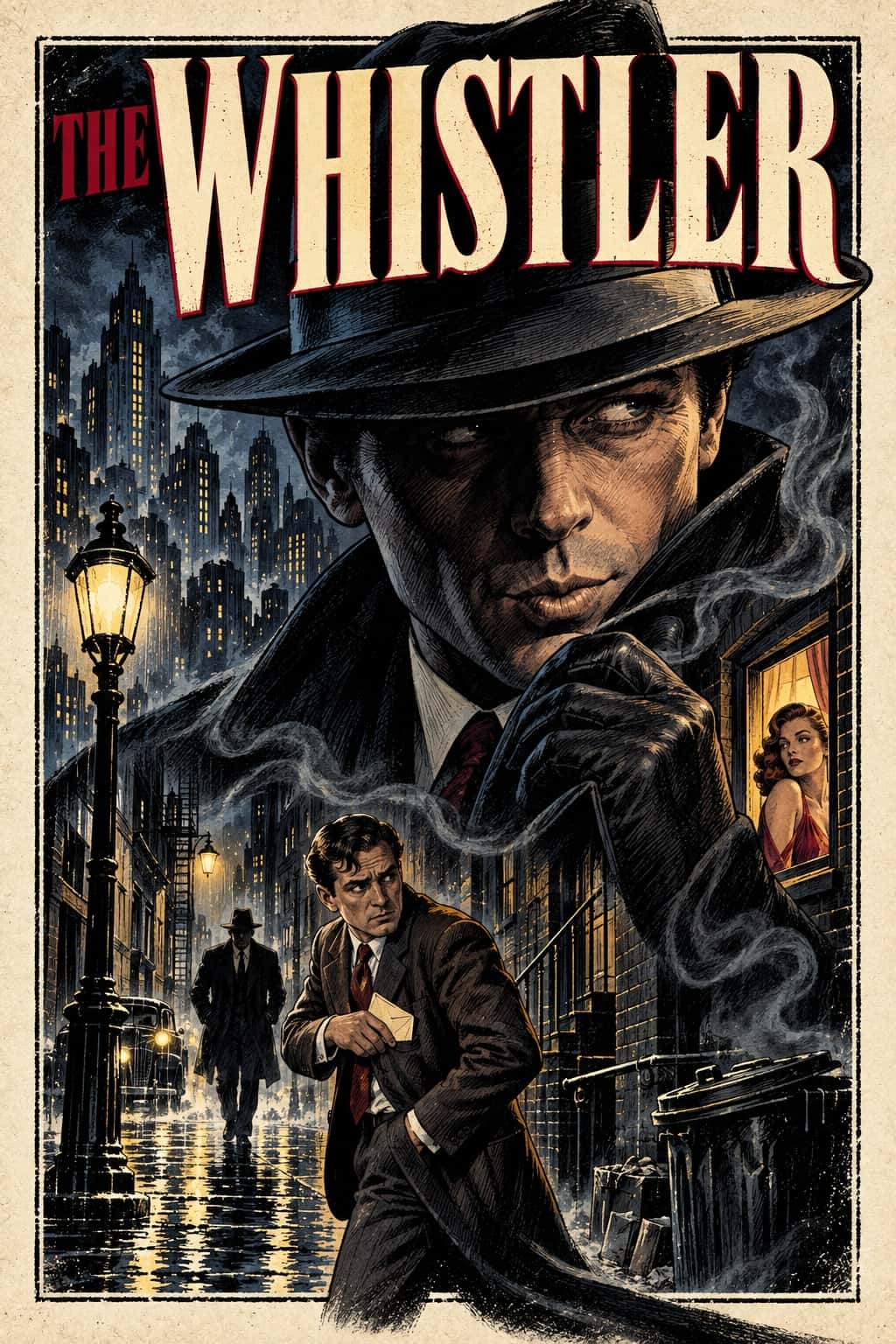
...in the hearts of men and women who have stepped into the shadows. Yes, I know the nameless terrors of which they dare not speak. What? It's the Whistler's strange story, Bright Boy. How inwardly he was raging at her. Outside, Steve Carson was cool as a piece of ice. Ten years as a private detective had given him that. The nonchalance outside, in spite of the burn-ups underneath. Steve was a top-notch detective. A bright boy. Smart enough to see, when Verner came along five years ago, that investigation fees were chicken fees. But with her duty and his ability, there was real money on the other side of the line, in blackmail. It had turned out to be a great thing, an unbeatable combination. And as he left the automatic elevator at the end of the corridor and walked down to her apartment, he thought what a shame it was that Verner could be so naive as to think she could change it.
With a simple phone call. Come on, Stevie. We've been expecting you. I could tell by your attitude on the telephone that you were unhappy, dear. You know Randy Summers, of course. Hello, Mr. Carlson. Nice of you to drop in. Wait, I want to talk to you. Alone. Alone, aren't you? Randy, darling, fix him a thing. Of course. Looks like you could use one. Get that guy out of here. No. I like having him around. You think I need a whole school for this? I think so. That's a bad guess. If he stays, I go. Are we going through all that again? I'm not playing second horn, baby. If you want a new stooge, that's your business. If I want a clip, that's mine. I'm a private eye, not an errand boy. Get that through your head. Would you mind if I put it down in writing? In writing? My dear fellow, surely you should know by now, in order to put anything in writing that confirms Verna. Stay out of this, Summers. I'm afraid our Mr. Carlson isn't going to be the least bit confident. It's not easy, darling. Here's your drink, old man.
Now, see here, Carson, I can take so much of your bad hair. Now, look. This sort of thing isn't going to get you anywhere. I told you once before how things stand. Randy and I are running the show from now on, and we'll let you know when we need you. Is that clear? Okay, Brennan. This is yours. There might be others. Could be. What about our dear friend Charles W. Ralston? Get over to tell him about the letters. Well, he's f***ed with that, and I need you. I suppose Walsh and the girls he found out had been paying for letters that had burned up three months ago. What? What if it is? What happened? A little fire, son. An accident at Verna's cabin. Yeah, she kept the letters there. Oh, the place up at Lake Tahoe. Wasn't that the one Walsh and Bill for you as a contribution to the cause? Yes. It was nice of him, wasn't it, Steve? Oh, you'll love it, Randy. Way off in the mountains overlooking Lake Tahoe. Ah.
peaceful. Miles from death. It was lucky you were there at the time so it wasn't a total loss. You know, Steve, I think I'll have that old-fashioned stealing rap removed. It's too dangerous. The same thing could happen again. What about the letters? Well, since you brought it out with some nasty little insinuations that you might possibly tell Mr. Ralston. She think I won't. Let's see. There's a Helen McCoy play. No, her death was dental. Don't be serious. And then there was that... Wendell, I'm most close to memory. Wendell? Few other enterprises you wouldn't want the DA to know about. Uh-huh. A skeleton in a private investigator's closet, huh? Oh, they could put you away for years and years, Stevie. And I know how you feel about short hair curls. No, darling. I don't think you're going to tell Mr. Ralston anything. You're going to go right on doing little favors for me. You do it best for him. So you say. Oh, darling. That's where we go with that. A dream, darling.
I have no idea Mr. Carson was so sentimental. What do you say, Steve? Come on, let's have a drink on it. Oh, me. At this time, old man, shall we try not to spill it? It's also good scotch. Randy. Huh? Please. Listen to me. Oh, now, Steve, there are a few little things I'd like to discuss with you. Randy's flying down to Los Angeles tonight. When he gets back, he'll join me at the cabin. The cabin? I'm going up alone tomorrow afternoon. Why don't you drop by? We'll talk things over. A lot of good. Well, I could let you know in the morning.
that when everything's going to work out. More than enough to know there's only one way to handle Werner now. Leave him in an apartment, drive across town, and finally pull up in front of another apartment building and follow up to the penthouse. I don't think you know me, Mr. Ralston. I'm afraid I don't. Steve Carson, private investigator. I came to see you about a Miss Venus Sheldon. I'm sorry, I don't have a proposition, Mr. Ralston. Please do.
You, uh, you know all about the letters, of course. And you're a pretty influential businessman in this city. Shall we say, not without enemies. But suppose Miss Sheldon's letters would have fallen into the hands of the wrong people. She's assured me they will. You don't know her. Suppose she were to sell those letters to a group of individuals for so much greater than you could afford to pay. She wouldn't. Oh, but she would. And is. Yeah, I've been able to find out that much and a little more. Shall I go on? She's coming to her cabin tomorrow. Over the weekend, someone will contact you there to make the transaction. Now, you'll have to work fast if you want those letters. I see. The proposition. I think I can break up that little meeting before it ever takes place. You could get the letters for me? Yes. But my fees run a little high for this sort of thing. How much, Carson? $25,000. You don't think it's worth it? Considering your position. No, I couldn't, Carson. $25,000? Think it over. And do make up your mind soon, Rolf.
I'll call you sometime tomorrow morning. You're quite certain she's planning to sell those letters? Oh, quite certain. How do I know that this isn't another one of our tricks? And how do I know you're not in league with her? That's just a chance you'll have to take. Good night. The next move is a big one, isn't it, Steve? There's the matter of the defective kerosene lamp in Berner's cabin at Lake Tahoe. The same lamp that caused the fire that burned Mr. Rolston's letter. A thing like that is liable to happen again, isn't it? Especially since you arrive at the cabin five hours later, equipped with five gallons of high-tech gasoline, and proceed to change the possibilities into a certainty. You can see Werner now, arriving at the cabin, pulling the lamp down. There's the flick of a match, an explosion, and a fire to remove any trace of your visit. By eight o'clock the following morning, we're back in town to call on Werner, who promised.
To regret that you can't accompany her. And to make sure her visit to the cabin is coming off on schedule. Well, if it isn't Bright Boy. Yes, right. I'm standing by. The lieutenant just left on an errand. You. Come on, Sergeant. What's the pitch? What are the police doing here? I was just going to ask you what you're doing here. Suppose you tell me first, huh? I was calling Inverna. Business. You over there if you want to. No, where? Under the blanket, he's dead. Slight case of homicide, a blunt instrument to coin a phrase. The Whistler will continue tonight's story. We're proud of our hometowns, and rightly so. In this brief moment before we continue with our program, we'd like to offer a salute to one of our hometowns in America, Indianapolis, Indiana. Capital of the state and a great transportation center, Indianapolis' extensive trade is based on the rich territory that surrounds it, large coal fields.
tremendous deposits of building stone, and one of the richest sections of corn and wheat in the world. But perhaps one of the best-known features of the city to the world at large is the Indianapolis Speedway. It was built in 1909 as a proving ground for automobiles, and each Memorial Day, the famous 500-mile race is held there. From the experience gained in this annual event has come many improvements in automobiles. Every time you use your rear-view mirror, every time you fill your tank with ethyl gasoline, Every time you appreciated the comfort of your improved tires, you were given credit for something that was first used on that speedway. Indianapolis has its famous citizens, too. Benjamin Harrison, the 23rd President of the United States, called it his hometown. So did James Whipson Riley, the great Hoosier poet. And it was the birthplace of General Walter Beaver Smith, chief of staff of the American forces in Europe during World War II. Nearly half a million people are in Indianapolis today.
And they're proud of the part their hometown has played in the building of America. And now, back to The Fiddler. It stopped you cold, didn't it, Steve? The news of Werner's murder. Alibis. Alibis. Alibis. Flashing on and off in your brain like a neon sign. Everything you figured on, planned for, set up like a spring trap. Everything's gone. Werner's dead. Yes. You're the number one suspect. And you're driving on a lonely mountain road on an errand you can't explain at the moment she was killed. That'll sound great in court, won't it? But there's one thing you're sure of. Ralston killed her. There's no question about it. The talk last night, the deadline you tossed up to him. Yes, it was Ralston, all right. It takes you just 15 minutes to get across town for a showdown with... We'll get right to the point, Ralston. I'm here for two reasons.
The first is that I'm as sure you knocked off Verna Shelton as if I'd been there watching you. What? Oh, don't look surprised, Roxton. I had nothing to do with it. Don't give me that. I didn't get any farther than with a jump in the entrance hall, and I could see them going over with a fine tooth comb. Maybe someone looking for those letters, huh? Somebody figured tonight might be too late. Why are you so interested? My good friend, Sergeant O'Hara, seems to think I killed her. Unfortunately, it looks like my only defense is to prove you did. Letters, unless... Unless? Unless I come through with an alibi. I know you're capable, Alston. I've been in the business long enough to know that all I've got to do to hang you is to flash those letters in the DA's office. You have them? I've got to have them, Carson. I'll do anything. Okay. First, there are a few things I'd like to know. When did you see who had burned his apartment last night? I didn't go up to her apartment last night. Okay. I'm going to dig up those letters. Come on, Alston.
Wait, wait a minute. I have to. I would have been married. That's better. You wouldn't have just hopped a cab and gone over there to knock her off, would you? No, no, you're smarter than that. ...else at the time. First I went down to the yacht harbor. I had a boat there. 10.50. No one saw me at first, but a short time after I went aboard the boat, the night watchman came by and called after me for the dock. He had seen the life of the boat. That time, 10.30. He talked to you? Yes. As far as he was concerned, you were on the boat between 10.15 and the wheel. He didn't see me here until I'd come back the second time. After I had... After you and I saw Verna, yes. What time? 11.30. Much better myself, Roxton. I was lucky. I spoke to the Roxton at 11.30 when I was leaving for the night. Anyway, that's the news. Yes.
Several men a few yards ahead of my eye. I think they came from the crop. Okay. And the watchman will recall our others when we spoke to him. I suppose so. It's rather dark, but I think he must have noticed them. Oh, that's good enough for me. I'm sure the police will accept your word. What are you doing here? I'm an alibi. I was with you in that boat all the time. Well, that alibi means a lot to me, Ralston. You might even be willing to forget about the 25,000. The watchman didn't see you were in the boat alone. He didn't see you leave when you left to find his apartment, nor when you came back. When you finally checked with him just before going home, there were others around. That makes it out of time for the both of us. What about the others? You almost tore the junk to pieces and you couldn't find them. I could have told you they weren't there. You're going to go on believing me, aren't you? The same way that she did. Don't trust me. Give me the cash. Good night. Wait until the investigation's over. Let me see. It's like sitting in a...
And you know that 30 seconds after he finishes his story of what happened between you and Verna on the evening of the murder, the D.O. will be on the phone asking for the answer. There's nothing to do now but wait. Friday. And then... Friday morning, you can enter your office. I'm waiting for you. It's on your monitor, huh? It's like I have a little talk with you, that's all. You're my shouting band of good friends, aren't you? You're only good friends. You're sour. Little pigeon flew in from L.A. and slipped that to you, huh? Would you now threaten her because she dropped you for the summer's guy?
He had a slight disagreement, that's all. The first quarrel was a week ago at her apartment. The second was the next day in a downtown bar. And don't say you didn't, because Summers says so, and so does the bartender. The third one was on the night she was killed, just after she called you on the phone and told you it was all off. She wouldn't be interested. Why didn't you tell me you were after her apartment on the night of the murder? You didn't ask me. Summers was there, too, incidentally. He was still there when I left. He caught the 945 plane at the airport. We checked it. Now, you were there at 7.30. Right.
the first time. The first time? You didn't go back around 10.30? What are you talking about, O'Hare? Mr. Sheldon didn't get a phone call at 9.15 just before he was left. Oh, wait a minute. You are wrong. You made an appointment to see her at 10.30. That's a lie. How'd you keep it, Carson? Someone's been giving you a line. Summers was there when the call came in. She told him it was you. Because you were coming back. Summers wanted to stick around until she got rough, but she told him she could handle you. So he took his claim. The guy's lying, Larry. I believe him, Carson. That's how I tend to have this warrant. In the great debate of 1787 and 88 as to whether the Constitution should be voted for or against, the framers of our Constitution had a hard fight on their hands. But they had many allies, and one of them was James Sullivan, who wrote the following words to the Massachusetts Gazette in November of 1787.
Let us view the characters who composed the late Constitutional Convention. Are they not men who, from their infancy, have been nurtured in the principles of liberty and taught to pay a sacred regard to the rights of human nature? Are they not honest, upright, and just men who fear God and hate evil? Brethren and citizens, listen to the voice of men who have thought only of you and your prosperity's good. The Constitution was voted for, of course, because it was understood that the men who framed it did so not only for themselves, but for the future. We today are that future. And now back to The Whistler. Well, Steve, it's quite a poker hand, isn't it? O'Hara and Summers have played their cards. But you still have the copper up your sleeve. However, the phone call they must supposedly receive from you is puzzling, isn't it?
You try to figure it out as you sit in the ante room, waiting to see District Attorney Skelly. Summers must have been telling the truth. For some reason or other, Verner didn't want him to know who called and told him it was you. It was Ralston, of course, pleading for his letters again. And when she turned him down, he decided to kill her. Ralston, you knew you'd need that top car, didn't you, Steve? But you had no idea you'd need it this badly. Well, Carson... Hello, D.A. Doesn't look so good, does it? Huh. All figured out, huh? Just about. Well, good. Now, if you'll stop figuring long enough to ask me where I was at the time of the murder, maybe we'll all have a great big laugh. Okay. What was yours? I was on a boat at Yacht Harbor talking over some confidential business with a client of mine. Yeah? Who? He's a pretty important guy, Skelly. Big shot in the savings and loan business. Hmm.
I suppose his name's confidential, too. No, not at all. Charles W. Ralston. Is that good enough? Ralston? If you don't believe me, get on the phone. Call him. You're, uh, serious about this? Sure. Go ahead, call him up. You better brace yourself. Ralston was killed in a cabin at Lake Tahoe last night. Seems a coal lamp exploded or something. I thought the rangers saw the flames. Something wrong, Carson? A question. You know when the naval rank of Commodore was first recognized as such? During the Revolutionary War, the Navy used the rank of Commodore simply as an honorary title. Until 1861, all Navy captains who had at any time commanded a squadron were considered Commodore, though they were never actually given that commission. In 1862, however, Commodore was established as a fixed rank, and in July of that year, 18 were commissioned on the active list and 17 on the retired list.
This is but one of many interesting facts which can be found in the history of your United States Navy. Featured in tonight's Grand Shod story were Bill Foreman as the Whistler, Jack Moyles, Betty Lou Durston, Jack Edward, Victor Rodman, Vic Perrin, and Olin Soule. The Whistler, directed by Gordon T. Hughes, with music by Wilbur Hatch, is produced by Joel Malone and transmitted overseas by the Armed Forces Radio Service. This evening's story was by Adrian John Doe. The Whistler was entirely fictional, and all characters portrayed on The Whistler are also fictional. Any similarities of names or resemblances to persons living or dead is purely coincidental. This is George Walsh speaking, reminding you to listen again next week for another strange tale by The Whistler. This is the United States Armed Forces Radio and Television Service.