
The written record
Read the transcript
Read along with the recording · About 17 min to read
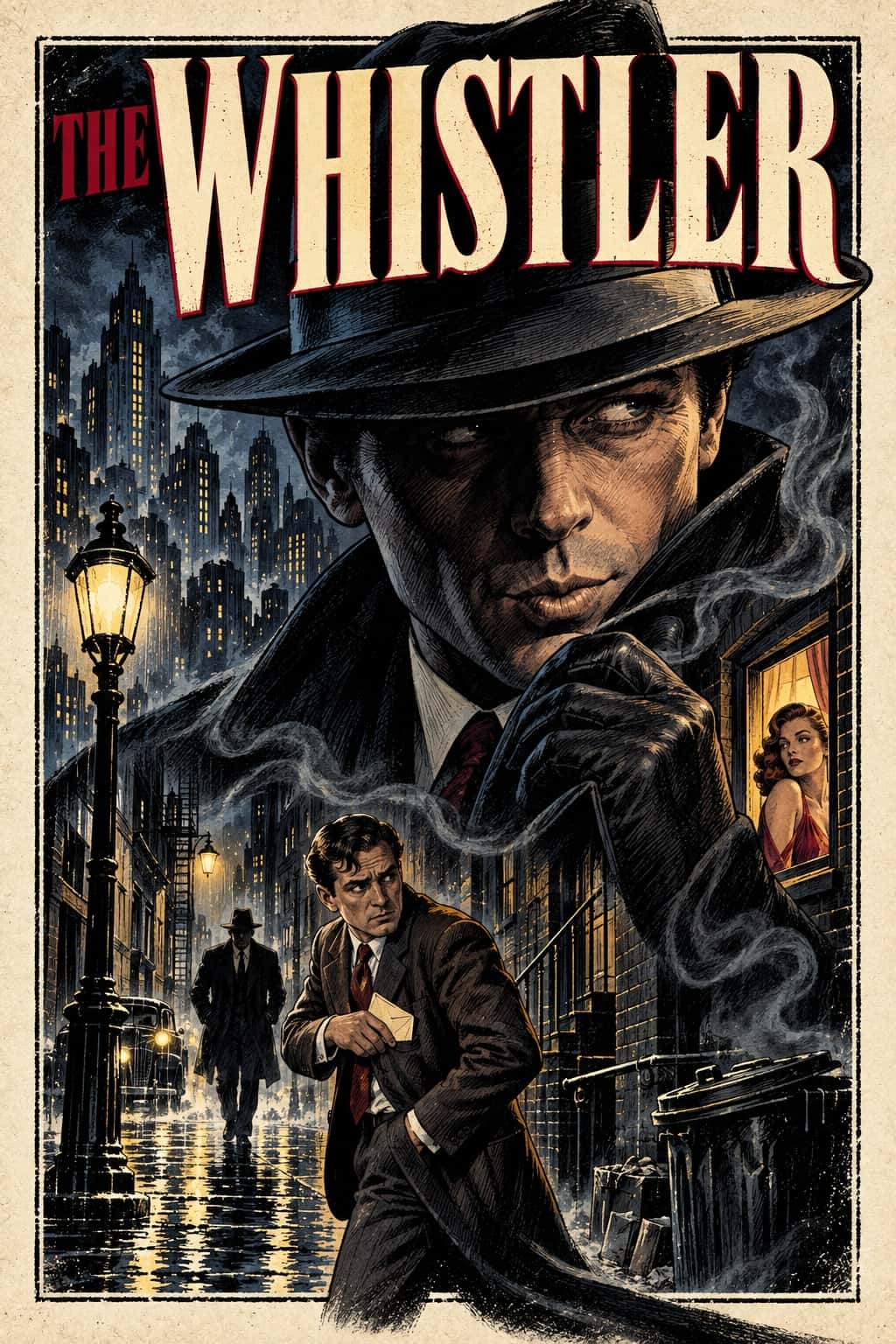
I'm the Whistler, and I know many things before I walk by night. I know many strange tales hidden in the hearts of men and women who have stepped into the shadows. Yes, I know the nameless terrors of which they dare not speak. Tonight transcribed, it's the Whistler's strange story, The Lovely Look. It began quietly. Matter of fact, Charles Belden would have found it difficult to trace it back to the exact moment when he began to feel as he did toward the girl. Certainly it wasn't love at first sight. Somehow he could still tell himself that he was beyond that sort of thing. That as a respectable married man and the competent manager of the London importing firm, founded by his wife's father, he'd accomplished a certain reputation. But he did remember the first time they met, some of the words they spoke, the way she looked at him. It was a Sunday morning, and out near the front gate the fog parted momentarily, drew back like a soft gray curtain.
And there she was. She came walking up the road, hesitated as you discovered one another, silently. And then... Oh, hello. I'm sorry, but I've been walking forever, it seems. I wonder if you could direct me. I'm trying to find the Belden residence. Well, I'm Charles Belden. Oh, Mr. Belden. Of course you don't know me, but I came in response to the ad regarding a housekeeper. Oh. Or you didn't write Mrs. Belden? Talk to her on the telephone? No. No, I thought it was best to meet her. Talk to her in person. Yes, yes. Well, how long? I believe she's back from her morning stroll. A daily ritual with her, you know. Oh, here. I'll take your suitcase. Oh, you're very kind, Mr. Delvin. Not at all. It's strange, isn't it, Charles? The effect of that brief moment of silence when you first caught sight of her.
And a few minutes later, you find yourself oddly interested in the outcome of Helen's questioning. The interview with... Laurie, ma'am. Laurie Edsley. I read of your need in the courier. I know I should have thought of references, but if you have no one else in mind... We haven't. No. However, I'd appreciate a few days' trial, Mrs. Belden. Very well. We'll try it for a week. Oh, thank you, ma'am. And you, Mr. Belden. The way she looked at you. That's it, isn't it, Charles? Glory's gentle, lovely look. It lingers in your mind, fading in and out of focus as you think about it. Consider its meaning. Somehow it's more than a grateful glance, Charles. You're certain of it. And it remains with you all through the days that follow, through the dull hours at the office. And then one night as you arrive home. Charles, in here. Hmm? Why? What is it, Helen? Close the door. Charles, that young woman. We've got to get rid of her. Glory?
Isn't she satisfactory? As a housekeeper, she's excellent. Well, then I don't understand. It happened early this afternoon. Oh, Charles, it upset me so. Mrs. Wilkins drove up from the village. Oh, that busybody. We're going to discuss the elections at the club. You know I'm running for the presidency and I'm counting on her support. All right, all right, all right. But what happened? Well, Laurie didn't answer the door. I finally had to do it myself. Is that all? Helen, the girl simply hasn't caught on to the routine of things. It isn't that. I'm trying to tell you. I spoke to her and Mrs. Wilton had gone. Charles, she asked if she did everything else to our satisfaction, would we mind if she didn't answer the door or take telephone calls? What? Naturally, I demanded an explanation. Well, did she give one? It isn't satisfactory. Not to me, Charles. What did she tell you? Oh, a wild tale. Something about coming out here to get away from someone. Oh?
A man. He's in love with her. She professes to be terrified of him. Says that he's threatened to kill her. Oh, you don't believe her? Believe her? Of course not. Leave me way out here alone with her. Charles, I'll never understand you. You're careless of me, thoughtless, disinterested in everything. Even my father's company. No, you're going to talk to that girl. Charles, dismiss her. Oh, I'm sorry. It's all right, Molly. Come in. I'm going to bed, Charles. Good night. Good night, Mrs. Belden. Laurie. Yes, Mr. Belden? Laurie, we've just been talking and... Yes? And she... Mrs. Belden told me how... how well you did your work today. It's all right, Laurie. I'll get that. You don't have to answer the phones at the front door, ever. And you're going to be all right. Right here. Oh, thank you, Mr. Belden. Thank you very much. In just a minute.
The Whistler will continue tonight's story. All of us are proud of our hometowns, and rightly so. In this brief moment, before we continue with our program, we'd like to offer a salute to one of our hometowns in America, New York City. Hometown to more people than any other in the world. Its history is pretty well known. How it was supposedly bought for $24 worth of trinkets from the Indians. How it started under the Dutch, went to the British, and passed to the young United States after the Revolutionary War. It was our national capital for five years. and George Washington was inaugurated there. Today, it's not only the biggest, but probably the busiest and noisiest place in the world. Much of its growth and prosperity is due to New York Harbor. The port clears more than 5,000 vessels a year and ships almost half of the entire trade of the United States. But New York City is many things to many people. It's not just San Francisco multiplied by 10 or Chicago multiplied by 3. It's Wall Street and Harlem, the Statue of Liberty in Greenwich Village.
It's Broadway, otherwise known as the Main Stem or the Great White Way. More theaters are crowded in that area than any place in the world. It's the Empire State Building, the world's tallest structure. It's a parade up Fifth Avenue and a baseball game between the New York Yankees and the Brooklyn Dodgers. It's the Metropolitan Opera and Madison Square Garden. It's Rockefeller Center occupying 12 acres and 15 buildings. And it's the headquarters of the United Nations. It's the native New Yorker who never moves off his block. and the immigrant who came from halfway around the world. It's the George Washington Bridge and the Holland Tunnel and Grant's Tomb. And when you've said all this, you've still only scraped the surface of what New York is like, what it's all about. But one thing is for sure. The people of New York are proud of their hometown and proud of the part it has played in the building of America. And now, back to The Whistler. You couldn't dismiss her, could you, Charles? Temporarily, you win Helen over to your way of thinking and Laurie stays.
But week after week, the contest between you and Helen is renewed and her patience reaching the breaking point. But it doesn't seem to matter, does it? Because you know that Laurie understands. And all the time, the strange, unspoken bond between you is increased. As she attends to your every wish, hangs on every word you say. You wonder how long it will go on, where it will lead. Then the answer finally comes in a phone call to your office. Mrs. Eldon calling, sir. Yes, Helen. Charles, I want you to drop around to the employment agency sometime today and see about another housekeeper. Another... Helen, what do you mean? What's the matter with you? I can't stand it any longer. I won't have Laurie around another minute. I've... I've discharged her. What? I'm just not satisfied with this arrangement at all. What? Really, Charles, I don't care to discuss it any further, nor have I the time. I'm due at the club in half an hour. The elections are now... Helen, will you listen to me now? It's no use, Charles. I've made up my mind. I've told Laurie she can stay just one more week, and that's all.
For a moment, you sit there, stunned. Then slowly replace the receiver. And as you sit back, trying to think it out, you realize Laurie is everything to you, Charles. And just as she has tried to tell you, with every action, every look, you suddenly feel the urge to tell her. An hour later, you're racing across the English countryside. The rain driving against you as the car swerved perilously along the narrow, crisp road. Finally, you cling into the driveway. Hurry up the steps. Then into the house. Laurie! Laurie! Then you hear it. The movement in the kitchen. Hurry down the hall. Catch sight. Laurie, a thunder drowns your voice. She doesn't hear. Move across the kitchen. Touch her arm, gentlemen. Oh, Laurie, I'm sorry. I didn't mean to scourge you. No, it's quite all right. It was silly of me to... Well, I always think it...
It might be him. I know. What? Whatever you're doing right now, Mr. Bellin. Laurie, listen to me. You can't go away. You mustn't. But, Mr. Bellin... Oh, no, no. She's quick-tempered. She says a lot of things she doesn't really mean. Besides, I can't let you go. Well, I suppose I could stay until you've got someone else. No, that isn't what I mean, Laurie. It's that I... I know I'm handling this rather badly. I don't... quite know how to do. You see, I have never really been in love before. In love? Free, Mr. Delvin. You mustn't hope that way. I had to let you know how I felt. And once I'm free, well, I don't expect an answer right away, Laurie. But I hope you'll want to think about it. A little. I think, I think I'd better go now, Mr. Delvin. You watch Laurie as she hurries out.
Somehow you feel confident that she'll want you to find a way to be free, a way to rid yourself of Helen. But that isn't going to be easy, and a divorce would leave you penniless. The importing business, the house, everything belongs to Helen. Later in the library, you're so engrossed with your thoughts, you don't hear the car in the driveway and the sound of the front door. And then... Helen! What? Oh, Helen, Helen, I... I know. You didn't expect me since noon. Well, I thought this was going to be an all-day meeting. It was going to be, yes. I... By the way, Charles, what are you doing home at this time of day? Oh, well, I... Oh, really, Charles. I could have saved you this early trip back from town. I should have told you Laurie always goes to the village on her day off. Didn't you know? What do you mean? I know why you came here, darling. You thought I'd be gone all day.
You came back to see Laurie, didn't you? Laurie? Oh, that's ridiculous. Is it? Helen, you... You just can't be serious. Oh, stop it, Charles. You take me for a complete fool. I've noticed the way you've walked, with a sick, stupid look on your face, mooning about like a schoolboy. Really. Helen, you're imagining things. Indeed. I tell you, Helen... Oh, you're so musical. Do you think for one moment she'd be interested in you? Helen, that's enough. You're so terribly dull, Doc. So unromantic. Helen! I feel sorry for you. If you get over it, Laurie's gone. You'll go back to your rose garden, pipe collection. And you'll still have me, won't you, darling? Charles, where are you going? Charles! You wonder why you didn't kill her. Yes, with Helen dead, you'd be free to marry Laurie, wouldn't you?
Suddenly the answer to your problem becomes quite clear. You stop your car in the village and enter the tobacco shop. Good morning, Mr. Belden. Good morning, Matthew. Clearing up a bit, eh? What a storm we had last night. Yes, yes, it was. What's going on over at the constable's office? I noticed quite a few people. Oh, yeah, a bit of excitement we had. Constable and some of the lads brought a man down from the cliffs. Huh? The cliffs? A tourist chap staying over at the inn. Decided he'd take a bit of a stroll early this morning and lost his footing. Lucky thing for him he wasn't killed. I see. What would it be, Mr. Belden? Well, the same as usual, Matthew. Small tin. I know. Yeah, lucky chap, that one. Dropped some 15, 20 feet down to a ledge he did. He was lucky, all right. There you are, Mr. Belden. Thank you. Mrs. Belden still take her walks along the cliffs every morning? Yes. Yes. Yes, she does. Better warn her that cliffs are dangerous in this kind of weather.
Never can tell what might happen, you know. You're quite right. You never can tell. That's it, isn't it, Charles? An accident on the cliff, and you're free. Everyone knows of Helen's daily walk. Yes. Late that evening, when you return to the house, Helen is already retired. You hurry to find Laurie. As you step into the half-darkened library, you see her standing by the window, staring out into the garden. You approach within a few feet of her. Laurie, don't turn around. Don't say anything. Just listen to me. I've found a way. A way to be free of Helen. But first I've got to know how you feel. I've got to know if you want me to go ahead with it. Now, listen, Laurie. This is very important. You will not be implicated. You don't have to answer me. You don't have to say a thing, Laurie. Unless...
Unless you want to stop me. Laurie, shall I... Shall I go ahead with it? All right, darling. I'll do it. Oh, good morning, Charles. Morning, my dear. My, you're up bright and early. Rather surprised. We haven't had breakfast together in ages. Yes. I wanted to catch you before you left the house. You are going for a walk this morning. I thought I would. The rain has stopped. But why do you ask? Helen, I'm... Well, it might sound odd to you. Early in our marriage, we used to go for walks together. It seemed that we were able to talk out so many things. That's true, Charles. I was wondering, couldn't I walk along with you now, this morning? We'll walk along the cliffs, like we did before. Well, I'll get my coat. And Charles? Yes? I'm glad that you thought of this. Good. I think it will settle a lot of things, Helen. For both of us.
Don't be half right. Use USAPI. For example, how many of our United States presidents were former lawyers? Eleven? No, that's only half right. Brush up on your American history. Tell your I&E officer you want to study with the United States Armed Forces Institute. USAPI. It's easy. It's simple. If you don't want to be half right, use USAPI. And now back to The Whistler. It's all over now, isn't it, Charles? The walk along the cliffs with Helen is the last one you'll ever have to take her. And as you turn away from the crescent, the fog moves in around you. And you hurry back along the path toward the house. You're anxious to see Laurie again, talk to her. Gain the reassurance that sweeps over you every time she looks at you. There's magic in those moments, isn't there, Charles? An enchantment and beauty that cannot be denied. And after the weeks of waiting, you've settled it finally.
And, Laurie, need never leave the house that will now be yours. Laurie! Laurie! There you are. Is something wrong? No, no, no, Laurie. It's over. Exactly as I said. Over? It'll seem like an accident, Laurie. I'm sure of it. It happened to someone from the hotel in the village. They'll think it was the same with Helen. Your wife? Oh, don't you understand, Laurie? Helen's dead. Now, if they come around, just tell them we missed her this morning. Thought she'd gone for a walk. You... You've killed her. Gloria. No. No, don't come near me. Don't touch me. Laurie. She turns, hurries away. You take a few steps after her, then stop. It's the shock, isn't it, Charles? You can feel it yourself now. The realization of what you've done. But you'll be all right, and so will Laurie. You wonder if you should go on to the office and give her time to think.
Then suddenly you hear the sound of Helen's car from the drive and rush to the window. Laurie, driving toward the village. Good Lord. Racing after her in your own car, a dozen thoughts pound in your mind as you wonder what you've done wrong. Perhaps it was the way you told her, the suddenness of it, the cold shock. And then you see Helen's car parked at the curb. You stop, step out, and realize too late that you have followed Laurie right to the constable's office. where he is talking to her. And then as you turn to hurry away... Just a minute, Belden. What? I wouldn't try to get back in that car if I were you. What's the matter, Constable? I have a few questions to ask you. Laurie here tells me you killed your wife. She told you? Yes, just now. But she was in on it herself. She knew I was going to do it, I told her. And she didn't stop me. No.
No, no, that's not true. Laurie, last night in the library, you were standing by the window, looking out into the garden. The library? Last night? What? I didn't even see you. But you heard me, Laurie. You must have. Just a moment, Vernon. Laurie says she didn't see you. She couldn't have heard you. What? Don't you understand? That's why I couldn't answer the doorbell or the telephone. That's why I made up that story of the man who was supposed to be threatening me. Belden, haven't you ever noticed the way Laurie looks at you? Yes, a lovely look. She has a good reason for that look. You see, Laurie can't hear. And when she looks at you like that, she's reading your lips. Now, a question. Do you know the significance of the oak leaf worn by the Navy's commanders and lieutenant commanders? In the early days of the Navy, since all ships were constructed of wood...
A wood had to be selected which would be durable and long-lasting, capable of sailing through any kind of weather. Thus, the wood of the sturdy oak tree was selected. Later, when insignia were selected for the officers of the Navy, the oak leaf was chosen for commanders and lieutenant commanders as a symbol of their capability and strength of leadership. This is but one of many interesting facts which can be found in the history of your United States Navy.
Featured in tonight's transcribed story were Bill Foreman as the Whistler, John Daner, Lorene Puddle, Mary Lou Harrington, Eric Snowden, and Dick Ryan. The Whistler, directed by Gordon T. Hughes, with music by Wilbur Hatch, is produced by Joel Malone and transmitted overseas by the Armed Forces Radio Service. Tonight's Whistler was based on a story by Mary Ruth Brunt. The Whistler was entirely fictional, and all characters portrayed on the Whistler are also fictional. Any similarities of names or resemblances to persons living or dead is purely coincidental. This is George Walsh speaking and reminding you to listen again next week for another strange tale by the Whistler.