
The written record
Read the transcript
Read along with the recording · About 16 min to read
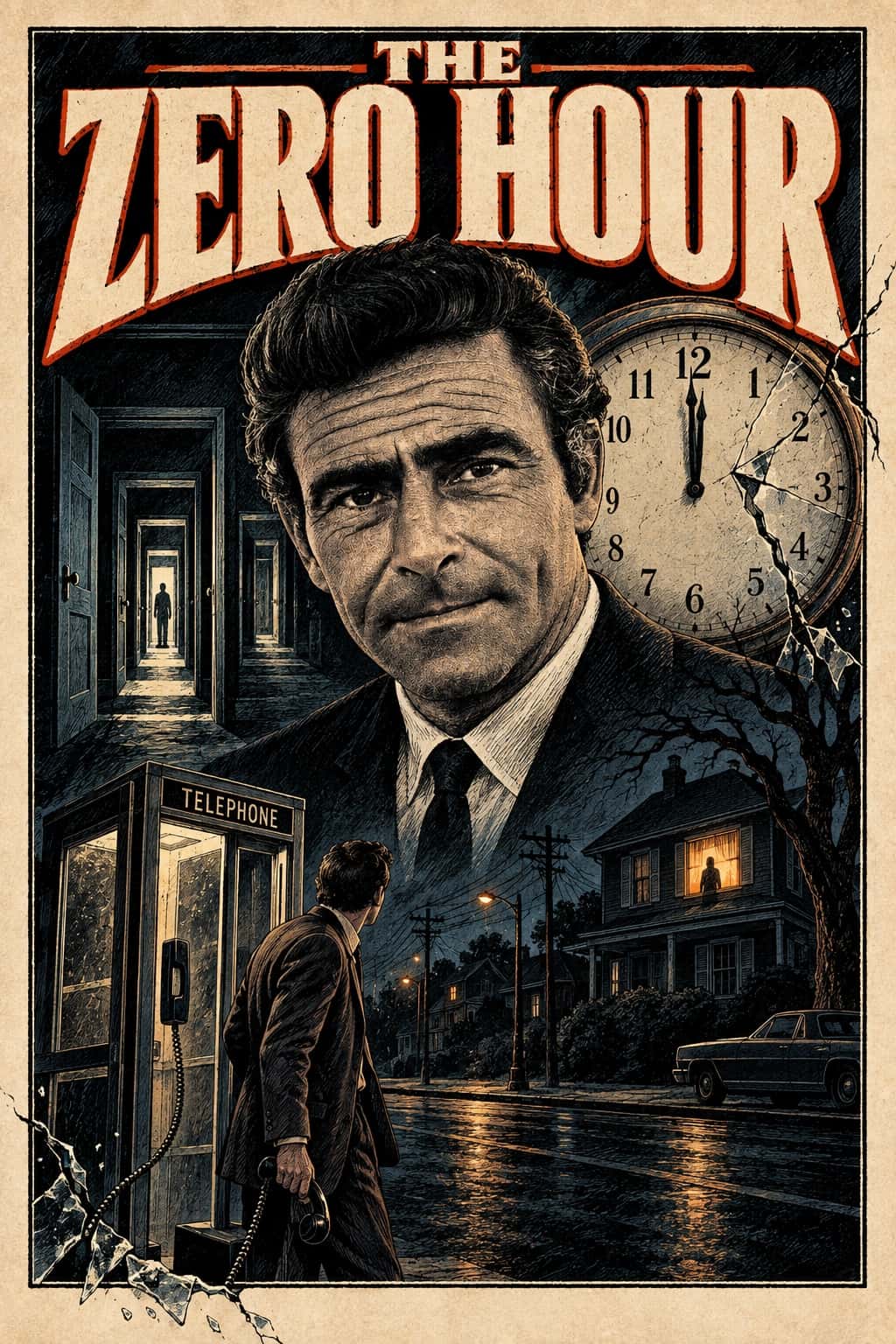
I'm Rod Serling. You're listening to The Zero Hour. Rest your eyes. Exercise your imagination. This week, Bill S. Ballinger's study of a deadly obsession. Fourth of Forever. Starring John Daynor and Susan Oliver. In Elliot Lewis's production of The Zero Hour. The Mutual Broadcasting System presents The Zero Hour. Sponsored in part by... Ford Motor Company. Wrigley gum and sign-off. This is the Zero Hour on Mutual Radio. It's been said that luck is a lady, but never in between. James Marius has spent a lifetime leaning on lady luck. He's been a gambler of magnitude, never one to bother with a penny-ante game. Then he met Lou Jackson, his biggest venture to date. It was all or nothing. And a man on a losing streak is liable to shoot the works on a long shot.
Such was the case with James Marius. A 3,000-mile coast-to-coast flight, time and place, and the word of a woman he'd never seen. Lady Luck followed him that night to a New York hotel. He had lots of luck. James Marius incurred a debt the law requires he pay for with the rest of his life. Fourth of Forever resumes after this word. Leukemia is a disease of the blood-forming organs. It takes the lives of more children than any other disease known to man. It afflicts even more adults than children. At present, there is no cure. However, a great deal of progress has been made in the treatment of leukemia, and many doctors believe that if we can find a cure through research, it could well open the door to the cure for cancer. I'm Shirley Jones, national chairman of a program to raise funds for leukemia research through radio broadcasting.
If we can find a cure to this dread disease, we can stop the deaths of 15,000 victims each year and help in the search for the cure to cancer. Today, radio stations across the country are fighting leukemia. Please help. Make your check payable to LSA for Leukemia Society of America and send it to LSA Hollywood 28, California. That's LSA Hollywood 28, California. With a start from the old familiar nightmare. But this time, Lou was with me in the battered DC-3. We were trying to find a place to land, but couldn't. Gas was running out. And so was time. Time. That's what woke me up. I looked at my watch. It was four in the morning. I would make it one in Los Angeles. Dangerous as it was, I had to phone Lou from the hotel. Warned her that Warren was shot. I placed the call. Why didn't she answer? She should have been there, but she wasn't. What had happened? Had the police already taken her?
My fear was more terrible than any I'd ever known. Not for me, but for Lou. How could the cops have connected her with me so quickly? They hadn't taken me yet. What was happening? I couldn't go back to sleep. The blazing in my arm kept me up. I knew I had to have it taken care of, the bullet removed. I needed a drink, but instead I emptied the bottle down the drain. I could no longer afford the luxury of getting drunk. I was facing a 20-year jolt for attempted robbery and the accidental shooting of Warren. I destroyed my return plane ticket. All out-of-town flights would be screened thoroughly. Of Lou's $1,000, I had about $500 left, enough to get me back some way. I waited until about 8 before leaving the hotel. I draped my top coat over my right arm to conceal the bloodstains on the sleeve. Walking to University Place, I bought a paper and went into a small cafe. It was practically empty. I sat in a booth near the back and ordered coffee and opened the paper. The story was on page 3.
It wasn't a big one, but the headline caught my eye and shook me through to my feet. Multi-millionaire murdered in hotel room. The article said Warren's body was discovered after an anonymous phone call to the police. Bloodstained prints had been found on his door. The lab was checking these for identification. My belly dropped. Warren was dead. I hadn't meant to shoot him. I hadn't aimed. I didn't remember pulling the trigger. All I remembered was his shot and my arm jerked. And then the second shot in the reflection in the hall mirror. In the back of the restaurant was a public phone booth. I tried to call Lou again, by which he'd take so long to answer and then not say a word. Was it possible the cops were in her apartment and trying to trace the call already? I left the cafe in a hurry. I took a cab to the Bowery. My jacket was badly bloodstained, so I bought another one in a used clothes store for $5, and then I walked up the street.
I knew I had to get out of New York, but I had to do something about my arm first, get that bullet out before the infection took over. I stopped in front of a fly-speck window and tried to light a cigarette. Give you a beauty, mister. Huh? Oh. Oh. Bojo Jack's Tattoo Parlor. Take your pick. Anything you want. Butterflies, mermaids, hearts and dogs, battleships, the works, man. Twenty-five bucks. Bojo Jack had an old leathery face split into a wide smile. One front tooth was missing. The other was rotten with a gold star right in the center. His features were squashed together as if he supported a heavy weight on his head. But his hands were what caught my attention. They were sensitive and delicate. I'll make you a deal. Cut it to 15. Let's talk inside. The tattoo shop was long and narrow and partitioned by a heavy green curtain.
I assumed Jack lived behind it. In front was a white kitchen table, a couple of metal stools, and on a shelf at the table were his instruments and inks. Hanging above the table from a cord was a large light bulb inside a metal reflector. I've been messing around this business 40 years, mister. You ain't gonna get hurt none. Don't hurt at all. How would you like to make $50? Tattooing? No. I thought not. I'll do a lot of things for 50 bucks, but not everything. What you got in mind? If you turn down my proposition, will you keep quiet about it? Well, I don't ever do much talking unless someone's whipping me real good. That happens, maybe I'll talk. Won't happen. I got a slug in my arm. Can you take it out? The man after you? No, not yet. You've plenty of time. Ain't got much anything to work with. It figures to hurt real bad. It hurts now. Wait.
Let me take a look. I don't want nobody watching me. You need a little light. That's better. That arm. Well, it ain't so awful bad. Don't look like any bones broken. I guess if you can stand it, I can. I'll have to. Get out of that shirt and wrap this sheet around you while I get some hot water and things. Gotta use a lot of hot water. Real clean, like a doctor. Jack came back with the water, a straight-edged razor, a pair of tweezers, and a metal ice pick, and a bottle of gin. He started to wrap a cord tightly around my arm. You hold this ice on that proud flesh. Sort of deaden it down a little bit. Now, I can do it two ways. Sort of slow like, which will hurt a long time, or right quick. Get it over with. That's the way I like it myself. Got into a bit of shooting a couple of times, too.
Hate to waste this good gin washing my hands. Just like old Dr. Kildare. Nothing better than gin to keep the bugs out, though. Well, here she goes. Looking for a car that's easy on gas, easy to buy, and yet has the luxury you want in a car?
Mustang II. It's the all-new economical car from Ford. The right car at the right time. Built even smaller than the original Mustang. It has an easy-on-the-gas four-cylinder engine, rack and pinion steering, tachometer, four-speed transmission, plus a beautifully appointed interior. All standard. Luxury plus economy. That's Mustang II. Mustang II, $28.95, excluding dealer prep, destination charges, title, and taxes. See your local Ford dealer.
I clung to the metal stool and bent a rung on it. Then it was over. Jack poured gin in the wound and bandaged it up. Neat, professional. And handed me the slug for a souvenir. Now I can concentrate on getting home. I had to see Lou, regardless of the danger. Somehow I had to get back to L.A. I'd find her and we'd leave together. Beyond that, I had no plans. I took a bus from New York to Boston. I tried to call her from the depot. You have reached a disconnected number. Please check your number and dial again or ask your operator for assistance. This is a recording. From Boston, I took a train to Chicago and took a taxi to the airport. It was risky, but I flew from Chicago to San Francisco. I made it without a hitch. And from San Francisco to Los Angeles by bus. In the L.A. bus station, I bought a newspaper. It said that the police in both New York and Los Angeles were searching for James Marius in connection with Warren's murder. Obviously, I'd been identified through my prints.
But to my great relief, there was no mention of Lou Jackson. She hadn't been connected. Lou was safe. I decided to try Lou's apartment. No one there had seen me before, so I wouldn't be recognized. Unless the cops were waiting for me there. I found her name had been removed from the mailbox. So I tried the manager. Yes? Say, I'm looking for a friend of mine who used to live here, Miss Lucille Jackson. She moved last Thursday. Thursday? The 24th? I don't know what day. Yeah, yeah, the 24th. Hey, look, I got a show I'm watching here. I got no time. Has Miss Jackson's apartment been rented yet? You ask a lot of questions. I'm looking for a place to rent. Is it vacant? Oh, why don't you say so? Come on, I'll show it to you. It's in perfect condition. You'll love it. Your friend was real clean. I didn't even have to paint. Take a look around. Miss Jackson used to have a painting of mine.
A big one. A nude woman. I don't know nothing about no nude painting. I leave my tenants be. How long did she live here? Oh, four, five months maybe. Did she leave a forwarding address? No. Hey, do you want the place or don't you? Well, I'll get back to you. Thanks. Common sense warned me not to go to my old apartment. The cops would have my place staked out. It was an awful risk. But I knew I'd try because of the faint possibility she might have left me some clue. So at 3.30 in the morning, the darkest hour of the night, I crept into the parking lot behind the apartment building. As I expected, my car was gone, impounded by the police. I didn't see anyone around the patio or pool. My apartment was dark. I listened outside a window. Finally, I went inside. I froze. Against the faint light of the window, I saw the silhouette of head and shoulders rising from the couch. A cop. Who's there? Bill behind the Hollywood Bowl.
A short winding street. I saw a parked car in an open garage. It was concealed in the shadows. I climbed in. I stretched out in the back seat, cursing myself. Now the cops knew I was back in Los Angeles. I just had one lead left. Clara in Warren's office. Realty. I'd like to speak to Clara. Mr. Warren's secretary. Way you know. So I heard. But may I speak to Clara, please? How could that be? Clara must have lied about everything. Even about being Warren's secretary. Then I remembered the painting. Lou had taken it with her when she moved so quickly. If she needed money as badly as I, she might try to sell it. Now, who was the painter? And what was his name? Gazzetti. I looked up an art dealer, went to his gallery, and he said... Gazzetti? No, we don't have anything he's done. Well, I saw a seated, draped figure of a nude he did. I'd like to buy it. If it were for sale...
What would it cost? Some Gazzettis brought $5,000 a few years back. Might be higher now. That much? Why? You're paying for snob appeal. Apparently, Lou hadn't tried to sell the painting. But it puzzled me. How had she gotten hold of a $5,000 painting? I was of the belief that she had only a limited income. Getting around on foot had become too hazardous. I had to have a car. I walked to a big supermarket. Hundreds of parked cars, big, small, cheap, expensive, take your pick. I wasn't choosy. I found a small, inconspicuous sedan with its keys tucked in the sun visor above the wheel. I got in and drove off. I returned to my boarding house and switched plates with another car parked on the street. I had transportation now, but not much else. I went up to my room and had a drink. And once again in my memory, I saw Lou.
Her silver gilt hair aglow in the sparkle of my imagination. The music of her voice, the touch of her fingers, the scent of her body were opiates that deadened the pain of my failure, the loneliness. I sat down in the soft chair and thought back to how it was. I could see in my mind the gazette on the wall, and there had been an envelope. When I sat down, there was a name on that envelope. Rothman Associates. Had an office in a shabby building on Western Avenue. Just the name on the door, nothing else. Rothman himself was a wiry man with blunt features and thinning hair parted in the center. He stared at me through deep-set eyes. Didn't offer to shake hands. Sit down. Say, I'd like to get in touch with Miss Lou Jackson. I think you know her. I think you're wrong. Yeah, well, I've been away, Mr. Rothman. In the meantime, she's moved. No forwarding address. Could be she didn't want you to find her.
Now, that isn't the reason. We're good friends. What's your name? Horton. Clarence Horton. You're lying. No. No, you're lying, Mr. Rothman. She gave me your name. We don't give out information regarding clients. You're a private investigator. Now, that's good thinking. Well, I'm not asking for information, Mr. Rothman. Just an address. Don't have it. Haven't heard from him in maybe... Well, about six months. Well, did you have her address before then? Mister, my business is selling information, not giving it away. Fifty dollars a day. You want us to find her? All right, here's fifty for one day's work. Just give me her old address. See what I can do. Now, wait a minute. Here's her folder. I see the Jackson woman paid us in cash. She didn't give an address. Well, she must have had some way for you to get in touch with her. Yeah. Oh.
Here's a telephone number we were checking out. Who did you say you were? Rothman shoved back his chair. I don't know what alarmed him, but he came at me. I picked up a metal ashtray on the desk. He fell across the desktop. I grabbed at the white card he had in his hand. The card tore in two. I still had part of it as I ran from the office. I reached the street and slowed to a fast walk so as not to attract attention. Around the corner where I parked the stolen car, I paused to look at the piece of card. There was a name. Lucille Jackson. A telephone number in the San Fernando Valley and the notation paid $500. I tore up the card, chewed the pieces to pulp and spit them out. And I got in the car. Holland? Yes, officer? Outside. Up against the car. Let's go. What's this all about? Where'd you get this car?
And identified because of that lousy stolen car. One of the new plates had fallen off while I was driving. All they had to do was find the mate. And they did. They threw me in a cell with a little guy, about 40, with a wise, secretive, perpetual smile. He told me his name was Leroy Grimes. I figured he might be a plant, a stoolie, so I didn't say much. First time? My third. What the rap? Did they question you yet? You don't talk much, do you? No, not much. I wasn't interrogated right away. Instead, I was taken from my cell and led to another room. It was small, completely bare, no furnishings of any kind, no fixtures, but a light sunk into the ceiling. I sat on the floor, my back propped against a wall, and waited. It's time. Rest your eyes and listen here.
to this week's renewing study in suspense, to forever. I'm Rod Serling, and this is The Zero Hour. This episode brought to you in part by Ford Motor Company, Wrigley, Gellman, Sinoff. This is The Zero Hour on Mutual Radio. You have been listening to The Zero Hour, a presentation of the Mutual Broadcasting System in association with Hollywood Radio Theater. Heard every weekday at this time. Rod Serling is your host. Zero Hour is produced and directed by Elliot Lewis. The Hollywood Radio Theater theme was played by Ferranti and Teicher and is now available on United Artists Records and Tapes. Hugh Douglas speaking. Tune in tomorrow and once again, rest your eyes and listen here to The Zero Hour. This is the Mutual Radio Network.