
The written record
Read the transcript
Read along with the recording · About 19 min to read
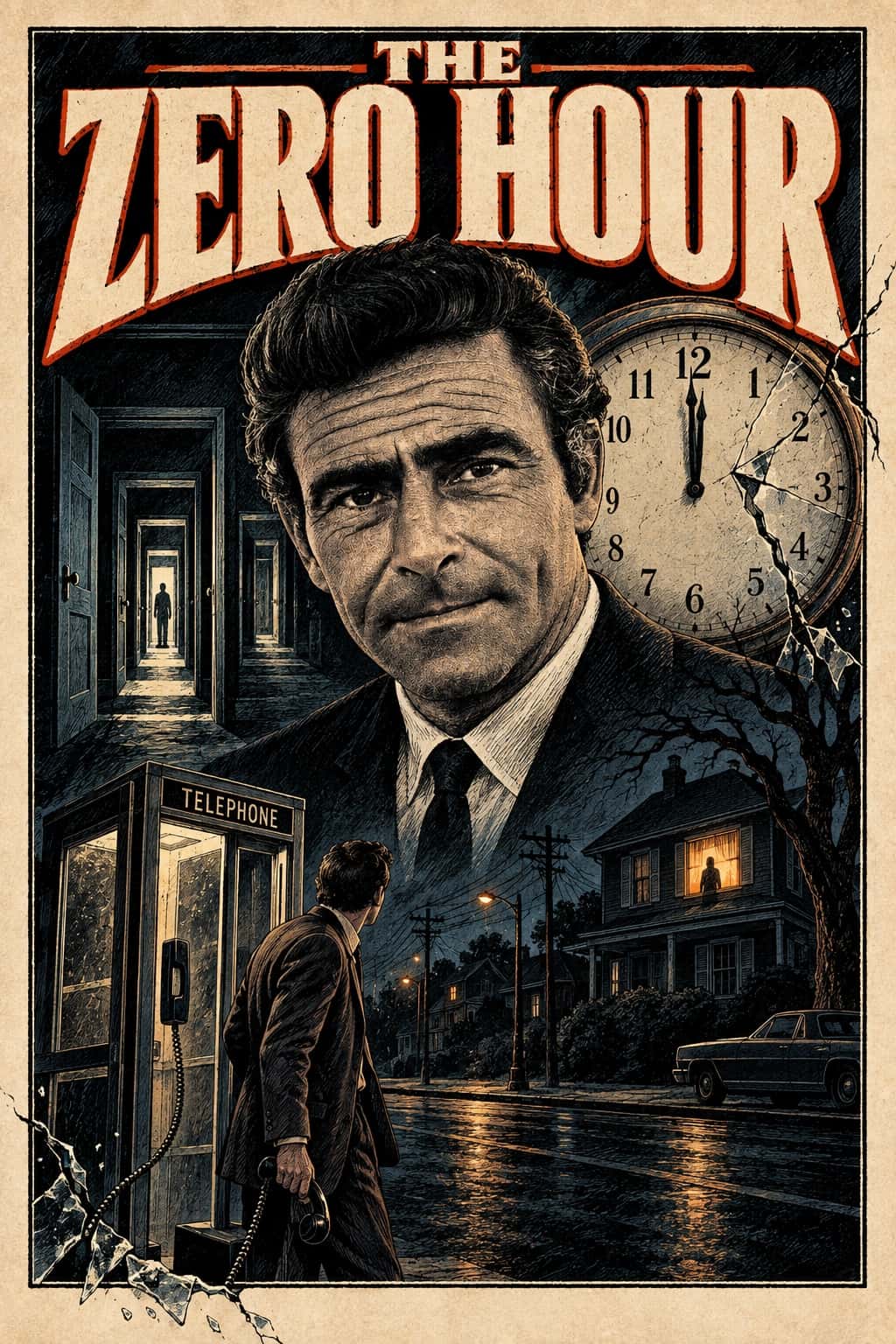
I'm Rod Serling. You're listening to The Zero Hour. Rest your eyes. Exercise your imagination. Today, Keith Walker's frightening voyage into the past. Lost in time. Starring Joe... Mutual Broadcasting System presentation of... Brought to you by the Ford Motor Company and Lazy Boy Recliers. This is The Zero Hour on Mutual Radio.
Hi, this is Jim Backus with a special announcement about an exciting Lazy Boy chair sale taking place at your Lazy Boy dealers now. Lazy Boy reclining chairs of your choice are available at unheard of savings for a limited time only. Treat yourself and your family to a lifetime of comfort and beauty. Once you do, you'll wonder how you ever relaxed without one. Get America's comfort favorite, a Lazy Boy chair now. See your Lazy Boy dealer today. Run in there. He'll be glad to see you. Yes, he will. This is Jim Backus with news about the most comfortable experience of a lifetime. A Lazy Boy reclining chair. It's ideal for apartments, living rooms, dens, family rooms. Lazy Boy is as beautiful as it is comfortable. Available in any style you can imagine and in hundreds of decorator fabrics and vinyls.
Make your favorite room a haven of gracious living. See your lazy boy dealer today. Hurry up. He's waiting. Run down there. Go. Yes, indeed. Old saw that says writers of science fiction only predict a minute amount of what's to come. That man's great leaps forward in science far outstrip even the most imaginative predictions of the fiction prophets. Many writers have sought to penetrate the fabric of time. And many have suggested it would require energy sources unavailable to us. That may all be changed now. Modern lasers are the newest attempt of man to create massive energies equal to the sun. Would these be enough to open the door to time? Perhaps. But what then? If we traveled back in time, could we return? Join us now as we explore Keith Walker's prophetic anomaly, Lost in Time. Okay.
What time is it? You mean the pellet came back? Yeah. Well, hang up. You're slowing me down. Call Bill Hathaway and have him meet us. Right. Believe it, Jesse. Okay, a little more later. This had better be important, or you... Bill, it's the biggest thing to happen in science since Edison yelled into his light bulb. Pete, forget the jokes. Bill, let me show you what we think we've got. Now, you know we've been working on a form of laser fusion, and that it's our theory when you compress a... propellant of neutronium to less than one-five-thousandth its original size, you then get an incredible release of energy for a short period of time. Dr. Latham, I'm only the money guy for this institute, not its chief scientist. Why tell me? Because we wanted you to understand what we think we've got. Come on, Bill. You can see a touch coming five miles away. Oh, you know me so well. Okay. Pete and I have been experimenting with an anomaly we've noticed in the progress. Three days ago, we reset the glass lenses that control the beam. We used the computer to figure the angles of all 32 of them.
It fed us erroneous information. Oh, wait a minute. What do you mean erroneous information? You set the program a long time ago. How could it give you new figures? Bill, when we set the angles, the computer figures in a couple of necessary variables, such as humidity and room temperature. I see. Go on. So that was the day the air conditioning had broken down. Ah, Sylvia, come in. Morning, Jesse, Bill. I'm glad you came, Syl. I was filling Bill in on the experiment. Now, when the air conditioning broke down, the humidity had climbed that day more than we had allowed for in our calculations. It changed the curvature of the laser lenses just enough so that when we fired our burst, the deflection of the beam was infinitesimally off target. But it was enough. Enough for what? Here's what happened. In the burst chamber, the pellet we were using disappeared. How did that be? Wait a minute.
Does that mean you managed to convert it into pure energy? Well, that was our first thought, but then Pete remembered something that sent chills up our backs, Pete. Right. Three days before that experiment, I noticed that we had an extra pellet in the inventory. When I went to get Jess and show him, it somehow disappeared. You mean it was there, and then it wasn't there? Right. It took about five minutes to get Jess, and when we looked again, it was gone. The pellet we used in the experiment disappeared, too, but it returned also. The mind blower is that it was gone exactly five minutes. If I'm listening right, what you're saying is that somehow the two incidents are related. Right. Then yesterday, another pellet, how shall I put it, arrived. Yes, arrived. Stayed a minute and then vanished again. That's when I almost had a stroke. It scared me to death. Tonight, I had Pete run another burst with the identical lens alignments. The pellet disappeared for a minute and then reappeared, exactly the same as in the first experiment. Bill.
We can send something material back in time. Has anything else shown up in duplicate? No, no. But all that means is we've changed our line of experimentation, or will change, depending on how you look at it. All right. What can I do? I want you to convince the board to allocate money for us to build a system ten times as large. Ten times? What do you plan to do? Simple, Bill. We plan to send a man back in time. Welcome, ladies and gentlemen, to your local hoard dealer's late, late show. And I'll feature a presentation entitled, It's Clearance Time. An all-star cast has been assembled for this year's show. You'll see Ford LTD in its lead role as the well-built, strong, quiet type. The dashing style of Ford Torino, cast at the solid midsize. And though the parts are small, the performances are beautifully economical by the compact Maverick and back-to-basic Pinto. To the sporty Mustang, too, critic that Motor Trend gave Car of the Year Rave Review. And in a special guest appearance...
The magnificent Thunderbird gives an elegant show, performing at a surprisingly reasonable end-of-season price. There'll be continuous award-winning performances from the entire Ford lineup all through the summer of 74. So don't miss the action. See your local Ford dealers late-make clearance show today. Remember, the price of admission may never be this low again. You're 17, 18. You've graduated from high school. You want to make something of yourself. But you don't have that something to make it with, like money for four years of college. What do you do? Well, you don't need four years of college to get a good job. Today, there's a crying need for technicians in exciting fields like oceanography, electronic data processing, health service, environmental control, forestry, and many others. Technicians earn twice the salary of the average high school graduate. Some even make more than four-year college graduates.
All you need is a year or two of technical training. To learn how you can become a technician, send for our free booklet. It's called 25 Technical Careers. Write careers, Washington, D.C., 20202. If you can't afford four years of college, write careers, Washington, D.C., 20202, and make something of yourself. I know what Dr. Latham is working on, so I'll let him bring you up to date. Jesse. Thanks. First, our team, Pete Elmore and Sylvia Barber and myself, have been doing some basic research. We hope to find other time anomalies in the fusion experiment that the world has conducted in the last few years. We found something in particular that I'd like Pete to tell you about. All of us remember the first hydrogen fusion bomb that the U.S. exploded in Anuitoc. Something happened that was kept a deep, dark secret by the Navy. It seems that a month before the blast, a cruiser patrolling the area recovered the body of a fisherman floating in the restricted waters. What makes this so unusual...
was that the man was covered with massive third-degree burns and was highly radioactive. Please hold it down till Dr. Elmore finishes. The discovery was immediately classified a tomahawk. Yes, Dr. Ranger. Pete, are you saying that this fisherman was killed by a bomb that wasn't scheduled to go off until a month later? Exactly. He must have been fishing in the restricted waters when the bomb exploded, killing him, and at the same moment... thrust him back a month in time. Amazing. We think so, Dorothy. The energy was, of course, uncontrolled. Had it been focused, there's no telling how far back along the timeline he might have been carried. Then that's what you plan to do now. Focus the energy with the new laser. Yes. Also, we believe there'll be a sine curve here where, past a certain point, very little energy is needed to jump, say, 10 years or 200 years backward in time. Yes.
Dr. Barlow, putting a man back in time is one thing, and I'm as excited as you, but how are you going to bring him back again? Sylvia. We've discovered, Augustus, that reversing the energy field will return an object to the present. I say discovered because we have only constructed the problem on the computer, but that's the answer. The final proof lies with Jets. What? You mean Jesse is going to be the one that travels back? Right. That's ridiculous. With respect, sir, I am the only one fully familiar with a way to program the operational equipment. Augustus, we have developed a circular laser generator that Jess will use for his return. Essentially, it works on the same principles that the linear laser does, but instead of lenses, we use special glass rods coming out of the central core where the energy source originates. Built into each are miniature light amplifiers that give us the controlled burst.
The whole unit is the size of a travel bag and has the advantage of being calibrated to return our men to this time angle. Wait a minute there. I don't much like the sound of that. What's a time angle? That's the problem, Augustus. We believe that we can use the machine to send us back in time to within a decade of target. Well, it sounds like using a shotgun to shoot down a barn. True, but at this stage of the discovery, that still is a major achievement. Well, still, that time angle you talk of, that means when you return, it would be any time in the next ten years. No, no, no, no, no. Again, I refer to the pellets. They both return to this moment in time. That is the moment we're living at now. We believe that when I activate the return, it will be to come back to this moment.
If I stay away an hour, actually, I plan for that on the first try, then one hour after departure, I will return. At least we hope so. All right. Before we wrap this up, anybody got any last questions? Yes. Yes, I'm aware that you've moved the apparatus to a building in Manhattan. Why? We chose that building because it was built in 1880. It is essentially unchanged now. And that's our target decade. 1880? All right. Okay, everybody, that's it. We'll keep you informed. Jess, best of luck. What time do you go? Tomorrow night, 10 p.m. Jess, I'm a little like Columbus. I know where I'm going, but there's still a nagging thought that I'll sail over the edge. If this works like it's supposed to, Jess, you can make your next trip back to his time and reassure him in person. Isn't that a mind-boggler? Imagine lunch while Rome is burning. I could be the seventh wife of Henry VIII. Yeah, so perhaps the early assassination of Adolf Hitler. Oh, I never thought of...
What would happen, Jess, if we could prevent the Second World War or famine in India or the Black Death? I truly don't know, Sal. It's been suggested by science fiction writers many times that a single incident could change the entire course of history. Yes, and with it, this experiment. Us, we might not be here if time were altered. Before we change anything, much thinking would have to be done about the alternate futures. In any case, that's not our purpose tonight. Evening, Jess. Pete, Sal. I'm afraid I couldn't follow my own edict and stay away. It's all right, Bill. Glad to have you. 9.50 p.m., Jess. You better change. Already done, under my coveralls. Change? Yes, I've got a complete 1880 suit on underneath. Our schedule calls for me to use my hour on the other time to assess exactly what period we've hit. Wouldn't do to walk around in 1976 clothing. No, no, no, it's not. Pete, I'll enter the capsule now. Right. Bill, Sylvia, let's adjourn to the control room. Good luck, Jess. Take care. Can you hear me, Jess? Roger, and I'm ready. The portable generator is within the field.
Stand by. I'm coming to full power now. Ten seconds to break out. Eight, seven, six. Alignment. Three, two, one. My heavens. I don't know what to say. Amazing, Pete. One minute he's sitting there and the next he's... The next. He's 80 or 90 years into yesterday. Here's some super news. Wait, let me give you a fanfare. Thanks. Right now, your Ford dealer is featuring the all-new SuperCab pickup. Now for a cymbal crash. Yes, Ford SuperCab, the only two-door pickup roomy enough... Hold it, hold it. A drumroll. Roomy enough to carry a family of six. So march on down to... Now the full band.
March on down to your Ford dealers and see the super cab. With an on-bench seat or facing jump seats. Or with no rear seats, you get 44 cubic feet of cargo space. And because it's clearance time now at your Ford dealers, he's really dealing on all his pickup Rancheros, Broncos, and Vans. Great choice now available, too. I didn't know all that. Great marching band imitation. How'd you ever do it? I got excited. You'll get excited too about the super news at your local Ford dealers now. Leukemia is a disease of the blood-forming organs. It takes the lives of more children than any other disease known to man. It afflicts even more adults than children. At present, there is no cure. However, a great deal of progress has been made in the treatment of leukemia, and many doctors believe that if we can find a cure through research, it could well open the door to the cure for cancer.
I'm Shirley Jones, National Chairman of a program to raise funds for leukemia research through radio broadcasting. If we can find a cure to this dread disease, we can stop the deaths of 15,000 victims each year and help in the search for the cure to cancer. Today, radio stations across the country are fighting leukemia. Please help. Make your check payable to LSA for Leukemia Society of America and send it to LSA, Hollywood 28, California. That's LSA, Hollywood 28, California. Pete, what's the time? Sylvia, that's the ninth time you've asked. It's 1.10 a.m. Oh, where is he? I don't like it, Pete. The experiment called for him to return at 11 p.m. He's long overdue. I know, I know, but there's no telling what variables he ran into back then. Look, forgive the negative thinking, but what if he doesn't return? Can we retrieve him? Not without his help. He's got the time generator.
Plus, there is no way to place him exactly in time. Well, what if something happened to the generator? Could we send him another? Same problem. We don't know where to send it. We could drop a hundred in the decade, and still there'd be no way we could be sure it would reach him. All we can do is hope that he'll make it on his own. Pete, Sylvia, sit down. What's up, Bill? It's been almost two months now since Jess made his trip, and I've been doing some hard thinking, as I'm sure you two have. Sylvia hasn't left the lab. I don't know what to make of it, Bill. I've run a hundred different programs through the computer, and I still can't find an answer as to how to locate Jess. Yes, well, I've got an idea. It's probably not a good one, but it may be a starting place. Why don't we check the library for the back issues of, say, 1880 to 1890? Great idea, Bill. He may have tried to communicate to us in some way. Okay, let's take our best shot. Coming soon.
Exhausted. I've looked at so many papers, I'm getting newsprint on the eyeball. I know. I've been covering 1887 through 1890. New York was worse then, I think, than it is today. Depression, political chicanery, fighting over the western territories. So what's new? Well, this is the last one. December 31st of 1883. As soon as I finish this, it's home to a dark room. Oh. Oh, my feet. Look at this. What? Hold on, let me see. Oh, beat. That's our Jesse. Quick, get that copied. We've got to find Bill. Right. I wouldn't believe it if I wasn't looking at it. Amazing. I know. But since the fire didn't destroy the whole building, there was no reason to suspect. Here, let me read it. December 31st, 1883. Today, the newest skyscraper on the New York horizon was engulfed in flames. As the above picture shows...
Many people were able to escape the fire which consumed the four floors. For a short while, police held a Dr. Jess Latham. That explains how he managed to get his picture taken. However, the doctor was released after he satisfactorily explained his presence inside the burning structure. That must have been some explanation. I got it, Bill. Got what? Bill had a sheer stroke of genius. He sent me over to the building owners. They confirmed that when the building was rebuilt in 1884, old man Palmer laid a new cornerstone. Oh, bless the old traditions. So you think, Bill, that Jess may have left a message for us? I don't know, but it's the way Jess would think. I can't see how else he might figure he could contact us. What are we waiting for? Let's go dig up a message from the past. You sure this okay, Mr. Happily? I'm sure, Mr. Hunt. Please continue. Sir.
Some sort of hollow place inside. A large opening. Okay, sir. I feel something inside. A metal box. Ah, pull it out, please. Thanks, Mr. Hunt. Would you please see that that is repaired? Yes, sir. I'm almost afraid to open it. If I'm not here, let me. It is hard to believe we are looking 91 years into the past. There's some papers here. It's very, very yellowed. Wait. Wait, here, here, it's here. Let me see. That's terrific. Phil, you read it. I'm too nervous. Yes. To my dearest colleagues, if you are reading this, it means you know most of the story. My arrival was without incident. One moment I was watching Pete, Sylvia, and Bill through the glass, and the next I found myself in the deserted storeroom of the building.
What we fail to take into consideration is that the mass of heat generated by the laser reached this end. Before I could do anything, the room was on fire, and I had to abandon the time generator. So now I am trapped down time. The picture in the paper I arranged, hoping that you would research the period, although it nearly got me caught. As to my return, I have worked out a possible solution. Pete, I hope you're reading this, because if you are, you'll remember my cabin in Vermont where we fish. I have traveled to that area. It took almost a month. It stands unclaimed in this time. It is my thought that you should move the laser to that area and transfer a new time generator to me. As we have discovered, we can hit a decade, but no closer. So it could take as much as ten years before I am able to return, if at all. Nevertheless, I will travel to that area roughly every two months in hopes that you are successful. So, until we meet again, I'm yours most respectfully, Jesse Latham. The 2nd of February in the year of our Lord, 1884. Steve Zasadnik, chief engineer, WCBB-TV. If I were buying a TV color receiver today, it would be 100% solid state. RCA asked these TV chief engineers a question you could be asking yourself. If you were buying a color TV, would you pick a tube type set or 100% solid state?
Robert Porter at KMEX-TV. I'd buy a 100% solid state set for the low maintenance, high reliability, and low power consumption. In a nationwide survey, 95% of the TV chief engineers polled said they'd prefer to buy solid state for their next color TV. So if you've been asking yourself the question, you know what these experts say. Otis Freeman, New York. I'd buy a 100% solid state like the RCA XL100. For color, for reliability. Consider the new RCAs. Every one is an RCA XL100. 100% solid state. Don't settle for less. Close your eyes, exercise your imagination, and join us again on our next presentation of The Zero Hour. Lost in Time is an original radio drama written by Keith Walker. Joe Campanella was heard as Jesse Latham. Featured in the cast, Charles Aitman, Peggy Walton, Richard Thiel, Alice Reinhart, and Herb Vagran.
Zero Hour, created by G.M. Kolos, directed by Don Hills, is produced in Hollywood for the Mutual Broadcasting System by Radio Productions Incorporated. Music composed and conducted by Stanley D. Hoffman, Roselle Sherman, associate producer. This has been a presentation of the Mutual Broadcasting System.