
The written record
Read the transcript
Read along with the recording · About 20 min to read
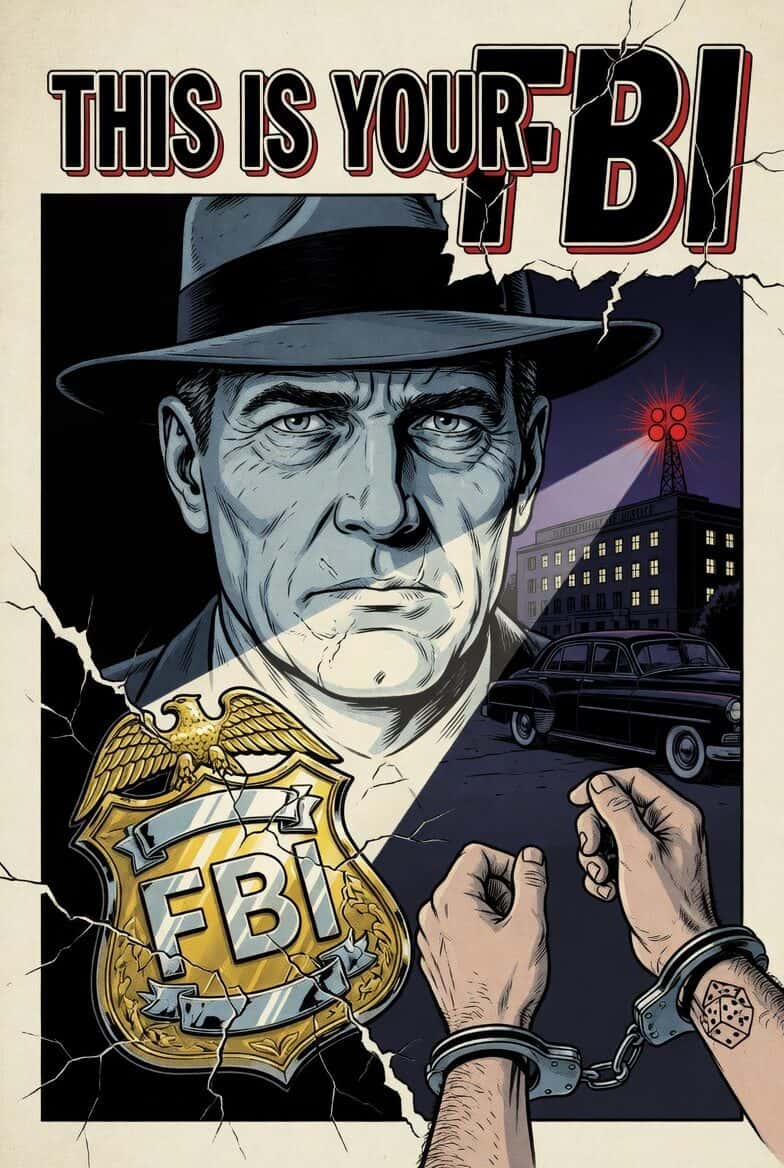
This is your FBI. This is your FBI, an official broadcast of the Federal Bureau of Investigation, presented as a public service by the Equitable Life Assurance Society of the United States. To your FBI, you look for national security, and to the Equitable Society for financial security. These two great institutions are dedicated to the protection of you, your home, and your country. During the course of tonight's opening broadcast, you will hear from Mr. Thomas I. Parkinson, President of the Equitable Life Assurance Society of the United States, and Mr. J. Edgar Hoover, Director of the Federal Bureau of Investigation. Tonight's the story of a crime against the nation, espionage. Spying is just like any other business. A spy gets paid so much a week to do so much worse.
And in most cases, that salary is small because most spies gather only small bits of information. But when these bits are pieced together in Berlin or Tokyo, the result is a stolen invention or a spoken concept. That's why spies are ordinary people working in ordinary places. Places like a waterfront where ships can be watched. Places like a factory where parts for new planes can be copied. Places like a bar where people talk and talk too much. Oh, brother, you should have seen. Yeah, she was steaming right into that tray when, boom, out from no place come a zero. Zero. Bang. Oh, I'm sorry. Did I get any on you? No, no, no, but it's all over you, June. Willie. Willie. Yeah, I'm sorry. A thousand apologies for a lady. A million.
Oh, oh, look at that. Well, will you wipe it up, Willie, and get him another drink? Sure, sure. Excuse me, young man. You're awfully cute, Junior, but you're getting a little messy. Poor battle wagon. She's sunk now. Uh, sunk off Guam? Yeah, but they got a new one. A bigger, better... Well, it's a heck of a battle wagon. It must be, Junior. You're pretty. You hear that, George? She is. Where's my drink? I'll get it right away, sir. Where was I? You were talking about that battle wagon. Oh, yeah. Oh, let's see. Say, I'll tell you what. Friday morning, you walk up to the top of the street here, and you'll see the newest battle wagon in the best navy in the world come steaming down the bay.
She's just been commissioned. Excuse me, sir. I was still zipping on you. Yes. Then you'll see a real ship. Well, then let's drink. No, no, no. Let's drink to you. To our most beautiful girl. Oh. What's the matter, baby? I don't feel so. Junior, now you've got it. I think I've got it. Here you are, son. You go right back there. Thanks. Excuse me. Be right back. Poor Junior. Oh, it's the same. What is, Willie? Those kids, they want to enjoy themselves, but they sit with people and drink too much. They talk too much. Talk too much? Say, do you think we... I don't say you did anything. I just think it's the same, that's all. Let's get out of here, George. I'm sick of this dump. Okay. Here you are. Thank you. What about your friends? Uh, tell them...
Tell him we'll wait for him outside. That was in January 1943. Early in February, three letters were brought to the attention of the FBI. Three pleasant letters typewritten in English. Three innocent letters intercepted on their way to Switzerland. Three friendly letters containing, among other bits of information, a report and description of the newest battleship launched by our Navy. Come in. Hello, Dan. Hi. I've been waiting for you. Off the chair. Thanks, Ross. You look bushed. Yeah, I am kind of. Why don't you try hitting the hay early? Are you kidding? I was in bed at 11.30 last night. But starting at midnight, the phone rang every hour on the hour. My wife says she wishes she'd married a doctor instead of an FBI agent. My wife's been wishing that for 15 years. Did you read those letters from...
Switzerland, then? Yes. Very dull if you don't happen to catch the parts printed in secret ink on the back. Have they been sent to the laboratory yet? No, they just got here. Oh, we'll send them, Phil. Check the printing on the back. It's in German, isn't it? Yes. Not in code, though. That's a help. Let's see. We'll have the ink checked, typewriter, paper. They're all signed Henry Brown. Yes, and all postmarked New York City. There must be a slew of Henry Browns in a small town like New York. And it's probably an alias anyway. That's my guess, too. We'll check up on him anyway and see what the laboratory has to say. A spy doesn't usually know exactly how much information he'll be able to pick up or exactly when or where he will get it. He knows, of course, that convoying movements in general are valuable. And he knows, too, that he may get this information from Navy or waterfront personnel. He knows he may be able to pick it up around the dock. But he's never sure just how much information will fall into his eager lap.
just when and from just whom. Sometimes it may come accidentally at an odd moment, such as during a practice air raid, a blackout, say, near the harbor in New York City. Lights out! All lights out! Mrs. Johnson, turn out that bathroom light! Quiet, Mr. Blackout. Mrs. Johnson! Turn out that bathroom light! Lights out! All lights out! Oh, good evening, Mr. Gordon. Having trouble? That's with Mrs. Johnson, as usual. Yeah. She's dark now. Yeah, now, but I always have to yell my head off. She's a fine one. And my wife tells me she's always complaining about race men, too, and how she can't get enough coal. Quiet, listen, quiet. Is listen sick? Hey, I just had to stamp it. People like Mrs. Johnson ought to wake up and learn there's a war going on. Knockouts are very important. If I weren't a warden, you wouldn't find me out tonight.
Weren't you feeling too good, Mr. Gordon? My kid's home on liberty, and this is his last night. Well, he'll be back soon. Not this time. He says he's going on a convoy run to Russia. Russia? What, at 5? Yeah. And he's leaving tomorrow? Or the day after. Can you imagine? Just came back, too, from... Where was it? Italy. But that was a short run. They just dumped some machinery there. Airplane parts out of it. No, but thanks, I think he said it was. Oh, yeah? Yeah. Oh, how was business at the bar, Mr. Seabrook? Pretty good, thanks. Well, I think this will be a short blackout tonight. I hope so. Me too. I've got to write a letter before I go to bed. Business? No, it's for a friend. Oh, you were over there in 41, weren't you? Yeah, fine country. Well, good night, Mr. Seabrook. Good night, Mr. Seabrook.
A spy, you see, can be a very ordinary man. He doesn't have to live in a penthouse and drive a low-slung car. He doesn't have to work with a bulging wallet and an exotic woman. He doesn't have to employ gunmen disguised as chauffeurs or secretaries or waiters. He can be a waiter himself. A waiter in a waterfront bar. A waiter with a sick dog. A waiter named Willie Seabury. As a matter of fact, it's better for the enemy if he is, because ordinary men like Willie Seabrook are hard to track down. So, Ross, we know what kind of a typewriter our friend used, and we've had every agent in New York checking on him. What angle are you working on? We're taking the chance that a good percentage of the drivel he writes in English to his friend is the truth. So we've drawn up a list of what the man's like, and we're checking that. Want a beer? Yeah. Here you are. Thanks.
and speak and write both English and German fluently. You can get that, of course, just from the languages used in the letters. He's married, has a dog that had distemper recently, and lives near the New York Harbor. That's just a guess. This is a good one. He probably poses as a great patriot inasmuch as he is an air raid warden. He asked his friend in Switzerland to address him as Dear Willie in his letters. He came back from Europe in the spring of 1941. Wait a minute. You got something? I don't know. I, uh, I'm looking over this letter you just brought in. Listen to this. Mm-hmm. I would love to wander through Lisbon again, particularly at this time of the year. Lisbon, eh? Yes. He came back from Lisbon in the spring of 41, Rod. If he's writing the truth, well, we've got to take a chance on that. What are you going to do? Check on everybody who came into this country from Lisbon in the spring of 41. We don't even know the name he came in under. No, but we know what his handwriting's like.
And if he came in from Lisbon, he had baggage. And if he had baggage, he had to declare it in his real name. And if he declared it, he had to declare it in handwriting. Sure, but there must be hundreds of those baggage declarations. There are thousands of air raid wardens and with dogs. Okay. Ever look for a needle in a haystack before? I have. But this time, we're going to find it.
We momentarily close the Federal Bureau of Investigation file on the case of Willie Sebring. We will return to this case in just a moment. It is now my privilege to present the president of the Equitable Society of the United States, Mr. Thomas I. Parkinson. Good evening, ladies and gentlemen. You deserve a clear and forthright statement of the reason why the Equitable has undertaken the sponsorship of these radio broadcasts. For 86 years, this mutual society has shielded the financial welfare of millions of American families. And whenever there has been an opportunity for the equitable to serve the public interest, we have gladly undertaken that privilege. We believe that no medium more vital than this official FBI broadcast could be used to bring society closer to its members and those who may become members in the future. Our business, too, is the business of safeguarding the security of the American family.
Whether it be through the provision of life insurance protection for your loved ones, or the protection of your homes and property, or the financing of industry to make more and better jobs, or the participation in war bond subscriptions and other war activities. In fact, in nearly every form of security other than the services rendered by your FBI, the equitable considers itself your partner and your friend. Through the medium of these radio programs, we hope to let you know the manifold ways. in which the equitable can serve and is serving you and your community. Our business is carrying on into the next generation the benefits of savings in this generation. Public service and human relationships. Preservation of homes for widows and children. The education of sons and daughters. The security and comfort of thousands of elderly men and women living in retirement. And finally, the peace of mind of the American citizens is the mission of our society.
And after all, there could be no closer parallel to the objectives of your Federal Bureau of Investigation. Thank you, Mr. Parkinson. And now we continue with the file on the case of Willie Sebring. Fire! Being a special agent of the FBI is a business, too, but a business unlike any other. An FBI agent, for example, must be a college graduate or have a degree in law or accounting. He must go to school all over again when he enters the Bureau. must be intelligent, observant, and thorough. So thorough that the notion of examining hundreds and hundreds of baggage declarations will not faze me. Actually, special agents of the FBI discovered that from February 1st to May 5th, 1941, boats sailing from Lisbon brought 3,095 aliens and 1,786 citizens to the port of New York. Approximately 5,000 people.
Approximately 5,000 baggage declarations to check. Approximately 5,000 samples of handwriting to check against the handwriting on the letters to Switzerland. To match, to examine, to scrutinize, to sweat over, pour over, work over. Wait a minute. I think we've got it. Yeah. Here, look. You see that M? See that German F? Get the slant of the print here. Here. I think we've got it. I think the laboratory will back us up that Mr. William Sebring is our boy. William Sebring, eh? I'd almost swear to it, boss. What's the report on him? He was born in Germany, but he became a citizen here in 1925. That takes in the languages. He's married, and he's an air raid warden. Has he got a dog? Well, the ASPCA has three dogs registered in his wife's name. I see. It follows all the way down the line, boss. He lives near the harbor. He works in a bar near the harbor. He... Come in.
This just came over the teletype. Thanks. Ross, if Willie Sebring isn't the man, no one is. Sit down, Dan. Huh? What's the matter? Sit down. Mr. Hoover sent this over the teletype exactly seven minutes ago. Concluded question script writing on intercepts this case written by William Sebring. Baggage declaration and letter to bank written by Sebring. However... insufficient samples to ascertain whether Sebring hand-printed German messages in secret ink. Also, no typewriting specimens available for comparison. Not enough proof. I'm afraid not, Dan. Okay. Now what? I think Sebring's the man. I think Mr. Hoover does, too. But we need more proof. Yes. More samples of his handwriting. And his printing, if we can get it. And typewriter specimens. That's right.
Get them, and we get Sebring. I'm going to pay a call on Mr. Willie Sebring. It may scare him. Not this way. His wife rents rooms in their house. I've been instructed to be a roomer. I'll be a welder working in the Navy Yard. That ought to interest Willie. Why, hello. Well, say, can I rent a room here? Oh, well, I'm sorry. My wife takes care of that, and she's out now. Oh, dear, tough. I wanted to get a room right away. Why don't you try across the street? I've got a room there. Oh, thanks. I guess it doesn't matter. Same distance from the Navy Yard. Be quiet, Fitz. Be quiet. Well, hello there, old sport. Oh, uh, do you like doors? Sure. Well, that's a... I'll tell you what. My wife will probably bite my head off, but we have a room on the top floor. Oh, thanks. Ed, I don't want to get you and your wife in. No, no, it's all right. Come on in.
Well, thanks, Mr., um, Sebring. Willie Sebring. Dan Braddock. Glad to meet you. Thanks. You know why I'm really giving you this room? No, why? The Navy, uh, I don't get you. Any man who works for the war effort, I do what I can for him. Say, you're a real patriot, Mr. Sebring. One hundred percent. Five foot four. For six dollars a week. Special agents posing as Dan Braddock's welder rented a room from Willie Sebring's spy. And at the end of the week, that room was worth exactly $6 and no more. The agent found that Sebring left the house each day at 3 p.m., went to the bar, came home for supper at 8.30, and went to the bar until midnight. He found that there were two roomers in the house beside himself. He found that Sebring spent most of his time in the attic, which had a view of the harbor. Beyond that, he found nothing. And the letters to Switzerland had stopped.
So on the afternoon of the 21st of May, Mr. Willie Sebring's hand was forked. No, Blitzen, no. No, I said no. If you eat too much, you'll get sick again. Now, be quiet. Excuse me, Mr. Sebring. Oh, hello, Mr. Braddock. Come on in. Sit down. Thank you. Well, still on the night shift, huh? Yeah. Well, those new ships probably need very careful work. Oh, they do, but they're honeys. I sneaked a picture of one I want to send to my kid brother. He's in the Pacific. A picture, huh? Yeah. Say, Mr. Sebring, I wonder, could you do me a favor? Well, I'd be only too glad to, sir. I want to send this packet to the kid, but I can't address it. See, I burnt my hand last night. Oh, Marta. Oh, it's not too bad. It doesn't bother me. Except I can't hold a pen in it. I was wondering if you had a typewriter in the house. You know, I could type up a label. A typewriter? Yeah.
No, no, there's no touch out of here. I'll tell you what, though. My handwriting isn't so good, but I could print the address for you in ink. Well, I'd appreciate that. That's no trouble at all. Listen, be quiet. That dog will give the death of me one of these days. Now, who did this go to? Sergeant Fred Braddock. S-E-R.
Once again, a handwriting specimen comes to the FBI laboratory. In all, 5,376 specimens were checked in this one case. But this is the last. This is it. This is proof, neatly signed by Willie Sebring himself. Only one thing more remains. One missing piece of evidence. One last final proof. A typewriter. Hiya, Blitzen, old boy. What's the matter with you tonight, huh? Lonely for your master? Well, he'll be back later. But in the meantime, we'll have a little look around without him, huh? We'll see where he... Oh, I'm sorry. You didn't scare me out of my wits. I really am sorry. I didn't mean to frighten you. My name is... I know. You're Mr. Braddock. How do you know? Mrs. Sebring told me. Well, I didn't know you lived here. Well, I'm bored here, but I've been away on a two-week vacation. Oh. Did you take your typewriter with you? Why, yes, why?
Oh, I was looking for one the other day. Well, you can borrow this any time you want. Everybody else in the house does. From Mr. Sebring down, huh? Mainly Mr. Sebring. At 2.30 p.m. on the 5th of May, Willie Sebring left his house, walked to the corner, and waited for a bus. He never caught that bus because two special agents of the FBI came up, identified themselves, and asked him to go with them to their New York office to answer some questions. Willie Sebring smiled. He was a patriot, so he went willingly. At 3.15 that afternoon, he sat in Conference Room C on the sixth floor of the FBI office in New York. Mr. Sebring, I want to tell you frankly that you don't have to answer any questions if you don't want to. Oh, I consider it my duty as a citizen to answer questions. Don't you, Mr. Gravick? We all do. But you understand, Mr. Sebring, that anything you say can be used against you later on. Against me? Sure, of course, I understand that, but if there's anything I've done, it...
Certainly was done innocently. Okay. Mr. Sebring, were you in Lisbon in the spring of 1941? Why, yes, as it were. Where were you born? In Europe? Germany? Yes, but now I'm a citizen of the United States, of course. And I'm an air raid warden. I know that. Mr. Sebring, look at this baggage declaration. Did you write it? Yes, when I came back from Lisbon. Okay. Look at this package. Did you address it? Well, yes. Mr. Braddock said it was for his brother. But I guess... Mr. Sebring, look at this letter, please. No. Look at the back, where the secret ink has been developed. Did you write that? Yeah. Could I have a look at that? Spying is just like any other business. Its market is the enemy. Its merchandise is talk, gossip, conversation in a bar, on a street, on a train.
In times like this, in wartime, the FBI is more alert, more watchful than ever. It has a tremendous job to perform. In this country, espionage is under control. But remember, talk is the merchandiser, buying and its market is the enemy. What you talk about in a public place may seem unimportant to you. But if it's anything connected with a war, you may be helping spies. You may be writing a letter to Tokyo or Berlin.
Before we close tonight's file, it is our special privilege and pleasure to introduce the director of the Federal Bureau of Investigation who is in Washington, Mr. J. Edgar Hoover. Good evening, ladies and gentlemen. Your FBI hopes that these broadcasts will help you to know more about the organization which is dedicated to the safeguarding of your welfare and that of your family. Perhaps through these radio broadcasts, you will not only be entertained by the stories of your FBI in action, but you may also gain a better appreciation of your own personal responsibility to your family and to the community in which you live. And I want both you and Mr. Parkinson to know that speaking for myself and for the whole Bureau, I am especially pleased that these messages are being brought to you under the sponsorship of another institution, which likewise is dedicated...
to the security of the family, the equitable life assurance society of the United States. Every man, woman, and child in this nation should be alert and ever watchful for the slightest information which might lead to prevention of a crime by our enemies within and without the United States. While our fighting men all over the world are tonight meeting the enemy on land, in the air, and on the sea, it is the duty of every one of us to protect them by guarding the homeland they have left in our trust. It is my sincere hope that these broadcasts will enable you to know more about how to cooperate with your local police officials and every branch of law enforcement in your community. I also hope that you will come to know your FBI as a group of men and women who seek no personal glory and who are part of a great nation.
The incidents used in tonight's broadcast are taken from the files of the Federal Bureau of Investigation. However, all names used are fictitious. Any similarity thereof to the names of persons living or dead is accidental. In tonight's cast, the part of Sebring was played by James Van Dyke, Dan by Carl Swenson, and Ross by Jeffrey Bryant. Others in the cast were Francis Chaney, Helen Lewis, Will Hare, Chuck Webster, Jack McBride, and Brad Barker. The music for tonight's performance was under the direction of Van Cleave. The author was Lawrence MacArthur, and your narrator was Frank Lovejoy. This Is Your FBI is a Jerry Devine production. This is Carl Frank speaking for the Equitable Life Assurance Society of the United States and inviting you to tune in again next week at this same time for this.
is your FBI. This is the Blue Network of the American Broadcasting Company.