
The written record
Read the transcript
Read along with the recording · About 21 min to read
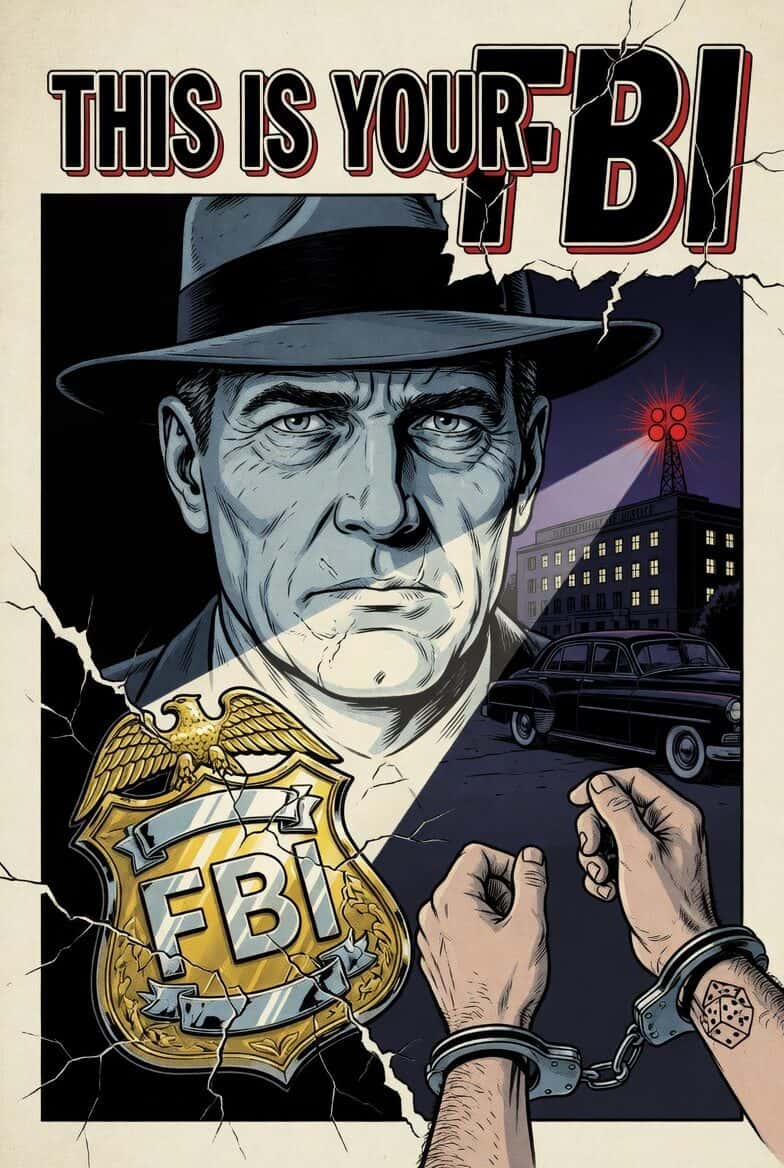
This is your FBI. This is your FBI, an official broadcast from the files of the Federal Bureau of Investigation, presented as a public service by the Equitable Life Insurance Society of the United States. To your FBI, you look for national security, and to the Equitable Society for financial security. These two great institutions are dedicated to the protection of you, your home, and your country.
Tonight, the story of a peril to the nation. Escape prisoners of war. There are several million Nazis across the sea. Each one of them is a threat to the security of this country. There are several hundred thousand Nazis right here within our borders, prisoners of war. Each one of them who escapes is a threat to the internal security of this country because they are Nazis. And for us? For our democracy, for our way of life, Nazis have but one feeling, contempt. The FBI proved that less than a year ago by a case that broke on the morning of June 19th. Early that sunny morning, two soldiers, two G.I.s, were walking through a patch of woods on their way back to camp. Hey, look at him, a rabbit. What am I supposed to do, salute? Gee, did you see him go, boom, right into the ground? Probably crawled down a hole to sleep. Gee.
He's just down a little hole. What are you pouring around for now? I always wanted to have a rabbit for a pet. All right, so you always wanted a rabbit. This is no... Hey, Eddie. Yeah? What kind of a rabbit could dig a hole this big? A big rabbit? Come on. Hey, these leaves are just covering up the entrance to a tunnel, it looks like. Be sick, Mickey. Hey, it is a tunnel. Come on in. I'm too tired. Oh, come on. What do you got to lose? Well, I really am tired. Where's your pirate spirit? And where's your rabbit? And don't tell me... What's the matter? It stops here, that's all. Oh, that's great. Now, I suppose we crawl back like a couple of brave pioneers. Wait a second.
Help me push this thing up. What thing? The roof here. Feels like boards or a trap door or something. Yeah, it does. Come on, push. I'm tired. Will you push? One, two... Eddie, close it. Eddie, you know where we are? Yeah. Right under the barracks of the Nazi prisoners.
That was on Monday morning, June 19th. But the tunnel had already been used. During the night of the 18th, two Nazi prisoners had escaped. That was in Texas. And immediately, the FBI headquarters in that state were notified by military authorities. They weren't caught unprepared because special arrangements had been made for such an emergency. And the special agents went to work immediately. The newspapers, the radio stations... And most important, the local police of Dallas and Fort Worth were notified and given detailed descriptions of the two men. The police radioed warnings to all sheriffs and all peace officers. And broadcasts were also sent out over the Texas State Patrol's network. By late afternoon, the FBI was busy checking the dozens and dozens of reports which kept coming in. Dean speaking. Yes? Yes. Yes, okay. Thanks a lot, Sheriff. All right. Well, that's another lead going, Phil. Which one?
Those two fellas spotted fixing a puncture on a back road. Those local police sure get on the job quick. Age 23. What? I was just reading over the description of Tanner. Oh. Lieutenant Paul Tanner of the German Navy. Captured when submarine disabled by death charge. Gene speaking. Yeah? Uh-huh. I see. Okay, thanks a lot. All right. Which one was that? Those two men seem sleeping in that cemetery. Bad lead? Yeah. Something's got to turn up, Dean. Yes, and you know when it does, Hackenberg's going to be easier to spot than Tanner. Because of that scar on his cheek? Yeah. Well, with the whole state out on the hunt, there's got to be... Dean speaking. Yes? Yes? Yes. Thanks. Right. Bicycle was stolen from a house one mile from the camp the night of the escape.
Bicycle? Yes, and the house was on the same road the prisoners took when they went on labor details. That sounds good. That sounds better than good. Two men on one bicycle. They ought to be easy to spot, Phil. If we can spot them before they get rid of the bike, let's send out a call. Right. Late that afternoon, a truck driver reported seeing two men on a bicycle on the night of the escape. An hour later came another call. A farmer had seen two men on a bicycle the morning after the escape. Then there were no more calls, no more reports. The search was intensified, but by 1 o'clock on the morning of the 20th, the two Nazis on the bicycle seemed to have disappeared, seemed to have vanished completely. Where were they? At that moment, at 1 o'clock on the morning of June 20th, they were sitting in a diner. Dressed in blue jeans and khaki shirts, drinking coffee, two escaped Nazis were sitting in an all-night diner in a small town in Texas, USA. You boys want anything with that coffee? No, thanks. You ain't from around here, are you?
No. Just passing through? Yes. Where are you heading? Um, east. East, huh? I know somebody's going east. Maybe we will have something else. Um, do you have any pie? Sure, what kind do you want? Oh, anything that's good. You pick it up. Yeah, trust me. Sure. Okay, two pieces? Yes. Okie doke. Whitey, let me have two cuts of that peach pie. Okay. Now, Whitey, now. I heard ya. Gee, I'm getting hungry myself. Scramble me up a couple eggs? I just ate an hour ago. I'm a growing girl. Scramble up the eggs, you cheapskate. Here's your pie. Thanks. Two of them eggs, too. Peach pie, boys. Don't you... I don't think we want the pie after all. But you ordered it. We have to go. Here. You didn't finish your coffee? Come on, let's go. Let's go. Good night. Here you come with those eggs, Whitey. I'll keep your shirt on. You'll get them. You can put this pie back.
What's the matter? Deep think. Didn't they want it? They didn't want nothing. They even left the coffee. Millionaires. Come on, make with the eggs. The griddle ain't hot enough yet. Hot just. You ring this up, I'll keep the change. How much? Dimes. You ain't gonna charge him for the pie, are you? I guess not. Hey, what those guys rush out for? Now, how do I know? The griddle looks hot enough to me. You want your toast, though, don't you? And coffee. Uh, how about a steak, too, your highness? Ha, ha. Very funny. Marty? Yeah? What's tonkishen mean? Huh? Tonkishen or tonkishine? What? One of those fellas said it to me when I brought him the pie. The pie he didn't eat? Yeah. I think I'll have a piece myself. Oh, here. Tonkishen. What? Maybe that's French for what's your telephone number? French.
Sounds more like German to me. Where do you get German out of that? Listen, when you want to say thank you in German dope, you say danke schoen. That's it. That's what he... Why did he... Holy crow. That diner was in a small town. But even the smallest town has more than one road leading out of it. And it's never long before a road branches into other roads, into a network of roads, into highways. As soon as the telephone call came in from the diner, the FBI and the local police drove out after the two men on the bicycle, after the escaped Nazi prisoners. They tried to cover all roads. They kept in touch with each other by radio. And they drove fast because they realized that even on a bicycle, a man can make time if he's desperate. Where are we now, Dean? About 20 miles outside of Van Court. Must be awfully strong. Hmm? Who? Whoever's pedaling that bike to get this far so fast.
And with a passenger. Yeah, if they're still using the bike. Or if they haven't ducked off into a field. Well, if they have, we should be able to catch them in the morning. The whole area's been alerted. They managed to disappear completely for at least 24 hours so far. I know, Phil, but if we... That is a bicycle, isn't it? Looks like it from here. You have your gun ready? Yes. Dean, do you see anybody on the handlebars? No. Don't tell me it's going to be a farmer out for a joyride. This hour of the morning? Say, pull over to the side there. Where are you going, mister? Vancouver. What for? Why do you want to know? We're federal officers. What's your name? Frank Johnson. Isn't it kind of late to be out for a ride, Mr. Johnson? Oh, my sister just had a baby. I rode over to see her. From where? Vancouver. You live there? Yes. Can we see your draft card, please?
I'm sorry I forgot it. You know how it is when you get a cold at the baby's. Samantha, where'd you get that scar on your cheek? Germany. Where's Lieutenant Tanner? I really could not say, but probably very well taken care of. What do you mean? Americans are extremely hospitable and just as stupid. I think you'd better get in the car, Hakenberg. Captain Hakenberg. Captain Hakenberg. Thank you, sir.
By morning, the Texas newspapers and radio stations had spread the report. One prisoner was captured, but the other was still at large. An escaped Nazi was still free, was still somewhere in the vicinity of Van Court, Texas. The cooperation of every citizen was requested, and the response was fast. Report after report came into the FBI and the state and local police. Report after report was checked and followed up. The most promising came from a doctor. Well, gentlemen, I was coming home from a late call and... Just as I passed that filling station outside San Angelo, I noticed a man climbing into the back of this truck. About what time was that, Doctor? Oh, I left the hospital at two. I guess that was about five after. What'd the man look like? Well, to tell the truth, I didn't notice him much or think much about it. I heard the radio broadcast about the escaped prisoners this morning. Thank you, Doctor. We appreciate your help.
That doesn't sound like much help. It doesn't even sound like a real clue. But the FBI checks everything, every report. Special agents immediately called the owner of the San Angelo filling station. He remembered selling gas to a truck driver a little after two in the morning before. But he'd only seen one man on the truck. From the gas coupon, the agents learned the license number of the truck. From the license registration, they learned the name and address of the owner. And then they went to him to see what they could learn from the truck itself. You can see for yourself, I'm here fixing the blowout like I was. Anybody could hop on the bag without me seeing them. Would be pretty easy, don't you think, Dean? Well, let's see if there's anything in the back to prove that Nazi was riding with you. What you looking for? Oh, lots of things. Fingerprints? Yep. But with all this cloth back here, I don't know if we'll find any. The surface is too soft. Phil, you have your flashlight? Sure. Shine it over here, will you?
Is that your hatchet, Mr. Lang? Yeah. Use it to open crates. You mind if we borrow it to send to our laboratory for a fingerprint check? No, sir. It's all... Hey. What? That Nancy could have been riding in the back of my truck and picked up my hatchet. Hey, I had a pretty narrow escape. We don't know yet whether he was the one. Even so... Wait a minute. Shine that flash over here, Phil. Right. Now, this may be something. That? Sure. What? That's just a little piece of thread. Here's an envelope for Dean. Thanks. This little piece of thread, Mr. Lang, is going to take a long trip to our laboratory in Washington. What for? They'll find out what kind of a shirt it came from. And I got a hunch it came from the kind of shirt worn by prisoners of war. The hatchet and the piece of thread arrived at the FBI laboratory in Washington on the morning of June 21st.
That afternoon, the result of the examination was teletyped to special agents in Texas. From a small piece of thread, from one fingerprint on the blade of a hatchet, there was proof, conclusive proof, that the hitchhiker on the back of the truck had been Lieutenant Paul Tanner of the German Navy. But where had he gone? Where was he now? An escaped prisoner of war, a Nazi, was still at large in the state of Texas.
We momentarily close the Federal Bureau of Investigation file of the case of escaped Nazi prisoners of war. We will return to this case in just a moment. It is the year 1872. A distinguished army officer, a young man with golden hair that reaches to his shoulders, is about to sign his name to an application for membership in the Equitable Life Assurance Society of the United States. The Indians of the Western Plains call him White Sheep with the Yellow Hair. But you and I will know him better by the name he is signing on the equitable application. So let's watch his pen as it writes, George Armstrong Custer. Brevet Major General, USA. A name that has also been inscribed for all time on the role of America's immortal soldiers. Now, we do not know what led General Custer to choose the equitable. But we do know that he showed sound judgment.
For in four wars and through seven major depressions, this society has never failed to meet a single financial obligation. And for 86 years, equitable funds have marched in the vanguard of American progress. Equitable dollars helped build the railroads. They promoted the growth of our greatest industries. They helped grow wheat in Minnesota, oranges in California, cotton in Texas. So by serving its members, the equitable serves America. And now... Back to the file on Paul Tanner, escaped prisoner of war. When a convict escapes jail or when a Nazi escapes prison camp, it is fairly easy to catch him during the first two or three days because the trail is fresh. But after that, just as rain can blot out footprints, the trail can disappear into nowhere. That's what happened to the trail of Paul Tanner, former lieutenant on a German submarine. The search continued all through the summer. Reports came in, but by September, Tanner was still free.
Where was he? Still in Texas. As a matter of record, he was working as a hired hand for a farmer named Allen. Working under the name of Gene Meyer. Working to get enough money to escape to Mexico. Gene! Gene! Yes, Dickie. Gene, look what I got done. Hey, Dickie, don't start pestering Gene with those model airplanes or whatever they are. But, Pa, we want to... He worked hard today and he wants to rest. Oh, that's okay, Mr. Allen. Let me see what you got done today, Dickie. Say, Jean, are you going to have to go back to that hospital? Oh, no. Merchant seamen aren't like Army or Navy. We're pretty free. Should I glue this on now? Uh-huh. That's right. Still, it's funny they let you do what you wanted after you got out of the hospital. What do you mean, funny? A little further down, do you think? Right. We're not making you go back to sea. I told you. I decided to work. Build up my health.
Well, I ought to just pray that they let you finish out the harvest. Every time the mail comes, I say, that's no model airplane. Whoever said it was, Pa? Anybody can tell it's a submarine. A submarine? Where'd you learn about submarines? Gene drew the plans for it. Oh, looks just like a picture one I saw. Are you ready? Oh, nuts. Come on, Gene. We'll finish after supper, Dickie. You wash your hands, Dickie. I did. Wash them again. Oh, Pa. That's a darn good submarine. I guess you... What's the matter? Well, I was going to say it's probably a model of a sub you was on yourself, and then I remembered. Remembered what? They don't have merchant seamen on submarines. Come on, let's see. Sit down, Mr. Allen. Oh, thank you, sir. Sheriff Holster said you might have some information for me. Well, I don't know for sure, sir, but I...
Well, I think my hired hand's that Nazi prisoner you've been looking for. What makes you think so? Well, he's been helping my little boy build model planes and stuff, you know. Yeah, sure. Last night I got a look at something they were making. It was from some plans this fella drew. And you know what the darn thing was? A submarine. Submarine? Yeah. And I got to thinking about it in bed last night. It looked just like the real thing, and I was wondering... Excuse me, Mr. Allen. Sir? Yeah, look at this photograph. Sure. Why? Why, that's him. Let's go, Phil. Is this his room, Mr. Allen? Yes, sir. Where is he now? Well, I left him cutting hay down near the river bottom. I think I'll go over there. Right, Phil. Doesn't have much stuff of his own, does he? Nope. Nothing you don't see. Except that little zipper bag there. Let's have a look at it. Sure. Here you are. I wonder where he picked this up.
That doesn't seem to be... What is it? Something in the lining here. A book. It's a diary. June 20th. We had a close call today. H completely forgot himself in a restaurant. He sure did. I am a soldier of the Reich, and I must get back to the fatherland. Did he write that junk? It's not junk to him, but to people like him, Mr. Allen. It's something a lot of us don't realize. Listen to this. These Americans are stupid fools. This miserable country will cry for help when the Fuhrer lets loose his secret weapons, and I will be there to help him. That fellow's crazy. Well, he's a Nazi. Dean. Yeah? He's gone. What? Not a sign of him in the field. He was there when I left. Did he see you go? Sure. Did he ask why you were going? I said for supplies. Guess he knew you didn't go to town often and got suspicious. He must have cleared out right after Mr. Allen did. Why?
There was a jug of water next to the mower, and it's full to the top. But where did he go? I don't know where he went, but I know where he was heading. Where? Galveston. He's got it in his diary. Thirty more dollars, and I'm ready to leave for Galveston, then Mexico. I guess he didn't wait for his thirty dollars. Mr. Allen, that river down there. Oh, we'd take you to Galveston, all right. Once I rode there, me and Dickie and... Rode there in what? An old frat bottom I had. Did you have it beached right near the hayfield? Yeah. I followed some footprints down there. Your boat's gone, Mr. Allen. And that Nazi in it? Yes. And if he gets to Galveston... Mr. Allen, I don't think he will. The Brazos River winds its way through Texas to Galveston. And along its banks are reeds, tall grass, foliage thick enough to hide a man in a flat-bottomed boat. They hid Paul Tanner for the rest of that hot afternoon. But by nightfall, sheriffs, deputies, state patrolmen, local police, and citizens from all around are joined in the hunt.
By nightfall, FBI agents were in planes and motorboats watching the river and keeping contact with each other by walkie-talkie radios. By nightfall, there was a moon, a bright moon that stripped the river of shadows and made it a clear field of vision for a plane flying above. Moving upstream toward the bridge. Nothing yet from up here. We're moving up too, Dean. But this boat's running low on gas. Well, you think you can hold out about... Wait a minute. Wait a minute, Phil. I just saw a reflection of moonlight on... Something that... Yes, there it is again. Looks like a wet paddle. Close to the right shore, heading downstream. About a quarter of a mile above Dead Man's Bend now. Just below Hempstead. He's moving closer to shore, though. Looks like he's trying to land. Come on. Give her everything you've got. He's trying to make sure. Cut her off. Stay where you are or I'll shoot. I warn you, Tanner, stay where you are or... Okay!
Come on, jump aboard. Well, you led us a fine chase. Who's in command here? In command? Yes. I am. Heil Hitler! At this moment, there are approximately 390,000 prisoners of war in this country. Most of them are Nazis, and each one is a potential threat to our safety. Alert citizens and cooperative law enforcement officers have aided your FBI in the quick apprehension of escaped prisoners of war. before they could commit army acts of sabotage. But they remain a menace. Any information on an escaped prisoner should be reported immediately to the FBI. A Nazi may have been a prisoner in this country for a year or for two years. He may have had a chance to learn something about us, about our democracy, about our way of life. Don't think, however, that his objective has changed. It hasn't. He is still a threat to our security, still a menace.
Because he is still a Nazi. In these days, young Americans are fighting and dying all over the world. So the question, what are you doing here at home to help win the war, is one that deserves a straightforward answer from every American citizen, from every American organization. Members of the Equitable Life Assurance Society of the United States may take pride in their society's answer to that question. In the Equitable Service Flag are 2015 stars. Here at home. Equitable agents and employees are backing up their fellow workers in the fighting forces by selling thousands of war bonds in every drive, by giving hundreds of blood donations, and by performing all the other services that are expected of patriotic citizens in wartime. Of the funds that have been entrusted to the Equitable Society by its members, 44% has been invested in government bonds. In both the fifth and sixth war loan drives, the Equitable made the largest single subscription, each subscription amounting to $500 million. In wartime, equitable dollars are fighting dollars, and at all times, they are security dollars for you, your home, and your country. The incidents used in tonight's broadcast are taken from the files of the Federal Bureau of Investigation. However, all names used are fictitious, and any similarity thereof to the names of persons living or dead is accidental. In tonight's cast, Tanner was played by Paul Mann. The music was under the direction of Van Cleave. The author was Lawrence MacArthur. And your narrator was Frank Lovejoy. This Is Your FBI is a Jerry Devine production. Now, this is Carl Frank speaking for the Equitable Life Assurance Society of the United States and inviting you to tune in again next week at this same time for this...
is your FBI. This is the Blue Network of the American Broadcasting Company.