
The written record
Read the transcript
Read along with the recording · About 20 min to read
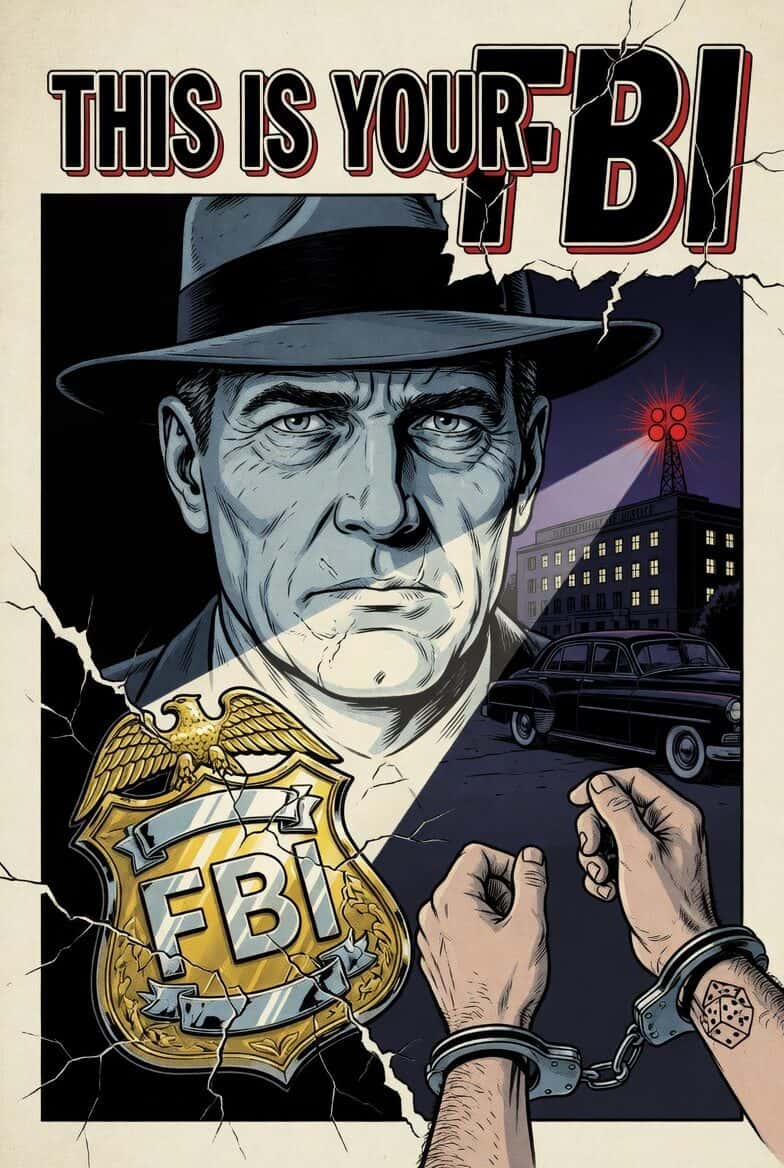
This is your FBI. This is your FBI, an official broadcast from the files of the Federal Bureau of Investigation, presented as a public service by the Equitable Life Assurance Society of the United States. To your FBI, you look for national security. To the Equitable Society for financial security. These two great institutions are dedicated to the protection of you, your home, and your country. Tonight, the story of a crime against society. Murder. In the crime-mad era of the 1920s and early 30s, state boundaries proved haven for the gangster criminals who plagued the nation. Law enforcement agencies had to rely upon complex systems of extradition to bring these lawbreakers to justice.
But since 1934, since Congress gave the FBI jurisdiction to track down these fugitives, to skew them across state borders, this type of roving criminal has almost disappeared. For the criminal, there is now no refuge in flight. The proof of this? A man who called himself John Dixon is an excellent example. His flight began in a city in Florida, in a well-to-do home in that city, in fact, in the living room of that home. You go ahead and put on the light, will you, dear? Okay. Double pieces always wear me out. We should stop that way before we left. I've always... Just stay where you are, folks. Fred! Quiet, lady. Who are you? I was just doing a little work here. I'm afraid you came in at the wrong time. Fred, he's a burglar. Lady, I told you to be quiet. Sometimes I get nervous with a gun in my hand. Nothing. You're very smart. Now, just come in and sit down. Very well.
The grades are down. We couldn't be disturbed. Now, there's just one other precaution I think I'd better take. There's some cloth and adhesive tape on that table there. I brought it along just in case. Well? Your wife will use it on you first. You won't mind it. Come on. Put it around his mouth. No idea. Did I hear you say you're a friend of the movie? Yes. What's the thing? I don't remember. It just puts the adhesive over the cloth. Like this? Yes. Have you seen the new Crosby picture, Central? No. It's, uh... I caught it last night. Is that too tight for you? Leave it that way, lady. That's... Poor darling. Now, I'm afraid I'm going to have to give you the same thing. Oh, please. Sorry, lady. Oh, no, please. I always hate to do a job this way. Oh!
Let's stay still. Let's go home 15 minutes later. We've been out of here. And we wouldn't have had to go through all this. There you are. Now, if you'll both sit down. Right over there, we do. Come along. A few of your possessions in that bag. I'm afraid I'm going to need transportation, too. Have you your car keys, sir? Which pocket? Fine. Now, why don't I sit down with you? I have one little... Farewell drink. Leave. With the crime committed, the criminal's flight begins. It's a casual flight at first. He feels secure in the knowledge that his victims are helpless, but they cannot report him for many hours. So he drives north in their car, drives on a main highway, drives to a refreshment stand on the outskirts of town. Good evening. Oh, hi, Max. Can I get something to eat? Sure. How about a hamburger? Sorry, Max. Meatless day. Cheeseburgers? Fine.
Huh? I said fine. That's what I thought you said. I just ain't used to hearing it anymore. Everybody's got complaints. All they do is speak. All the time, speak. Oh, it's not yours, is it, Mac? Yes. Why? Do I see your registration? Of course. It's in the car. Come on, I'll get it. Is there any trouble, officer? Yeah. This car was reported stolen. Well, a real mistake. I've been driving it all day. I still want to see the rich police. Well, then, we must love some fun. Here we are. Hey, what happened? Cancel my order. Max? With the crime of robbery, the fugitive is out of the crime of murder. A two-shot killed a policeman who sought to question him regarding the ownership of the car. The flight is not so casual now.
John Dixon abandoned the stolen car and hurriedly went to a nightclub on the outskirts of the city. Hello? Hello? Oh, hiya, honey. When did you come in? Just now. Kind of late, aren't you? I just came out to see you. Oh, I'm not singing any more tonight, baby. In fact, I was just on my way home. Well, maybe we can stop off for a bite to eat someplace, huh? Yeah, do you think I'd be okay? Fine. You have a car, don't you? Yeah, don't you? Come on with me. Salomine dropped me off here. Well, we can use mine. Ready now? Sure. Let's go then. Say, you know something more? What? I forgot your name. Dixie. Johnny Dixie. Oh, dear. I should have remembered that, but so many fellas come out here and all. I understand. Go ahead. I'm parked right over here. Okay. Hey, what a night. Yes. Beautiful. You from around here? No, I'm from up north. Oh.
Sure, you told me that last night, didn't you? Yes, I believe I did. So many fellas tell you so many stories and all, you know. I understand. We are. Do you want to drive? I'd rather not. Okay, how about it? Thanks. I asked you if so many fellas like to drive and all. I guess I'm the exception. You can say that again. Now, where to? I suggest that you drive north. But there's some good eating places up there. I would drive north. Hmm? What would I say? Not just a minute. Look, do you see this gun? Yes. I killed a cop with it. Be a good girl and drive north. Hmm? I said, are you tired? Yep. Sorry, I can't relieve you of driving. I just think it's better this way. For you, maybe. What time is it? Almost 4 a.m. Tell me something, will you? What? Is this a regular business with you? What do you mean? Killing people, cops.
No. Why'd you do it? He tried to interfere. What with? I was driving a car. It wasn't mine. You steal cars, too. Yes. I'm quite physical. You sound like you were proud of it. I am. You stick to singing, don't you? Well, there's not a great deal of difference. What do you mean? We both enjoy prominence, being in the public eye. Kidding. Not at all. You're undoubtedly... when you see your picture in the paper? Well, I am, too. You got a press agent? No. But my picture was in Food Detective magazine three times last year. With numbers under it. Still satisfying. Okay. Wait a minute. What? That's the bus up ahead there. Yeah. When you pass it, stop. You mean you're getting out? Yes. According to the gauge, your gas tank's just about empty. Hurry up and pass it.
Mister, that'll be a pleasure. John Dixon left his car, left his unwilling companion after crossing the state line into Georgia. This was a mistake for him. A costly mistake, for he was now under the jurisdiction of the FBI, as are any and all criminals who cross state lines to avoid prosecution. Exactly one hour after Dixon left the nightclub singer, she was telling her story to special agents of the FBI. Did you see that bus, Miss Harvey? Yeah, sure. Can you describe it? Well, it was an interstate bus. Was there any sign on it telling where it was bound? I didn't see any. It was heading north, though. And this was a little after 4 a.m. Okay. I'll stick with the bus terminal here, see what they can do. All right, Nick. He sure had plenty of nerve. How did you meet him? Oh, he'd come into the club a couple times. Do you recall who introduced you to him? Nobody, really.
In my line of work, you meet so many fellas and all. Do you seem to know anyone else in the club? No, I don't think so. Have you ever been out with him before? No. The name he gave you was John Dixon. That's right. Probably an alien. I wish I could describe him for you better, but like I said before, he looks just like a hundred other guys. That's the same report we received from the couple who was filming, Rob. Did they give you anything? Yes, a good deal. That bus is bound for Savannah. Are you sure? Yes, and it's fresh. It doesn't make any sense. Well, that's a break. How do you mean? We're going up to the Savannah field office tonight. We have tickets on a plane that leaves here in exactly 15 minutes. No, kid. We'll teletype a report ahead, but it's just possible that we might reach Savannah in time to meet Mr. Dixon in person. I wish we had more to go on. His description, I mean. Well, if he flagged a bus down on the highway, the driver should recall him. This could be it now, yes. Let's stand over here. Not many passengers.
Can't be more than a dozen. No. This is Savannah. Last stop. I see nothing but women. Uh, two soldiers there. Yes, but no other men. Uh, driver? Yeah? We're special agents in the FBI. Here are my credentials. Oh. Well, what can I do for you? We're looking for a man. He boarded your bus on the highway about 30 miles north of Jacksonville. This bus? I believe so. It's a little after 4 a.m. Well... It was there a little after 4 a.m., but I didn't stop this bus for nobody. We momentarily close the Federal Bureau of Investigation file on John Dixon, murderer. We'll return to this case in just a moment. Let's open the dictionary to the letter S and look for the word society. Let's see. S-O-S-O-C. Oh, yes, there it is. Society. And the dictionary says that society means...
a voluntary association of individuals for common purposes. Well, that certainly describes the Equitable Life Assurance Society of the United States. The Equitable Society is a voluntary association of 3,200,000 men and women. The idea that led this group to get together is very simple. We of the Equitable Society believe that 3,200,000 pairs of shoulders are a lot broader than one pair. Our common purpose is to combine our dollars into a common protective fund which gives each of us far greater security than he could achieve by his own unaided efforts. In our dealings with the equitable, we members receive the friendly service and personal attention that the word society implies. Moreover, since we are the sole owners of our society, we know that equitable funds are at work for our benefit.
And because the Equitable Society's investments cover America, they are at work for our fellow citizens, too. By serving its members, the Equitable Society serves America. And now, back to the file on John Dixon, murderer. A fugitive, a clever fugitive, can find many ways to elude the law. He can travel on railroads, buses, cars, trains. He can move swiftly from city to city, from state to state. But the FBI moves swiftly, too. And with the invaluable aid of local police agencies and law-abiding citizens, they contract the cleverest fugitive down. The man who called himself John Dixon was extremely clever. His failure to board the bus, his complete disappearance, was proof of this. Returning to Jacksonville, a special agent sent for the woman who traveled with him, the nightclub singer, and questioned her again. Look!
I didn't really see him get on the bus, but what else was I saying? Naturally, presumably, it was. Naturally. We found out now that he didn't. We have to look for other leads. Oh, I got no idea what happened to him. I thought of what I told you. Miss Harvey, we're trying to set up something definite to identify him by. Perhaps you can contribute to that. I already told you what he looked like. Yes, I know. But this time, see if you can recall some things he said. We've already given his description to the authorities. Bronson. That's the closest good-sized town after you let him off. Did they see him there? Had no word. What did you talk about on that ride last night, Miss Harvey? Him, mostly. Yes? Sure had a thing for himself. Fragging, was he? Fucked all the time. Can you remember anything specific? No. Being a larceny guy was a career with him, he said. He mention any other jobs he'd done? No. Well, why did he refer to the career?
That was because he thought his work and my work were alike. I see. It was all puffed up because his picture had been in True Detective magazine three times last year. His picture was in True Detective three times? That's what he said. In one year? Yes. Well, that could tell us who this boy really is, Nick. Yeah. See if we can get back copies of that magazine. Harvey is going to help us do a little research.
The idle remark, the boasting remark made by the man called Dixon to the nightclub singer brought results. In copies of the detective magazine, one man's picture did appear in three issues. The girl identified him as Dixon. There was text accompanying these pictures, text that saved the FBI agents much time in determining the killer's true identity. They learned that his criminal record was a long and vicious one, that he had changed his name many times, that he was also adept at changing his complete identity. This was a valuable lead. This was something specific. This was what sent special agents to all clothing stores in Brunswick, Georgia, seeking knowledge of Dixon's whereabouts. Finally, in one store... Let's see that picture again, Charlie. There you are. Yeah, that's the fellow, right? You're sure of that? Yeah, positive. And he came in here yesterday? That's right. Around noontime. What did he buy? A blue suit and brown felt hat and...
Oh, yes, the top coat. Can you describe the coat? It's a brown tweed, just like that one hanging on the rack there. What did he do with the clothes he was wearing? I took them with him, had me wrap them up for him. I see. He said he wanted them wrapped for mailing. Did he say where to? No, and I had no mind asking questions. Why not? Well, I noticed when he rolled his clothes up for packing that he put a gun in the bundle, too. Hey, clothes. A clue that is 24 hours old. In 24 hours, a man can cross and recross our continent. But still, there was now a clue. The special agents, armed with Dixon's complete description, visited all transportation centers in Brunswick. At the railroad station, they came up with a lead. The day before, a man they believed to be Dixon had inquired about trains to Atlanta. When informed that one did not leave for many hours, he inquired where he could hire a car. He was sent to a garage. Look at this picture.
That's the lad? Sure, that's him all right. He told us his mother was dying and he had to get out of town. Did you rent him a car? No, no, he couldn't do that, but he got up to Atlanta anyway. Ah. Well, we got him a lift with Doc Whitney. The doc was driving up there in his ambulance. Sure, I remember him. He was a pleasant enough fella. And you drove him right here to Atlanta? I drove him right to the airport. Where was he bound for? Chicago. How do you know? Well, I put him on board the plane.
Yes, I remember him. He occupied seat five on yesterday's run. Did you talk with him? Mm-hmm. What about? Well, he said his mother was dying, and he inquired about the flight to Omaha. Did he say he was going there? He wanted to, yes. I sold the ticket to a man yesterday. He looked like that picture all right. He went to Omaha? Yeah, on a nine o'clock flight. Did he say his mother was dying? Yeah, but his name wasn't Dixon. It was Snyder. That's an alias he frequently used. Well, he should be in Omaha right now. That's the story, Mr. Bryant. He arrived here in Omaha late last night. Yes, he was on the 1235 flight. And did you report on him at the airport? He took a taxi into the center of town. Do you know? We contacted a soldier who was on the plane. Yes. The soldier reported that he'd ordered a cab. He sent word ahead to have it waiting. Yes. When he got into it, a civilian climbed in after him. His description had to be Dixon. And this soldier stopped him off downtown? That's right.
What makes you think that his flight has ended here? All the conversations he had along the way with ticket agents and other airline employees indicated that this was his destination. Very well. We'll do a complete check on him here at once. In Washington, Director Hoover instructed that no effort should be spared to locate Dixon and bring him to justice. Constant checks were made at the airport, railway, and bus stations, but no further information was developed. Special agents visited hotels, tourist camps, and boarding houses in an attempt to pick up the trail. It appeared quite likely that Dixon had stopped his desperate flight in Omaha and was somewhere in the vicinity. Relentlessly, the investigation continued. A double check was made at communication centers. Long-distance toll calls were examined. Dixon's photograph was shown to Pullman conductors, Beard's cabin operators. A crew of agents made regular rounds of nightclubs, but no trace of him was found.
Once more, Dixon had completely disappeared. Just a dead end, Nick. I know. He could only uncover something. Ferris is kind of a lead. You're still convinced that he's here in Omaha? Yes. Everything points to this being his destination. True. I don't even think he's hiding out. I can't suspect it for the first time. Excuse me. Warren speaking. Oh, yes, Frank. Yes, I see. What was this? He'll have the place covered. Good. Thanks. Goodbye. Well, there's a lead you wanted, Roy. What? A waitress in the coffee shop at the Rome Hotel identified a picture of Dixon. Really? Had breakfast in there yesterday morning. Okay. Someone's going to cover the place from now on. Nick. Yes. That's the letter. What? The package. The package Dixon had wrapped for mailing in Brunswick. Yes. This is his last stop. He could have had it sent here. Yes. Cover the post office and express companies at once.
Stop orders were placed in the post office and express companies against every name Dixon had ever used. The express company notified the FBI that a package had arrived that morning addressed to a John Snyder, one of Dixon's many names. Special agents sent to cover the express office found that the package had been sent from Chicago, Illinois the day Dixon had been there. This looked open and shut the end of the trail. But a week passed, a week of endless waiting, and Dixon made no effort to pick up the package. Dixon was in the city. The FBI was reasonably sure of that. It would have to be a matter of time. Hmm. Tired, Nick? Tired of waiting. Why don't you go out and get some lunch? I'll stick around here for a while. Yeah, maybe I will. I'm sure that if we... How do you do? Well? I wonder if you have a package here for me, please. What's your name? Snyder. John Snyder. I see. This is it. Yeah, come on.
Dixon. What? That's your name, isn't it? No, I'm sorry. Now, there's a package here for you, Mr. Carter. Thank you. Just a minute. Look, I told you my name wasn't Dixon. You're wasting your time. Who are you? We're special agents for the FBI. What do you want with me? We'd like to talk to you about Florida. I've never been there. In fact, I... Hold it. Do me. Hold it. I just remembered. We heard there was a gun in that package. Would you pick it up, please, Nick? Right. Come on, Dixon. There are few heroics in the FBI. They depend on superior brain power, manpower, and firepower. They will never rest in their crusade to make crime an unprofitable business. No clue is too obscure, no time too long, no detail too small for their attention. Their entire resources are available at all times to all local law enforcement agencies and to you.
the law-abiding citizen. This combination cannot be beaten. Many have tried it. To date, few have succeeded. You'll hear about the disposition of this case in just a minute. Imagine the entire area of New York City's Manhattan Islands, 31 square miles covered with four feet of oil. That's the total amount of petroleum product. Fuel oil... lubricating oil, aviation, and motor gasoline supplied to the Army in 1944. Requirements of the U.S. Navy have been equally staggering. So will you join the Equitable Society in a salute? A salute to the men of the petroleum industry. By working this miracle of war production, they have proved that no job is too difficult for the men and women of America and for the system of free enterprise that flourishes in America. For many years...
Funds of the Equitable Life Assurance Society of the United States have aided in the development of the petroleum industry. Equitable dollars help drill the oil wells, help rear the derrick, help build the pipelines through which the lifeblood of modern warfare flows toward the fighting front. In wartime, equitable society dollars are fighting dollars. And at all times, they are security dollars. For you, your home, and your country. Dixon, returned to Florida and turned over to local authorities, was convicted of murder in the first degree without recommendation for mercy. The incidents used in tonight's broadcast are taken from the files of the Federal Bureau of Investigation.
However, all names used are fictitious, and any similarity thereof to the names of persons living or dead is accidental. Tonight, the music was under the direction of Van Cleef. Our narrator was Frank Lovejoy. This is your FBI is a Jerry Devine production. Now, this is Carl Frank speaking for the Equitable Life Assurance Society of the United States and inviting you to tune in again next week at this same time. For this is your FBI. This is the American Broadcasting Company.