
The written record
Read the transcript
Read along with the recording · About 19 min to read
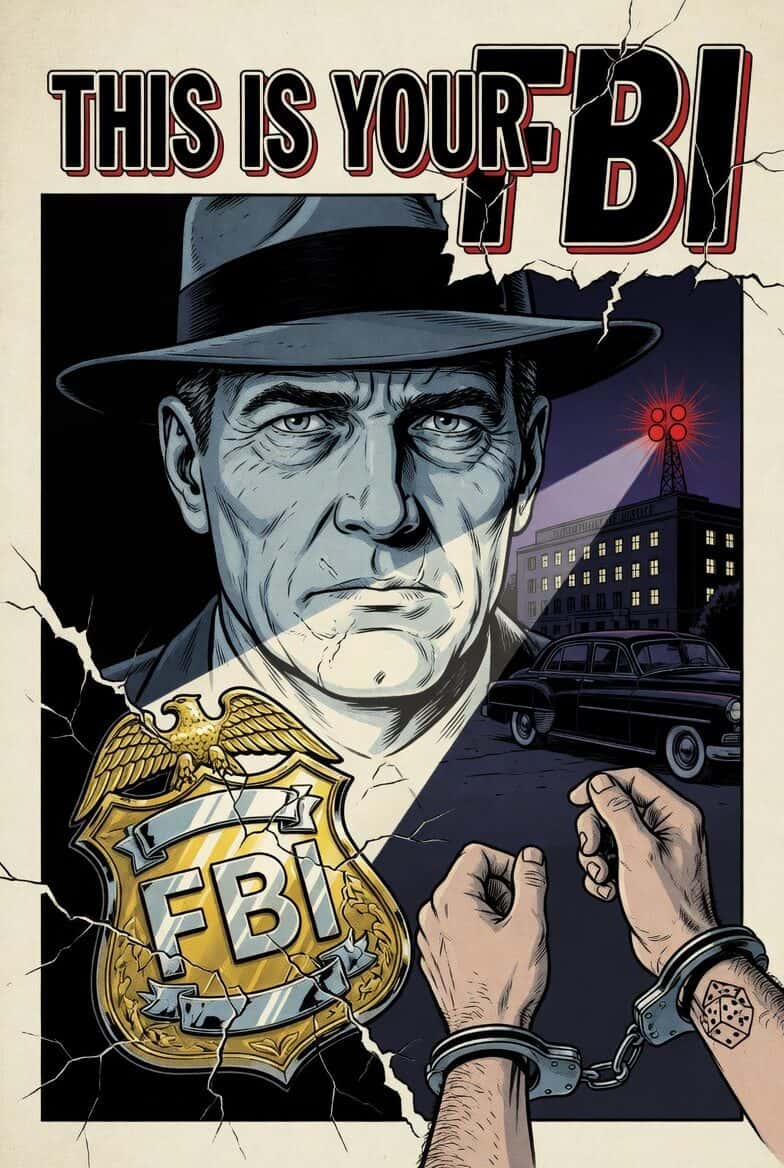
In the course of an ordinary year, your FBI handles big cases and small cases. The important thing about tonight's case is not the sum of money involved or even the people involved. The important thing is that the FBI took as much time and effort as it did in this comparatively minor infraction of the law. This is T4Y, opening the doors of the Mystery Playhouse. For tonight's story called Robert Perry, Impersonator, we have opened the files of your FBI. Our story tonight opens in a tourist cabin on the outskirts of a small town near New York. It's early in the morning and a pleasant, white-haired old lady is talking to her son. Robert? Huh? Can...
Can I help you with anything? No, I'm all set, ma'am. Come here, let me look at you. Okay. Well, nice and neat. Just straighten your tie a little. Sure, ma'am, sure. You must always look your best before you go out to do business. Sure. That was one of your father's rules. That was one of the reasons he was such a grand success. How's the tie now? Oh, that looks fine. Well, I'd better get going. Uh, wait, Gun. Huh? You... You'd better take this along with you. Gun? Yes. What do I need that for? It was your father's gun, Robert. But, Mom, it's not that kind of a job. I want you to take it anyway. Your father always carried it when he began a new venture.
He was so sentimental. Okay, let's have it. That's a good boy. I'll see you later, Ma. Robert? Huh? You forgot something. What? Come here, son. Have a good day, Robert. Yes, sir? You're John Gordon? Yeah. My name is Perry, government inspector. Government? Oh, well, come on in. Thanks. Emily? Yes, John? Emily, this is Mr. Perry, government inspector. Oh. Oh, this is my wife. How do you do? How do you do, Mr. Perry? Well, what can I do for you, sir? I'm afraid I have some very bad news for you two. Bad news? It's about those white leghorns you had delivered yesterday. Yes? I took a few from the crates as they were being unloaded and sent them out to the laboratory. Well, what's the bad news? Well, I'm afraid we're going to have to condemn all of your chickens.
Condemned them? Why? Two of them showed signs of tuberculosis. Oh, no. That couldn't be. Our reports are never wrong, Mr. Gordon. Couldn't the chickens be treated? Fixed up some way? I'm afraid not. What can we do, Mr. Perry? Well, you can sue the people you bought them from, and the government service will stand behind you. Oh, by the way, have you got a lawyer? No. We haven't any money either. That's a shame. Well, I'll tell you what I'm going to do. Both look like honest people. I'll loan you enough to retain a lawyer. Well, now, Mr. Perry, I... Hey, let me make you out a check. Well, now, I don't think you... Well, really, this is really very nice of you, Mr. Perry. Mr. Perry, I don't think we ought to... There. There's my check for $50. You can pay me when you get your money back for the chicken. Oh, I don't know how we can thank you, Mr. Perry. Oh, don't mention it. Oh, and Mr. Gordon, have you got a man around the farm who can help me load the chickens out of my truck?
No, but I'll help you myself. Come on, Emily. Mr. Perry helped us. Now let's us help him. No one was to blame because this petty crook had successfully impersonated a federal official. No one was to blame, but it was important that Robert Perry be apprehended. Because his brazen theft had been a sudden catastrophe for the farmer and his wife. Had wiped out ten years of hard work. Because women are more suspicious than men. It was Emily Gordon who telephoned the FBI. Telephoned them and told her story. A short time later, Emily and John Gordon were at the FBI's New York office. This man impersonated a government inspector, Mr. Gordon? Yes, sir. That's what he said he was. Will you try to give me as much of a description of him as you can? Well, he was about 40 years old. And he was kind of sucky, John. Yeah. How tall would you say he was? Uh, about...
Five feet ten. And he wore glasses. Only when he wrote a check, Emily. Oh, yes, I remember that. How about his hair and his clothes? What was he wearing? Well, he had kind of brown hair. He was wearing a blue suit. How about the truck he was driving? It was a 1940 Chevrolet. How do you know so exactly? Bill Miller up the road from us has one. Mr. Perry's truck was painted brown, and he didn't have any writing on the side. This is really asking too much, but... You didn't happen to notice the license plate number, did you? Oh, no. Oh, I did. I don't know what the whole number is, but it started with a one and a three and a five. Yes, that's it, I'm sure. One, three, five. Well, that's fine. That'll be a big help. Hi, Dad. Come on in, Bill. Got anything? Your hunch was right. I called the bank. No one named Robert Perry has an account there. I guess we'd better send out a teletype. Yes, alert all retail and wholesale chicken dealers within 100 miles.
Send Perry's description and a description of the truck. Right. Maybe we can give Mr. Perry a little indigestion from too much chicken. Driving too fast for you, Mom? Oh, no, no. Were you dozing off, Mom? No, just thinking. About what? About your father. Oh, he'd have been very proud of you today, son. Thanks, Mom. You did a fine job. Now, isn't this better than passing checks? Yeah, I guess it is. Those places where you were passing checks were always looking for dishonesty. That's because they were dishonest themselves. Uh-huh. Yes, your father always said, if it's larceny you're thinking of, you're much better off dealing with honest people. One thing bothers me, though, Mom. When I passed a check, I had cash. Now we got chicken.
What do we do with them? We drive to Waterbury and sell them. That's easy, isn't it? Yeah, but who do we sell them to? Oh, don't worry about that. Why, have you got a customer? Certainly. When I was in Waterbury yesterday, I took care of that. I told the man I had some chickens to sell. Told him I was closing down my farm. Didn't he ask you why? Yes, I told him. that my son was going into the army, and I had to tell Al, you see. Mom, I guess you're the smartest mother a fella ever had. Fortunately for the FBI and all other law enforcement agencies, the human brain has channels, and ideas tend to run along the same line time after time. It accounts for the odd fact that some thieves, like Robert Perry, love to pass bad checks. Bad checks are always returned.
And this bad check was to haunt Robert Perry. For the next morning in the New York offices of the FBI, Special Agents Baker and Webster were looking at a report from Washington. A report on Robert Perry's bad check. How far back does he go? Over ten years. Caught once in the very beginning. That's how he happened to have this much of a record. Did three months. Since then, he's been working in spurts. Anything else besides a bad check? No. Kind of puzzles me. This isn't his kind of a job. His father may be, yes, but the old man's dead. His father was a thief? Yes, his mother, too. Well... Mr. Perry can trace his family three all the way back to Alcatraz. Hello, Baker speaking. You have? Good. Where? Waterbury. Hold on to it. We're leaving now. Come on, Bill. What's up? The Waterbury police have picked up Perry's truck. Grab your hat and let's get going. Hello, Sergeant. I'm Baker, New York Office, FBI. Oh, how are you? This is Bill Webster. Hello, Sergeant. How do you do, sir?
Well, gentlemen, somebody just called to claim the truck. Harry? No, a legitimate fellow. Who is he? A chicken dealer named Crawford from right here in Waterbury. How did he get a hold of it? I'll let him tell you that. He's right in here. Mr. Crawford? Yes? Mr. Crawford, these gentlemen are special agents of the FBI. How are you, gentlemen? How do you do, Mr. Crawford? Would you mind telling us how you happened to get hold of that truck? I bought it. Same time I bought the chicken. From who? A real nice old lady. She came in to see me on Tuesday. Said she had to sell her farm because her son was going into the army. She reminded me of my mother. Nice old lady. Bill. Hmm? I think this nice old lady is Perry's mother. Yeah. Mr. Crawford, it's very important. Was there a man with this nice old lady? Yes. Did he look about 40 years old, pretty stocky, about 5 feet, 10 inches tall, wearing a blue suit? Did he have brown hair? Yes. That's the fellow who was with her. Where did they go?
Why, after I bought the truck, the old lady asked me if I'd drive them to the railroad station. What train did they take? Did you say where they were going? They took the 521 out of here. She said they were going to New York. They're in New York by now. Well, we better get down there before that nice old lady sells somebody the Brooklyn Bridge. In every case the FBI works on, the criminal has the advantage in the beginning. That advantage is the element of support for the one who calls his shots. Once a crime has been committed, though, the FBI begins to move, begins to close the doors of escape. But first, they must find the criminal. In a city like New York, a city with seven million population, it is almost impossible to find two inconspicuous people, two people like Robert Perry and his mother. It is almost impossible to locate them in New York if they are in New York. It is impossible to locate them in New York if they are, as Robert Perry and his mother were, in a small tourist cabin in southern New Jersey. Well, Mom, the weatherman is on our side. Yes, it's a beautiful day. I think I'll go swimming. Mr. Haskell got his delivery of chickens yesterday, son. Oh, Mom, let's take a little rest. Not on vacation, son. Haskell is an apple on a tree. We can pick him whenever we want. Your father always said strike while the iron is hot.
Now, those were different times. Times never change in our business. Now, look, Mom, why don't we settle down someplace? I can't settle down. Why not? Well, I never want to stay in one place that long. But you're getting older now. Your father always said a person's as old as he feels. Okay, I guess I'd better go to work then. Uh, son. Huh? I, I meant to talk to you. What? I found a checkbook in your blue suit. Mom, I haven't cashed a check. There was one missing. Oh, I gave it to that farmer up in Connecticut. Why? Well, I'm so sorry for him. He didn't have any money to hire a lawyer. But, son, you left a calling card. I asked you. You asked me not to cash any checks. I didn't. I gave one away. Well, well, it's done now, and...
Your father always said there was no point in crying over spilled milk. I'll see you later, Mom. Robert? Huh? You forgot something. What? Come here, son. Have a good day. It is impossible to help some people. A sign will read, wet paint, but some people get paint on their clothes. A sign on the highway will read, slow down, curve ahead, but some people get killed. A warning is issued by the FBI. But some people, some stubborn, self-sufficient people, get robbed. You've seen cards with a criminal's picture and his description. Those cards are called identification orders. Despite the fact that every chicken dealer in the East had gotten an identification order on Robert Perry, he was not caught. Twice in the next month, Perry and his mother worked their swindle again.
And the New York offices of the FBI, Special Agents Baker and Webster were going over the latest report. I don't understand why those identification orders didn't work. Both farmers got them. They admitted that. Yes, and he followed the pattern exactly both times. He's always been a government inspector, and the chicken disease has always been tuberculosis. And don't forget Mom. Good old Mom has always sold the chickens because her son was going in the army. I don't know how we can make it any easier for the farmers. We can't. Unless we tell them not to answer the door. Of course, the people who get stuck are not the farmers. They get their chickens back. The legitimate chicken dealer who buys the loot, all he winds up with is a truck. That's it. What? The truck. That's the angle we've been overlooking. What about the truck? It's a legitimate purchase every time. You're right. Every time Perry sells one of the trucks, he and his mother come back down to New York. That means they're buying their trucks here. I think we've got something, Dan. Yeah. Got one of the Perry identification orders in your desk.
Yes, but we'll need more than one. No, let's not take another chance that people won't read them. What are you going to do? I'm going to call on every second-hand truck dealer in New York. I'll go with you. Okay, let's move. For three days, three long, weary days, Special Agents Baker and Webster interviewed truck dealers. The response was always the same. Sorry, like to help, but never saw the man. Sorry, I never saw the man. Then, on the fourth day... I know this is the right way to do it, Dan, but if we don't find Perry's trail pretty soon... I know. I keep seeing secondhand trucks in my dreams. Here's the used call-out. Yeah. I'll get out on your side. Okay. That looks like someone in charge. Yes, gentlemen? How do you do, sir? My name is Baker. I'm from the FBI. The FBI? Yes. Here are my credentials. All right. I see. This is Mr. Webster. How do you do? How do you do? If this is an investigation of some sort, gentlemen, I run my business...
Clean. No black market. We're not checking on black market operations. Take a look at this picture, Mr. Turner. Ever see that man before? I think so. His face is familiar. But I see so many people. Try to remember. If he was here, it was probably with a nice old lady. Oh, sure. I remember them now. You do? When were they here? Well, let's see. Today's Friday. He was here Wednesday. That's it, Wednesday afternoon. Did he buy a truck? Mm-hmm. Paid me cash, too. Lucky. What do you mean, lucky? Sometimes he pays by check. I see. No, he paid me cash, and they drove right out of here in the truck. They didn't by any chance say where they were going. No, they didn't. Now, wait a minute. Yeah? I'm trying to think. He asked me for the best road to Albany. Albany? Yes, sir.
Thank you, Mr. Turner. Oh, not at all. Then let's whip down to Grand Central and grab the next train north. Right. A woman's place is in the home, so let's find a home for Mrs. Parrott. Albany, New York, has been an important American city since the completion of the Erie Canal in 1825. It is the capital of New York State, has a population of 561,000. It is a city of steep hills and lovely scenery. And on the outskirts of Albany, you'll find lush farmland. Lush farmland and lots of chickens. In addition to all of these things Albany had on this particular day, in the FBI field office, two special agents, two hard-working agents named Baker and Webster. Hi, Bill. Hi. Have any luck? No. I checked the local police and they haven't spotted Perry's truck yet. I went up to the Chamber of Commerce and checked all of the big chicken dealers by phone. No luck either. Well, where do we go from here? I think we've got all the holes sealed up.
Let's just wait for Perry to try to get through. Maybe we'll get some help from the identification orders. Could be. We've certainly sent enough of them out. Sometimes it looks as if the people who get the I.O.s must make their ads and tear them up. Bill. Huh? We're missing a bet. What's that? I.O.s are also put up in railroad stations. That's what made me think of it. Think of what? We ought to be at the railroad station, not here. Why, to catch Perry as he's leaving town? No, but you remember that first farmer, Gordon? That was a thousand years ago. What about him? Remember, he said that Perry told him he had seen the chickens unloaded at the railroad station the day before. Yes, and he must have been telling the truth. Right. Otherwise, he wouldn't have known about the delivery. Well, I've got a hunch that Perry's waiting for us. Never saw this fellow, huh? No. We don't let anybody hang around this platform unless they got business here, Mr. Baker. Have you had any really big deliveries of chickens the last few days?
Well, I guess so. I'll have to look it up. From Thursday on. Thursday, huh? Well, let's see. Well, here's one. A couple here. There's another batch here. Two more here. Let's see. That's 15. 15 altogether. Let's copy down the names and addresses of the farmers. Right. Then we'll make a tour. If we get lucky, we're overdue. We can only get lucky. We'll be waiting when Perry knocks on the door. That's one date I don't want to stand up. Well, it worked again, Mom. Hey, it will work every time, son. It's foolproof. This last one was the softest touch yet. Yeah, and they're the best-looking chickens we've gotten, too. What do you say we take a little vacation after this one, Mom? All right, son. Good. Where do we go? Oh, Niagara Falls. I wanted to go there with your father, but...
He was always too tied up with business. Not Niagara Falls, ma'am. Well, why not, son? It's lovely up there. I've seen the postcards. Buffalo Cops, ma'am. I'm hot up there. Oh. Oh, yes, I forgot. Well, there are plenty of other places. Of course. How about California? I'd like to go there. Oh, no. No, I'd always be thinking about your father if we went to California. He was at San Quentin. Well, we've got time to think about that after we get back to New York. You know, I think we ought to stay right in New York. Why? Well, the papers have been saying that it's unfatriotic to take long trips by train. They need the space for soldiers. Well, maybe you're right. Maybe we'll stay in New York. What? That car. It's forcing us off the road. Be careful, son. It's not forcing us off the road, Mom. They want us to stop. Have you been speeding? No, Mom. Pull over, Perry.
Okay. What in the world is this, son? Come out of there, Perry. You too, Mrs. Perry. Who are you? Special agent for the FBI. What do you want with us? Well, you and your son seem to like chicken so much. We're going to do you a favor. What is it? We're going to arrange for you to be sent to an institution. A place where they have chicken every Sunday. Robert Perry and his mother, like all criminals, thought they had a foolproof scheme. A racket that was beyond being broken by the forces of law and order. Robert Perry and his mother were petty thieves, but they showed the same contempt for decency that all criminals show. The FBI gives every effort to each of its causes, no matter how small, because it knows that the one sure way to prevent crimes is to stop them from being committed. And it knows, too, that the one way to do that, the one sure way, is to keep apprehending criminals, to keep advertising what the FBI has proven time and time again.
that crime does not pay. When every child knows that, when he knows it the way he knows that two and two make four, then crime will stop. Until that day, the FBI will stay on the job. This closes tonight's performance from the Mystery Playhouse. The story tonight was from the files of your FBI. This is T4Y saying goodnight. Sleep tight. This is the Armed Forces Radio Service.