
The written record
Read the transcript
Read along with the recording · About 21 min to read
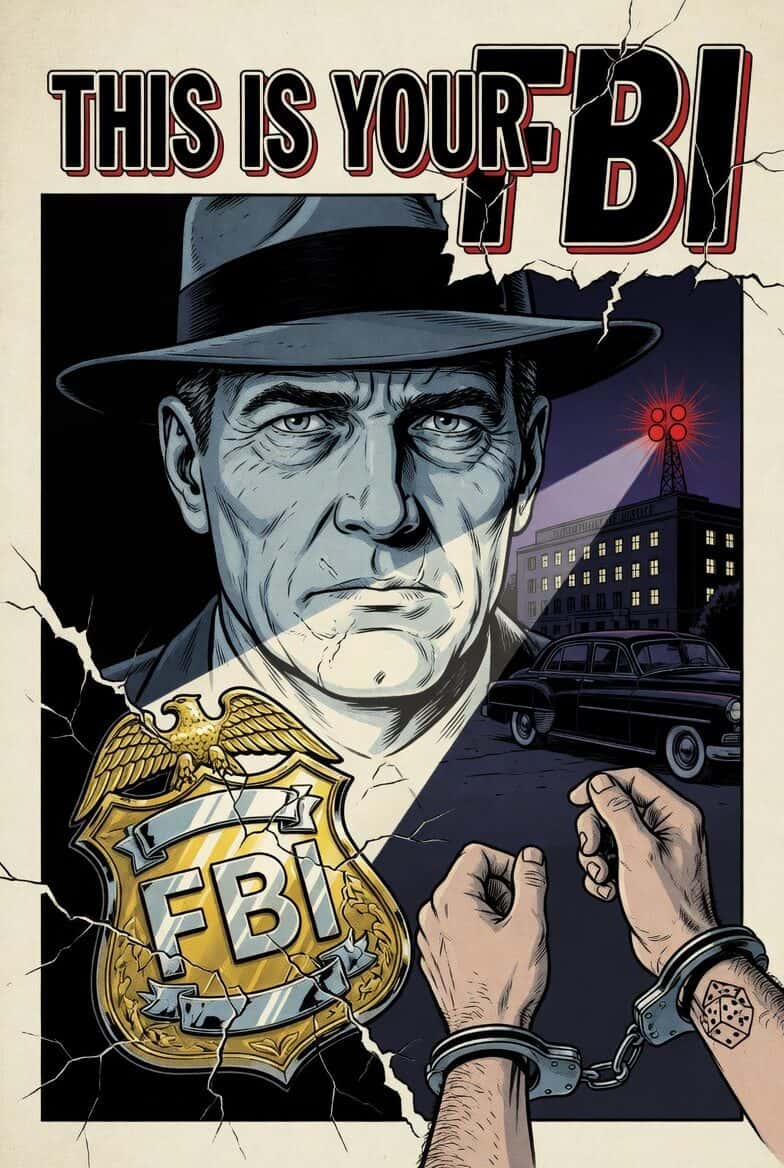
The Equitable Society presents This is Your FBI. This is Your FBI, an official broadcast from the files of the Federal Bureau of Investigation, presented as a public service by the Equitable Life Assurance Society of the United States and the Equitable Society's representative in your community. Midway through tonight's program, we shall have the special pleasure of bringing you once again one of America's best-loved businessmen, Thomas I. Parkinson, President of the Equitable Society. Tonight's file, Murder on the High Sea. The international thief, whose criminal activities were curtailed by wartime restrictions on ocean travel, is now at work again along the ship lanes of the world. The international thief is the cleverest of his breed. Because of the scope of his activities, It is difficult for the law to detect his work and track him down. But when he commits a crime on a vessel flying the American flag, he finds himself up against the forces of your FBI. It is 9.30, and the small American freighter Edna May out of Maracaibo continues steadily on its northward course toward New Orleans. In his cabin under the bridge, Captain Peterson has been dinner host to two of the ship's passengers, Dr. Myler and his secretary. They have just finished their coffee.
Have a cigar, Doctor? No, thank you, Captain. I prefer my pipe. Yeah, it's been a delicious dinner. Agree, Karen? Well, with two such charming companions, I must say I hardly noticed the fool. Now you can see, Captain, why I engaged her as my secretary. Indeed I can. Beg your pardon, Captain. Yes, Mr. Ramey. Blast has fallen, sir. Looks like it's making up in the northwest. Secure everything. I'll be along. Right, sir. I'm afraid, folks, it's going to get a little rough. Then we'd better make for our cabins where we can still stand up. Good night, Captain, and thanks for your hospitality. Yes, it's been charming. This was my pleasure. Good night, Captain. Good night. Karen, give me your hand. A very entertaining man. Yes, he's delightful. We go around the radio shack here. Very well. Oh, wait a minute.
What is it? My bag. I've left it in the captain's cabin. Oh, I'll get it for you, my dear. You're going ahead to your cabin. I'm awfully sorry. Oh, nonsense. It's getting rough. I'll be careful. I will. Who are you? I say, who are you and why are you standing? But I left him just a few minutes ago, Captain. It's incredible. I know, Miss Brenner. How did it happen? Your fellow passenger here, Mr. Hanley, found the body. Yes, purely by accident. I was taking a turn around the deck when I fairly stumbled over the doctor. He was between the radio shack and the captain's cabin here. Where did he leave you, Miss Brenner? At the after ladder. He was coming back here to get my bag. I see. Can you think of any motive for his being killed? Yes. Yes, Captain, there was plenty of motive. What do you mean? Dr. Mahler was in a Nazi concentration camp. The report was that he had died there.
Actually, with the help of friends, he escaped to South America. Yes? In South America, he fought the Nazis just as he had fought them at home. But the war is over now. All the Nazi troublemakers have not been caught, Captain. You think he was killed because of this? He must have been. He was on his way to the States to tell what he knew. Do you know of anyone on board who might have had a reason to kill Dr. Myler? No. We never knew Mr. Hanley or your other passenger, Mr. Dargan, until we boarded ship. Excuse me, Captain. Yes, Hanley. Of course, I don't wish to create any trouble for a fellow passenger, but... Well? I saw Mr. Dargan on deck just before I discovered Dr. Marlowe's body. What was he doing? Walking rather hurriedly away from where the body was found. Well, I think we should have a talk with Mr. Dargan. I'll have the steward get him up here at once. Come in.
I have Mr. Dargan here, Captain. Bring him in, steward. Yes, sir. Go ahead, sir. Okay. Hi, Miss Brenner. Mr. Dargan. Hanley. Hello, Dargan. Mr. Dargan, do you know why I sent for you? Yeah, the steward gave me a fill-in. Too bad. I'm trying to check on everyone's activities. Can you tell me what you've been doing for the past hour? Yeah, I was in my cabin most of the time. Were you on deck at all? For a while. Why? Mr. Hanley here discovered the body. It was between my cabin and the radio shack. Yeah? He told me that just before this discovery, he saw you on deck. So what? You were walking away from where the body was found. If it was near the radio shack, he was right. I was in there sending a message. You can check that with your operator. I will. Who was with Hanley when the body was found? I was alone.
Why? Maybe somebody ought to check up on you. I believe you're in the mining business, Mr. Dargan. That's right. Have you ever had any dealings with the Nazis in South America? Are you kidding? We just fought a war with them, remember? Captain, I wonder if I might go to my cabin. Yes, yes. Go ahead, Miss Brenner. I'm going to question these men a bit further, and then radio a report to the federal authorities. Stuart. Yes, sir? Take Miss Brenner below. Yes, sir. Good night, everyone. Good night, Miss Brenner. Good night. Go ahead, Miss. Thank you, Stuart.
This way, miss. Never mind the act, you fool. What do you mean? You bungled the job. What are you talking about? Why didn't you throw the body overboard? I never had the chance. Why? Somebody beat us to the job. Oh, Tom. Yes, Nick. Radio message from the captain of the freighter Edna May of Antwerp, New Orleans. There's been a murder on board. Oh? Dr. Heinrich Meiler escaped to South America two years ago from a German concentration camp. Oh. He was accompanied by his secretary, Karen Brenner. Oh, and seems both originally from Vienna. Radio the captain to send us a list of his passengers right away and all details he has on them. What about the crew? There's a possibility he took on a hand or two at Maracaibo we can't check on at this end. Get that information, too. Right. Meantime, we'll go to work on Myler and Brenner. Who is it? Message for you, Miss Brenner. Mr. Dawson. That's right, baby. The first name is Sam. What's the meaning of this?
I guess you might call it a business call. I don't know what you're talking about, but please leave. Look, baby, I just came here. Please. I don't feel well. I'm terribly upset. Over the doctor? Yes. Now get out of here. I told you this was a business call. The business is why the doc died. What do you mean? Well, it's kind of a long story, but if I were you, I'd listen. Well? When the Nazis invaded France, they helped themselves to a lot of things that didn't belong to them. When they left France, some of those things weren't returned. Yes? One of these light-fingered Nazis was a guy named Karl von Ritter. His touch was painting, paintings stolen from a gallery in Paris. Look, I am not interested in... Just listen. This von Ritter guy took these paintings to South America with the idea that eventually he'd bring them to the States and make a nice score. Only he didn't quite make it. You know why, don't you? You know that the doc was really Karl von Ritter.
That's not true. Oh, now look, baby, I did a lot of research. It's a lie, I tell you. Suppose we let the captain decide that. Come on, let's tell him the story. Wait a minute. Okay. What do you want? I know you're talking, sweetheart. Where are the paintings? I don't know. Now, wait a minute. I swear I don't. Look, you were working this thing with him, weren't you? Weren't you? I knew who he was, yes. And you knew about the painting? I didn't know where he kept it. Somebody did. That's why the guy was killed. Then find out from whoever killed him. Oh, baby, that's why I came here. I had nothing to do with his death. Look, you and that guy Hanley are working on this thing together. Hanley? I pegged him the minute they came aboard ship. He's a larceny guy from way back. I never saw him before in my life. Stop, will you? I swear it. Okay, maybe you're leveling. But if you are, you've got real trouble. How?
Hanley must have killed the doctor. The chances are you're next on his list. Oh. You've still got one chance. What? We become partners. How do I know you didn't kill the doctor? You don't. But I didn't. How do I know I can trust you? You don't. But you've got to play ball with me. Now, where did he keep the painting? In a secret compartment in his trunk. That's my girl. Let's nail him now.
Here's the Edna May's passenger list, Tom. Just came in. Good. There are only four passengers aboard. I see. Did you get a call back on Myler and Miss Brenner yet? Not yet, Nick. They're still checking. Captain Peterson took on two hands at Maricabo. Yes, I see. An oiler and a steward. Shall I start a check on them, Tom? Yes, and on these passengers, too. Grady speaking. Huh? Definitely, huh? What about Brenner? Uh-huh. All right, send over the files on them, please, and thanks. Well, Dr. Heinrich Myler died two years ago in a concentration camp. Then who were the murdered men? We've got to find that out. Tom, what about Miss Brenner? Been in South America four years, suspected of having worked with Nazi agents, but nothing was ever proved. You think she could have killed a man? We can't think anything yet, Nick, until we get the answers to an awful lot of questions. When is the ship due at New Orleans? Sometime tomorrow, if the storm she's in now doesn't delay her too much.
Well, we've got some fast work to do. We can make that 8 o'clock plane for New Orleans. Radio the captain. We'll board the ship once you drop the anchor in midstream for inspection. Right. Meanwhile, we've got to find out who Dr. Myler really is. Isn't this his cabin here? Yes. There we are. Go ahead, baby. Right. The lights are right over... We ain't putting on any lights. I've got a flash here. There. Now where's the truck? Right in the corner. Okay. Where's the secret compartment? In the bottom.
Hey, this trunk is locked. I have a key for it. It's back in my cabin. That's great. Go get it quick. Very well. Who's that? This week at the Equitable Society, I happened to hear President Thomas I. Parkinson talking about New Year's resolutions. And some of the things he said impressed me so much that I've asked him to repeat them in person to our radio audience tonight. Ladies and gentlemen, I take pleasure in introducing Thomas I. Parkinson. President of the Equitable Life Assurance Society of the United States. Thank you, Carl Frank, and good evening, ladies and gentlemen. In three days and a few hours from now, the bells will be ringing, the whistles will be blowing, and people will be saying Happy New Year to one another. Since I won't be able to be with you at that moment, I'll have to give you my good wishes in advance. So a happy and prosperous New Year to all of you, from me personally and from the Equitable Life Assurance Society of the United States.
I think everybody realizes that this year, 1946, we are soon to enter, will be a critical year in the history of civilization, the beginning of a new age for the whole world. So when we make our New Year's resolutions, isn't this a good time for all Americans to reaffirm their faith in the traditional American virtues of thrift, neighborly cooperation, and self-reliance? In all past times of crisis, those three qualities have stood us in good stead. We've defended on them before. We can depend on them again. Of course, when I say traditional American virtues, I don't mean that we Americans have any monopoly on them. The Scots, for example, are celebrated for their thriftiness. The Scandinavian people are famous for the success of their cooperative movements. But in all history, in all the world, no other nation has ever beaten America on self-reliance. I believe that this is a matter of inheritance. After all, every citizen of this country, if he goes back far enough, is descended from immigrants. That's something to be proud of.
Any immigrant is a man or a woman who had the courage and initiative to leave his homeland and cross an ocean in search of greater opportunity and greater freedom. That's the pioneer spirit. And this same spirit of self-reliance is the backbone of our American system of free enterprise today. Self-reliance is what makes a man start a little business and then develop that little business into a big business. Self-reliance is what makes a man buy a farm, build a home of his own. and plan things so that his children will get a first-class education. For 86 years, the organization of which I have the honor to be president, the Equitable Life Assurance Society of the United States, has been working with Americans who practice the virtues of thrift, cooperation, and self-reliance. You see, when a man buys future securities in the form of life insurance, he gives the perfect demonstration of self-reliance. He proves that he believes in taking care of himself and his family, no matter what happens.
He proves that he believes in standing on his own two feet. Furthermore, our society is strictly a cooperative enterprise, owned entirely by its members and run solely for their benefit. Thanks to the thrift of our three and a quarter million members, a great protective fund has been built up which gives every individual member far more security than he could achieve by his own unaided effort. Thrift, neighborly cooperation, and self-reliance. These... are the qualities that have made the equitable society strong. They are also the qualities which have made America strong. The more we practice those three virtues in the future, the more certain we can be of a happy new year in 1946 and of happy new years for many years to come. And now back to the file on murder on the high seas. Many unusual methods have been employed by your FBI in the solution of crimes.
Tonight's file is an example of this. A murder is committed on the high seas. FBI agents have neither seen the corpse nor interviewed the suspect. Nevertheless, they are already gathering facts, building evidence that will ultimately lead to the apprehension of the killer. The killer is still at large, however, and aboard the freighter Edna May in a cabin below deck, Sam Dargan, victim of an unknown assailant, lies unconscious on the floor. Dargan. Mr. Dargan. Mr. Dargan, what's wrong? What happened? In my head. What happened to you? Somebody slugged me. Who? I don't know. I was right over there. Yes? Did you really leave this room? Of course. Why? I heard the door close, but I might have stayed here. I didn't want to go out. No. Here's the trunkie. I went to my stateroom. You put on those lights. I did when I heard you running. Turn them off.
The trunk, it's been opened. Hey, what is this? It's been rifled. The secret compartment is open. The paintings are gone. Hanley. What? This is Hanley's work, baby. You mean he has the paintings? Sure. But he ain't gonna have them for long. Good morning, Captain. Well, good morning, Miss Hanley. May I fall in with you? Of course. You're up and about rather early, aren't you? Oh, yes, I'm always an early riser at sea. Sleep well? Yes, like a top stone. Um... Anything new on the killing? No. I'm just waiting now to turn it over to the FBI. Good morning, Captain. Well, Miss Dargan, Miss Brenner. Good morning, Captain. Looks like a lot of early risers this morning. Yeah. Heavens, Dargan. What? Your head. The bandage. What happened? I took a pretty good wallop last night, Hanley. Well, how was that? I got a little restless and took a walk. And just as I came to Dr. Milett's cabin... Yes? That's where it happened.
What do you mean? Oh, the ship did a half roll, Captain. I banged my head on a brass fitting. Oh. Well, that's too bad, old man. Yeah. Um, what time are we due at New Orleans, Captain? We're out of drop hook in about an hour. Good. Well, shall we continue our stroll, sir? Very well. Will you join us, folks? I know, thank you. See you later, then. Cheerio. I was watching Hanley's face when you told the story. He's a one-on-one. Sure. We arrive in an hour. What are you going to do? You make sure that he stays on deck. I'm going down now and case out his cabin. Well, what happened? No dice. What? I went through everything in Hanley's cabin. The paintings aren't there. What do we do? Where's Hanley? Up forward there. Come on, we're going to talk to that guy. What good will that do? At least I can find out if he really slugged me. It still could have been you, sweetheart. Now, look. Shut up. Hanley! Yes, little boy? I want to talk to you. Very well. Uh, this, uh...
That slug on the head I got last night, you know how it really happened, don't you? Yes, I heard your story. Quit stalling. I know all about you, Hanley. You work on the same side of the street that I do. I'm afraid I don't follow you. Larceny Boulevard, mister. You gave it to me last night on the doctor's cabin, and you were there for the same reason I was. Mr. Brennan, what are you talking about? Look, she belongs to the same club, too. Now, where are the paintings? What paintings? I'm giving you one chance, Hanley. Either you play with us on the three-way cut or everybody falls. There's a boat pulling alongside. That's probably the G-man, Hanley. You know, the FBI. Now talk fast. Very well, but what I have to say will be very disappointing. I give you my word, I have not got the paintings. Captain, I think you should know some of the facts we've already assembled on this case. You mean you have something just from that list of names I sent you, Mr. Grady? Yes.
Dr. Myler's real name was Carl von Ritter. He was a Nazi who fled to South America. You understand he had in his possession some very valuable paintings. Stolen, I suppose. Yes. We can assume that he had them with him aboard ship here that he hoped to dispose of them in the States. Yes? Oh, come in, Mr. Jackson. Thanks, Captain. How'd you make out, Nick? I searched von Ritter's cabin. And? I found a trunk that had been forced open. There was a secret compartment in the bottom. It was empty. Yeah. The paintings were probably in that trunk. They must have been found. There's no trace of them anywhere else. That Brenner girl sounds like the logical suspect, gentlemen. Could have been either of your passengers, too, Captain. Hanley or Dargan? Yes, we're waiting for information on them now. It also could have been that steward you took on at Maracaibo. What? In fact, he's the first man we'd like to talk to, if you'd be good enough to send for him, Captain. Surely. You send for me, Captain? Yes, steward. This gentleman is a special agent of the FBI. I see.
He wants to talk to you about the death of Dr. Myler. I'm afraid I know nothing about it. Then let me tell you something I know. What do you mean? Your real name is not Paul Mason. It's Max Schmidt. That's true, but... But I tell you, I didn't... Wait a minute. You and your Euler friend jumped a Swedish ship six weeks ago in a South American port. Well, what if we did? Police down there keep pretty good track of strangers, Schmidt. That's how they were able to tell us about your contacts with Miss Brenner. Shall I go any farther? All right. Miss Brenner did hire us to make this ship and help forge our papers and everything so we could sign on the ship. And you were supposed to kill Dr. Myler and get part of the money from the sale of the paintings. But I tell you, I didn't kill him. No? What happened? The oiler and I decided not to go through with it. Excuse me, Tom. Yes, Nick. The wireless room just gave me this. I see. Oh, that'll be all now, Stuart. You can go. Yes, sir. Well, this is the information we wanted on Dargan and Hanley.
Both of their records would fill a book. Well. Captain. Yes? I'm going to call on you for some help. Now, here's what I'd like you to do. Well, Captain, it's very gracious of you to attend us a farewell dinner. This was by request, Mr. Hanley. Really? Whose request? The special agents of the FBI. What was their point? Well, for one thing, Mr. Dargan, they wanted to be sure they'd know where you all were. Gerard? Yes, Smith? Some more coffee, please. Surely. They also wanted to acquaint you with a few facts. Like what? Like who murdered Dr. Myler. They have learned who the killer is, Captain. They have plenty of suspects. For instance? All of you know that Dr. Myler was really Carl Von Ritter. He was attempting to smuggle some valuable paintings into the States. And how could we know that, Captain? Well, for one thing, Mr. Hanley, you dropped your initial cigarette case in Von Ritter's cabin last night while you were rifling it for the paintings.
Cigarette case doesn't prove that. The lump on Mr. Dargan's head does. What? There was no blood on the brass fittings outside of Von Ritter's cabin, Mr. Dargan, where you might have bumped your head. But there was some on the floor inside the cabin. That doesn't make me the killer, Captain. I'd say whoever has the paintings committed the murder. The paintings have been found. What? Where? In one of the crew quarters. All right. Stay where you are, all of you. Put down that gun, Stuart. Take care of him, will you, Nick? Right. He is the killer? Yes. He told us all about his deal with you, Miss Brenner. We figured if he'd do that, he'd also double-cross you. That's why we searched his quarters. Now, Captain, you may proceed, if you wish, to dock the Edna Mae. The subsequent finding of the murderer's weapon led to the trial and conviction of the ship's steward on the charge of first-degree murder. And the...
Dargan and Miss Brenner were sentenced to the federal penitentiary for their part in the conspiracy. Their apprehension is a reminder that wherever the American flag flies as a symbol of civil authority, your FBI is on the job day and night, enforcing the law of the land on all who conspire against it. Before you hear about next week's thrilling case from the files of your FBI, May the Equitable Society again wish you a happy and prosperous New Year. Just as you look to the FBI for national security, you look to the Equitable Society for the financial security of life insurance. In the same spirit in which it has lived through 86 years, the Equitable Life Assurance Society of the United States shall, throughout 1946 and the years to come, continue like your FBI.
to be dedicated to the security of you, your home, and your country. Next week, we will bring you another colorful story from the files of the Federal Bureau of Investigation. Crime in the Roaring Twenties. The incidents used in tonight's Equitable Societies broadcast are taken from the files of the Federal Bureau of Investigation.