
The written record
Read the transcript
Read along with the recording · About 24 min to read
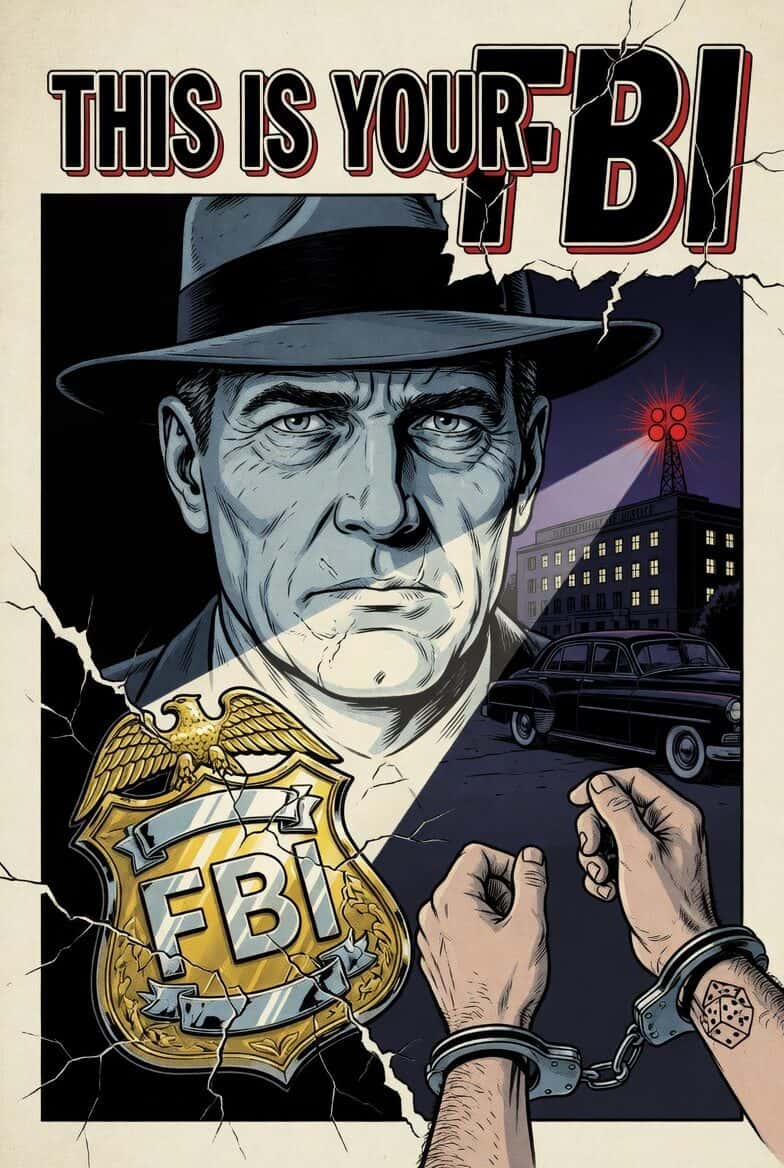
The Equitable Life Assurance Society presents, This is Your FBI. This is Your FBI. The official broadcast from the files of the Federal Bureau of Investigation. Presented as a public service by the Equitable Life Assurance Society of the United States and the Equitable Society's representative in your community. Tonight, the Equitable Life Assurance Society is going to give you some facts about group insurance. a type of insurance that is important in the lives of 50 million Americans. How important? Well, take the Pan American Petroleum and Transport Company. Its president and chairman of the board of its marketing subsidiary, the American Oil Company, Mr. D.J. Smith, says, Greatly as we regret the loss in the recent Texas City disaster of valued employees to the company and their families, it is comforting to know that group insurance provided for their families.
For further information on group insurance, showing just how it can benefit you, be sure to listen in about 14 minutes to a message from the Equitable Life Assurance Society. Tonight's FBI file, Merchants of Arson. This is a nation of 140 million people. And in that number, there are more than 50 million wage earners. Some earn their daily bread in normal ways, working with their hands in factories, driving trucks. or killing the soil. Others manage to exist because they engage in some bizarre occupation like diving for sponges or riding with smoke in the sky. But of all the various obtuse methods used to make money, perhaps the least understood is a method used by a certain breed of criminal. This perverse system of garnering a yearly income is managed by those criminals who fraudulently go through the process of bankruptcy. In other words, there are those who make their profit.
by having a court declare them penniless. They never make the page one headlines, and the public rarely hears about them. But like the killers and the thieves who become notorious, these men, too, are criminals. Tonight's file opens on a quiet tree-lined street located in one of the suburbs in a large eastern city. In the backyard of one of the cottages on this street, an elderly man is expertly hitting a croquet ball through a maze of wickets. Two visitors approach. One of them calls out. Uncle Ed. Hmm? Oh, hello, Chuck. Find a couple of visitors? Nope. Uncle Ed, I hate to interrupt your practice, but I'd like you to know Mr. Bedford. He's a client of mine. How do you do, sir? I do. Uncle Ed, me and Mr. Bedford would like to have a little talk with you. Hmm? What about? Business. Not interested. But Mr. Bedford here has a real good proposition for you. I'm retired. Hey, stand away from that wicket there. Chuck, this looks like a waste of business. I know. But he just said, look, Uncle Ed has retired more times than Harry Lauder. Let me handle him.
Uh-oh. I got a sure system. Never fail. What? Oh, Uncle Ed. What is it? Are you positive you don't want the job? Yep. Then would you mind doing me a favor? In what? Tell me where I can get in touch with Tommy Gillen. What do you want him for? I want to bring him together with Mr. Bedford. You're going to give that old bungler a job? Who else can I get? You're the only two guys around. Mr. Bedford, don't you let him do this to you. Well, if you won't take the job, sir, it looks like I have no choice. I'll take it. Swell. What's the setup? It's a warehouse. Oh, they're tough, boy. Big buildings like that take a lot of work. This is only a two-story structure. You work with me, Chuck? Sure, I'd be glad to. You know my purse, Mr. Bedford? Yes, Chuck told me. It'll be paid immediately after the job. Good. Wait. When can you do the job? When do you want it? Oh, could you do it tonight? Mr. Bedford, your warehouse will be nothing but ashes by morning. Chuck, bring me some more eggs. There you are.
What are you doing with that gasoline? Well, I was going to pour some in that corner. Don't let me handle that. Get bad distribution, place burns uneven. I've got my reputation to think of. Here, soap these. Okay, sure. Now, I'll just line them neatly along this wall here. You want some help? No, no, no. How much longer will we be here? Well, about a minute. Yeah? This place is empty. What does Bedford want it burned down for? Where's the property? Well, Bedford runs a legitimate business. About two weeks ago, he bought $40,000 worth of drugs on consignment. Oh, where are they? Well, he had me move them over to another warehouse as soon as they came in. Oh. Now Bedford's gonna say they burned up in this fire and quit the insurance, eh? No, no, he didn't insure the stuff at all. Huh? He's got a much smarter touch. Oh? What? Well, after the fire, he can make the claim that he can't pay for the drugs, that he's broke. So he goes bankrupt and sells the stuff to a fence.
That is pretty smart. He deserves a first-class fire. We should just about give it to him. Are you all finished? Yep. Hey, let's get over by the door. You gonna light it now? Uh-huh. And get ready to run, boy. Here it goes. A few weeks after the warehouse fire and the local FBI field office, Special Agent Jim Taylor is at his desk going over a file of correspondence as a visitor approaches. Jim Taylor? Yes, that's right. Vic Norwood. Just got in this morning. Oh, hello there, Vic. Hi. Fine, thanks. Hey, uh, by the way, Bill Sweet said to say hello. Oh, hey, that's right. You were in the Salt Lake City office, weren't you? That's nice country out that way. Nice people to work with, too. Yeah, I know. I was in that office for a year myself. Uh, you've been in to see the agent in charge yet? Yeah, it's my first thing this morning. He wants me to work with you on this bankruptcy case, if there's anything there. Well, I'm just going over the file of correspondence myself, eh? Well, what's the story? Well, we received a letter yesterday from C.J. Crawford and Company. That's a drug house out on the West Coast. Well, how'd they happen to write us?
Well, they sold a man named George Bedford $40,000 worth of drugs on consignment about three weeks ago. Now, Bedford's business is here. Oh, I see. There was a fire in Bedford's warehouse right after the shipment arrived. And then Bedford filed a petition in bankruptcy. That's right. How much do we know about Bedford? Nothing yet, Vic. Have you contacted the fire department for their reports on the fire? Yes, they're sending them over. In addition to that, I'm going to talk to the inspector who covered the fire and interview him. That should help. Those fellows are pretty shrewd. Yeah. Vic, I'll tell you what. You take this file here and read through it, huh? That's the correspondence between Bedford and the Crawford Company. Good. That'll give me a little more background. And why don't you check and see what you can find out about this Bedford fellow? All right. Meanwhile, I'll go over and see the fire inspector, and if he thinks there's any point to it, maybe we'll go see what's left of Bedford's warehouse. You'll check back here with me? Yeah, I'll call in by noon at the latest, Vic. And if you've got any dope on Bedford by that time, maybe I'll pay him a visit, too. Uncle Ed! You come out here in the back porch. Oh. You alone?
Uh-huh. Uh, can I talk to you for a minute? Wait till I finish up here. What's all that stuff? Press clippings. About what? Fires. One's I said. Is that whole book full of them? Yep. Scrapbook. It's kind of to be like. This one was a pippin'. Detroit. Four alarms. Oh, I'll read you over later, Uncle Ed. I've got something to talk, talk up with you about first. Uh-huh. What? Well, I, I've kind of got the shorts. I was wondering if I could tap you for a couple of hundred. You bro? Yeah, for real broke. What about the money you got from Bedford? Well, I spent it. So soon? Well, he only gave me $500. $500? Yeah, so I... Wait a minute, boy. Wait a minute. He paid you that measly amount after all the things you've done? Oh, I didn't do so much. You made it possible for him to steal $40,000 of merchandise. Yeah, but he thought the thing up. Well, you've done all the dirty work. He should have cut you in for plenty. Well, look, it's too late for that now. It's never too late. Wait. Did Bedford get rid of them drugs yet? No.
Then you're cut in for 50% of them. By who? By me. Oh, now, look, Unc. How can an old guy like you... Save that talk, boy. Save it. Where does Bedford live? On 12th Street. Why? We're paying a call on him tonight. Mr. Taylor, you say you're from the FBI. That's correct, Mr. Bedford. Here are my credentials. You see? Well, what can I do for you? You were the sole owner of the Bedford Company before it went through bankruptcy. Is that right? Yes. We received a letter from the C.J. Crawford Company, with whom you did some business. Yes, I purchased quite a bit of merchandise from the Crawford out just prior to the fire that wiped me out. Yes, I know. You see, that warehouse was a fire trap, and I could never get any insurance out of Mr. Taylor. When that Crawford shipment burned, I was wiped out, clean as a whistle. I went over the fire department reports on that fire this morning. You did? Why? Just checking.
And I went to the scene of the fire where the inspector who examined the ruins right after the blaze was put out. What was the purpose of all that, Mr. Taylor? Now, look, I'm a taxpayer, and I'm entitled to know. Oh, certainly, Mr. Bedford. I went over the reports and over the scene of the fire to try and make sure that the Crawford Company drugs actually burned, as you claim. Are you implying that I'm not an honest man? That's not part of my job, sir. I'm merely checking to make sure there is no fraud connected with your petition of bankruptcy. Well, that's what you ought to know. Are you absolutely sure that those Crawford drugs were in the warehouse when it burned down? Certainly I'm sure. I saw them with my own eyes. Why? The fire inspector's report and an examination of the ruins today failed to disclose any traces of tin or of steel rods. Tin or steel rods? Some of the products in that shipment were packed in tin. And every one of the Crawford shipping cases for the past six months have been reinforced with steel rods. There should have been some evidence of those things in the ruins. Mr. Taylor, I gather that you're calling me a crook. I'm not calling you anything. I just came here to ask you some questions. You've asked your questions.
You going to arrest me? No, Mr. Bedford. I don't have anything to arrest you for. Nobody can prove anything. Yet. If you ever think you can, come back and see me. I'll be right here. All right, sir. Thank you. Just a minute. Hi, Mr. Bedford. Oh, hello there, Chuck. You remember my Uncle Ed. Yes, of course. How are you, sir? I'm good. Come in, both of you. Go ahead, Uncle. I'm very glad that you stopped by, Chuck. I was about to call you. What for? A man from the FBI came to my office today. What did he want? He asked questions about the fire. I gather that they don't think the drugs were there when the place burned. Oh? I think it might be wise for me to get out of town for a while, which means that I've got to get rid of the drugs as soon as possible. You mean sell them? Yes. You know these men. What are they called? Fences. Get the best deal you can. Mr. Benton. Yes?
What do you figure on paying the boy for this? Same fee I gave him before, $500. He's not interested. Now, just a minute. This is a matter between your nephew and myself. I'm handling this business now. The job will cost you 50%. What? Right, Chuck? Right. Well, this is preposterous. I'll get someone else to do the job. Now, hold on there, mister. Let me point out something to you. Well? I understand that the warehouse you get the drugs in now is rented in my nephew's name. That's right. I arranged it that way. You know what that could mean, don't you? What? Chuck here could take everything. Oh, that's how you're playing it. Mm-hmm. Does the boy get 50%, Mr. Bedford? Yes. Of this. He's got a gun. That's right. Then I'll use it, too, Chuck. Put that away. You'll hurt somebody. Get out of here. Chuck, take that gun away from him. Don't come near me, Chuck. I'll shoot if you do. He won't shoot, Chuck. Ain't got the fortitude. Just walk right up to him.
That's it. Keep away from me. That's it, Chuck. Now take the gun. Come on, give me that. Chuck, take it. Okay. Give it to me, I said. Let go. What do I do now? That's elementary, son. You've got a gun in your hand. Use it. We will return in just a moment to tonight's case from the files of your FBI. Now, a 50-second interview on group insurance with a man from Texas City, Texas. Ed? You were in Texas City last April when that ship blew up and wrecked the town? Yes, I was there. And am I lucky to be talking to you right now. 31 of the guys in my plant were killed in that blast. Yes, it was one of America's most terrible tragedies, Ed. Sure was. I don't know what the families of those boys in our plant would have done if it hadn't been for group insurance with the Equitable Society. I understand those 31 families in your company received a check from the Equitable Society totaling more than $300,000. That's right, Mr. Keating.
What's more, equitable paid off fast. Yes, group insurance with the Equitable Society is a mighty good thing for the employee and his family, and it's just as good for the company for three good reasons. First, it means satisfied, loyal workers. Yes. Think of getting life insurance, accident and sickness insurance, and retirement income, plus hospital and surgical and medical benefits, all in one package from the Equitable Society, without any medical examination. Second... Group insurance with the Equitable Life Assurance Society decreases labor turnover. Right. A fellow thinks twice before he walks out on a job which gives him extra insurance coverage at far lower cost than he could buy it as an individual. Third, Equitable Society Group Insurance improves quality and quantity of production. Believe me, I do better work now that I've got rid of worries about sickness and accidents and my wife and kids' future. Well, I hope every employer in this radio audience hears what you've said.
and that every one of them is resolving now to get the facts on complete group insurance protection from the nearest office of the Equitable Society. That's E-Q-U-I-T-A-B-L-E. Or write direct to the New York Home Office of the Equitable Life Assurance Society of the United States. And now back to the FBI file, Merchants of Arson. As can be seen in tonight's case in the files of your FBI, the professional bankrupt. The man who makes a living by alleging that he is poverty stricken is the true criminal. For his crime contains the very essence of criminality. The taking of something for nothing. That what he is doing is morally reprehensible carries no weight with the criminal. He is not concerned with what his community thinks of him. He is an isolationist who lives in his own little world with his own rules and his own moral code.
It is unfortunate that nowhere in that code is there any room for loyalty or compassion. But the absence of those things is what makes him what he is, a criminal. He not only has no desire to live by the golden rule, he doesn't even understand what it means when he sees the words do unto others as you would have them do unto you. For his motto is different. His motto reads, Rob and cheat and steal. Because people are fools, and there's only one real crime, and that is being caught. Tonight's file continues in the local FBI field office, where Special Agents Jim Taylor and Vic Norwood are comparing notes on the fraudulent bankruptcy. Jim, I checked on George Bedford every place I could. There's one thing that puzzles me. What's that, Vic? How he ever got a $40,000 shipment from anybody on credit. No way. Well, the Better Business Bureau has him marked down as a sharpshooter.
Every credit rating bureau in town has enlisted as a bad risk. Well, that figures, I guess. Oh, I also picked up pretty definite information that Bedford was mixed up in the black market during the war. Oh? He was supposed to control the penicillin black market before it became plentiful. Huh. Nice guy. Making a racket out of people's health. Now, what'd you get on him, Jim? I just received a supplementary report from the fire department on Bedford's warehouse fire. Well, what'd it say? Well, there is no proof, but there's an awful deep suspicion that the fire was no accident, that the place was empty when it burned down.
What happened to all those drugs? I don't know, but I've notified every wholesale drug company in town to be on the lookout for anyone trying to sell anything on the list that we got from Crawford. Looks like we're going to have to wait for Bedford to make a move, then. I'll miss. Oh, I'll get it. Special Agent Taylor speaking. Yes, Lieutenant. What? Where? What's that address again? 26 12th Street. Yep. Right, I'll be right over. It was Lieutenant Jones down at police headquarters. Bedford was found dead in his apartment a half an hour ago. What happened? Shot through the head. Oh? Lieutenant thought it looked like suicide. I'm going right over there.
Chuck. Yeah, Uncle? Let me have that mucilage. Sure. Hey, uh, putting something in the scrapbook? Yep. Another fire? Nope. About Mr. Bedford. Oh, you mean his suicide? Mm-hmm. Hey, that's a good picture of him. Too bad he ain't alive to see it. He should have got it years ago. Them legitimate fellas give honors thieves a bad name. Yeah. Well, I think I'll take a run downtown. What for? I'm going to shop around, see if maybe I can peddle them drugs. Not yet, son. Why not? Too hot. But they're dead. They'll still be looking for the drugs. When the time comes to peddle them, I'll give you the word. Okay. I think I'll go downtown. Wait a minute. What? Don't leave that cigarette burning there. Things like that could start a fire. Jim, what'd you find out about Bedford? That suicide story looks like a phony, Vic. Why? Well, for a lot of reasons. The living room showed signs of a struggle.
There are no powder burns near the wound. The bullet entered at a bad angle. You pick your own reason. I see. And Bedford probably was doing business with criminals who got rid of him when trouble turned up. Certainly looks that way. What happened to the drugs, though? I don't know. But if we had any doubts at all, this kind of clinches the fact that the drugs didn't burn and that that bankruptcy was illegitimate. You didn't get any leads at all on where Bedford might have hidden the drugs, did you? Just one. I found a key in Bedford's desk that had a tag attached to it. And on the tag was written an address. 171 Front Street.
Front Street? Oh, I forgot, Vic. You don't know this town very well. Front Street is down in the warehouse district. That might be the key to the warehouse for the stolen goods, then. I hope so. I had Wentworth go over and check on it. He ought to be calling back here pretty soon. And what about Bedford's office? Nothing much up there that I could see. The police and Bob Williams came over from our office, and they're going up there now and over his books. Do you have a secretary? Yes, I spoke to her. Did you get anything? She told me Bedford had a visitor who seemed to be able to walk right into the private office whenever he wanted to. What was his name? She never knew.
Said he was a tall, blonde fellow, about 26, 27 years old. Special Agent Taylor speaking. Yes, Lieutenant. He did? Mr. Horton at the Brooks Company. That's first and Main Street? Yes. Thanks, I've got it. Fine. Thanks for the information. Vic is our first lead. That was the police. Somebody just tried to sell the stolen drugs to a Mr. Horton over at the Brooks Company. They're wholesale suppliers. Did they catch him? Not quite. They tried to detain him, but he got away. Vic, why don't you hop over and see Mr. Horton? I'll wait for the report in the warehouse. Hey, who's that? Me, Uncle Ed. Oh. Thought you were going to stay downtown for dinner. I was, but something happened. Oh, what? We got trouble. What is it, boy? Well, I tried to peddle a drug. You what? Look, I told you. I know, I know. So I made a mistake. What happened? Well, a guy I tried to sell the stuff to called a cop. What did you do? I ran out. Anybody follow you? I don't think so. I circled the block a couple of times, did some fast turns, and then I went to the warehouse and left the car there.
What shall we do now? Only one thing we can do. What? Can you get a truck? Sure, rent one. Then let's get to the warehouse, load the truck, and head for Chicago. What'll we do there? Get rid of the drugs where the heat's off. When do we go? Get the truck right now. Jim, the description of the man who tried to peddle those drugs. Good, let's have it. It was that same tall blonde fellow who hung around Bedford's office. Did he tell Mr. Horton where he had the drugs hidden? No, he didn't. Horton sent one of the boys out in the office to trail him. We gonna call you here when the boy comes back? Yes. I take it you had no luck with the key to 171 Front Street? No, it turned out to be a warehouse, all right, but the key didn't fit any lock in the place. Whose warehouse is it? Parker and Gordon, the furniture company owns it. Oh, yeah. Oh, excuse me. Special Agent Saylor speaking. Yes, sir, just a moment. Special Agent Norwood speaking. Yes, son. Just a moment. That boy from Horton's office, Jim. Go ahead, son. Yes. Yes. That's where you lost him.
I see. Well, thank you for the information. Goodbye. The boy followed our suspect down 7th Street, but he lost him on the interstate bridge. Interstate bridge? Vic, why didn't I think of that before? What? The interstate bridge. Come on, let's go. 71 ought to be that next building, Jim. Okay, Vic. Park the car right here. Leave your door open, Vic. I'll slide out that side. Right. I think the best thing to do is try this key I found at Bedford's in the office door, Vic. If that doesn't work, then we can try the trucking entrance. Okay. You see all right? Yeah, fine. Works. Be the place. Turn on my flashlight. Hold it a minute. It's dead. Did we look through it? No, no time. There's a door over there. Put your light out, Vic. We'll try it. Right. Come on, let's see who that is, Vic. Look, it's a truck. And that front door's opening. It's gonna drive out. Look at that man behind the wheel, Jim. Looks like our suspect. Yes, I'll cover the truck, Vic. You close those doors. Break! Hold that truck! All right, come on. Cut that motor and get out of there. Better do as he says, boy. He's got a gun. Looks like I've got a couple of murderers, too.
Now, Vic, never mind closing those doors. We'll all be driving out of here together. Chuck York and his uncle were given a ten-year term for a violation of the Federal Bankruptcy Act in a federal court. They were then turned over to local authorities who tried and convicted them for the murder of George Bedford. And so, because of the timely intervention of your FBI, another crime was solved. Solved because a special agent remembered when he heard that the... criminal had crossed the interstate bridge, that there was another front street in another community on the other side of the river. In addition to adding to their total number of successfully investigated crimes, your FBI also added to the total value of stolen goods recovered and restored to their rightful legal owners. For that, too, is part of their job. A job so well done that last year the amount of goods recovered and returned ran into millions and millions of dollars.
an amount that was a dividend of good law enforcement, paid to you, the American people. In just a moment, we will tell you about next week's exciting case from the files of your FBI. Now some more useful facts on Equitable Society Group Insurance. It's a bargain for workers because it enables the company to give its employees the benefit of its wholesale purchasing power. It's a bargain for the management because it builds loyalty and goodwill. decreases personnel turnover, improves quality and quantity of production. For instance, the president of General Oil Sales Corporation, Mr. O.D. Robinson, writes, the tragic loss of 31 of our subsidiary employees in the Texas City disaster emphasized to our company the dollars and cents advantage of operating with group protection. If your company does not have group insurance, or if your group program is incomplete, get in touch immediately with the nearest office.
of the Equitable Life Assurance Society of the United States. Next week, we will dramatize another case from the files of the Federal Bureau of Investigation, a case that dramatically exposes the battle between honest law enforcement officers and a corrupt political machine. Its subject, anti-racketeering. Its title, The Sinister Shakedown. The incidents used in tonight's Equitable Life Assurance Society's broadcast are adapted from the files of the Federal Bureau of Investigation. However, all names used are fictitious, and any similarity thereof to the names of persons living or dead is accidental. Tonight, the music was composed and conducted by Frederick Steiner. The author was Jerry Lewis. Your narrator was Dean Carlton, and Special Agent Taylor was played by Stacey Harris. This Is Your FBI is a Jerry Devine production. This is Larry Keating speaking for the Equitable Life Assurance Society of the United States and the Equitable Society's representative in your community, and inviting you to tune in again...