
The written record
Read the transcript
Read along with the recording · About 22 min to read
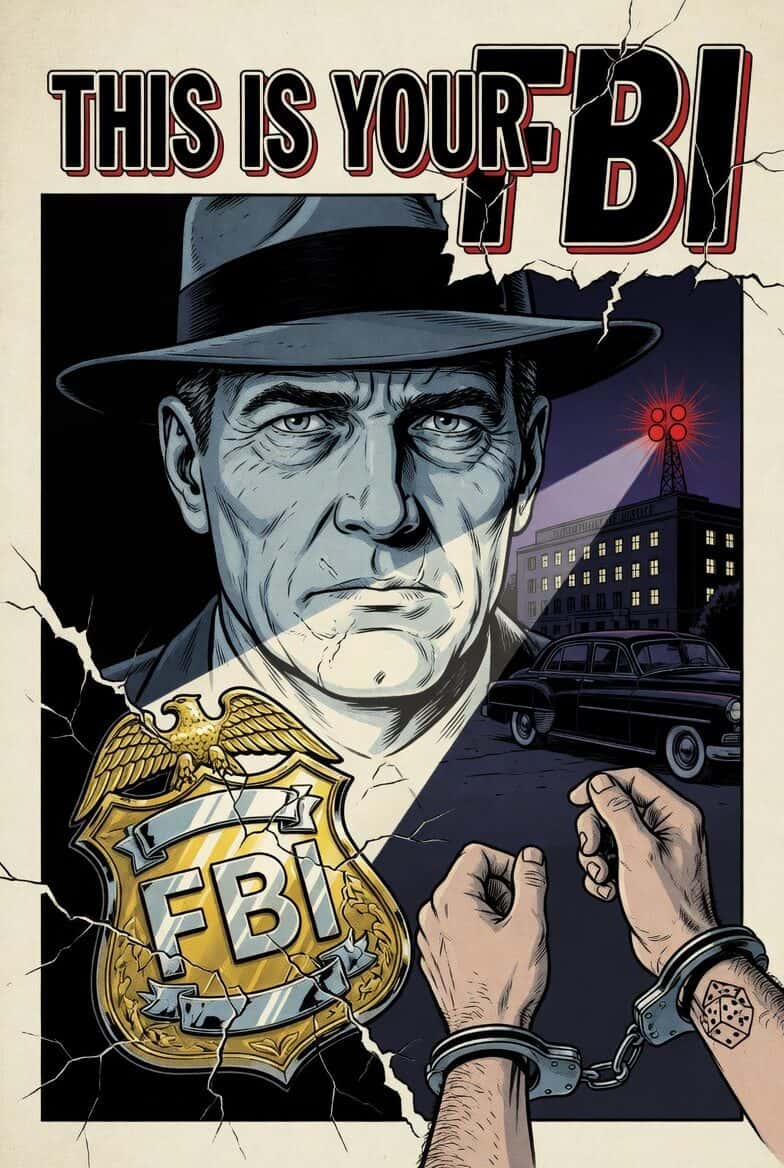
The Equitable Life Assurance Society presents, This is Your FBI. This is Your FBI, the official broadcast from the files of the Federal Bureau of Investigation. Presented as a public service by the Equitable Life Assurance Society of the United States and the Equitable Society's representative in your community. Before we hear tonight's file, I have a special request for our boy and girl listeners. If your dad or mother is not near the radio now, please tell them that in just 14 minutes, the Equitable Life Assurance Society has an important announcement about home mortgages. Yes, the Equitable Society is going to give full details on their Assured Home Ownership Plan. It's a money saver, a worry saver, a home saver. So, will you do that, boys and girls? Tell dad and mother to listen 14 minutes from now.
for the important information on the Equitable Society's Assured Home Ownership Plan. Tonight's FBI file, The Big Guy. History has a way of repeating itself, of forming a pattern which recurs at almost regular intervals. For that reason, anyone studying the field of crime today must go back and study the happenings after World War I. There began a rising tide of crime with the coming of peace in 1918, even as there is a rising crime wave today. Criminals banded together and formed what used to be called gangs. The men were identified by the now almost outworded gangsters. But if the word is outmoded, the methods of operation are not. And today, one of the biggest problems facing every law enforcement agency like your FBI.
is the potential return of the mobs. The crime wave can be fought, and fought successfully if the formation of new interlocking groups of criminals can be prevented. Once the ranks are formed, fighting the war against criminals is more difficult, because arresting an underling does not impair the effectiveness of the mob, does not destroy the leader, the man on top. Tonight's file opens in a small apartment in the midtown section of a large eastern city. A short, stubby man is removing his shirt as he talks to a newly arrived visitor. Sorry you had to wait for me, Charlie. I had to go down to the drugstore to get this stuff. What is it? It's a mosquito bite. I'm covered with it. Yeah, I can see them. You want to rub some of the stuff on my back, Charlie? Sure. Oh, I hope it works. Snitch is driving me crazy. How's that feel? Oh, great. Get them on my neck, will you? Okay. How'd the trip go? Can't you see the condition I'm in? What a trip.
Brother, that's the last time I leave this town. Here. A little right here? Yeah, yeah, right there. The first thing is the train. It's old, it's hot, and it's dirty. Then to make it worse, I draw an old guy sitting next to me who beefs with the conductor when I light a cigar. Can't smoke all the way up. Oh, fine. Then I get up there, walk three miles to the river. I find a spot behind some weeds and a little clearing. For three and a half hours I wait, just sitting there. Chewed by mosquitoes, bees, and every other bug in the book. Yeah. I guess that does it. Thanks. Lou show up? Yeah, finally. What happened? Came down the river in a canoe. When he was maybe 15 feet away, I let go with both barrels. He's dead? Natch. I'll tell George. He'll be glad Mr. Lou Dillon is out of the way. Look, when you see George, tell him any time he wants somebody else knocked off, he should please make it indoors.
The next morning at the local FBI field office, Special Agent Jim Taylor is standing in front of the teletype machines reading an incoming message when Agent Don Conway approaches. Jim? Oh, hello, Don. I didn't know you'd come up. There's a girl named Ann Whitman waiting for you at your desk. You talked to her? No, she said she wanted to see you. I called her the other day about Lou Dillon. He's the fellow who violated his federal parole. Oh. She's his girl. Did she know where Dillon was? No, not specifically. She said that he'd gone hunting someplace upstate. How long ago? Last week. She said she'd get in touch with us if she heard from him. Maybe she has some information now. Could be. Come on. Dylan's the man who was sent away for being a lookout on a bank robbery, isn't he? Yeah, that's right. With his first conviction and what he said, his first crime. Yeah. You made the arrest, didn't you? Yes, yes, I did. I thought at the time that Dylan was a nice young fellow who'd gone wrong because of circumstances.
I remember your report. He had a good record in prison. Still in all, after his good record, he's run away. Oh, Don, you'd better stick around while I talk to Miss Whitman. Okay. Miss Whitman, sorry to keep you waiting. Oh, that's all right, Mr. Taylor. That's Mr. Conway. We met unofficially a few minutes ago. Oh, yes, hello. Have you heard from Lou Dillon, Miss Whitman? No, sir. But I had a call about an hour ago from the chief of police of a town upstate named Centerville. What did he want? Well, he... He said that one of his men found a canoe in an upstate park. There was a hole in the bottom of it that looked like a shotgun hole. They identified the canoe as one that Lou had been using on his hunting trip. And was there any trace of Dillon? No, sir. They... they're afraid something's happened. Something serious. How did the police happen to call you? Well, they said Lou was staying at a lodge, and when he was reported missing, they went there and looked through his papers. They found my name on a letter.
I thought you told me you didn't know where Dylan went. Well, this wasn't a letter I wrote to him, Mr. Taylor. This was one he was going to send to me. Oh. Oh, I see. I'm sorry. Do you think that something serious has happened to him, Mr. Taylor? Well, Miss Whitman, that's difficult to judge. Tell me, do you know of any enemies he had? Anyone who might want to harm him? Well, no. It might be one of the men he was in prison with, Jim. That's possible, darling. Miss Whitman, did the police tell you where the canoe was found? Yes, I think they said Franklin National Park. If they did, then that's our case, Jim. That's right. Don, I think we'd better start an investigation on this right away. Yes? Send him right in. Yes, sir. Oh, and Miss Williams, hold all calls for the next ten minutes. I don't want to be disturbed. Yes, sir. Hi, Mr. Medford. Come in, Charlie. Okay. Well, glad to see you back. Thanks. It's good to be back, Charlie. How was the trip? Very tiring. I covered ten cities in ten days. Hey, you do any good?
Well, some things were accomplished, but they didn't come easy. You know, Charlie, I wish that some of the people who think that criminal activities are a soft touch could work alongside of me for a week. I think that they'd have found out that those of us who deal in larceny have to work twice as hard for our illicit dollars. You can say that again. I've been tempted many times myself to turn legit. Ready to get back? Yeah, I came in yesterday covered with mosquito bites. You really seemed about being sent to the country. Was he successful? Oh, yeah. Everything went fine. I'm almost sorry to hear that. Well, you're the one who wanted Lou Dillon knocked off. Yes, yes, I know. But I was rather fond of that young man. Then why did you want to see him get it? For business reasons. He could have gotten us in trouble. How? Well, when he was released from prison, he decided to go straight. That made him too big a risk. He knew too much about us. Oh. Didn't I hear that he planned to get married? Yeah. Next month.
Probably be quite a blow to the girl. You know her, Charlie? No. Freddie does. I'll have Freddie pay a call on her and, you know, bring her some cash. That might make things a bit easier. Okay. Oh, and tell Freddie that he's got a bonus coming for killing Dylan. A bonus? Yeah. Two weeks in the country.
Oh, brother, that's a slow train from Centerville. I know. Did you see the chief of police? Yes, by the time I got there, he had already had part of the river dragged. Find anything? No trace of Dillon's body, if that's what you mean. How about anything else? Well, they found Dillon's rifle, and it hadn't been fired. Well, that removes any question of suicide. We knew before we found the rifle that it wasn't suicide, Don. How? Well, the canoe was found downstream. So? An examination of it showed that the blast, which ripped a hole through it, had been fired from the outside. It still could have been an accident. Oh, this wasn't any accident, Don. Well, how do you know? We've got evidence. Along the bank of the river at approximately the same place Dylan's gun was picked up, there were indications that someone may have been lying in wait for him. It was a small area of beaten down grass where someone had been sitting, and sitting quite a long time, too. There were 17 cigarette butts strewn around. We also found footprints leading to the spot and away from it. I hope they were good enough for impressions. Yes, yes, they were. The lab ought to be able to give us some help on this one.
Well, I sent in the cigarette butts and the footprint data on the way up here. Any idea when we'll get a report? We've got the right to work on it. Jim, does Lou Dillon's girl know about these latest developments? Yes, I notified her. You know, this case started out to be a simple federal parole violation, Don. Yeah. And the way it looks now, it's murder. Just a moment. Hello, Ann. Oh, hello, Fred. Can I come in? Yes, come ahead. I, uh... I hope you don't mind my dropping by like this. Why, no. I had a reason for coming. I just don't know how to say it, I guess. About Lou, you mean? Yeah, I just heard about it. It's real tough, man. Lou is a great little guy. Fred, please don't say what. There's still hope that he'll be found. Oh, sure, sure. What I meant was, well, everybody liked the guy. I know. You and him were, I mean, planning to get married, right? Yes.
Well, I got something for you. It's sort of like a wedding present, I guess. Here, you take it, Ann. Fred, what is this? Take it. But I... Honey, it's dough. A real nice bundle of dough. What? Here, look. What? I don't understand. Fred, why should you give me a... I ain't giving it to you. It's from a guy me and Lou both have worked for. Who is he? Well, he don't want his name brought in. Just compliments of a friend. Fred, I can't take this. Huh? I sound ungrateful, I know, and I'm sure the man means well, but I can't possibly accept it. Honey, that's 500 bucks. Just take it back, Fred, and tell the man thanks. Well, okay. And thanks to you, too, for stopping by. Don't mention it. I'll be seeing you, honey. Get back inside. You heard me. No. We will return in just a moment to tonight's file which shows how your FBI protects American citizens and American homes.
Now a word about another type of home protection. Protection against mortgage foreclosure. A plan which not only safeguards the homeowner during his lifetime, but also continues to protect his widow if he should die. Here is what happens. It's the Equitable Society representative holding an envelope in his hand. He says, Good morning, Mrs. Rogers. I thought I'd bring these over personally. Here's the canceled mortgage on your home, all paid up. And here's a check from the Equitable Society. It covers all the payments your husband made to reduce the principal of the mortgage during his lifetime. Sounds almost too good to be true, doesn't it? But this is exactly what happens in the Equitable Society's Assured Homeownership Plan, which combines a low-cost first mortgage with special life insurance protection. Under this plan, the widow doesn't inherit a mortgage. She inherits a home that's hers free and clear. What's more, every dollar previously paid under the plan...
To reduce the mortgage is returned to her. If the plan has been in operation for a number of years, this payment will amount to a very considerable sum of money. In addition, this equitable plan protects the home against another great hazard, hard times. The Equitable Society's Assured Home Ownership Plan accomplishes this through a special cash fund which is built up during the owner's lifetime. This fund is always ready for use if sickness or unemployment threaten home security. As the mortgage shrinks, The cash fund increases. For example, it can be used to pay off a 20-year mortgage in approximately 15 years. Last but not least, the mortgage interest is only 4%, and there's a liberal allowance to cover title search, lawyer's fees, and other closing costs. So, all in all, a man is very fortunate if his health, age, income, home, and his location qualify him for an equitable, assured homeownership plan.
The way to find out if you qualify is to get in touch with your Equitable Society representative. Look in the phone book or write care of this station to the Equitable Society. That's D-Q-U-I-T-A-B-L-E. The Equitable Life Assurance Society of the United States. And now back to tonight's FBI file, The Big Guy. One of the many shocking things about the tremendous segment of our population confined in the prisons of the nation. is that more than 50% of those persons are in prison for at least the second time. Some of them have been returned more than a dozen times. Somewhere there is an answer to why there is more than an even chance that anyone who is sentenced to prison for the first time will ultimately be returned to prison after his release. Possibly part of the answer lies in the fact that the public will not accept an ex-convict into its midst.
There are many firms which will not hire a man who has done time. There are some communities which will not allow him to live within their confines. Not every ex-convict wants to lead a perfectly law-abiding life after his release from prison. Some of them are bitter at their treatment by society and want only to inflict revenge. But there are some who honestly want to lead a normal, useful life and to forget the past. It is our duty. The duty of every one of us to make those men welcome in our ranks and to give them a chance to prove themselves useful members of society. Tonight's file continues at the apartment of Ann Whitman. Lou, oh, Lou, darling, this is so wonderful. I just can't believe it. I can't believe you, really. I'm here, honey. Lou, everybody thought you were dead. Lou, where were you? What happened? It's kind of a long story. Look, I know you two want to be alone. Now, wait a minute.
I want you to hear the story, too. But I have to get back to... Sit down. Listen. Okay. What did you hear about me, Ann? What story did you get? Well, your canoe was found and there was a shotgun hole in it. Local police reported you missing. Uh-huh. And then the FBI investigated. They found evidence that someone was waiting for you. That it wasn't an accident. That someone had shot and killed you. They were right, Ann. All but the part about being killed. Someone did shoot you? Yeah. Who? You want to answer that, Freddie? Huh? Do you want to tell her who shot me? Not what I know. I saw you through the weeds just before you pulled the trigger. Me? Uh-huh. I don't know what you're talking about. That's it. Did you pick up his gun, honey? Yeah, sure. You got anything we can use to tie him up? Well, I don't have any rope. Can I use that extension cord? Oh, sure.
I want to be sure we keep him here after he comes to. Lou, did Freddy really try to kill you? Yeah. But why? You were friends. He was just taking orders. From who? The big guy. Who's he? The guy I used to work for. But why should he want to... I'm playing it straight, honey. I guess the big guy didn't like that. So he tried to take care of me. How awful. He almost did it to him. What did happen, Lou? Well, I saw Fred just as he was going to shoot, and I ducked away a little. I only got hit in the shoulder. Oh. The canoe went over and I went underwater and came up some distance downstream. I guess Fred figured he'd really finish me. Well, why didn't you go back to your lodge? I knew they'd come after me again. I went to a cabin downstream. An old trapper lived in it. He took care of me until I felt well enough to leave. There, that ought to hold him. You better keep that gun on him anyway, though, just in case. Lou, where are you going? I got a call to make. To the police? No, not yet. I've got to see the big guy first.
When I see the police, I want him to be with me. Special Agent Conway speaking. Hello, Don. Oh, Jim. Where are you? I'm up in Centerville. What? How do you know? I just interviewed an old trapper who has a cabin about five miles downstream. Dylan stayed with him after he'd been shot. Well, why didn't he notify the police? Dylan asked him not to. Where's Dylan now? He left there. Any idea where he's headed? Trapper police. Oh. This was early today. That's right. Well, if that's his destination, he should be at her place by now. Just about. Oh, done the lab yet? They just called. They'll have all the information for us in about an hour. Good. Now, look, I'm flying down. Right to Miss Whitman's from the... I'll meet you there. Just a minute. Oh, hello, Mr. Taylor. Come in. Thanks. Mr. Conway just got here. He's with Fred Hall. Fred Hall? Hello, Jim. Oh, hi, Don. This is Fred Hall, Jim. And according to Miss Whitman...
Hall is the one who shot Dylan. Lou got here just in time to catch him and tie him up. I see. And where is Dylan? Miss Whitman said he went to see someone called the Big Guy. He believes he's the person who ordered Hall to shoot him. Who is the Big Guy, Hall? I don't know what she's talking about. You don't know anybody called the Big Guy? Never heard of him. Lou said he wanted to get him and bring him into the police. Well, that was foolish. Don, let's take Hall down to the office. We'll question him there. Hello, Mr. Medford. Lou. Lou Dillon. That's right. I didn't bother to announce myself. Do you mind? Where did you come from? I thought... I know. You thought I was dead. I'm afraid Fred gave you a bum steer. Fred? What do you mean? Look, don't go into any act. I know the whole deal. Lou, I don't know what you're talking about. Fred Hall tried to kill me, Mr. Medford. And you ordered the job. I know this because I just left Fred.
But I haven't seen Fred Hall in six months, Lou. Suppose you tell that to the cops, huh? Cops? That's what I came here for, to bring you to headquarters. Lou, I honestly don't know what this is all about. Obviously under a strain of some sort, it appears to have stimulated your imagination. Now look, why don't you be a good boy and go home and get some rest? I'm not leaving here without you. That's what you think, kid. Thank you, Charlie. Paul? The last time you were arrested, you were picked up with a man named Charlie Blair. Is Blair the big guy? I don't know anybody by that name. Don, I think we've got some ammunition now to use on Mr. Hall. Did you get something in the lab? Yes. Paul, listen to this report. It should interest you. Item one. There were 17 cigarette butts found in one spot on the bank of the river where Dylan was shot. What's that got to do with me? Well, the laboratory says that the person who smoked those cigarettes has type AB blood.
They determined this by analyzing the saliva. The blood test you took a little while ago showed your type matches this. What does that prove? AB is a reasonably rare type of blood. Still don't prove I shot Dylan, does it? No, no, it doesn't. Item two. The lab states the footprints found at this ambush were made by a man approximately 5 feet 8 inches tall, weighing about 170 pounds. You get that kind of stuff from a footprint? That's right. Once the laboratory knows how long a stride that person takes and how deep his footprint went... That still don't prove I did it. Granted. Item three. Item three was a sample of ground at the scene of the crime. This was analyzed by the lab. From it, they could tell you were there. How? Recognize these shoes, huh? Yeah, they're mine. Where'd you get them? We got a search warrant. We found them in your apartment. Have they been to the lab yet, Jim? Yes.
And the report shows that the sample of earth I brought in matches the mud on these shoes. So what? A lot of guys have shoes with mud on them. Not that mud, Hall. There isn't another place in the country where you'd find dirt of this exact composition. I'd say that report proves that you were by the river. Hall, we've got enough here to have a federal attorney get a conviction. An attempted murder is the same as actual murder. Now, do you want to take this all along? Do you want to go to jail for life? You want to let the man who gave you the orders go free? Start talking. He's out, Mr. Medford. Real cold. Good. What are we going to do with him? That's pretty obvious, isn't it? Yeah. This time you'd better take care of him yourself. Okay. But not in here. It's too messy. How about the garage? Well, I'd just as soon he didn't turn up for a while, Charlie. Suppose I drop him in the river. Fine. Can I move him now? Yes, take him away. I've got some work to finish. Okay.
Use your freight elevator, huh? Yes. Kind of heavy. Would you open the door? Sure. Put him down, Blair. Go ahead, Jim. I've got them both covered. Who are you? We're special agents of the FBI, Medford. We came here for you and Blair. Still in the unconscious, Jim, but still breathing. That's good, but it still doesn't change the charge. You two are still being arrested for attempted murder. Charles Blair, George Medford, and Fred Hall were tried in a federal court for attempted murder on government reservation. All three men were sentenced to life imprisonment. And thus, a vicious machine of crime and corruption was broken up by your FBI. It is true that two special agents made the actual arrests in tonight's case. But the evidence from which the convictions were obtained came from the laboratory of your FBI. The laboratory which serves as the unsung hero in a great percentage of cases. As recently as 1932, there was one man in the FBI lab.
and he had one microscope with which to work. Today, there are more than 300 trained scientists who examine evidence, who last year examined more than 104,000 pieces of evidence. Those reports helped your FBI to prove the guilt of a great many criminals and thus helped the Federal Bureau of Investigation protect its employer, you, the American people. In just a moment... We will tell you about next week's exciting case from the files of your FBI. Friends, if you were impressed a few minutes ago by what I told you about the Equitable Society's Assured Home Ownership Plan, if the idea appeals to you of a low interest rate first mortgage combined with life insurance to protect your home against death and hard times, then I suggest that you get in touch with your Equitable representative soon. He'll show you exactly...
what this plan will do for you personally, how much money it can save you, how much added security it will give you. So contact your Equitable Society representative without delay or write care of this station to the Equitable Life Assurance Society of the United States.