
The written record
Read the transcript
Read along with the recording · About 22 min to read
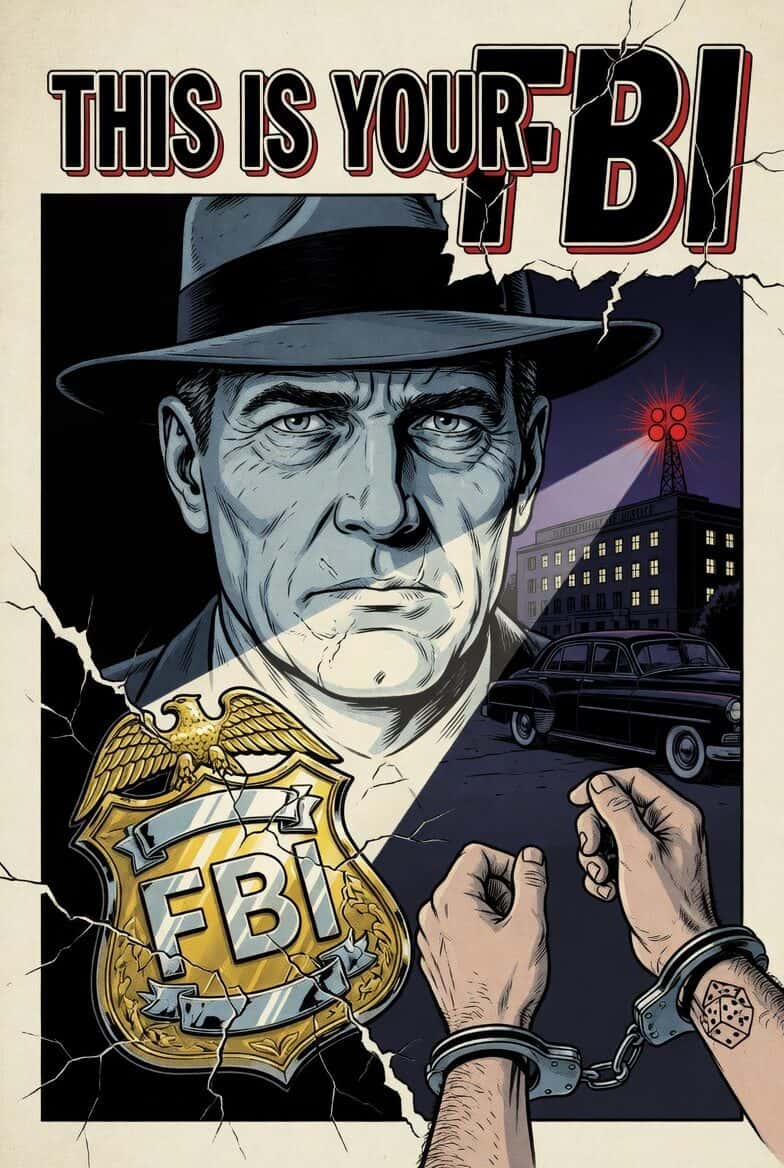
The Equitable Life Assurance Society presents, This is Your FBI. This is Your FBI. The official broadcast from the files of the Federal Bureau of Investigation. Presented as a public service by the Equitable Life Assurance Society of the United States and the Equitable Society's representative in your community. A.H.O. A-H-O. When my husband died, A-H-O saved our home. A-H-O stands for Assured Home Ownership, a unique plan created by the Equitable Life Insurance Society. A low-cost first mortgage is combined with life insurance protection, so the homeowner gets extra security. And if he should die, his widow inherits her home free and clear.
In just 14 minutes, the Equitable Society will give you more details on this ideal plan for homeowners offered by the Equitable Life Insurance Society of the United States. Tonight's FBI file, The Tropical Shakedown. It is only natural that the members of the Federal Bureau of Investigation, who spend their days and often their nights in a constant fight against crime, should have learned certain things about the seven and a half million people who have fingerprint arrest records, or about those who have committed one of the graver offenses. Those agents know, for instance, that there is no such thing as the typical criminal. They know, too, that many lawbreakers are above the average in IQ, and they know how cunning, how quick can be the mind of the criminal.
Those special agents are aware of the fact that behind the more than 13,000 murders committed in this country last year lay a small variety of reasons, with revenge, passion, and profit topping the list. Yes, they have amassed a sizable store of knowledge about crime and about criminals, these men who stand as your last line of defense against the lawbreaker. But the thing they regard as having the most significance Crime will take place, for crime knows no geography. It can take place in a teeming city, on a desolate farm far from any neighbor. It can happen on the desert, or on a lush, ocean-going luxury liner. Tonight's file opens on the deck of the S.S. Honolulu Queen. It is late afternoon, and the Queen is just starting to pull out of the pier at Honolulu for the long trip across the Pacific. We're moving, Mother. Yes.
I can't say I feel sad about leaving. We'd better throw the rest of these streamers. Do you want some of them? No, thank you. Here you are, madam. Some of mine, if you like. No, thank you. How are you today, Arthur? Oh, hello, Judge. Who is this man? Oh, he used to hang around the plantation. Is he a judge? Oh, no, of course not. This is all very technical, wouldn't you say? Why, yes. Yes, it is. Arthur, I think we should go below. All right, Mother. Arthur. Yes? Before you go, may I have a word with you? What do you want? Arthur, I find myself in a rather embarrassing position. All right, Mother. Wait, Arthur, wait. You see, I came aboard rather hurriedly without going through the formality of purchasing a ticket. Well, they'll sell you one. See the person. Well, that's the embarrassing part. I happen to find myself lacking the necessary funds with which to conduct the negotiation. Why are you telling all this to me? Because you're paying my fare.
What? I have some convincing reasons why you should, sir. I'll come down to your stateroom later and discuss them. I'll answer it, Arthur. All right. Good evening, madam. What do you want? I'd like to speak to your son, if I may. My son is resting. But when I spoke to him on deck... Yes, he told me about your conversation. And under no condition will he pay your fare. Not even if I brought out certain facts about your son? Facts that have to do with his... army career? Oh, come in. Well, thank you, madam. Mother! Mother, why did you bring... I told her I wished to discuss your army career. Oh, you see, I am aware of the fact that certain authorities would appreciate knowing your whereabouts. Who told you that? You did, madam. What? Yes. You wrote those long letters to Arthur at the plantation. I never showed you any of mother's letters. From time to time there arose the opportunity for me to go through your room.
You should have locked those letters up, son. Reading my letters was highly unethical. But they were most informative. In them I read that Arthur was an army deserter, that you supplied money for him to come to Hawaii, that you got him a job at the plantation. Mother, he can't prove any of that. Young man, I was not bestowed the judicial title for nothing. I had each of those letters photostated. Well, just exactly what do you want? Madam, I'd appreciate your seeing the purchase. Tell him I'm a close personal friend. Say that I came down to see you off and was persuaded to stay aboard and make the trip with you. When you have completed that transaction, we can make the other arrangements. What other arrangements? Pocket money, social contracts, all the little amenities that befit a gentleman at sea. Well, at an FBI field office on the West Coast.
Special Agent Jim Taylor approaches the desk of Agent George Patterson. George? Oh, yes, Jim. We just got a report in on the Arthur Madison desertion file. Madison? Madison? I don't think I know that one. Is that one of the files you got when Jefferson was transferred? That's right. I haven't had a chance to get through all of them yet. Oh? Well, this Arthur Madison is a wealthy widow's only son. When this peacetime draft came along, she tried to keep him out. How? Well, the first thing she tried was a fake medical record. It said the son had a very bad heart condition. Uh-huh. When that didn't work, she sold everything she owned and put the money in a safe deposit box at the Forest Bank so she could claim hardship. She said if her son were drafted, she wouldn't have any means of support. Nice people. Well, none of her subterfuges worked, though, and finally her son was drafted. He was sent to an induction center and from there to a basic training camp. After about a month of that, he deserted. I assume the surveillance was set up at the mother's house. Yes, but he never appeared. How much do you know about the Madisons, Jim?
Well, according to the psychiatrist who interviewed the boy when he was inducted and the officers who tried to train him, he's rather helpless without his mother, and she's the indulgent type. I see. You said a report came in on the case. Somebody see him? No, the superintendent of the apartment house where Mrs. Madison lived called in here. What did he have? Mrs. Madison has moved out, and according to something the superintendent overheard, she was going to join her son. Any idea where she went? No, he didn't hear her say anything about that. Have we got a description of Mrs. Madison, Jim? Yes, and let's start circulating it, George, and see if we can find out where she's headed for. Here, let me wrap your feet up. Oh, Mother. That's what the blanket is for. I'm really not chilly, Mother. Now you know the way you take colds here. Ah, good afternoon, Mrs. Madison. Oh. You seem somewhat less than overjoyed to see me. What do you want? I detest bothering you again, Madam, but...
I happen to find myself in that deplorable condition once a month. Drunk? Oh, madam, I refer to my lack of negotiable security. Why, I gave you $50 after breakfast. What did you do with it? I, uh, I've been playing the horse game. Why, mother, the tickets are only 50 cents a piece. I played yesterday and I won. Proving that talent is hardly an integral part of a game. Mrs. Madison, kindly let me have $50. I have some friends waiting for me to buy them a drink. Very well. I want you to know that I am not unappreciative of these papers. Here you are. Thank you, madam. Thank you. I'll try to make this last. At least to dinner. Well, at least we only have to put up with him for one more day. Where is this place we're going? Well, it's called Greenwood Lodge, and it's near Pacific City.
But won't you have to go back home? Oh, no, dear. I've sold everything and converted it into cash. And it's all in the safe deposit box. Oh, I see. Once we get to Greenwood Lodge, neither the judge nor anyone else can bother us. Oh, no. Jim, for a time this morning, I thought I was going to find out the Madison. Why, George? What happened? I had to go down near Fort Bradshaw on a Masterson case. And while I was there, I decided I'd try to follow Madison's trail from the time he deserted. And? I got a lead at the fort that took me to the Hotel Dalton. George, we knew he went there. I know, I saw it in the file, but I got a little further than that. Oh, how? I went through the telephone sets at the hotel for the day that Madison checked in. Find anything? Yes. He made a long-distance call. Where to? A number here in town. I checked the number, and it was his mother's. I figured that he might have called her for money, so I went to the Western Union office. Anything there? Yes. Arthur Madison got a money order that day for $2,500. You did find something. But that's where the trail ended. Oh.
Well, George, let's try to figure something out. Like what? Our young Madison calls his mother. She sends him $2,500. Now, if he were coming home, he wouldn't need that much money. Right. Well, I think we have to assume that he used that money to travel quite a distance. Now, she's on her way to meet him. Oh, excuse me. Special Agent Taylor speaking. Yes, that's right. Are you sure? When? Well, thank you very much. Yes. Yes, that's a great help. Thanks again. Goodbye. That was the superintendent of Mrs. Madison's apartment house again. What did he have to say? He ran into a friend of Mrs. Madison's on the street a little while ago, and she told him that Mrs. Madison had gone to Hawaii. Wow. George, let's get down to the radio room. Notify the Honolulu office. Good evening, Mrs. Madison. Uh-huh. I trust that you enjoyed the captain's dinner? Come along. Wait, I'll stroll with you. Oh, don't bother. Oh, it's a pleasure, madam, a pleasure.
These things always make me sad. But I stay at sea means that so many friendships made on shipboard are about to be broken. Oh, I know they all promise that they'll write to each other and see each other, but somehow they never do. Well, I'm glad the trip is over. You lack sentiment, my boy. Shall we take a turn about the deck? No, thank you. I prefer that you do, madam. I have a very important matter to discuss with you. You reconsider, madam? Very well. Splendid woman, your mother, splendid. Go ahead, brother. After you. Thank you, Dean. Ah, look at that moon. Just one great romantic glow. Did you ask us here to discuss the moon? Oh, forgive me, forgive me. I asked you here, Mrs. Madison, to correct an erroneous impression under which you've been labelled. And what is that? Well, first I should tell you that I departed from the island of Oahu for the express purpose of making this voyage with you. What?
I stole enough money there for my passage. Unfortunately, on my last day in Honolulu, I met a gentleman who persuaded me to engage in a small game of cards. And of course you lost. Every penny I had stolen. That's why I had to come aboard without my passage being paid for in advance. You see, I never had any intention of seeing you merely for the purpose of getting a free trip to the States. I really... Will you please get to the point, Mr. Kennedy? I am. I mean to collect substantially for my knowledge about your son, Mrs. Madison. But I've already paid for your suite. I've given you $250 in cash. A mere fitness. Well, how much do you expect? $25,000. What? And until I get it, I shall remain your constant guest. We will return in just a moment to tonight's file which shows how your FBI protects American citizens and American homes.
Now a word about a plan which not only safeguards the homeowner during his lifetime, but also continues to protect his widow if he should die. Here's what happens. Good morning, Mrs. Ramson. I'm George Stanton. Oh, you're the representative of the Equitable Society who sold my husband his assured homeownership plan. Right. Here's the canceled mortgage on your home. And here's a check for $3,375 from the Equitable Society. That covers all the payments your husband made to reduce the principal of the mortgage. This woman's husband had an equitable, assured home ownership plan. The widow inherited a house that's hers free and clear. What's more, every dollar her husband previously paid to reduce the mortgage was returned to her. My husband always said the children and I would be well taken care of. Now some other features of the Equitable Society's assured home ownership plan. First...
There's the cash fund, which builds up in the owner's lifetime, and which may be used whenever sickness or unemployment threaten home security. Second, this cash fund may be used to cancel the mortgage well ahead of schedule. Equitable Society records show that many 20-year mortgages have been completely paid off in just about 15 years. Finally, the mortgage interest is only 4%, and there's a liberal allowance to cover title search, lawyer's fees, and other closing costs. So for many reasons, a man may consider himself lucky if his health, age, income, and the location of his home enable him to qualify for an equitable, assured home ownership plan, combining a low-cost first mortgage with life insurance. For full information, see your Equitable Society representative or write care of this station to the Equitable Society. That's E-Q-U-I-T-A-B-L-E. The Equitable Life Insurance Society of the United States.
And now back to the FBI file, The Tropical Shakedown. Extortion is an ancient crime. Payment or receipt of it was made a felony by Queen Elizabeth of England as far back as 1601. In those days, it was a tribute of money, corn, cattle, or household possession exacted in the north of England and the south of Scotland by roving groups for protection from pillage. That was the 16th century. And it will afford you some idea of how little crime has changed when you realize that exactly the same situation, the payment by people for protection, existed in virtually every section of this country in the 1920s, almost 400 years later. In tonight's case from the files of your FBI, you see an extortioner at work on a mother and her son, two people who have themselves conspired to break the law. However...
Even they would be better off going to the police, as your FBI hopes you will do if an attempt should be made to extort you. Sometimes going to the police will involve public censure, or invite the derision of your acquaintances, or even, as in this case, force you to confess a crime. But as an organization which has dealt at long length with extortion and extortioners, the Federal Bureau of Investigation can tell you with certainty that any of those are better than being an extortion victim. And much less expensive. Because your first payment is not the last. It is merely a down payment on perpetual misery. Tonight's file continues in the local FBI field office. George, this report just came in by radio from the Honolulu office. Located Mrs. Madison. She was staying at the Imperial Hotel. Was staying? Well, she and her son left there last week on the SS Honolulu Queen.
Then all we have to do is meet the boat. The Honolulu Queen docked at 8 this morning. Oh, fine. I went down to the pier, though, and I talked to the purser. He confirmed the fact that Mrs. Madison and her son had been aboard. Do you have any idea where they went? No, none at all. Then we're right back where we started. Oh, a new factor's been added, though. What's that? The Honolulu office asked us to apprehend a man named Robert Kennedy. Who's he? He's charged with having robbed a plantation owner two weeks ago on a government reservation at Oahu. How come he was able to slip through onto the boat? Well, the theft wasn't discovered until yesterday. Did the purser confirm Kennedy's the passenger? Yes, and he told me that Mrs. Madison paid for his passage. How did that happen? I'd like to know that myself. Sounds like an odd combination. Well, maybe it'll make them easier to find. I've just had an alarm sent out on all of them. Now, come on, George. Let's check all the local hotels.
Oh, Arthur, dear, I'm so sorry. What for? Making you run so much. We'd better hurry on, dear. Yes, all right. Is this our car? Yes, yes, come on. I'm breathless. Oh, I know, you poor boy. Our compartment is right at this end. It's all right. Here we are. After you. Thank you, dear. Oh, my, it's good to sit down. Oh, mother. You know I hate to ride backwards. Oh, I forgot, son. I'm sorry, dear. I never thought I'd be able to pack and get over here on time. I couldn't help it, Arthur. It was necessary. Why? Well, I called you just as soon as I left the bank. What bank? The one where I had the safe deposit box. You see, I went there with Mr. Kennedy. Mother, you didn't give him that money, did you?
Oh, dear, when I went there with him, I didn't see any way out of it. Oh, Mother. But when we got to the section of the bank where the safe deposit boxes are, I asked Mr. Kennedy to wait while I went in. And after I emptied the box, I saw that there was another exit. That's when I left and called you. What about Kennedy? Well, so far as I know, Arthur, he's still there waiting for me. Where is Sting, George? They've already checked in. But the boat didn't get in until this morning. I know. The reserve didn't sweep for overnight, but something happened to make them change their mind. You know what it was? No, not for certain. I spoke to the telephone operator, and she said that she remembered a call coming in for young Madison. From? A woman. Surely after that call, he came down with packed bags, paid the bill, and checked out. Where was his mother? She had left here earlier in the day. I suspect that she's the one who called. How about Kennedy? He checked in with her.
And left with him, too? No, no, he's still registered here. He's not in, though. Get anything else? No, that's it. Oh, I picked up those search warrants. Oh, fine. Well, let's go upstairs and take a look at Kennedy's room in the medicine suite. Kennedy travels light, doesn't he, Jim? I hope we find more than that in the medicine suite. It's right down the hall, isn't it? Yes, Jerry. It's 411. Oh, 9. It's the next door on this side. Ellen, this is it. Here's the key, Jim. Oh, fine. Go ahead, Jim. All right. Let's take this room first, huh? Okay. If we don't get anything in here, George, we'll need to take a bedroom. Right. Hey, Jim, are you sure the maid hasn't cleaned this place? Positive. The young Madison must have packed everything that wasn't nailed down. Oh, George. Look, this blotter, it's been used. The manager told me they put new writing equipment in all the rooms this morning. Why do I hold this blotter up to that mirror? Okay. There's the letter B and...
Number's 1642. Can you make out those other numbers there underneath? They look like a 3 and a 7. Yes, that's it. 137. George, I think I've got it. Young Madison checked out of here about a quarter past 1, and he was in a hurry. What about it? Well, maybe 137 is the time of something, like a departure time. For a plane or train? Yes, and my vote is a train. Why? Well, that B1642 could be the number of a Pullman car. Let's check the railroad station at once.
Mother. Yes, son? Must I maintain this rigid a schedule? What do you mean, dear? Walks at a certain hour, vitamin pills at a certain hour. Why, you've been under a terrific strain, darling. You need building up. I know, but... Now, now, now, mother knows best, dear. Come into the cottage and take your nap. Well, all right. But I'm warning you now, I won't sleep, mother. No, Arthur. No, I mean it. At your will of your own. Allow me, mother. Thank you, darling. Greetings. Greetings. What? What are you doing here? Well, to be truthful, madam, I found myself a trifle bored waiting for you at the bank, so I... Get out of here. Arthur, my boy, your mother and I can discuss this alone. Please be quiet. How did you know we were here? I took the liberty of going through your purse one day aboard ship. Found a letter from this hotel confirming your reservations. Why, you're no better than a common thief. Mrs. Madison, your character analysis...
is of no interest to me. I came here for my money. Well, I won't pay you a penny. Good for you, Mother. I don't want to seem ungentlemanly, Mrs. Madison, but you'll pay me or your son goes to jail. Oh, no, I won't. Put up your hands. What? This is a challenge. Arthur, don't fight, please. Sorry, Mother, but... Oh, Mrs. Madison, shall I continue to strike him or will you pay? You won't have to pay a thing, Mrs. Madison. Just who are you? I'm a special agent of the FBI. The FBI? Yes, and I'm taking all three of you back to headquarters. Robert Kennedy, alias The Judge, was tried, convicted, and sentenced to ten years for fraud on the high seas. He also received a 25-year sentence for robbery of the plantation owner in Oahu. Arthur Madison, on expression of his mother's insistence that he join the army...
was given this opportunity and is now on his way to complete rehabilitation. One of the things which enabled the two special agents in tonight's case to close the file so quickly was the close cooperation they received from the Honolulu FBI field office. This kind of cooperation has come to be a part of the workings of the Federal Bureau of Investigation, has given to every agent the warm feeling that he is never working alone, but as part of a team, as part of a great organization which has been entrusted... with more and more important work as the years have passed. A hundred years ago, Ralph Waldo Emerson wrote the line that read, An institution is but the lengthened shadow of one man. And never was that more true than in the case of your FBI. The real growth of the Federal Bureau of Investigation dates back to May 10th, 1924, exactly 25 years ago this week, when a young lawyer assumed the direction of...
the Corps of Federal Law Enforcement Officers. That young lawyer has made your FBI not only the greatest instrument for fighting crime in the history of the nation, but has also made the initials FBI synonymous in every quarter with the protection of the national security in time of peace as well as war. That young lawyer's name was and is J. Edgar Hoover, and we who are privileged to work with him take this opportunity to congratulate him. on a quarter of a century of distinguished public service to his fellow citizens and to his country. In just a moment, we will tell you about next week's exciting case from the files of your FBI. Now, a word to the wives. Let's consider the Equitable Society's Assured Home Ownership Plan from the woman's point of view. While her husband lives, the home she lives in has extra protection from the Planned Special Cash Fund.
which can be used if sickness or unemployment threaten home security. If her husband dies, the mortgage is automatically canceled. For full information, see your Equitable Society representative or write care of this station to the Equitable Life Assurance Society of the United States. Next week, we will dramatize another case from the files of the Federal Bureau of Investigation.