
The written record
Read the transcript
Read along with the recording · About 22 min to read
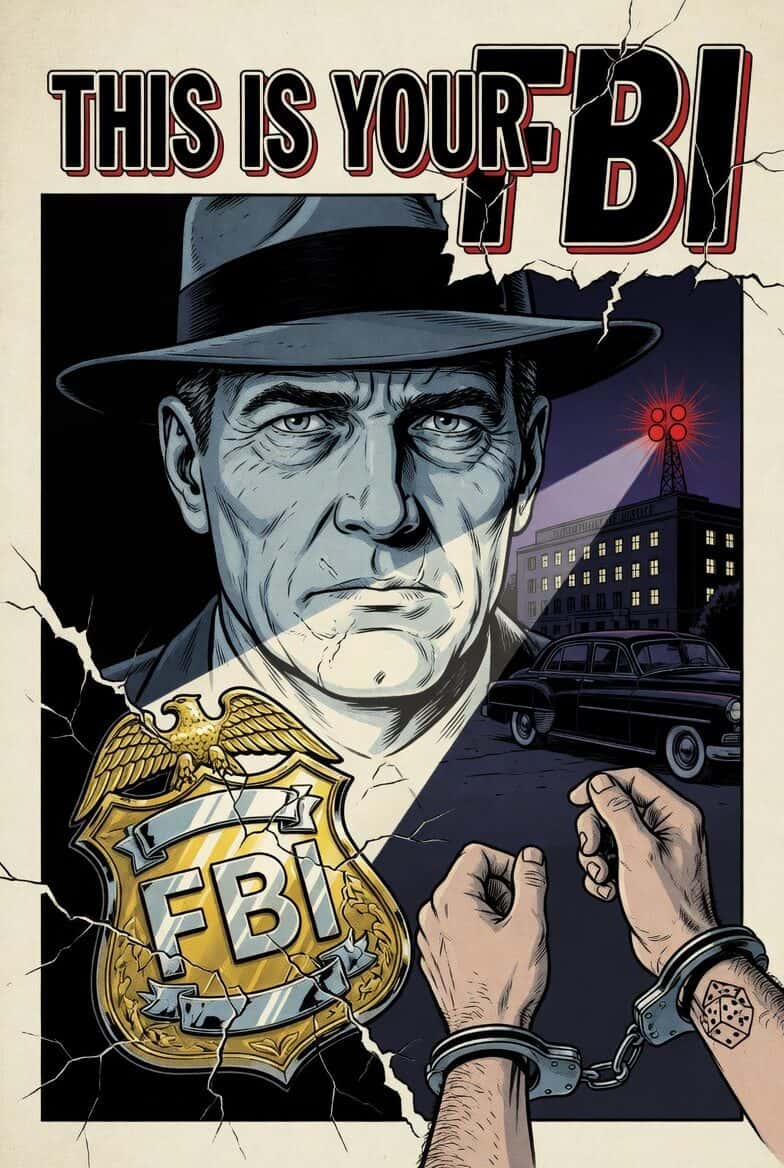
The Equitable Life Assurance Society presents... This is your FBI. This is your FBI. The official broadcast from the files of the Federal Bureau of Investigation. Transcribed and presented as a public service by the Equitable Life Assurance Society of the United States and the Equitable Society's representative in your community. Now for a moment, we're going to hear from a representative of our sponsor, the Equitable Life Assurance Society of the United States. I wouldn't trade my job as a representative of the Equitable Society with anyone else in the country. Right now, for instance, there are at least five boys and girls in our state university who might not be there if I hadn't talked to their fathers about an Equitable Education Fund. In approximately 14 minutes, I'll be back with full information about the Equitable Education Fund, an important contribution to American education made by the Equitable Life Assurance Society of the United States.
Tonight's FBI file, The Delinquent Father. In the course of investigating the thousands upon thousands of cases in its files, the special agents of your FBI receive cooperation from virtually every local law enforcement agency in the country. Cooperation without which many of those files would never be closed. For that reason, the men in every FBI field office are good judges of the character and quality of your local police. of the men who form your first line of defense against crime. Local police forces all over the nation are composed of men whose life is based upon a simple devotion to duty. For those of you who want proof of that statement, consider the study made into the private lives of the policemen of a large American city. It revealed that because of a salary so low that it compared unfavorably with many menial jobs, almost 50% of the force was deep in debt. And yet...
That same survey did not, could not, unveil one single instance of a policeman taking breath or of a policeman who took advantage of his uniform for his economic good. That is a record of which not only that local police department can be proud, but every force throughout the country. For they are all made up of the same type of man. The type of man who puts duty above dollars.
Tonight's file opens in the exclusive residential district of a large Midwestern city. It is late at night and the quiet is broken only by the purring motor of a car as it drives to the rear of a large apartment house. A man alone is driving the car. He parks, turns off the motor, looks furtively about, then opens the car door. He steps out, closes the door, and walks quickly toward the back of the building. Hold it. What? Hello, Mr. Jones. Who are you? You remember me. Fat Willie from the club. Oh, yes. I figured maybe you were using the back door. That's why I waited here. I've been trying to see you now for a week. Well, I've been very busy here. Yeah, I know. Your office told me. I waited out in front of this building for you a couple of nights. Then I waited outside your office. You play a good duck, Mr. Jones.
Well, I haven't been trying to avoid you. I want to tell you that Mr. Parker doesn't like to get hung up. Especially not for $20,000. I'll pay him. I always have. It's been a month now, Mr. Jones. When you come to the club and win, you get paid on the barrelhead. Mr. Parker wants his money the same way. But I haven't any money. You live in this place on the cuff? No. My wife pays the rent. It's her money, not mine. Well... How you get it is your problem. Mr. Park will be waiting for you tomorrow night at the game. Nine o'clock. You'll be there. Yes, sir. Two to one, no change. All down. Here he comes. And it's seven, six and one. Mr. Jones, I'm glad you got here on time. Where's Parker? In his office. Come on. And here he comes. E-O-11. Right through there, Mr. Jones. Go ahead in. He's waiting for you. Hello, Mr. Jones.
Hello, Parker. Have a chair. Thank you. Cigar? No, thanks. Drink? Well, then we can get down to business. I understand you can't pay. That's right. I haven't any money. But you know where to get some. What do you mean? You're married to her. My wife won't give me anything. I think I have a solution to your problem. What? Here. Here, read this note. Dear Mrs. Jones. Do you mean my wife? Uh, read it. We want $20,000 in cash. Or we will kidnap your son James and kill him immediately. What is this? A note to your wife. She'd pay $20,000 to keep your boy from being kidnapped, wouldn't she? Parker, you see people at their worst out in that room. I know it. I've been there. But nobody is this low. Nobody conspires to kidnap his own child. You don't have to kidnap him. But how else? The threat would be enough. When she gets the note, you convince her to pay. Oh, uh, don't send that one.
Make a copy of it. I haven't said I'd send any. I'm showing you how to pay me back for $20,000. You've got ten minutes to make up your mind. Taxi! Taxi! Mind if I come along, Mr. Jones? Huh? It's me again. Oh, come on. Thanks. The Wentworth shipping driver. Yes, sir. Mr. Parker's been waiting to hear from you. I was going to call him from my office. I'll save you the trouble. You can tell me, did Mrs. Jones get that letter? Yes, this morning. I had quite a bit of work convincing her it was best to keep quiet and pay. And did you convince her? Yes. If you've got the dough with you, I'll take it. I haven't got it yet. My wife is going to the bank for it. When are you going to see her? I told her I'd come home early from the office and make the rest of the arrangements. Oh, that's good. Tell Parker I'll call him as soon as I have it. All right. But, Mr. Jones, you know I like you.
Be sure you call by 6 o'clock tonight. A few hours later, at the local FBI field office, Detective Al Gilbert of the local police is approaching the desk of Special Agent Jim Taylor. Hi, Jim. Well, hello, Al. What brings you up here? I just didn't see your agent in charge, and he told me to bring the story to you. Well, it'll be like old times, working together again. I hope we do as well this time. What kind of a case is it? Threat of kidnapping. Oh? About a half hour ago, a woman named Jones walked into the station house. Death Sergeant sent her back to see me. She gave me this note. Here, take a look at it. Yeah, this threat of violence would give us jurisdiction if it was sent through the mails. It was. Any leads? Well, she's married to a man named Charles Jones. She described him as an investor. My guess is that he invested her money for her. I see. He tried to invest some of it in this deal. Oh, what do you mean, Al? According to what she told me, he was quite insistent about the fact that she should pay this money.
And she came to you in spite of that? Yes. She said that her husband asked her not to go to the police, even if she decided not to pay. Well, it seems to me that Mr. Jones will bear a little looking into. Is he in office? Yes. Did you find out where it is? Yes, I did. Good. Al, why don't you go down there and see what you can find out about him? Okay, Jim. I'll go over and talk to Mrs. Jones. Oh, good afternoon. Are you Mr. Jones? That's right. I'm a special agent of the FBI. Here are my credentials. Well, what is it you want, Mr. Taylor? May I come in, please? Yes, surely. Thank you. Now, what can I do for you? I'd like to speak to Mrs. Jones, if I may. She's out. Do you know where she went? Yes, to her mother's. May I ask why you want to see her? Oh, certainly. Your wife received a note this morning threatening your son's life. You know about that? No, Mrs. Jones brought it to the attention of the police. I asked her not to. Oh, may I ask why, Mr. Jones? You ought to know.
I don't understand what you mean. Well, you see enough of this kind of thing. You know that people who write notes like this mean business. Well, you're being a little pessimistic about the ability of the police, aren't you, Mr. Jones? I know that the only way out is to pay this money. Mr. Taylor, I'd appreciate it if you'd forget the whole thing. I'm afraid that's a favor I can't grant you. A formal complaint was made by Mrs. Jones, and from that point on, we must complete our investigation. Well, then, I wash my hands of it. You and Mrs. Jones can take the responsibility for what happens to our son. If she wants us to, we'll share that responsibility with her. Now, when Mrs. Jones returns, will you please have her call me? Oh, hello, Mr. Jones. Oh, George. Where you been lately? Oh, I... I've been busy. Oh, working hard, huh? Yes, that's right. Well, that's when you need the baths most. You know, I was saying just the other day, fella's a businessman, works hard. He should come every day for a massage.
George, has anyone been here looking for me? Not since I come on. When was that? Two hours ago. You expecting somebody? No, no. Have you got two nickels? Well, I should have. Oh, yeah. Yeah, here. Thank you. Hey, Mr. Jones. You like to play a horse once in a while, don't you? A fella gave me a tip just about an hour ago. He says the horse is running tomorrow. He says it can't lose. It seems like the train has got a daughter who's real sick, see? Needs an operation. Hello, dear. Dear, look, I don't think I'll be home tonight. Well, I can't explain it on the phone. I'll tell you tomorrow. No, no, no, no, no, no. It has nothing to do with the kidnapping. It's business. That's right. Darling, has anyone been there looking for me? What does he look like? How big? I see. If he comes back, just tell him you don't know. That's right.
I'll talk to you tomorrow. Goodbye, Dick. George. Yes, sir? I'm going in to get undressed. And I'm going to take some steam. Oh, yes, sir. If anyone calls me on the phone or comes here looking for me, just say I'm not here. Who's that? Oh, it's me, Mr. Jones. Who's me? George. I brought you some fresh towels. Oh, just leave them, please, George. Yes, sir. Mr. Jones. Yes? You've been in here a long time. Too much steam ain't too bad. That's my business. Yes. Would you like some cold water? No. No, thank you. Just leave me alone, please. Yes, Mr. Jones. Glad you came here, Mr. Jones. I can use a little steam. How did you get in here? I just walked in. When? When the guy with the towels walked out. Was it private? No. Mr.
Parker was very mad when you didn't call. Made me look bad. I told him you were going to pay him tonight. Well, I... I thought I was going to pay him, too, but something happened. What? My wife went to the police. About the kidnapping? Yes. Why did you let her do it? I couldn't stop her. She called the FBI in, too. There'll be no collecting any money from her now. That's too bad. So, if you'll excuse me, please... Wait. Where are you going? Well, it's getting hot in here. It's going to get hotter, Mr. Jones. I'm going to collect that $20,000 with this hose. We will return to tonight's exciting FBI file in just a moment. Millions of Americans are beginning to think of college football. Only a few more weeks now, and you'll be hearing that familiar roar of a college football crowd. Talk about thrills. Here we are, the very last play of the game. Ten seconds to play.
Score tied, 6-6, and Wilson's going to try for a field goal. Ready now. The ball's snapped back. Here's the kick. It's good. They win. Yes, on the gridiron in the classrooms, college men play to win. And in later years, because of their college training, it's usually the college men and women who win the big rewards. Did you know that a college graduate nearly 15 times is likely to make $10,000 a year or over as a non-college man? That's right. The odds in favor of a college education are 15 to 1. It's odds like those that caused the Equitable Life Assurance Society to found its famous Equitable Education Fund. This is a plan for farsighted parents who want to make certain that their children get the higher education that means so much. First and foremost, an Equitable Education Fund is sure. S-U-R-E. Right. This fund combines planned regular saving with life insurance.
That means that if the father dies or becomes permanently disabled, this plan makes it certain that his children will still be able to get the education he wanted them to have. Second advantage, an equitable education fund is easy. You'll be amazed how quickly a comparatively small monthly payment builds up. Remember, the more your children learn, the more they'll earn. Think that over, father and mother, and decide right now for your children to give them a head start towards future success and happiness with an equitable education fund. Naturally, the man to see is your Equitable Society representative. He'll be glad to give you full facts and figures. Or, if you prefer, send a postcard care of this station to the Equitable Society. That's E-Q-U-I-T-A-B-L-E. The Equitable Life Assurance Society of the United States. And now back to the FBI file, The Delinquent Father.
Tonight's case from the files of your FBI has been chosen for dramatization because it has something in common with almost every other crime. The common quality is the character of the criminal. In this case, a father has conspired to extort $20,000 from his own wife under threat of kidnapping and killing their son. The thing that made him join in that conspiracy, the thing that made him a criminal, is his lack of moral stature. And in that, he is no different from every other criminal. There are, among the seven and a half million people with criminal arrest records in the fingerprint files of the Federal Bureau of Investigation, every conceivable physical type. Every grade of education is represented, from those who never saw a schoolroom to those who hold degrees from the most lofty universities in the land. As a group, they present as diverse a picture as any other army. This army, however, marches not on its stomach, but on the loot it steals. It is an army which, unless checked in the very near future, may strike at any time and at any target, or it chooses its victims indiscriminately. Its next victim might be the man down the block. It might be the person you spoke to on the telephone a little while ago. It might even be you. Tonight's file continues at the local FBI field office. Morning, Jim. Oh, hi, Al. Oh, I just got word from our lab on Jones. Oh, but why? Remember that note his wife gave you? Uh-huh. Well, when I finished interviewing him yesterday, I went down to his office. Got some samples of writing from the typewriters down there. Oh.
I sent the samples on to our lab along with the note that Mrs. Jones gave you. What did the report say? The note was written in Jones' office. Well, that's enough to get a warrant for his arrest, Jim. I know that. But first, we've got to find him. I sent out an alarm on him. When did he turn up missing? Oh, I just spoke to Mrs. Jones a couple of minutes ago. She said her husband didn't come home all night. Oh, pardon me, will you? Sure, Jim. Special Agent Taylor speaking. Yes. He is? When? Where was that? Uh, just a moment, please. I want a copy of that address down. Go ahead. 834 West 43rd. Yes, thanks very much. Yes, we'll get on it right away. Bye. That was City Hospital, Al. Jones was brought in there during the night. He was severely beaten at a Turkish bath. How is he? He's still in a coma. Now, why don't you go up there and see if you can talk to him when he comes to? Right, Jim. I'll go up to the bath and see if I can get anything there.
You busy, Mr. Parker? No, no. Come in, Willie. I finally caught up with Mr. Jones last night. Where? At a Turkish bar. Well, why didn't you call me? Oh, it was kind of late. Did you talk to him? Yeah. In a steam room. What about the money? He didn't have it. What was his excuse? He said his wife went to the cops. Oh. I think he was telling the truth. Well, that don't help us any. That's what I pointed out to him. I roughed him up a little. He's in the hospital. Did I eat wrong, Mr. Parker? You just earned an extra hundred. Oh, thanks. No, don't thank me, Willie. Thank Mr. Jones. He'll be the one who'll give it to you. You still think you'll collect? I'm going to try. If I don't, then you've got another job. What kind? Next time, see that he goes to the morgue. This room is pretty messy. I know, Mr. Taylor, but the police asked me to leave it exactly the way I found it. I'm glad you did.
Have you thought any more about that man who came in here after Mr. Jones? Yes, sir. But all I can remember is what I told you. He was big and fat and he had blonde hair. How about Jones' clothes? Oh, they're still here. Oh, Jim. Oh, hi, Al. Well, George, could you get Mr. Jones' clothes and bring them to me? Yes, sir, right away. Thanks. Anything at the hospital, Al? Confirmation from the doctors that Jones was beaten with a hose from the steam room. Was Jones able to talk to you? No, he's still unconscious. What did the doctors say about his condition? Well, they described it as... Officially is fair. Here you are, Mr. Taylor. Here's his clothes, just like he put them in his locker. Thanks, George. Al, take the pants. I'll go for the jacket, huh? I didn't change. What? Key ring, four keys. Credit card? I ain't gonna... You ever ship in a golf club? It's all in the pants. Oh, Al, look at this. What? Copy of the kidnapped threat, except this one isn't typewritten. You think it's Jones's, right? Well, let's get back to your office, have your lab check, and make sure.
I just got that handwriting report back, Jim. What does it say? Jones didn't write this. Any idea who did? No, it doesn't match any of the samples on file. Hal, let me see that note again. All right, here. All these printed lines. They're arranged in kind of an odd pattern. Yeah. Let's check, see if we can trace where it comes from. Here's a list for us to check, Hal. What kind of a list? The name of every printer here in town that the Adams Paper Company sells to. Got two copies? Yeah, here's yours. Good, I'll start from the top, you start from the bottom. As soon as one of us hits, we'll get together.
I got the right printer, Al. Good. Who'd they print it for? Paul Parker. I've been trying to get something on Parker for years. I think we've got it now. Come on, let's get over there. Sorry, sir, we're not open yet. I didn't come here to gamble. What do you want? Here's my badge. I want to see Paul Parker. He is not here. His car is outside. The chauffeur said he was. Okay. Come on, then. We're right through that door. Who are you? Here's my badge, Parker. Have a chair. No, thanks. I'll stand. Suit yourself. Well, what's your pleasure? I've got a warrant here for your arrest. You have to find people gambling here before you can arrest me, you know that. The charge this time is different. We've got you now for conspiracy to kidnap. Oh, now wait a minute. I'll let you cops try to make reputations for yourselves by knocking me over once in a while, but you're not going to make any kidnapping charge stand up. Yes, we will. How? There were two notes employed in the threat of kidnapping.
One was a copy of the other. So? One of those notes was written on paper from your establishment. You can prove that? Yes. What's more, we took a fingerprint off it. We checked it against your card. It's yours, all right. Come on, Parker. We're taking a trip to headquarters. Hold it. Huh? Just keep your hands toward the ceiling. Nice going, Willie. This won't work, Parker. I think you'll have to admit it's got a pretty good chance. No, I wouldn't say that. Now, this is the gun that's in charge. Drop yours. Thanks, Jim. Who are you? I'm a special agent of the FBI. You and your henchmen are both under arrest. What for? Several charges. And if Jones should die at City Hospital, we can add another one. Murder. Paul Parker and Willie Black were sentenced to 50 years by a state court for extortion, attempted kidnapping, and attempted murder. Charles Jones was also sentenced to a long prison term for his part in the conspiracy. Furthermore, as a result of closing this case, gambling rackets were cleared up in this community.
As you have seen, tonight's case was brought to a successful conclusion because the paper on which Paul Parker wrote the original note was accurately and quickly traced to the gambling club. This arrest, of course, while it wiped out gambling, did not wipe out the crime wave in the community. No single arrest ever does or ever will. It is, in fact, to be questioned whether crime as we have come to know it will ever be completely wiped out. In a nation of 140 million people, some will always want what is not theirs. But the arrest in tonight's case is a step in the right direction. A step in the direction of attempting to prove to criminals and would-be criminals that they can't get away with it. The kind of cooperation between a local police officer and a special agent of your FBI that you witnessed tonight is one reason they can't and won't get away with anything. And that, of course, means greater protection for you, the American people. Greater protection of your property, your life, and your personal liberty.
In just a moment, we will tell you about next week's exciting case from the files of your FBI. But first, let's hear briefly from an Equitable Society representative on the subject of an Equitable Education Fund. I'd just like to remind this audience that an Equitable Education Fund is flexible at all times. Many young fathers start with an Equitable Education Fund that would pay part of the cost of a college education. Then, as their income goes up, they increase the amount of the fund. The man whose words you have just heard speaks for 6,000 Equitable Society representatives from coast to coast who are always ready to give you friendly help and counsel. If you do not know the name of the Equitable Man in your community, send a postcard care of this station to the Equitable Life Assurance Society of the United States. Next week, we will dramatize another case from the files of the Federal Bureau of Investigation.
A topical account of the exploits of a cunning and vicious criminal. Its subject, robbery. Its title, larceny well out. The incidents used in tonight's Equitable Life Assurance Society broadcast are adapted from the files of the Federal Bureau of Investigation. However, all names used are fictitious. And any similarity thereof to the names of persons living or dead is accidental. Tonight's broadcast was transcribed. And the music was composed and conducted by Frederick Stein. The author was Jerry P. Lewis. Your narrator was William Woodson. And special agent Taylor was played by Stacey Harris. Others in the cast were Tony Barrett, Bill Johnstone, Peter Leeds, Wally Mayer, and Roland Witten. This is your FBI. It's a Jerry Devine production. This is Larry Keating speaking for the Equitable Life Assurance Society of the United States and the Equitable Society represented in your community. And inviting you to tune in again next week at...