
The written record
Read the transcript
Read along with the recording · About 24 min to read
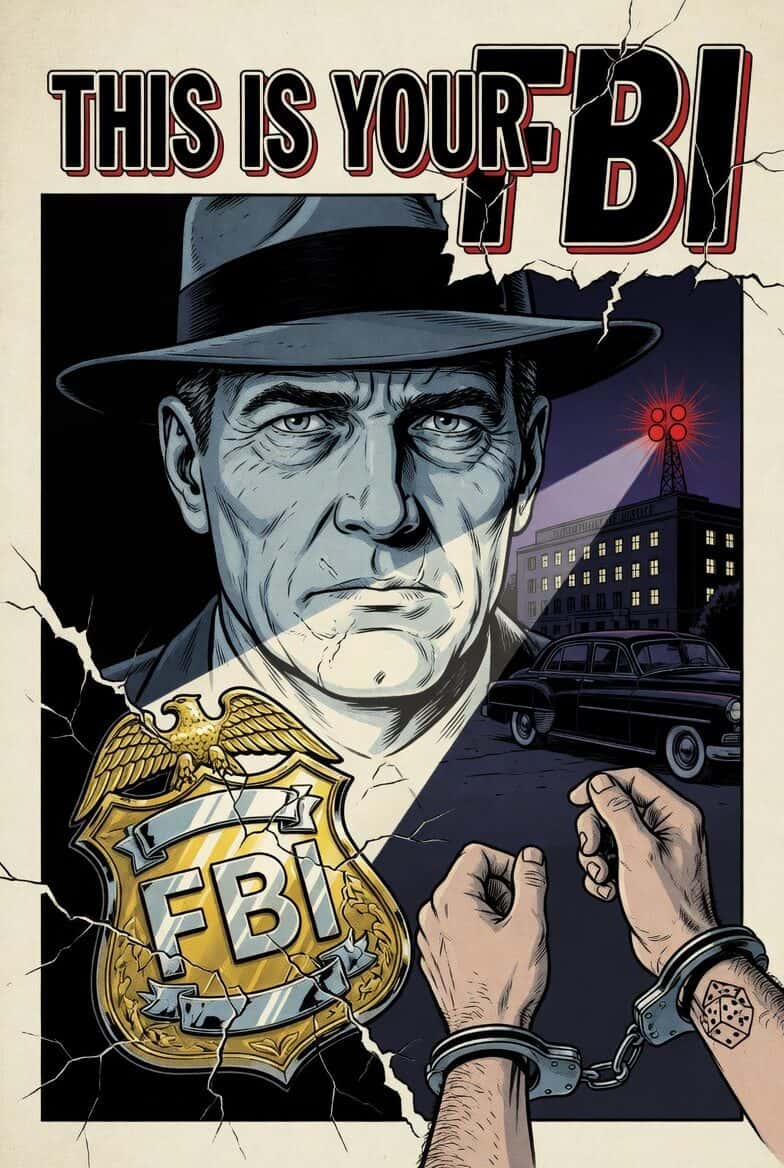
The Equitable Life Assurance Society presents, This is Your FBI. This is Your FBI, the official broadcast from the files of the Federal Bureau of Investigation. Presented as a public service by the Equitable Life Assurance Society of the United States and the Equitable Society's representative in your community. Now I should like to introduce a representative of our sponsor, the Equitable Life Assurance Society of the United States. Your future is his business. Security in years to come for you, your home, and your family. Yes, your future is in good hands when you entrust your life insurance program to a representative of the Equitable Life Assurance Society. Good evening, friends. I've come here tonight with just one purpose. I'm here to tell you that in about 14 minutes, Mr. Keating is going to have some important news for parents.
He's going to tell you about the Equitable Society's fact-finding chart for fathers and mothers. If you're like hundreds of parents to whom I personally have given copies of the fact-finding chart, you'll be very glad you listened to this eye-opening message from the Equitable Life Assurance Society of the United States. Thank you. Tonight's FBI file, Gentlemen Prefer Widows. The crime in tonight's case from the files of the Federal Bureau of Investigation is not a new one. On the contrary, it is almost as old as time itself, for the crime is extortion. In ancient times, and this goes back to every civilization the world ever knew, it was the practice for a strong army to roam and capture those towns whose defenses were weak. After the capture, an agreement would be drawn between the leader of the victorious troops and the city fathers.
An agreement whereby a good part of the town's income would be turned over to the army annually as a form of tribute. The penalty for not paying was a new attack. And when that was necessary, the town would be destroyed by fire after capture. That taught other towns to pay promptly, to pay for the privilege of living. Today, thousands of years later, extortion is still an important law enforcement problem. And the amount of money paid by the public each year to those who engage in that crime is impossible to estimate. No guess which went below the tens of millions, however, would in any way come close to the true figure. For pure viciousness, there is almost no offense to match extortion. For this is a crime based on fraying the nerves of a victim, on destroying the reasoning power by fear, on continuing the pressure until the victim pays.
or collapses. Tonight's file opens in a public library located in a large eastern city. It is late afternoon and in one corner a middle-aged woman stands in an alcove almost hidden by bookshelves which surround her. She seems to be searching for one book in particular when a man approaches. Pardon me. I'd like to see if the book I'm looking for is on that shelf. It's called A Human Bondage. Oh, it's you. You're Mrs. Montrose? Yes. Splendid. You brought the letters? Of course. Where are they? In my pocket. Let me have them. We're forgetting something. What? My fee. But I haven't seen the letters. You shall. When? As soon as you pay me. All right. Here. Where are my letters, please? I'll give them to you as soon as I make certain the money is in this envelope. I know it's frightfully rude, but if I got home and found nothing but paper...
Oh, this is very attractive. I shan't count it. I'm taking your honesty for granted. Here are your letters, Mrs. Montrose. I assume this concludes our business. Oh, wait. Before you go, you do recall what I told you about going to the police. What would happen to your daughter if you did? I remember. Splendid. May I leave now? Of course. Good day, Mrs. Montrose. Oh, poor woman.
Is that you, Arthur? Yes, dear. How did you make out? Everything was fine. She paid you the full amount? Yes. Then we should have asked for more. Lenore, every time we collect, you make the same comment. You must realize that up to a point, a client will pay and lick her wounds. Beyond that, she's wounded financially and driven into the arms of the law. Where will I put these groceries? Oh, leave them on the table, then. I still say this woman was good for another 5,000. Lenore, I don't wish to argue with you. This isn't an argument. It's a discussion. After all, I'm the one who has to run the accounts. I have to pay the bills. Well, today's collection should make that easy. Not at all. You spent over $1,000 preparing this job. That was necessary. Was it necessary to pay Wheeler $400? For the job he did, yes. I'm not talking about the job he did. He was broke. When a person's broke, he'll work for dirt.
You overpaid him. We've been all through this before, dear. Let's let it rest, shall we? Has Leo been around? No, but he called. Three times, as a matter of fact. Wanting to know if you'd collected. Poor Leo. Now, there's someone who really has financial problems. Every time we pay him for a job, he already owes the entire amount. Well, I'm afraid he'll be in more trouble this time. Why? I'm cutting down his percentage. Oh, now, Lenore. Twenty percent is far too much. I'm cutting him down to ten. Look, dear, I don't want to interfere with your handling of our finances, but I think you're being rather shabby with Leo. I've made up my mind. Have you told him yet? No. He might quit. Then we'd be in trouble. It'll stick. If he leaves, we'll just get somebody else to forge the letters.
Next morning at the local FBI field office, Special Agent Taylor is interviewing a woman who has just arrived. Now, Mrs. Montrose, I wonder if you'd tell me your story right from the beginning. I don't quite know where to start. Well, you said you paid a man $10,000 yesterday. That's right. At the public library on 1st Avenue. Well, then suppose you start with the first time that you heard from this man. Very well. A week ago, I received a note from a man named John Smith. I think we'll find that's an alias. Mr. Smith said he had some letters written by my late husband. He said those letters would destroy the good name Henry left when he passed away. Is that note in this package? No, sir. Those are the letters I purchased. Oh, I see. Where is the note? I burned it. Oh. Well, with his note, Mr. Smith sent me a photostatic copy of one of the letters Henry wrote. And what was the nature of the correspondence, Mrs. Montrose? The letter Henry wrote to Harvey Brooks.
He was president of the Allied Manufacturing Company when my husband was treasurer. Mr. Brooks has passed away, too. I see. And what makes these letters so dangerous? Well, well, they say that Henry... Oh, it seems impossible, Mr. Taylor. But right there in Henry's handwriting, he admits to Mr. Brooks that... that, well, well, that he stole $20,000 from the company. And you're sure this is your husband's handwriting? Yes, sir. Well, Mrs. Montrose, if you'd gone to the police when you got that first note, you could have saved that money. I know that now. But they threatened to waylay my daughter. I was worried. I finally told her last night. She made me come here today. You will help me, won't you, Mr. Taylor? I'd like to send one of these letters to our lab in Washington along with your description of Mr. Smith. I'll leave the whole package of them here if you like. I'm sorry, Mrs. Montrose, but you'd better take the others over to the police and tell them about it, too.
Must I? I'm afraid so. You see, without that original note, I have no way of knowing whether or not the FBI has any jurisdiction in this case. But, Mr. Taylor, that man is a criminal. Oh, I realize that, and you can rest assured of one thing. Even if we have no jurisdiction, we'll give the police all the help we can. And if it's at all possible, we'll get that money back for you, too. Madame? I'm in here. Oh. Oh, Arthur, I've just had an awful experience. What, dear? Leo Baker was just here. Yes? I told him about having to take the cut. He forgot to handle it. He called me all sorts of names. I told him that it was purely a business matter, that it was nothing personal. Where did he go? Oh, I don't know, and I don't care. Well, I do. I want to see him. Now, you're not going to give him... No, dear. This is an entirely different matter. I got a call a little while ago from the man who does our photo setting. He said our order was ready. What order?
That's exactly what I asked the man. He said the photostats were Leo Baker. I don't understand, Arthur. I didn't either, so I went over to the shop. And? Unfortunately, I was too late. Leo had already been in and picked them up. Must have gone there right from here. Did you ask the man what the photostats were? Yes. He said he wasn't exactly sure, but they seemed to be the same kind we ordered last week. Like the letters to Mrs. Montrose? Yes. Arthur, I don't like the sound of this. Neither do I. It could mean that he's forged some more Montrose letters and is going into business for himself. That little crook. We'd better put a stop to that. Come on, let's get over to his rooming house. Earl, have you finished testifying in the Amarillo case? Yes, Jim. Good, I'll fill you in on this new one that we're on. Fire away. Well, a woman named Mrs. Montrose came in yesterday.
She said she paid a man who said his name was John Smith $10,000 for some letters that her husband had written. Another extortion team. Yeah, but we've got a slicker customer to nail in this one. You know who this John Smith is? Yes, I sent one of the letters down to Washington along with a description of Smith. You got quick action. Yeah, Smith is actually a man named Arthur Scott. He's wanted in four states. And what's his pattern? Well, he picks a widow in each town whose husband has just died. And he does what he did with Mrs. Montrose. Mm-hmm. And where does he get the letters? Oh, they're forgeries. Handwriting says they're the work of Leo Baker. I know that name, Jim. I helped arrest Baker when I was in the New York office. Well, then you know he's pretty good, too. I don't say he's good. You know how he broke out of jail one time? Huh? He showed the guard a note from the warden saying he could go into town. The guard was the warden's brother, and he couldn't tell it was a forgery. I've just had an alarm sent out on Baker and on Scott. You think they've stayed here?
I'm not telling, Earl. It's worth a chance. After all, they don't know that Mrs. Montrose came to see us. Yeah, that's true. I'd better call her and tell her we're in the case now. In it till we round up these extortionists. Is Leo there, Eleanor? No, he's gone. Drive to Broadway and Maine. What for? That's where he is. Feed a man for a year, you put the clothes on his back, and this is how he repays you. How do you know he's at Broadway and Maine? Well, I spoke to the landlady. Told her I was his sister. Told her I wanted to surprise him. She let me into his room. It's amazing how clever you are when there's money involved. Well, I... I found some scraps of paper in his wastebasket. I put them together. Do you know what they were? Obviously not. Parts of another extortion letter. So he is tripping up. Yes. Well, I don't like to reopen old wounds, Lenora, but you've only yourself to blame for this. Why? Cutting him to ten percent. There's absolutely no excuse for disloyalty, Arthur.
We turned left here. I know. While I was in the room, the landlady came in. Did she catch you going through the basket? No. Came in to tell me she just remembered Leo wouldn't be home for a while. How did she know that? She overheard him making a phone call in the hall. He was calling some woman. Did you get her name? The landlady fished for it. Said it sounded like Morris. I said, Montrose? She said, yes, that's it. Leo is meeting her at Broadway in Maine at four o'clock. Good heavens, it's four now. We'll make it. Almost there. Let's see now. What will be the best way to handle this? Let him make the contact. Then we'll follow him and collect. Should we make him split with us? Split with us? I think Mrs. Montrose was our prospect. Anything he takes from her, we get 90% of. That's all we... What are you doing? Getting around the corner. What's the problem? I know. Did you want to be arrested for speeding? I'll take that chance.
There. Now I guess we're all right. What in heaven's name is this all about? We're looking for Leo. I saw him. Is Mrs. Montrose there? Yes. He could be collecting from her. I doubt that, darling. The last I saw of Leo, he was in the arms of two large cops. We will return in just a moment to tonight's exciting case from the official files of your FBI. Now a quick interview with a young father who looked as if he was feeling like a million. Well, wouldn't you feel pretty good yourself, Mr. Keating, if you discovered how to get rid of a ten-year worry in ten minutes flat? How did you manage to do that, George? Well, I asked my Equitable Society representative for that fact-finding chart for fathers and mothers you talked about on last week's program. Did the chart turn out to be as useful as I said it would be? Well, I'll say it did. Ever since my son George Jr. was born, there's been a big worry in the back of my mind. I'd say to myself, suppose I die unexpectedly. What's going to become of my family?
What income would they need for food, clothes, rent, and all the other month-by-month expenses? Well, that's something I'll never worry about again. Briefly, the Equitable Society's fact-finding chart gives a man a sound and reliable basis for estimating the minimum income his family would need to carry on without him. How much money they'd require to be well-fed, well-housed, and well-clothed until the children graduated from high school. What's more, this chart is simplicity itself. Every step is made absolutely clear by easy-to-understand pictures. As I said, it took my wife and me only a few minutes to fill it in. We really enjoyed doing it. And what a load off our minds to discover that the problem was not half as tough as we feared. By the way, George, how much did you pay for that chart? The equitable man didn't ask for any money. Of course not. This chart is absolutely free. And there's no obligation. Just drop a hint to any representative of the equitable society, and he'll be glad to see that you get a copy.
Or send a postcard, care of this ABC station, to the Equitable Life Assurance Society. That's spelled E-Q-U-I-T-A-B-L-E. The Equitable Life Assurance Society of the United States. And now back to the FBI file, Gentlemen Prefer Widows. Extortion is one of the most difficult problems facing every law enforcement agency today. And you have already witnessed at least one of the reasons why. In most cases, the extortion victim is carefully selected. is chosen because the extortioner depends on the victim's silence after the crime has been committed. If that silence is maintained for any length of time, the criminals have such a head start that virtually no clue remains. If the victim never makes any complaint, and that happens more often than you think, the criminal is free to commit still more extortion. The Federal Bureau of Investigation prides itself on its ability to fight crime wherever and whenever it finds it.
But by itself, your FBI cannot wipe out extortion. The fight on that crime must be initiated by you, the potential victims. And without your help, the fight is lost. By your help, your FBI means that when you or anyone you know receives an extortion threat, notify your local police immediately. Given that aid by enough people, your law enforcement agencies will wipe out the vampires and parasites who practice this ancient evil. The laws to punish them are on the statute book. But those laws apply only to criminals who are apprehended. And extortioners cannot be caught without the cooperation of one important person. You. Tonight's file continues later that evening at the FBI field office. Special Agent Taylor has just entered. Earl, the police arrested Leo Baker this afternoon. Good. How'd they get him? Well, he contacted Mrs. Montrose. He told her to meet him at Broadway and Main Street. For a second shake now? Yeah.
She immediately contacted the police, and when Baker arrived, they were there waiting for him. Have you interviewed him, Jim? Yes, I just left headquarters. Did you get anything? No, not much. Oh, he admitted working with Scott and his wife all right, but that's about all we could get out of it. Did you learn where they were living? No, not from him, but we may have a lead. The police found two keys in his pocket. One fit his furnished room. The other could be the key to where the Scotts are living. It was made by Acme Locksmiths on 9th Street. Did you stop by there? Yeah, but they're closed for the night. Well, these Scotts are human, Jim.
If he hadn't made the mistake of trying to get more money from Mrs. Montrose, we might not have any leads. You know, that angle bothers me. What angle? Scott's going back for a second helping. I just have a feeling he wasn't in on it. You think Baker did that on his own? Yeah. Why, Jim? Well, Scott's record. The modus operandi has always been the same. He's never gone back a second time. He's always made the collection personally. All appointments he's ever made have never been on the street like that. They've always been in a library. That certainly stands up, Jim. Of course, it still doesn't lead us to Scott. Yeah, but if this key fits Scott's apartment, we could find something there that might take us to him. Yes, dear? I'm going out now. I won't be back till dinner time. Where are you going? I've got to go to the library and brush up on my chess. You see, our next prospect, the late Mr. Jones, is the founder of the local chess club. Oh? After I've refreshed myself, I think I'll drop by the club, perhaps play a few games. How will that help?
Well, I thought I might find some specimens of his handwriting. You know, first draft of the club rules, maybe a letter recommending a new member. Oh, I see. By the way, dear, I've hired Jolly Putnam. To replace Leo? Yes. Never heard of him. He's been working in the South. I've heard excellent things about him. Everyone says he's a fine forger and honest as they come. Yeah, but will he work for 10%? Yes, I've already arranged that. But you're going to have to wire him $200. What for? Well, darling, he has to come here. I'll send him and I'll need him in the next day or two to write the letters. But why 200? That's for his plane ticket. I'll wire him 75. Let him come by bus. See you at dinner, dear. Well, that key did fit Scott's apartment, Earl. I assumed they were gone. Yeah, two days ago. But fortunately for us, their apartment hadn't been cleaned yet. Oh, don't you find any leads? I don't know. I piled everything I could find into this box. Well, let's take a look. You got a knife on you? Uh-huh.
Here. Thanks. Here we are. Now, let's see what we got, huh? Okay. Put these shoes on the top. I'd say they all belong to Scott. Well, we can check where they were bought. Might bring something. Yeah. Here's an old shirt I found in the closet. Any laundry marking? Yeah. Well, let's save it and check that. Okay. A couple of pipes. Set a book in. Maybe we could get some prints off them. Oh, I took care of that at the apartment. Oh, they're up at the lab now. Oh, God. And these are a sort of... Patent medicines and cosmetics that I found in the medicine chest. Jim. Yeah, I don't think they'll leave us any place. No. And these two newspapers. That does it. Didn't leave us much. Hey, those out-of-town newspapers, Jim? Yeah, yeah, they're from mid-city. Anything clipped out of them? No. Hey, let's take a look at Scott's record, huh? That's it over there in the corner of the desk. I got it. Here you are, Jim. Thanks.
Now, let's see if we can find what Scott would want with newspapers from Mid-City. He wasn't born there. He's never been arrested there. Hey, you know, Scott might have gotten these to find out what was going on in Mid-City. Let's call the police there, then keep an eye out for Scott and his wife. It's just possible that that's where he's going to do his next job.
Earl, I just got a call from the Mid-City Police. Anything on Scott? No. Then why did he have the newspapers? Well, maybe if we could trace where he bought them, we'd know. Let's check the out-of-town newsstands. There must be a dozen of them, Jim. Okay, let's take a picture of Scott and cover them all. You have any luck, Earl? No. None of the stands I went to even carried the Mid-City Journal. Same here. You think we're betting on a dead horse? No telling. Hey, wait a minute. I just thought of something. I'm going to make one more phone call to Mid-City.
Earl, we hit the jackpot. You found Scott? No, but I'm sure now he's in Mid-City. Why? I called the Mid-City Journal. They checked the record. Scott had a three-month subscription that just expired. Yeah, but Jim, that doesn't tell us where to look for him up there. Don't you remember his pattern? Come on, Earl, we've got a plane to catch. Quite an imposing library, isn't it, dear? Majestic pillars. Ivy's rotted walls. You know, I always enjoy these visits with a bounce of learning. Go ahead, Lenore. Thank you. Let's go over this way. I wonder if she's here yet. I imagine she is. I told her it's three o'clock. It's now five after. They're always prompt, you know. Where are you meeting her? In the financial sector. Quite apropos, don't you think? It's behind those bookcases there. It's quite sheltered. Now, you sit down here. Read one of those magazines. I won't be long. Would you rather... Shh. Sorry. Just wait for me, dear. Pardon me, ma'am. I'd like to see if the book I'm looking for is on that shelf. What is it called this time? Huh? Remember me, Mr. Scott? I...
Mrs. Montrose? That's right. Oh, goodness, I... I'll come here to get my money back. I'm sorry, Mrs. Montrose. I have to be running late. Oh, no, you don't. Let go of me. All right, Mrs. Montrose, we'll take over. What is it? This man is from the FBI. He's the one who told me you'd be here. Really? How clever. You can get my money back for me, Mr. Taylor. We'll certainly try, Mrs. Montrose, as soon as we get this man to headquarters. Arthur and Lenore Scott were tried and convicted in a federal court on a charge of extortion. Each received a ten-year sentence. Leo Baker and Charlie Hudson, the two forgers employed by the Scotts, were also sentenced to serve five years each in a federal penitentiary. Special agents Taylor and Clayton were able to locate the mid-city victim, from whom Arthur Scott intended to extort $10,000, by remembering his previous pattern of operations. Since the victim in each previous case had been a comparatively new widow, they reasoned that Scott had subscribed to the mid-city journal so that he could read the obituary pages.
This would also give him a list of close friends and relatives who had attended the funeral and from whom some information might be obtained at a later date. Information which, by itself, might be harmless, but which could form the basis for a new series of forged letters. A check of the widows of all wealthy people who died in Mid-City while Scott had his subscription brought to light one widow who had just received a letter similar to the one received by Mrs. Montrose. For the purpose of making a positive identification of Scott, Mrs. Markrose agreed to come to Mid-City and to wait at the library in the alcove Scott had set up for his meeting with Mrs. Jones, the new victim. Mrs. Scott was arrested on the front steps of the library, and their newest accomplice, Charlie Putnam, was located at a nearby rooming house. And so, two special agents of your FBI, in cooperation with the local police in two cities, were able to round up and exterminate this well-oiled machine of extortion. To remove them, at least temporarily, from the criminal scene. In just a moment, you will hear about next week's exciting case from the files of your FBI. But first, a few words from our Equitable Society representative on the fact-finding chart for fathers and mothers. I'm speaking for 8,000 Equitable Society representatives located in every state of the Union. Just say the word, and any one of us will be glad to see that you get a copy of the fact-finding chart for fathers and mothers. No charge or obligation. So why delay?
Phone one of us Equitable Society representatives soon. Or send a postcard care of this radio station to the Equitable Life Assurance Society of the United States. Next week, we will dramatize another case from the files of the Federal Bureau of Investigation. A case that is another true chapter from the annals of organized crime. Its subject, hijacking. Its title, the blundering felon. The incidents used in tonight's Equitable Life Assurance Society's broadcast are adapted from the files of the Federal Bureau of Investigation. However, all names used are fictitious, and any similarity thereof to the names of persons living or dead is accidental. Tonight, the music was composed and conducted by Frederick Steiner. The author was Jerry D. Lewis. Your narrator was William Woodson, and Special Agent Taylor was played by Stacey Harris. Others in the cast were Bill Johnstone, Ted Osborne, Florence Walcott, and Peggy Weber.
This Is Your FBI is a Jerry Devine production. This is Larry Keating speaking for the Equitable Life Assurance Society of the United States and the Equitable Society's representative in your community and inviting you to...