
The written record
Read the transcript
Read along with the recording · About 20 min to read
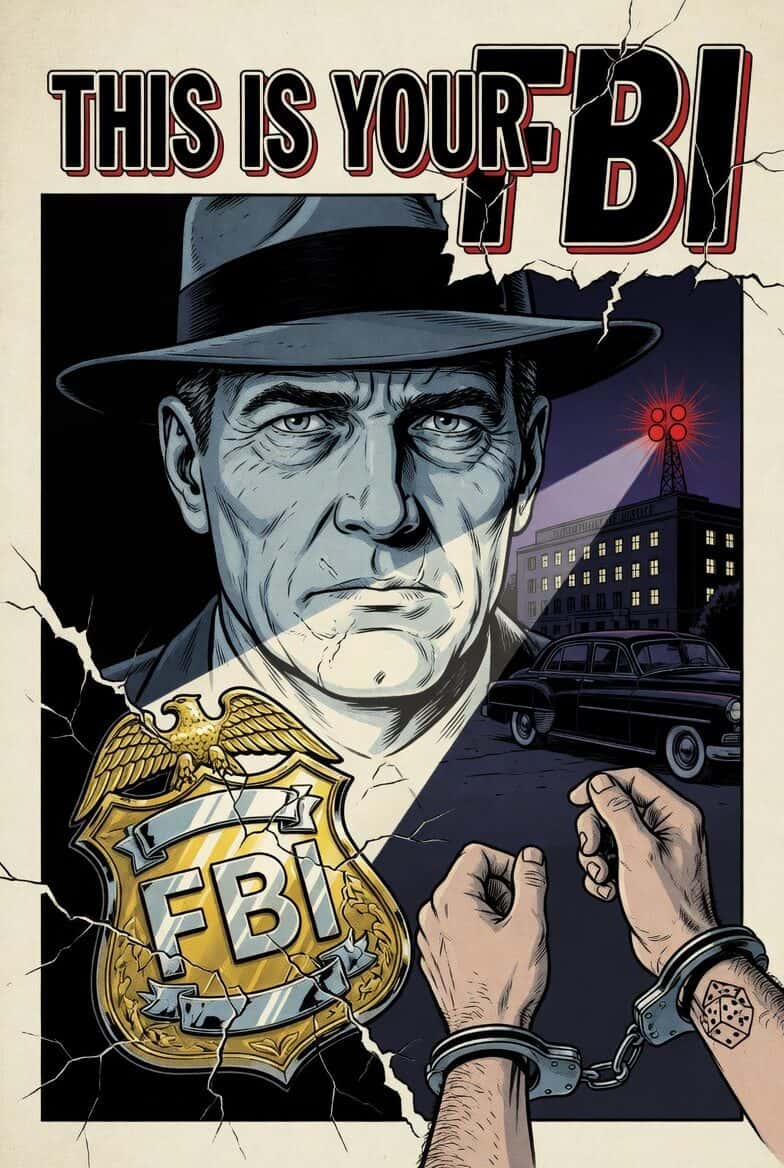
The Equitable Life Assurance Society presents, This is Your FBI. This is Your FBI, the official broadcast from the files of the Federal Bureau of Investigation. Transcribed and presented as a public service by the Equitable Life Assurance Society of the United States and the Equitable Society's representative in your community. Now a representative of our sponsor, the Equitable Life Assurance Society of the United States. Your future is his business. Tonight, our equitable representative has a very timely message for fathers and mothers of America. Today is a good time to plan ahead. To help you do that intelligently, the Equitable Life Assurance Society has prepared a special chart. It's called the Fact-Finding Chart for Fathers and Mothers. You'll hear more about this chart from Mr. Keating in about 14 minutes. Don't miss this important announcement from the Equitable Life Assurance Society of the United States.
Tonight's FBI file, Yesterday's Killers. More and more, you hear people who tend to weave a veil of romance about the names and escapades of Al Capone, of John Dillinger, of Ma Barker and Alvin Carter. The gangsters who made Prohibition first a laughing stock and then a serious business. Some who listened to this program tonight were not yet born at that time, were not alive to see the mobs of hoodlums who made illegal whiskey the basis for criminal syndicates, were not yet reading a newspaper that morning in 1949 when a trigger-happy gunman walked into a Chicago garage wearing a stolen police uniform and mowed down seven men. A killing that became famous as the St. Valentine's Day Massacre. Those were the days you hear people say.
And they are right. Those were the days when Al Capone had three entire floors in a large Chicago hotel. When the word bootlegger was in some circles a badge of honor. When decent people struggled to get a card of admittance to a smoke-filled cellar so they could drink while rubbing elbows with the dregs of human society. It is one of the jobs of your FBI to make sure that such days never return.
Tonight's file opens as Special Agent Jim Taylor, driving up a lonely country road through a heavy storm, stops at a farmhouse. He runs to the front door, knocks, and waits. Yes? Is this the Wilson farm? It is. Are you Mr. Taylor? Yes. Oh, please come in. Thanks. My Uncle Bob's expecting you. Here, let me have your coat. All right. That's quite strong. Yes, we get them out here. Here you are. I'll hang it up. Thank you. Uncle Bob's in that room there. Oh, fine. You can go right in. Thank you. Hello there. You Mr. Taylor? That's right. Well, you made good time getting out here. Considering the storm, I guess I did. Sit down. Thanks, Nelson. Well, I suppose you're wondering what this is all about. I couldn't tell you on the phone. I think I know what it's about. Charlie Madison being killed last night, right? Yes. And you know I was there. That's right. We went through his papers. I couldn't even answer that one.
You found a note I sent saying I was going to kill him. You admit writing it? Sure. Sure, I'll even tell you why. First, I think you should know, Mr. Wilson, that anything you tell me can be used against you. It's your constitutional right to say nothing. I know my rights. And I still want to talk. Okay. But first, I'd like to ask you a question. All right, what is it? Why should you care who killed anyone as foul as Charlie Madison? He was a key witness in a government case, now on trial in federal court. It appears that a violation of justice statute may have been committed, which requires the FBI to secure all the facts. Now, what was your story? Well, first I'd like you to know that I had a good motive for killing Charlie Madison. A lot of people did. Maybe you'll understand the motive a little better if I start at the beginning, back when I first met the guy. It was 1927. Oh, I was a hot 20 then. Saturday night was what I waited for all week long.
That was the night we had the neighborhood dance. Well, at one of those dances one Saturday night, I was just standing inside the entrance smoking a cigarette when a guy I knew walked up. Oh, hi, Al. Hey, want to get some exercise? For what time? The guy right under the club banner. See him? Uh-huh. We're going to work him over. You want to play? No. No, not tonight. Okay. You're passing up the fun. Bobby, I'm so... Where'd I find you? Mary, what's the matter? I was just on powder in my nose when I heard Peggy Austin say the fellas are all going to gang up on my date. Is he the one over there? Yeah, right under the banner. Look, Al, George, and Willie are all closing in on him right now. Just because he isn't from the neighborhood. Well, that's his tough luck. Bobby, do something, please. Why? For me, Bobby. Help him for me. Well... Please. Oh, okay. Oh, thanks. Look, they're all around him now. Yeah, but nobody's hitting him yet. All right.
All right, how many guys do you need to be tough? Don't talk smart, brother. Just walk outside. All right, I'll break it up. Huh? Leave the guy alone. He's okay. Hey, look, stay out of this. I said leave him alone. Oh, no. Oh, yes! Come on, buddy. Come on, this is your fight. You better help me. Okay. We're going to have to punch our way out of here. And that's how I first met Charlie Madison, Mr. Taylor. I look back now, I know that that was the tip-off. I was always going to be the guy who tried to get him out of a jam. Say, you want a drink or maybe some coffee? No, no thanks. Go on with your story. Well, the next time I saw Charlie was the night of the Dempsey-Tonney fight. I had a job as an usher. The seventh round had just started and I figured nobody else was coming. So I started down the aisle to find a place to work. That's great, Tony. I bet on where it goes my ten bucks. Ten. I thought you made a bet. I got three G's on Tony.
3,000? You must be doing good. Not bad. Got a little action going for me. Hey, are you working? Me? No. Look, I owe you one. You got a job starting tomorrow night. So that's how you went to work for him, huh? Yeah. He wasn't my kind of a guy, Mr. Taylor. But it gave me a chance to see Mary. You probably figured it out already. I was in love with Mary. But to her, there was nobody but Charlie. Well, he had a roadhouse out on the Turnpike. I started as a doorman at the place. Then one night I was at the bar when a guy said Charlie wanted to see me in his office. I started right away because Charlie didn't like it. You sent for me, Charlie? Yeah, Bob. Sit down. Okay. You remember I told you last night I was tired of being a penny ante guy? Well, I did something. I'm moving up. What'd you do, by Lake Michigan? Not better than that.
I bought four guys from Lefty Banning's mob. What for? They're crossing him. He's got a shipment of booze coming in, but he's not going to get it, will you? Charlie, just in case you're interested in some advice, I don't think it's a good idea. Why? If you can buy those guys, Lefty can buy them back. Then we've got a war. You afraid of war? No. I just think if you want that booze, let's go take it ourselves. You always do everything so you'll get punched in the nose. I saved you once. That was different. Lefty's got a boat coming in. Well, we got a boat, too. I picked it up today. We'll use it to hijack Lefty. We move tomorrow night. Well, Mr. Taylor, we did the job. And it went off just like Charlie laid it out. The next night I was in the roadhouse when I saw Mary sitting alone. Hi, Mary. Sit down. Thanks. I didn't expect to see you.
Why not? Figured you'd be celebrating after last night's job. Understand you're all in the big time now. I suppose I ought to say congratulations. Well... I ought to, but I won't. What do you mean? Oh, I don't like it. Mary, you'd better tell it to Charlie. I've been trying to. He won't listen. Big Bobby. Talk to him, will you? Try to tell him. Bob, I want to see you. Excuse us, Mary. Go ahead.
Lefty Banning's on his way out here. What? He's got a couple of torpedoes with him. How do you know? I just got a call in the office. Who told him it was us? One of those guys I bought. Well, then come. Our boys ain't here, Bob. They're stashing the whiskey. Oh, that's bad. I think we'd better blow. Where can we hide? You got a better idea? Yeah. Yeah, close the joint and send Mary home in a cab. We'll wait here. We'll punch our way out again. What are you doing? Checking my gun. Well, don't get too frisky with it. What do you mean? If we stay behind these tables, they'll be the targets, not us. We don't waste bullets till we get a real good shot. And what about the windows? What about them? Suppose they start shooting through them. They'll have to break them first, then we'll see them. They won't see us without lights. Yeah, but maybe we will... Shh, hold it, hold it. Are coming in. Be banning. Lock off. If you don't come out, we're coming in.
I'm giving you one more chance, Madison. Now come out with your dukes up or we're coming in. He left me. Okay, Madison, you had your chance. Madison ain't here, but I am and here I come. We will return in just a moment to tonight's exciting case from the official files of your FBI. And who's got the most satisfied smile on his face I've ever encountered. Yet up to a few days ago, he was a champion worrier. Yep, I was a regular worrywart. Until I got that fact-finding chart for fathers and mothers you've been talking up on this program. And did that chart turn out to be as useful as I cracked it up to be, Pete? You bet it did. Ever since those twin girls of mine were born, there's been a big worry in my mind. I'd say to myself, suppose I die unexpectedly. What's going to become of my family? What income would they need for food, clothes, rent, and all the other month-by-month expenses? Well, that's something I'll never worry about again.
Briefly, the Equitable Society's backfinding chart gives a man a reliable basis for estimating the minimum income his family would need to carry on without him. To be well fed, well housed, and well clothed until the children finish high school. What's more, this chart is simplicity itself. Every step is made clear by easy-to-understand pictures. It took me and my wife only a few minutes to fill it in. And what a load off our minds to discover that the problem was not half as tough as we feared. Pete. How much did you pay for that chart? Well, the equitable man didn't ask for any money. Of course not. This chart is absolutely free. Just drop a hint to any representative of the Equitable Society, and he'll see that you get a copy. Or send a postcard, care of this ABC station, to the Equitable Life Assurance Society. That's spelled E-Q-U-I-T-A-B-L-E. The Equitable Life Assurance Society of the United States. And now back to the FBI file, Yesterday's Killer.
Life in the United States has changed so much since the 1920s that comparisons are needless to prove the point. In one respect, however, there has been little change. And that is the state of mind which results in the constant growth of the criminal army. That attitude which was widespread then, and is equally at home in too many living rooms today, is the conversational tone used in referring to criminals. How many parents ask if the other has seen the story in the evening paper? The one about that bank robber who got away with $100,000? Far too often the answer is, I'd almost be willing to rob a bank myself for that much money. Or, that takes a lot of courage. How can parents who say things like that expect a child to correct them? To tell them it doesn't take courage to hide behind a machine gun? To tell them that criminals are the vermin of the earth? To tell them the very things that they should in fact be telling the child?
You as an individual cannot stop that practice. All you can do is to make sure of one thing. Make sure it doesn't happen in your home. Tonight's file continues at the farmhouse where Bob Wilson and Special Agent Jim Taylor sit talking. Well, they shot me up a little as I came through the door. But Lefty Banning wasn't interested in me. He wanted Charlie Madison and Charlie had gone. They left me there on the front porch of the roadhouse. Me and the body of the head waiter. When I came to, I was under arrest for his murder. Come in. There was a phone call for Mr. Taylor, Uncle Bobby. When? Just now. It was your office, Mr. Taylor, but while we were talking, the phone went out. Oh, that happens every time we have a storm. I see. Well, I'll keep trying to get your call as soon as the service comes back. Thank you. Well, as I was saying, I was arrested.
I didn't kill the head waiter, but the shooting came at a bad time. People were sick of hoodlums like me. The judge hit me with a 20-year bill. Yes, I know about that. I never heard from Charlie. He never showed up at the trial, never sent word to me. I did hear he and Mary got married, had a kid, a daughter. Well, after three years, I got word I had a visitor. It was Mary. I didn't want to see her, so they told her I was sick. She came back the next day and the next. Finally, I went down to the business game. Hello, Bobby. Hello. Sorry, you've been sick. I ain't been. I didn't want to see you. Look, there's a reason for my not having come here. Charlie told me you double-crossed him. Huh? He said you were trying to get some of your friends to kidnap our little girl. Mary, you believed him? I was in love with him. Was? He's a big man now.
Too big for me. His lawyer's arranging for a divorce. I'm going away. Where? I don't know. I'll write to you. You gonna be close enough to visit me again? I don't know. If I am, I will. If you're not, we've got a date. In 17 years. If I hated Charlie before, I hated him double now. I couldn't sleep at night. I'd lay awake thinking up new ways to murder him. Tell me, did you ever hear from Mary? Just once. She sent me her address but asked me not to write. Well, finally the day came. My sentence was up. I headed for Mary right away. But I was too late, Mr. Taylor. She'd been dead for three years. What about her daughter? I found Alice. Charlie had never sent them a dime. Mary died broke. Well, that brought all the hate back again. I started to look for Charlie. I found out he was in Europe.
So I rented this farm and kept my eye on the papers. Finally, he came home. When he did, I wrote him that note you found. He never answered it, so last night I went to see him. I climbed in a window. He wasn't home, so I... Hello, Charlie. Remember me? Why? Bob Wilson. Oh, sure. Sure. Hello, Bob. This ain't a social visit. Okay. Come to have a talk with you. Talk I've been waiting for for 20 years. Look, Bob, it's late. Why don't you come around tomorrow? We're talking tonight. Okay. What are we talking about? Your wife and your daughter. My wife's dead. I know. You sent flowers. That's right. Why didn't you send something when she was alive? Like dough. I didn't know where she was living. You're a liar. Now, wait a minute. No. You wait. You've lied about everything from the first day I met you.
Look, is this what you came here to tell me? No. No, I came here about your kid. What about her? You've got a chance with her, Charlie. A chance to make up for all the things you didn't do for Mary. Whatever I do with the kid is my business. Oh, no. I'm making it mine. You're going to give that kid dough, a lot of dough. $50,000 worth. $50,000? What a cheap shake this is. Huh? Using my kid as a front to take me for 50 grand. I'm leveling with you. Get out of here. Oh, no. Look, if you don't get out of here... You'll do nothing. You remember that note I wrote you? Let go. You remember what it said? It said I was going to kill you. Will you let go? No, Charlie, I'm going to do it. Let go of me. Not with a gun, Charlie. I don't need one. I'm going to do it with these hands. Let go of me. These hands are strong, Charlie.
They got strong in prison. Strong from working a drill press and breaking rocks. And now they're going... Mr. Wilson, didn't you tell Madison you didn't have a gun? I didn't. That shot was fired through the window. Why didn't you report that to the police? After you've spent 20 years in jail, you do what I did. You leave quietly. Mr. Wilson, I wonder if you'd come down to the office with me. You don't believe me about not killing him? I'm an investigator, not a jury. I just collect the evidence. Let 12 people in that box decide whether or not it's true. Oh, Mr. Taylor, I was just coming in to get you. I've got your office on the phone. Oh, thank you very much. It's down there, end of the hall and turn left. Thanks. Are you going out, Uncle Bob? Yes, yes, I have to go into town with Mr. Taylor. Oh. If the roads are bad, I won't try to come back tonight. All right.
So you better get your things and go over and stay with the Albrights. Okay. Call me at the Albrights when you get to town so I know you're safe, too. Now don't you go worrying about me. Well, the highway will be slippery tonight, and I'll feel better if I know you're there. Here, here. Help me on with this coat, will you, dear? Sure. No point in your putting on your coat, Mr. Wilson. The trip won't be necessary. My office tells me the case is closed. They've caught the person we wanted. Who is it? Someone who waited longer than you. Lefty Banning. Well... Well, good night, Mr. Wilson. And good night, Miss, uh... Oh, didn't you two introduce yourselves? No. Well, Mr. Taylor, this is Alice Madison. As Jim Taylor said, the FBI secures the facts. In their investigation of the obstruction of justice, their facts led to the identification and conviction of Lefty Banning in state court for murder. More important...
They cleared Bob Wilson, an innocent man entwined in a series of unexplainable circumstances. And now we bring you a message from Mr. J. Edgar Hoover, Director of the Federal Bureau of Investigation. Mr. Hoover's message to all of you tonight is, and I quote, Far too many people are under the delusion that because the well-publicized gangs of the 20s were exterminated, no such gangs can rise again. But the truth is that all over the country, There are men with plans for taking over a city, a county, an entire state. Those men can be stopped from the fulfillment of their odorous schemes, but they can be stopped only by you, the citizen. Your power to prevent those mobs of hoodlums from attaining power lies in your secret ballot. For only in a locale where venal politicians have taken over can organized crime prosper. Only in a place where the police are shackled. That situation has existed in the past.
If we are not careful, it may exist again. Unless you do something about it. That something is first to make sure you vote when election time comes. And second, make sure you know the man you're voting for. Do that this year. Remove the crooked politician from power. See to it that your police department is free to do its job. And we in law enforcement will have a better chance of helping us move forward to a better America. An America that has won the war against... crime. In just a moment, you will hear about next week's exciting case from the files of your FBI. But first, a few words from our Equitable Society representative. Well, friends, it's a case of now or never. This is the last time this season the Equitable Society will feature this fact-finding chart for fathers and mothers on this program. If you wish a copy, better act immediately or you may miss the boat.
Phone one of us Equitable Society representatives early next week and ask for your free copy of the fact-finding chart for fathers and mothers. Or send a postcard, care of this radio station, to the Equitable Life Assurance Society of the United States. Next week, we will bring you another case from the files of the Federal Bureau of Investigation. A reenactment of the activities of a trio of desperate thieves. Its subject, robbery. Its title... The Delinquent Doctor. The incidents used in tonight's Equitable Life Assurance Society's broadcast are adapted from the files of the Federal Bureau of Investigation. However, all names used are fictitious, and any similarity thereof to the names of persons living or dead is accidental. Tonight's program was transcribed, and the music was composed and conducted by Frederick Steiner. The author was Jerry D. Lewis. Your narrator was William Woodson.
and Special Agent Taylor was played by Stacey Harris. Others in the cast were Alice Backus, Bill Conrad, Paul Freese, Wally Mayer, and Peggy Weber. This Is Your FBI is a Jerry Devine production. This is Larry Keating speaking for the Equitable Life Assurance Society of the United States and the Equitable Society's representative in your community, and inviting you to tune in again next week at...