
The written record
Read the transcript
Read along with the recording · About 21 min to read
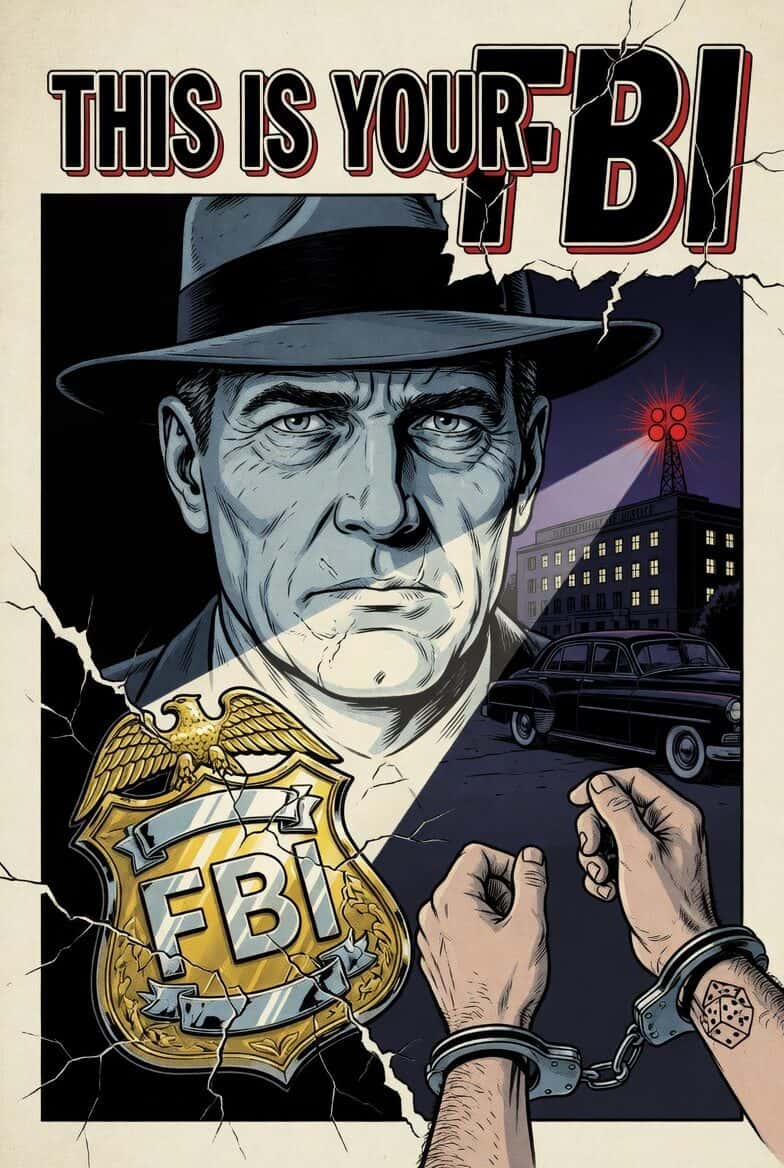
The Equitable Life Assurance Society presents, This is Your FBI. This is Your FBI. The official broadcast from the files of the Federal Bureau of Investigation. Presented transcribed as a public service by the Equitable Life Assurance Society of the United States and the Equitable Society's representative in your community.
Are you listening to tonight's broadcast because you received a phone call or a postcard from an Equitable Society representative? Many people are. They were asked to listen tonight because their Equitable Man believes they are the successful type. The type of people who will be interested in the Equitable Society's plan for men and women on the way up. In about 14 minutes, I'll give you full details on this special plan for every man who has faith in himself and his future. It is offered by the Equitable Life Assurance Society of the United States. Tonight's FBI file, A License to Kill. Modern man is the most ingenious animal in the history of the world. And the inventions that have poured from his fertile brain are the things that have made this present complicated civilization possible and workable. Most of those inventions have served to speed production on farms, in factories, in stores. Others have the job of entertaining.
And here, too, speed has been the keynote, for relaxation has to be jammed into a few hours, has to be jammed so that it sometimes fails to relax but only serves as an escape. Even music has been mechanized with the birth of the jukebox, the coin-operated phonograph where you insert your money, push a lever, and then press the buttons that bring the music you want. Now the jukebox has been modernized, brought to the point where you no longer exert any effort in pushing levers and buttons. You simply drop in a coin and an operator at the other end asks what songs your current taste demands. In time, perhaps even that amount of exertion may not be necessary, but for now it seems a small enough amount of work to do. This much time has been taken to describe those newer jukeboxes in order that you might better understand the case from the annals of your FBI which you are about to hear. For the machine, the customers, and the operators who take the calls all play a part, a very important part.
Tonight's file opens in a large room located in a downtown office building. Through the middle of the room runs a stand filled with the latest recordings. Banked against two opposite walls are rows of phonograph turntables. A girl is seated in front of each bank with earphones on her head. One turns and says... Mary? Yeah, Ruth? Same needle? Mm-hmm. Here. Thanks. Might as well put them in while it's slow. Slow is right. I've only had three calls all morning. Yeah? I had four. All for mule train. Two of mine were for repairs. Oh, pardon me, Ruth. Yes. Yes, we have that. Just a minute. No, we don't have it by Pete Simon. Crosby and Como. Como? All right. Huh? Fish fry? We've got Louis Jordan and Pearl Bailey both. Uh-huh. Play them both? Okay. What? Sorry, sir. We just play records.
Big deal. He spent a quarter. And wanted a date. Naturally. I didn't think you got that in the morning, too. Maybe I'll ask Mr. Wilson to switch me back to nights again. Oh, wait a minute, honey. Remember telling me how sick of talking to drunks you were? Well, you don't have that on the morning shift. No, but... Wait a minute, I've got a call. Yes, sir. What? Meanwhile, at the local FBI field office, police detective Bill Sherman approaches the desk of Special Agent Jim Taylor. Hello, Tim. Hi, Bill. Grab a chair. Thanks. Well, the SEC said you were coming back this evening. He didn't say what for, though. Do you remember the case about a year ago, the papers called the Hangover Murder? No. I can't say that I do. A bartender was hacked up by a customer for giving him the wrong thing to drink. It was late at night. It was about closing time. There was nobody else in the place. Yeah, yeah, I do remember that. Remember? Well, we arrested a man named Happy Marshall a couple of days later and threw circumstantial evidence of the strongest kind.
The DA's office got a conviction. What makes it so important now, though? Well, Marshall's lawyer entered a plea of insanity after the conviction, and the board went along with him. He was sent to the hospital for the criminally insane. He escaped yesterday. And followed him? Uh-huh. Pretty sure. Wasn't for Marshall. He stole a suit of clothes, said he was a federal parole officer, and walked out the front gate. Impersonated a federal officer at the FBI, is another case. Yeah, I know. That's why I went to see your boss. How much more do you know about Marshall? What do you want? Well, is he really insane? Well, he was a year ago, Jim, but yesterday when I talked to his doctors up there, they said that he was rational most of the time now. Most of the time? Yeah, occasionally he still goes off his rocker. And when he does, he's liable to kill again. So any lead at all on where he went when he left Plowder? No, but the likelihood is he's either coming here or he's here already. Oh, why? Born here, lived here all his life. So far as we know, he's never been away from the town. All of your men have been alerted, huh?
Yeah, as soon as we got word he was loose. Have we got his record, Bill? All Marshall's records were at the hospital. They're being sent in now by messenger. They'll be here in an hour. Good. As soon as they come, let's do some studying and then get to work. It's all right, Ruthie. Nobody's here. Where am I? We're in Mr. Wilson's office, Ruth. No, no, no. Everything is all right. What are we doing here? You fainted. Fainted? Yeah. When the lights on your board lit up, you answered, and the next thing I saw, you were on the floor. I remember now. What happened, Ruth? A call. It was from Charlie's Tavern. When I heard that voice, I... What voice? A man called Happy Marshall. Who's he? Do you remember? You weren't here then. When? Last year. This Marshall killed Joey Thompson, the bartender at Charlie's Tavern.
I heard the whole thing. You see, Joey and I used to go out sometimes when we got through work. I was calling to tell him I'd meet him. I plugged in Charlie's tavern and I heard Joey fighting with Marshall. It was awful. I heard them hit each other. Then I heard Joey groan. Then I heard Marshall keep hitting him. How did you know it was Marshall? I know his voice. He used to call in all the time to have us play starter.
Well, they made me tell about the fight when we tried. My story seemed to be the thing that swung the jury. But, Ruth, what's he doing out of jail? I don't know, but he'll come here. He'll want to get even. Oh, no, don't you worry about that, Ruthie. I'll call the cops. No, Mary, don't, please. Why not? I don't want to tell the cops anything. Well, if this mess... Please, Mary, you don't know what it's like getting mixed up with something like this. I couldn't sleep for a month. I couldn't eat. Now, look, honey, look. You just lie still now till the doctor comes. I don't need any doctor, Mary. I'm better now. I'm going home. Tell Mr. Wilson thanks. See, I'll be in the work in the morning. Special Agent Taylor speaking. Bill, Jim. Oh, yeah, Bill. Those records I sent get up there yet? Yeah. Yeah, I just finished reading them. Oh, did you contact the newspapers? Yeah, the city desk's a copy of Marshall's. Fine, let's hope it helps. Oh, did you check his old address, all the places he used to hang out? Personally, but men at the different precincts.
They all came up here. Came here from Flowerdale. He's got to be living someplace. We finished checking rooming houses and hotels. Sure, Bill. What? Magnolia, right? Hey, according to the records you sent over, that's only two blocks from Charlie's Tavern where Marshall used to hang out before he was sent away. That's right. Bill, I'll meet you there as soon as you can make it. That's right. I'm a special agent of the FBI. Here are my credentials. This is a pinch. Now, the bartender told me you were head man here. I'd just like to ask you a few questions. Go ahead. Now, can we go someplace else? I got no office. My office is in my hat. What's on your mind? You remember Happy Marshall? What about him? He's escaped. Now, look. He killed my bartender. That don't make him my friend, does it? I didn't say that. I just wanted to know if you see him. No. Have you heard from him? No, I told you he ain't my friend. He used to hang out here. A lot of guys hang out here. Look at them at the bar. Maybe I know what their names are. You gonna pinch me for that?
No, Mr. Bristol. It just happens that Happy Marshall was seen in this neighborhood a little while ago and I thought that... Oh, hi, Bill. Another cop. That's right. What are you guys trying to do? Put me out of business? Jim, step over here a minute, will you? Sure. Jim, I got a message from headquarters on my radio just before I parked the car. It's about Marshall. Oh? You see that jukebox in the corner? Yeah. A year ago, Marshall was convicted on the testimony of a girl who heard the fight from the other end of the line. Yeah, I know. I saw that in the transcript of the trial. Well, her name was Ruth Clinton. Headquarters just got a call from the jukebox office that the same girl heard Marshall call in from someplace this morning and fainted. Did you talk to this Clinton girl? No. From the report I got, she'd already gone home. I've got her address and phone number, though. Good. Why don't you call her and see what she has to say? Okay, Jim. While you're doing that, I'll run up there. We'll meet at her place. What do you want?
This morning? Yes. Charlie, I was afraid to. I don't want to get mixed up with him again. That's all the more reason why you should have called with your testimony having convicted. He's coming here? Can you help me? Yes, if you... I will. I will. I'll be careful. Goodbye, Mr. Sherman. Goodbye. I'll care. Don't get excited. I just come here to find out why you didn't play Stardust.
You'll return in just a moment to this exciting file which shows how your FBI helps protect the security of America. Now a quick look at the future of America as we stand at the halfway mark of the 20th century. Leading economists say, during the 1950s, the advance of technology promises to produce even more spectacular changes in the American way of life, in industry, in farming, in transportation, and in the home. As always, this expanding economy... and the prosperity that accompanies it, will offer unusual opportunities to alert progressive, ambitious men and women. For these leaders of tomorrow, for the men and women who will move into key positions during the 1950s, the Equitable Life Assurance Society has created a very special type of life insurance. It's known as the Equitable Plan for Men and Women on the Way Up. If you believe that on the way up describes you, then you will be interested in this plan's three important advantages. First, as your salary goes up, your insurance can keep pace with it. When you get that better job or that big promotion comes your way, you can adjust your insurance to measure up to your increased income. Second, while you're waiting, your wife and children have the life insurance protection they need. This means that you have the peace of mind, the freedom from worry about your family that's essential to a man who wants to concentrate on getting ahead. Third advantage, the equitable plan is flexible at all times. It can expand or contract as you see fit.
and offers you many desirable options which your Equitable Society representative will be glad to explain to you. So why not get in touch with him right away? Phone him and ask for full details on the Equitable Plan for people on the way up. Or send a postcard care of this station to the Equitable Society. That's E-Q-U-I-T-A-B-L-E. The Equitable Life Assurance Society of the United States. And now back to the FBI file, A License to Kill.
Democracy, as we in this country know it, is unquestionably the finest system man has yet devised for self-government. And it enjoys that superlative because of one word, the word choice. Democracy is bound on every side by the word. For here, a man is free to choose his politics, his religion, his career, his home, and many other things. That freedom to choose is what gives him dignity as a human being. is what makes him different from the citizens of totalitarian states. Among the many choices open to those of us fortunate enough to live here is the choice of listening to any and every kind of advice and just as promptly ignoring it, no matter from what thought of wisdom it spurts. That right is both a strength and a weakness, for the advice given by the Federal Bureau of Investigation to you listeners has been distilled from the experiences of thousands of special agents.
from the experiences of every member of the Bureau. Your FBI is an arm of your government. It draws its powers from you, the people, and therefore it cannot force you to accept advice. But it does make this earnest plea, this plea which may at some time keep you from the situation in which the young lady in tonight's case finds herself. The advice your FBI would like to give you, each and every one of you, is short, simple, and logical. When in doubt as to whether or not to call the police, always decide one way. Make the call. Tonight's file continues a short time later at Ruth Clinton's furnished room. Now, who's there? Oh. Welcome. Hi. Well, where's Miss Clinton? Your guess is as good as mine. Huh? The place was empty when I got in. After all I told her about not opening the door... You spoke to her? Right after you left Bristol's place. What did she say?
The call she got from Marshall this morning came from Charlie's Tavern. Now, that's not too surprising. She said she wouldn't open the door for anyone except you. When I got here, the door was unlocked. I came in, found that chair turned over. The wastebasket kicked out here in the center of the room. The lamp was knocked off the desk. It shambled. Bill, my guess is she didn't open the door. I think Marshall was here when she got your call. Yeah? Why? Well, the light was off when I arrived. Maybe she never got a chance to turn it on. Yeah. That's possible. Well, she obviously left here alive, Jim. Yeah. May not stay that way very long. Yeah. You find anything in the place might be a lead? Why, I found this piece of paper rolled up in a little bar. Here. Mm-hmm. Ruth Clinton, 17 Washington Street. Bill, why don't you go interview the girl who works with Ruth Clinton at that jukebox place, the one who called headquarters? Okay. While you're doing that, I'll go back and let the lab take a look at this paper. Let's meet at my office. Hi, Charlie. Huh? Sit down. Sit down, kid.
Listen to a good record. How'd you get in here? Oh, I got ways. Weren't you glad to see me? Sure, happy, real glad. Only... Only what? You're red hot. Pictures in the paper, every cop in town's looking for you. So? So, if they find you in my apartment, I'm slob too. You sound scared. Please, will you listen to me? Remember that dame who nailed you last time? She's gonna talk again. Nah. Yeah. She's already called the cops. Told them you used the jukebox in my joint. Now look, Happy. I'll give you some dough. You can go any place you want. That way, the dame can't make no trouble. She can anyway. But the cops want to see her. I got to see her first. Huh? She won't talk. If you don't believe me, go take a look on the floor in your bedroom. Special Agent Taylor speaking.
Bill Sherman, Tim. Oh, hi, Bill. You caught me going out the door. Railroad station. Oh, did you get anything from the girl? A couple of things. Good. Anything else? Means Bristol is probably lying about not having seen him. Bill, why don't you call in Bristol again? Maybe we'll talk now. Yes, the report on that piece of paper came back from the lab. According to our handwriting analysis section, it's Marshall's writing and his prints are all over the thing. Oh, the lab says the paper comes from pads the phone company uses at their counter at the station. They've got operators on duty up there, so maybe I can get some lead from them. Okay, Bill, when you're finished, let's meet at the station. Any luck yet, Jim? No, I spoke to the chief operator when I got here. She's checking through this morning's records now. Yeah, what for? Well, I figure maybe Marshall called Ruth Clinton when he got off the train. If he did, I'd like to know if he called anybody else. Well, that'll be tough to tell. She's checking to see if she can find Miss Clinton's number. If she does, she's going to check on the ten calls following that.
How'd you make out down at Bristol's place? I drew a blank. How come? Bristol wasn't there. The bartender said he went out of town in a hurry. He got a phone call or something. It sounds fishy. Oh, sure. It did to me, too. But I don't know how he can prove it. I asked him for Bristol's home address. He said he was new on the job and didn't know it. That makes it sound double queer. Sure. I looked in the phone book. Bristol's not listed. How about the liquor control board? Closed for the day. Oh, fine. Oh, pardon me, Mr. Taylor. Yes, Miss Jordan. Here's your list. Oh, thanks. Thanks very much. Yeah, let's take a look at this thing, Bill. You see? Yeah. Yeah, this first one is Miss Clinton's. Uh-huh. Hey, look at that next call, Charlie Savage. Yeah, that takes care of Bristol's story for sure. Oh, but these next ones, Jim, P&M Radio Store, Adam's Beef Market, the old English hat shop there, they're probably somebody else's calls. Yeah. Well, let's call them anyway and check. Cap? Yeah? Do me a favor. What?
Get that girl out of here. Okay. That's well. Let's go see. Okay. Hello, Miss Clinton. Prop her up, Charlie. Okay. That's good. She doesn't look very pleased to see me, does she? I'll help her carry her. Carry her where? Out of here. Oh, that don't happen yet. But you said... Charlie, you should know I can't take her out of here alive. Wouldn't be smart. Now, wait a minute. I don't want you to do no killing here. Why not? Won't bring no trouble. No trouble? That's right. You see, I got a license for murder. What? Don't you remember? The court said I was crazy. Now I bust out of the hospital, I kill somebody. I'm still crazy. Miss Clinton knows that, don't you, honey? I don't, and I'll try not to hurt too much. Don't bother me, Charlie.
Please, not here. It'll only take a little while. Grab Bristol! Watch it! Well, looks like we got here just in time. Throw the cuffs on him, Bill. Let's get him to headquarters. Happy Marshall was convicted of attempted murder in state court and sentenced to life in prison. His confederate, Charles Bristol, was convicted as an accessory to a murder attempt and sentenced to 25 years.
Special Agent Taylor's theory that one of the next few calls from the railroad station might provide a lead to Happy Marshall's whereabouts proved to be correct. A call to the radio store revealed that it also sold records, but the shop owner told Agent Taylor that he received approximately 100 calls an hour through the store switchboard and that it would be impossible to know whether or not Marshall had called. Taylor then remembered Happy Marshall's loyalty to the tune, Stardust, and a check of sales clips at the radio store showed that a record of that song had been ordered over the phone. had been ordered for delivery to the apartment of one Charles Bristol. And so another case from the files of the Federal Bureau of Investigation was closed, closed in a matter of nine hours after the file was opened. Not all files can be closed that quickly, but all received the diligent investigation this one did. It was perhaps no more than simple justice that Special Agent Taylor and Detective Sherman each grabbed one of the criminals as they burst into Bristol's apartment, or in this case, as you have seen.
There was tightly knit cooperation between a local police department and your FBI. The kind of cooperation that goes on in every section of the country every day of the year. The kind of cooperation that pays off in protection for you and in conviction for the guilty. In just a moment, we will tell you about next week's exciting FBI file. Now one last word on the Equitable Society's plan for men and women on the way up. It's a plan for the man who feels confident. that someday he'll be making a phone call to his wife like this. Betty, they're opening a new branch in Philadelphia. And guess who's going to be manager? Me. If you're that kind of man, then the sooner you get in touch with an Equitable Society representative, the better. Ask him for full information on the Equitable Society's life insurance plan for men and women on the way up. Or send a postcard care of this station to the Equitable Life Insurance Society. Next week, we will dramatize another case from the files of the Federal Bureau of Investigation.
A crime file unique in FBI annals. Its subject, piracy. Its title, larceny goes to sea. The incidents used in tonight's Equitable Life Assurance Society's broadcast are adapted from the files of the Federal Bureau of Investigation. However, all names used are fictitious, and any similarity thereof to the names of persons living or dead is accidental. Tonight, the music was composed and conducted by Frederick Steiner. The author was Jerry D. Lewis. Your narrator was William Woodson, and Special Agent Taylor was played by Stacey Harris. Others in the cast were Tony Barrett, Georgia Ellis, Bob Griffin, Florence Lake, and Roland Winters. This Is Your FBI is a Jerry Devine production. This is Larry Keating speaking for the Equitable Life Assurance Society of the United States and the Equitable Society's representative in your community, and inviting you to tune in again next week at this same time when the Equitable Life Assurance Society will bring you another transcribed thrilling story.
from the files of the Federal Bureau of Investigation.