
The written record
Read the transcript
Read along with the recording · About 19 min to read
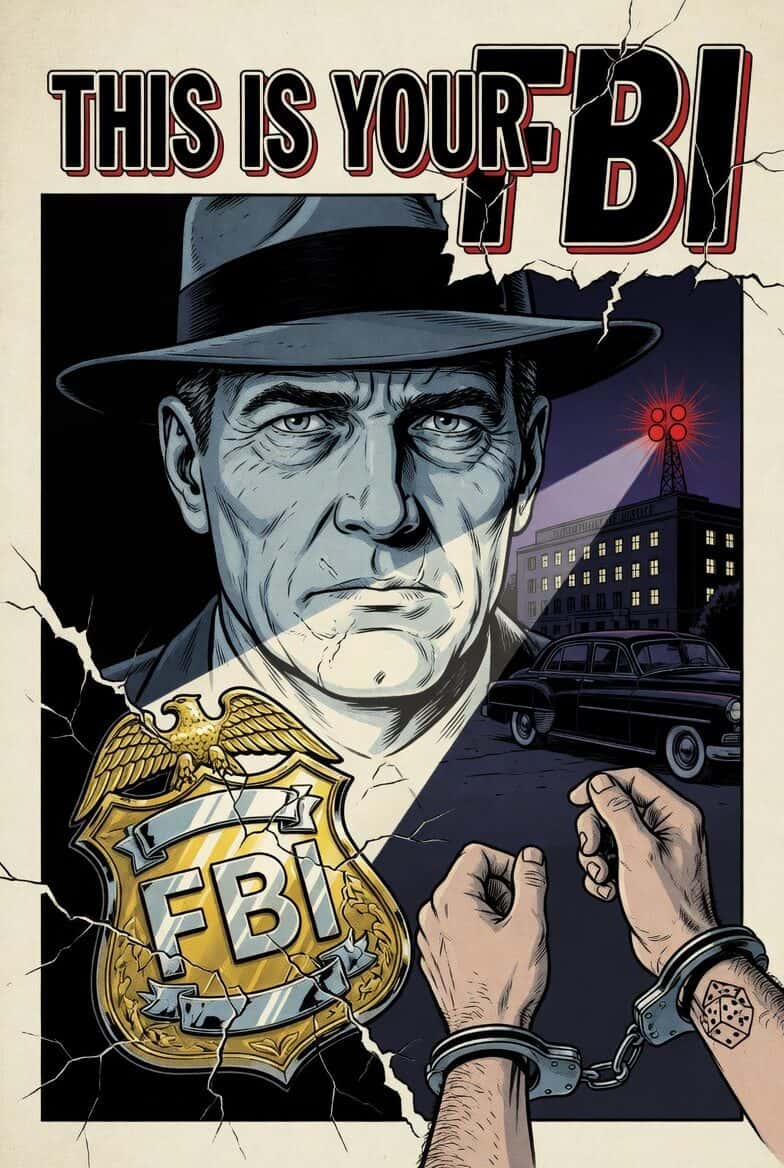
The Equitable Life Assurance Society presents, This is Your FBI. This is Your FBI, the official broadcast from the files of the Federal Bureau of Investigation. Presented transcribed as a public service by the Equitable Life Assurance Society of the United States and the Equitable Society's representative in your community.
The Equitable Society's representatives wanted tonight's audience to include certain men and women who are headed for successful careers. So they did an unusual thing. They asked them to listen. Yes, by telephone, by postcard, by personal request, they invited these special people to listen to tonight's message about the Equitable Society's plan for men and women on the way up. In just 14 minutes, I'll give you full details on this plan. for every man who believes he's going to succeed. It is offered by the Equitable Life Insurance Society of the United States. Tonight's FBI file, The Telltale Calendar. Like any profession, law enforcement has its moments of satisfaction. FBI Director J. Edgar Hoover's personal capture of Alvin Carpus in New Orleans was such a moment. However, there are also moments of discouragement.
moments when the men whose job it is to enforce the laws of a city, a state, or a nation are faced with the realization that their task is almost overwhelming. In the last 10 years, the population of this nation has risen 10 million people. Of that number, more than 500,000 have acquired fingerprint arrest records. And yet, in that same period, the total number of law enforcement officers in the United States has not increased at all. Those who opposed any increases in police departments gave many reasons, chief among them being that the taxpayer could not stand the added strain. That is short-sighted economy, though, for in the field communities which have added manpower to the police force, the number of crimes has shown an appreciable decline. Crime does not pay is a good slogan, but unfortunately, crime cannot be fought with slogans. It takes men, men who know their job.
Men ready to battle the army of criminals on every front. Tonight's file opens in a weather-beaten shack located on a desolate stretch of highway in the Midwest. Two crudely painted signs hang in front. One says, Harry's Diner. The other says, Gasoline. Inside, a nondescript blonde is wiping the counter. A middle-aged man, also in an apron, stands beside her, looking into space. You could wipe this counter till next year and it wouldn't be clean. I know, Mildred. Maybe if you painted it, Mr. Davis. No. Okay. Mr. Davis? What? Do you mind if I take Thursdays off instead of Tuesdays? You see, my friend Alice has Thursdays off, and this year her birthday and mine both come on Thursdays. And so if I could have off, well, on the 12th instead of the 10th, and then, well, here, you can see for yourself on the calendar.
You see, Mr. Davis, I could even start, say, on the 19th instead of the 17th, because my friend's birthday isn't until the 26th anyway. All right, Millard, go ahead. Mr. Davis, why you got each day X'd off? No reason. You gotta circle around next Friday. What's that for? Nothing, Millard. Harry, we're running low on coffee. All right, then. Is it a surprise or something, Mr. Davis? Is what a surprise, Mildred? The ring around next Friday on the calendar. Friday! Mildred, please mind your own business. There's a pile of dishes in the sink, Mildred. You better get at them. It's a simple question. All of a sudden, everybody gets mad. People are all the time getting mad about nothing. Harry, I wish you wouldn't worry so. They get out this weekend. I know.
But it's been so long. They won't forget. How do you know? They've been in jail for 20 years with nothing to think about except me. You're safe now. We're 10 miles from the nearest... No, Ethel, no. We're not safe. When they get out, they'll come looking for me. And they'll find me. A few days later, at an FBI field office, Special Agent Jim Taylor enters the office of Agent in Charge Butler. Send for me, Mr. Butler? Yes, Taylor. Now, uh... This may or may not turn out to be anything, but you'd better check into it. All right, sir. Two men named Al Cochran and Leo Parsons get out of the pen tomorrow. Al Cochran and Leo Parsons? Yes. There's no reason why you should remember them. They've been away for 20 years. All right, sir. In the old days, they used to sell protection to laundries. If they didn't get paid, the laundry trucks were dumped into the river. Well, one day, they dumped a truck with the driver still behind the wheel. In the getaway, they killed a United States marshal. They committed two murders and got off with jail sentences.
Yes, they were convicted mainly on the evidence of an underling in their organization whose name was Harry Davis. Cochran and Parsons had a good story and stuck to it, but this Harry Davis cracked under questioning. They swore they'd kill Davis when they got out. And they get out tomorrow. Yes. Now, ordinarily, that kind of threat is an empty one, but I just got a report from the prison. A guard overheard Cochran and Parsons talking about Davis. Have they been questioned? Yes, but they denied everything. If you locate Davis, we'll notify the police wherever he is to give him some protection. All right, sir. You'll find the testimony of the trial in our files. Read it as soon as you get a chance. I wish you'd try to keep this clock wound, Mildred. I do, Mr. Staden. You're always letting it run down. I must have stopped yesterday while I was off. Here, put it up on the shelf. You never have to wind those electric clocks. Mildred, I want to talk to Miss Davis.
Go ahead. Alone. Again alone? Yes. Mildred, go into the kitchen. I don't know what could be so private all of a sudden. I don't keep no secrets from anybody. I was right, Ethel. About what? About Leo and Al getting out. How do you know? I called the prison. You made a long-distance call? I had to. Oh, Harry. I had to find out, Ethel. They've probably already started to look for me. They'll never find you. They can't. Nobody knows where we are. Paul does. You're not afraid of your own son. I'm going to write him. If anybody asks for me, Paul can say I'm dead. He wouldn't tell anyone where you were anyway. Maybe we'll sell the diner. Move again. Harry, we've moved every year since this thing happened.
I knew why we were doing it, and I never complained, did I? No. But there comes a time when you have to stop. We can't just keep running for the rest of our lives. Moving once more won't hurt us. This will be the last time, Ethel. I promise. Where do you want to go? Anyplace. So long as nobody there knows me. We'll change our name. That's it. We'll change our name. And then there won't be any Harry Davis left to be killed.
Where does this ferry dock? Right over there. Remember? Oh, yeah. Everything looks the same. Remember that pier up there, Al? Sure. That ain't changed. Yeah? And that dock where that big boat is. I don't know that one. I used it once. Not with me. No, before I met you. Oh. I dumped a bag of cement off there. Anybody I know? Joey Lee. Yeah. I remember him. We're getting close. Let's move up front. I hope Harry Davis is still around. I ain't worrying. Why not? We know his kid lives here. If we don't find Harry, we'll find the kid. He'll tell us. He'll tell us real quick. I've got something to report on that Harry Davis assignment, Mr. Butler. Have you found him yet, Taylor? No, sir, but we should know where he is sometime this evening. Good. The police rounded up a couple of other members of Cochran and Parsons' old mob.
One of them told me Davis has a son named Paul who lives here. Oh, well, he shouldn't be too hard to locate. We've already found out where he lives. I called his house and left word with his wife to have him call me. You sure you've got the right Paul Davis? Yes, sir, and I'm also pretty sure that Leo Parsons and Al Cochran know about Paul Davis, too. Why? Well, I spoke to his wife. She told me that a man who wouldn't leave his name had called a little while ago to find Harry's address. Yeah? That he was an old friend of Harry's who'd just gotten into town. Pardon me. Certainly. Butler speaking.
Yes, Nelson. Yes, have you found him? No, but I just got a call from one of my... What happened? Thanks very much, Nelson. I'll send a man down there right away. You gentlemen sit at the table? No. Like to see a menu? Just coffee. And you? Coffee for me, too. You have some nice pies. Apples? Peas? No. You can change your mind. Wait a minute, lady. Yes? What is it? Been here long? About a year. Run the place alone? No. We didn't think so. Why? The sign outside says Harry's Diner. Oh. Where is he? Who? Harry. Oh, there is no Harry. Huh? I run the place with my sister. It says Harry's Diner. I bought the place from a man named Harry Jackson. I didn't change the sign. Harry Jackson? Yes. You believe that, Al?
No. What do you men want? Harry Davis. Nobody around here by that name. What did this Harry Jackson look like? Well, he was an old man. He had gray hair. Where'd he go? Someplace in California. He had some children out there. We got no more bacon, Mrs. Davis. You hear that, Al? Uh-huh. Go back in the kitchen, Mildred. Stay right here, Mildred. Mrs. Davis, he's got a gun. Where's Harry Davis? He went... Shut up, Mildred! Go ahead, Mildred. Talk. He went into town. What town? Minerville. He went to pick up some supplies. When will he be back? Thanks, Mildred. We'll wait for him. We will return in just a moment to this exciting file which shows how your FBI helps protect the security of America. Now a quick glance at the America of tomorrow. As we stand at the halfway mark of the 20th century...
It is natural to wonder what the future has in store for us. Among economists, the prevailing note is optimism. In America, new industries rapidly expanding have always led to widespread prosperity. And never before has this country had more infant industries that seem destined to grow into giants almost overnight. Atomic energy development, television, private airplanes, prefabricated housing. These are just a few of the reasons why the 1950s... may well surpass all past decades in American history. For men and women who expect to play leading roles in the dynamic years ahead, the Equitable Life Insurance Society has created a special life insurance plan. It is known as the Equitable Plan for Men and Women on the Way Up, and it offers these three important advantages. First, as your salary goes up, your insurance can keep pace with it. When you get that better job or that big promotion comes your way, You can adjust your insurance to measure up to your increased income. Second, while you're waiting, your wife and children have the life insurance protection they need. This means that you have the peace of mind, the freedom from worry about your family, that's essential to a man who wants to concentrate on getting ahead. Third advantage, the equitable plan is flexible at all times. It can expand or contract as you see fit and offers you many desirable options, which your equitable society representative will be glad to explain to you.
So why not get in touch with him right away? Phone him and ask for full details on the equitable plan for people on the way up. Or send a postcard care of this station to the Equitable Society. That's E-Q-U-I-T-A-B-L-E. The Equitable Life Assurance Society of the United States. And now back to the FBI file, the telltale calendar. It may have come as something of a surprise to those of you listening to this program to find... The two men, after having spent 20 long years in prison, were anxious to do only one thing when they regained their freedom. Were anxious only to commit another crime which might, in turn, return them to prison for the rest of their lives. That they cared little to enjoy freedom, for even a short time, is something which is perhaps incomprehensible to those of you not plagued with the criminal mind. Any study of arrest records, such as is made every year by the Federal Bureau of Investigation, shows how cheaply criminals hold freedom.
Once a person is sentenced to prison, there is a 50% chance that he will be sentenced again at some future date to serve still another term. And the figures also show that after a person has served two terms in prison, the chances are even greater that he will commit another crime serious enough to see him sentenced a third time. The figures you have just heard are the facts. And if they are unpleasant, then perhaps it is well to remember one thing. So is crime. Tonight's file continues at the FBI field office later that afternoon. Special Agent Taylor has just entered. I couldn't get much done at the hospital, Mr. Butlin. Did you talk to Paul Davis? No, sir. He hasn't regained consciousness. Well, I want you to give this your full attention now, Taylor. All right, sir. The Parsons and Cochran are the ones who committed this assault. They violated their paroles and we've got to move fast. Oh, I tried to talk to Mrs. Davis at the hospital, but she was too hysterical to answer any questions. So I left and went out to their house. Davis' mother-in-law was at the place taking care of their six-year-old son.
Did she know where Harry was living? No, sir, but the boy told me that his daddy got a special delivery letter this morning from Grandpa Harry. Right after that, they went out to the hall telephone, and Paul called the old man. Did you find that letter? I tried to, sir, but it wasn't in the apartment, and he didn't have it on him when he was brought into the hospital. Well, the Parsons and Cochran got a hold of it, and there was a return address on the envelope. They might be on their way. Tell me, did you find out where Paul Davis works? Yes, he's a bookkeeper at a meat company over on the east side.
Go over and see if the letter's in his desk. All right, sir. And report to me as soon as you get back. We'd better find Harry Davis pretty soon, or we'll have another murder on our hands. Mister? Yeah? There's a car outside. I see it. He wants gas. We don't get it. Keep the door locked. But, mister... You heard him. Don't move. The man's coming in. No, he's not. Tell him to go away. Hey, no more gas. Why don't you go, too? We're waiting for Harry, remember? Can't you leave him alone? No. Why not? You've been waiting too long. Cigarette, Leo? Thanks. Don't touch that phone. Hey, you. Yeah, answer it. And don't talk funny. Mr. Davis? Mr. Davis? Maybe she's on back. Bacon? Slow. Okay. Bye. What did he say? He'll be back in a little while. Anything else?
Yeah, he said to close up. Okay. When you get through with her, Al, you can tie this one up. Me? Then we'll turn off the lights and wait for Harry. Checking on the place Paul Davis works might pay off, Mr. Butler. Yes, what did you find? I didn't locate the letter from Harry, but I did come up with two other things. First is this snapshot. It's on the glass on Paul Davis' desk. Oh. Looks something like the old pictures of Harry Davis. Oh, it is Davis. Read what's written on the back of it. Dear Paul, this is the diner Ma and I have bought. We both miss you far. Seems like a new snapshot, Taylor. Yes, it does. Too bad it doesn't say where the diner is. What else did you get? Paul Davis and three men who work with him have a carpool. Davis drove them in this morning, but when the men went out to lunch at noontime, the car was gone. Got a description on it? Yes, sir. I called the motor vehicle bureau and got one from them. Then I set an alarm on it. Good. Now I'd suggest you get down to the hospital and wait till you can question either Paul Davis or his wife. Butler speaking. Jim Taylor. Well, that's just up the road. I like all these.
and also the police. But Mrs. Davis must be right about where her own father-in-law lives. The trouble is, she doesn't know what state it's in. Well, how did she know it was a place called Centerville? She saw Harry's telephone number. What's the report on Davis? When will you be able to question him? I have no idea, sir. Pulled in here. It must be. Got some keys. Yeah, looks real old. Ain't you gonna say hello? You don't remember us, Leo. It's you. Yeah. Where's my wife? Where's the girl who works here? What did you do with her? Take it easy, Harry. Looking back at you. Apple, I... Stand still, Harry. Yeah. We came to see you. Sun time. We're giving orders. Go ahead, give them. Fine. But first, listen to me, both of you. Start talking. The last couple of years, I've been scared to death. I knew you were... Keep it short, Harry. I knew you were getting out. I knew you'd come for me. I couldn't eat, I couldn't sleep. Now you're here, I... I don't know why, but I'm not scared now.
He's real brave, Leo. Ain't he? You came here to kill me, didn't you? What do you say? You got the gun, Leo. That makes you the head man. But those women there on the floor, they didn't have anything to do with you being sent away. Sent what? All right, then. Leave them alone. You want me? Come on. I'll go with you. Let's get it over with. We ain't going anyplace. Give it to them now, Leo. Yeah. Yeah. Hey, don't try to pick up that gun, Cochran. The law. That's right. Special agent of the FBI. Thanks, mister. Well, that's all right, Davis. And you don't have to worry about these two anymore. They won't be bothering anybody for a long, long time. Al Cochran and Leo Parsons were convicted of assault to commit murder and returned to federal prison for violating their conditional release before beginning to serve new sentences of 25 years each.
The thing Special Agent Taylor remembered, which enabled him to find out near which particular town named Centerville Harry Davis' diner was located, was his conversation with the six-year-old son of Paul Davis. He remembered that the boy had told him of having gone to the hall telephone when his father called Grandpa Harry. Special Agent Taylor had noticed that the hall telephone was a pay station and that calls had to be paid for as they were made. Fortunately, Paul Davis' son was able to tell Special Agent Taylor... how much money his father had dropped into the telephone when he made the call. A quick check at long distance revealed the toll charges to the various towns named Centerville in neighboring states. And so the Federal Bureau of Investigation was able to close another file and also was able to prevent a murder. Of the two, preventing a murder was, of course, more important. For though Harry Davis had a criminal record, he was entitled to all the protection your FBI gives every other citizen.
Protection against those who would infringe on the rights granted to each of you by the instrument which every special agent works to defend, the Constitution of the United States. In just a moment, we will tell you about next week's exciting FBI file. Now one last word on the Equitable Society's plan for men and women on the way up. It's a plan for the man who will someday soon telephone his wife and say, Well, honey, I saw Mr. Pearson himself. He said, I'm just the man they're looking for, and they'll double my salary. If you're that kind of man, then the sooner you get in touch with an Equitable Society representative, the better. Ask him for full information on the Equitable Society's life insurance plan for men and women on the way up. Or send a postcard care of this station to the Equitable Life Insurance Society. This is Bill Woodson of Jerry Devine's This Is Your FBI speaking to you again. Ordinarily, I bring you statistics about crime.
Tonight I have a different kind of figure. In the past year, with no respect for age or sex, heart disease killed more than 600,000 men, women, and children in this country. The 1950 Heart Campaign is now in progress. Give whatever you can afford to it, for your contribution may save your own life. Send that contribution tonight to HEART. H-E-A-R-T. HEART. Care of your local post office. Thank you.
Next week, we will dramatize another case from the files of the Federal Bureau of Investigation. The story of a desperate criminal's attempt to escape. Its subject, unlawful flight. Its title, Voice from the River. The incidents used in tonight's Equitable Life Assurance Society's broadcast are adapted from the files of the Federal Bureau of Investigation. However, all names used are fictitious. And any similarity thereof to the names of persons living or dead is accidental. Tonight, the music was composed and conducted by Frederick Steiner. The author was Jerry D. Lewis. Your narrator was William Woodson, and Special Agent Taylor was played by Stacey Harris. Others in the cast were Harley Bear, Ed Begley, John McIntyre, Jeanette Nolan, Joe Vitale, Peggy Weber, and Roland Winters.