
The written record
Read the transcript
Read along with the recording · About 20 min to read
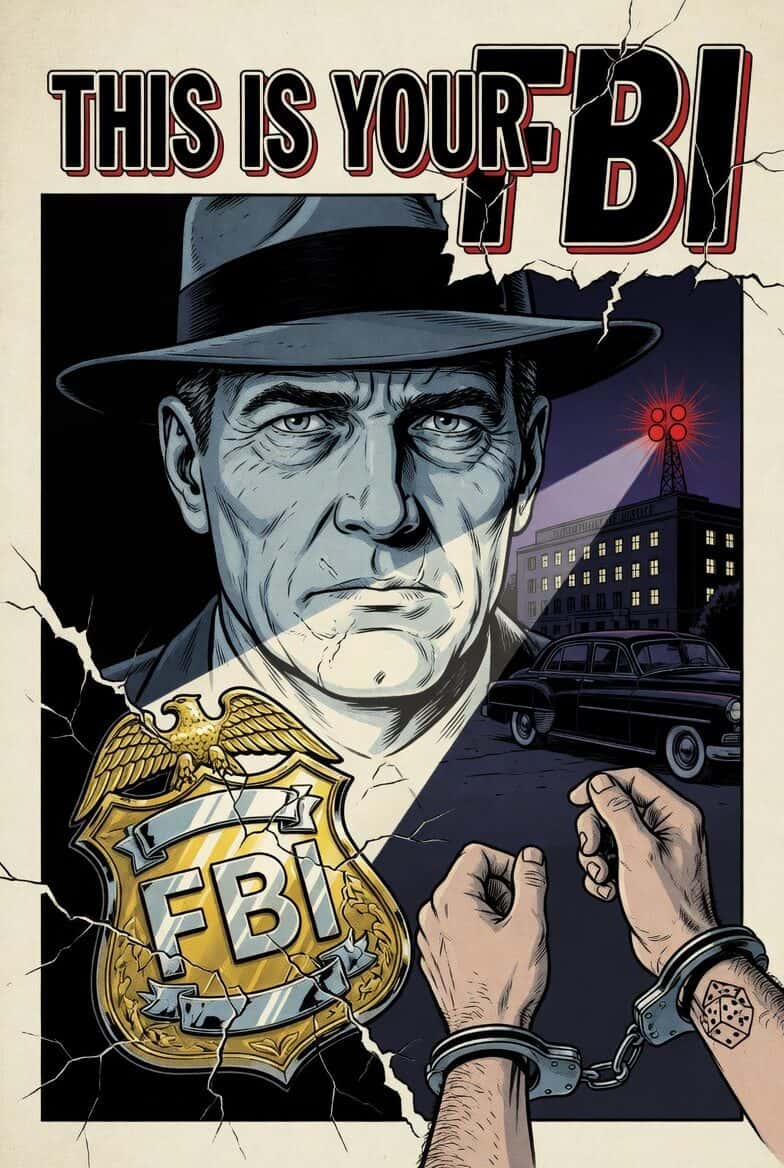
The Equitable Life Insurance Society presents, This is Your FBI. This is Your FBI. The official broadcast from the files of the Federal Bureau of Investigation. Presented transcribed as a public service by the Equitable Life Insurance Society of the United States and the Equitable Society's representative in your community. It has often been said that life insurance appeals most strongly to intelligent people. That is why the commercial messages on this Equitable Life Assurance Society program treat you like an intelligent human being. They give you useful and helpful information and do it in a sensible, straightforward way. Tonight, for example, the Equitable Society is going to talk to fathers and mothers about establishing an equitable education fund for their children. This is the painless way to pay for a college education. If you want to make sure that your children will have the advantage of college training, you'll be keenly interested in this equitable society message due in about 14 minutes. Tonight's FBI file, The Flophouse Frame-Up. Adversity has different effects on different people. Some have the moral stamina to conquer their personal misfortunes and almost to turn them to their advantage. Beethoven, for example, became deaf in the midst of his career as a composer. Instead of losing heart, He explained that now he would no longer be bothered by outside noises, and his last works are considered by the experts to be his best. In our own time, we have seen a Helen Keller prove that being a blind death mute is not an automatic sentence to oblivion. The list of these men and women, the ones who have overcome their adversities and gone on to establish themselves as entities, is endless. There unfortunately also are among us those who have not conquered their problem.
who have not had the will to strike back, who have been content with their periods of enlistment as soldiers of misfortune. If their lives were charted on a graph, the line would be one continuous downward plunge, and the line would end at a certain street, the street in every city where the human derelicts gather. In many cities, the very name of the street has been almost forgotten, and it becomes known as Skid Row. To the men and women there, only one thing is sure. They cannot sink any lower, cannot skid any further. A few, they know, will escape and return to the outside world. But for the others, the great majority, there is no escape, except death. Tonight's file opens on the skid row of a large western city. It is late morning, and in one of the alleys that go to make up the row, two shabbily dressed men lie covered with newspapers. One of them stirs and slowly manages to sit. Morning.
Looks like another nice day. People be feeling good today. Maybe we'll get enough for a couple of beds. Be nice. Climbing in the sack again, won't it? It's kind of drafty in this alley. Okay, sir. Okay. It was empty. Both of them empty. Guess we should have saved a couple of drops for this morning. Yep, might as well get up. Easier than I thought it'd be. Hey, Doc! Huh? Yeah, not a drop, boy, not a drop. Eat that, Silt. Word must have got around about us having a couple of bottles last night. Silt. You can't just lay there and sleep all day. You gotta drink. You'll feel better. All right, Silk. You got your eyes open. That's the toughest part. How about getting up now, huh? Come on, Silk. Come on. First time you had to be begged to go looking for a drink. You coming? Well, don't just lay there. Tell me. Hey, Silk. Silk. You can't still be asleep. You got your eyes open.
Man don't sleep with his eyes open. Maybe you're dead. You dead, Silk? Silk? Hmm, guess he is. Well, I better go for that drink alone. A short while later, at the local FBI field office, Agent in Charge Newton is talking to a visitor as the door opens. Send for me, Mr. Newton? Yes, Taylor. Troy, Agent Taylor. How do you do, sir? Oh, yes, sir. Have a chat, Taylor. Thank you. You weren't assigned here two years ago when Mr. Troy's bookkeeper disappeared. No, sir. In 48, I was in the Salt Lake City office. My bookkeeper's name was Joe Scott. The day he disappeared, the police found his jacket on the bank of the river, along with a suicide note. They dragged the river for two days without finding the body. There's always been some question as to whether or not he really did commit suicide. You see, Mr. Taylor, he had a good reason for wanting people to believe he was dead. Oh? Shortly after he left, I discovered the books had been falsified.
They showed a shortage of $11,000. Had Scott been your bookkeeper very long? Three years. What's our jurisdiction, sir? Mr. Troy's office was on the other side of the river, and there's evidence Scott may have come across the state line. Before the apparent suicide? After. A man carrying a wallet containing Joe Scott's identification papers was found dead on Skid Row. However, it wasn't Scott's body. Taylor, I'd like to find out just where and how the dead man got that wallet. All right, sir. I've already spoken to Lieutenant Clayton of the Metropolitan Squad. Oh, I know Gene, sir. He's a good friend of mine. Fine. He's promised to cooperate. Check with him and report back as soon as you get anything. Hi, Jim. Hello, Gene. How's your family? Oh, fine, thanks. Say, I got some stuff together for you on that dead man. Oh, who was he? His right name was Charlie Howell. But along the row, everybody called him Silk. You ever reckon? Mm, usual thing. Pickpocketing, vagrancy. Mm. How long was he on Skid Row? That's a tough question, Jim.
I doubt if even he could have answered that. Once they hit the row, time doesn't mean much. Well, Gene, you think you can help me learn where the silk got that wallet? I'll try, but I'm afraid it's kind of hopeless. Why? Those things keep moving. Bum falls asleep in an alley, another one comes along and rolls him. That night, the second one gets drunk and somebody rolls him. No telling how many of them had the wallet before it got to silk. Does silk have any particular hangouts? Every place on the row is a hangout for every bum down there. Well, he's got the price to get in. How about friends? He worked with a man named Doc Butler. You know Butler? Mm-hmm. You got a record? Yeah, here. Oh, thanks. Well, how about talking to him? If any of those men know you're a cop, Jim, they tell you nothing. But I got an idea for you. Huh? You got any old clothes around the house? Sure. Why don't you study Butler's record, dirty up a little, go pay him a visit? You hear the finish? So the judge looks at me and he says...
You deny you picked this man's pocket? I said, yes, your honor. They like that kind of talk. Shows respect, you know. I said, it was very cold that day, and I had on gloves, and my pockets were full, and I just had to put my hands someplace. He was so dumbfounded, he only gave me 30 days. You're right, Doc. That's worth another day. I know you like that one. You're the hostess, Marge. You pour. Okay. May you sell nothing but 50-cent magazines all afternoon. If I do, you get a bottle tonight. Hey, now, tell me you're Doc Butler. Huh? Maybe you're right. I just wrote in from up north. Big Harry sent a stale audience. Well, that's different. How's Big Harry? Fine. It's fine. Says he misses you. I miss him, too. I miss him, too. What's your name? Mark Skye. This is Mark. Hello, Mark. Well, Big Harry.
Those were the days, all right. Have a drink, Boxcar. I'm sorry, Marge. I can't go against the juice. Say, you ain't one of them anonymous fellas, are you? I just got a bad stomach and I have to keep stoking it. Doc, can you go tie some groceries with me? Well, if nothing else, Marge will cut loose with a bug. Well, that's okay. I'm holding a little. Go ahead, Doc. When he's tapped out, I'll see you at the stand. Come on, Doc. How about it? Rock stars, my boy. You just got yourself a guest.
Detective Clayton speaking. Jim Taylor, Gene. You hit the row yet? Yeah, a couple of hours. Had any chance to talk to him? Yeah. Adobe gave me his worth, I think. He was on his tenth drink when I found him. What kind of a story did he give you? Oh, something about this Silk and him getting lucky last week and staying at a different flop house each night. Sound right to you. Yeah, it could be. Well, he said he didn't remember which hotel they were in last Thursday. That's when Silk lifted the guard's identification paper.
If they were in a hotel on the row last Thursday night and they used their right names, we can find out which one it was. They all keep a register. Well, I'm at 5th and Main, Gene. How soon can you make it? Oh, ten minutes. Fine. As soon as you get here, we'll start checking those registers. Here's the next place on the list, Jim. Okay. Go ahead, Jim. Thanks. Hello, Gene. Hi, Fred. Meet Agent Taylor of the FBI. Nice to know you. Thanks. Best room clerk on the row. Sure, sure. What are you looking for? Last Thursday's register. Thursday. Thursday. There it is. Thanks. Need me for a minute? Not right now, Fred. Call me if you do. Gene, what's these numbers by each name mean? Just a plain number means a bed. With a circle around it means they had the 75 cents to get a room. That's Doc Butler's name. Mm-hmm. Silk howl right under it. Yeah, and bed's 36, 37. Whoever had 38 was the one with Scott's wallet. Yeah, and bed.
38 was registered to somebody named R. Jefferson. Say, Fred. Yeah, Dane. The name R. Jefferson mean anything to you? Fred not. You know Doc Butler and Silk Howell, of course. Sure, Doc's here now. Got a room down the hall. I've got a picture of somebody named Joe Scott. I'd like you to take a look at him. Ever seen him before? I don't know. Oh, wait. Put a beard on that face. You think you know him? Not sure. The guy who looks an awful lot like this is in room 11. Thanks. Hey, hello, boxers. Oh, hello, Doc. Hey, wait a minute. What are you doing with him? Go away, Doc. You in trouble, boxers? No, no, I'm okay. Which way to room 11, Gene? Upstairs. Hey! I hear you call him Gene. He's a cop. Doc, we're busy. Hey, you must be one, too. Means I've been friends with a cop. Boxcar, she said your name was.
Why, you couldn't get in the boxcar. You're a pullman bum. 11 will be three doors down on this side, Jim. Okay. You're real smart. Well, what's the matter? What's the matter? Here's number 11. Ain't good enough for you to talk to now, huh? Stay out, Doc. I can follow you if I want to. It's still a free country. Jane, if Scott was here, he's gone. We will return in just a minute to tonight's exciting case from the official files of the FBI. Now a special message from the Equitable Life Assurance Society. to fathers and mothers of young children, to parents of boys and girls who will be members of college classes of 1965 or 1970. Imagine how proud you'll feel 15 or 20 years from now when your young hopeful writes you and says, Dear Mother and Dad, here's good news. Just learned today that I'll graduate with honors in chemistry. When that time comes, your boy will face the future with confidence because he knows that a university education pays off in three ways.
First, college men and women earn more money. Yesterday, our college newspaper printed some figures which show that college men earn $72,000 more during their working years than non-college men. Second, college men land the bigger job. The article went on to say that out of every 16 men earning $10,000 a year and up, 15 are college grads. Third, college men get more out of life. Their all-around culture, their understanding of art and good books, gives them poison prestige in their social life. Think over those three points, father and mother, and decide now that nothing is going to stop your children from getting a college education. Decide to make that education sure with an equitable education fund. An equitable education fund? What's that? It's the painless way to pay for your children's college education. In this equitable society plan, you start when your children are young. Then each year you pay a sum of money that doesn't hurt, an amount that scarcely makes a dent in your budget.
When your youngster's ready for college, the money's all ready for him. Well, that's spreading the cost of education over 10 or 15 years instead of taking a beating in four. Right. Now, suppose the father dies or becomes totally disabled. Then no more payments are necessary. The fund becomes fully established. When the youngster is ready for college, he gets the same education as if his dad had lived. So don't delay a day longer. Let your equitable society representative show you how little it costs to start. an equitable education fund. All right care of this station to the Equitable Society. That's E-Q-U-I-T-A-B-L-E. The Equitable Life Assurance Society of the United States. And now back to the FBI file, the Flophouse Frame-Up. Before receiving his credentials as a special agent of the Federal Bureau of Investigation, every applicant raises his right hand and takes the following oath. I will support and defend the Constitution of the United States against all enemies, foreign and domestic.
that I will bear true faith and allegiance to the same, that I take this obligation freely without any mental reservation or purpose of evasion, that I will well and faithfully discharge the duties of the office on which I am about to enter to help me God. Sometimes the discharge of those duties takes him far from his desk. Often it is a short trip within the confines of the city in which he happens to be stationed. But there have been times when agents have gone halfway around the world in quest of a suspect. In the case chosen by your FBI for dramatization this evening, two years elapsed since the disappearance of the person charged with the crime. But never in that period was there even a hint of the file being closed. For it is part of the procedure of your FBI that a report be made on every open case every 45 days. That kind of dogged perseverance is the reason one fugitive was apprehended 23 years after the commission of the crime, some 6,000 miles from the scene of that crime.
That kind of dogged perseverance, too, is a guarantee. A guarantee to you, the American people, that the men you have chosen for this office are doing their job. Tonight's file continues at the local FBI field office. Agent in charge Newton is seated at his desk. Newton speaking. Jim Taylor, Mr. Newton. Any progress to report? Yes, sir. We're pretty sure that Scott is alive. And here in town? Yes, sir. What do you base that on? Well, I've just come from a flop house. I showed the room clerk that old picture of Scott. He thought he read it. As a guest? That's right, sir. We went to his room, but he must have heard us coming and climbed out the window. We found some money under his pillow and a wristwatch, initial J.S. Well, that's pretty conclusive evidence. Oh, sir, there's one other thing. What's that? I did some checking on Scott's background earlier today and talked to several people who knew him. Yeah? They brought out some rather damaging things about the man I met in your office, didn't they? What was it? They believed that Troy took advantage of Scott's disappearance to falsely accuse him of juggling the books. Did they have any proof of that? No, sir.
Well, I'll explore that angle. You keep after Scott. Yes, sir. Any word in from the freight yards, Gene? Not yet, Jim, but I have got something. Oh, what's that? Some dope on this R. Jefferson, or Scott, if it is him. You mean he's got a record? Not in our files, but I showed that picture you gave me to Andy Reynolds. He works the row with me. He recognized Scott? No, but he had to go to the row on something else, so he took the picture along. He just called me. He showed it around, came up with a few of Scott's friends. One is the owner of a bookstore on Main Street. Scott hangs around there. He's also friendly with a woman who runs a newsstand on 3rd Street just off the road. And the last one on the list is a blind beggar who works the corner of Main and 1st. Jones, I'm a special agent of the FBI. Here are my credentials. What can I do for you? Well, here's a picture of a man I'd like to talk to. I understand you know him. Yeah, that's Pop Jefferson. Have you seen him today? No, and he should have been here by now.
I give him a few dollars every week for dusting the books. What do you want him for? Questioning, sir. If he does show up, Mr. Jones, will you please call this number? Lake Journal, Kelly and Post. Look, ma'am. I told you once, mister, that's a picture of Pop. What else do you want? Have you seen him? No. You got any idea where he'd be? Yeah. At the jewelry store, buying a pound of diamonds. Well, if you see him, will you... No, I ain't turning him in. You want him? Go nail him yourself. Pencils? Pencils? Pencils? Oh, thank you, sir. Have a pencil? Oh, just a little information, please. I understand you're a friend of Pop Jefferson. Yes, that's right. He comes and takes me home every night. Have you been around today? Oh, about ten minutes ago. He went to the mission house down the block. Thanks very much. The road to Bethlehem is no shorter from the mansions of the mighty than it is from the bleak walls of this mission.
Each man in his life is confronted with problems beyond his cause. Oh, hello, James. Scott around? I don't know. But when you call... Well, the blind man is coming. Oh. One of your birds. Yeah, they're always on. Nobody who looks like the picture. No. Maybe the preacher can help us. I'll talk to him later. You know him? Mm-hmm. He'll do what he can.
Oh, no. Not a bit. Thanks. Police? Yeah, that's right. You looking for somebody? Bob Jefferson. You mean Joe Scott? You know him? I'm Joe Scott. Hello, Mr. Troy. Oh, thank you. Did you ever find out how that man happened to have Joe Scott's wallet? Yes, we did. That's why we called you in. Oh. Come in. Are you ready for me now, sir? Yes, will you come in, please? Mr. Troy? You recognize this man? Why, I'm Joe Scott. Scott? He didn't jump in the river, Mr. Troy. Well, that's fine. Now, about those books, the ones that Mr. Scott here had falsified, according to you. Yes. We've learned that you made up that set. You can't be serious. I am. Why should I do a thing like that? So you could go through fraudulent bankruptcy. That's a lie. We have proof.
We have the real ledgers and the ones that Mr. Scott kept. We found that they're all in order. Now, now, look, are you going to take his word for all this? If he was so honest, now, why did he want the police to believe he committed suicide? Tell him, Mr. Scott. Well, my wife died the week before all this happened, and I felt I had nothing to live for, so I went down to the river. Last moment, I couldn't go through with it, so... I just decided to go away. Now, that's a very touching story, but it's hardly one that any jury would believe. We have something that a jury will believe. I gave our experts a sample of Joe Scott's handwriting and one of yours. They say the false entries were written by you. I refuse to discuss this any further. I'm afraid you're going to have to, Mr. Troy, with the United States Attorney. Because Mark Troy failed to disclose to bankruptcy officials funds which he concealed by means of a fictitious set of books, he was convicted of violating the National Bankruptcy Act.
and sentenced to five years in federal prison. In tonight's case from the files of the Federal Bureau of Investigation, Special Agent Taylor and Police Detective Gene Clayton performed the highest function of a law enforcement officer. They helped prove the innocence of a justly suspected man. In any nation where almost two million major crimes are committed in the course of a year, it is understandable that among the accused, there will be some who are innocent. Law enforcement personnel, after all, are human beings and prone to make the errors all flesh is heir to. However, it is in the record that the special agents of your FBI are trained to be scrupulously careful in collecting all evidence, and after making their collection, to be just as careful in constructing the mosaic of proof necessary for the United States Attorney to secure a conviction against the guilty parties. The record mentioned above is one of which the men of your FBI are proud.
for it shows that more than 97% of all people arrested by special agents in the past year were judged guilty when tried in court, which is indisputable proof of the care with which they worked, of the pains they took to protect not only the property of the American people, but also a much more valuable possession, their personal liberty.