
The written record
Read the transcript
Read along with the recording · About 19 min to read
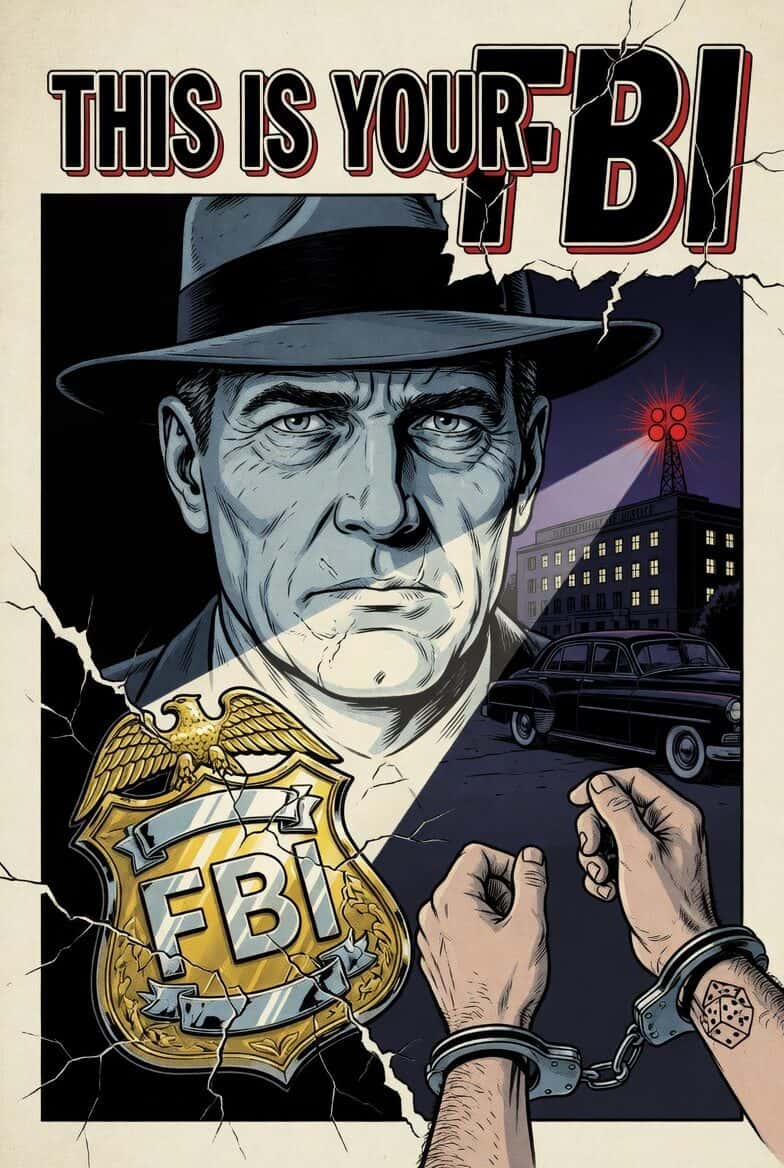
The Equitable Life Assurance Society presents This is Your FBI. This is Your FBI. The official broadcast from the files of the Federal Bureau of Investigation. Presented transcribed as a public service by the Equitable Life Assurance Society of the United States and the Equitable Society's representative in your community. Have you ever felt that some radio commercials waste your time, treat you as if you didn't have too much sense? If so, We challenge you to listen to tonight's middle commercial from the Equitable Society about the Equitable Education Fund. It gives you three interesting facts about the dollars and cents investment value of a college education for your children, then outlines a simple, painless way to pay for those four years in college. See if you don't agree that this is interesting and useful information intelligently presented. Watch for this middle commercial from the Equitable Society.
due in about 14 minutes. Tonight's FBI file, Prisoner of War. After two shorter respites, this nation is again engaged in war, notwithstanding every effort we made to avoid that conflict. Like the last war, and most of the preceding ones, the battlefield, the place where bullets are flying, is in another land far from these shores. However distant we might find ourselves from the nearest enemy artillery, though, we are in a zone of danger. For as wars are fought today, there is no such thing as a non-combatant. Almost all of us, in or out of uniform, are permanently enlisted, as we were during World War II. There were those among us during that period, though, who, while not wearing the uniform of the enemy, worked for an Axis victory, worked in our very midst.
and called themselves American. Tonight's file opens in the year 1944 in a large office located on the second story of a building on the Wilhelmstrasse in Berlin. Behind a big desk sits a lean, hard-faced man who looks up as a German soldier enters, approaches the desk, salutes, and standing at attention says, Leutnant Wetzel, melde sich zur Stelle. Nehmen Sie Gott, Leutnant Wetzel. Danke, Herr Schleicher. The tanned young man in uniform is directed to sit down and listen. Listen to the man who has sent for him, Herr Schleicher. The name doesn't mean anything to you? Maybe you never heard of him. But if you lived in New York, Detroit, Boston, Los Angeles, or any one of a hundred other cities, Herr Schleicher knew something about you. He knew, for instance, what was being manufactured in your town. For during this part of World War II...
He had an important job in the Nazi machine. He was head of the German school for saboteurs. The young Nazi in the field gray uniform of a German lieutenant is a combat veteran. He has been given training for a new kind of war, war when the enemy is not looking. He may find this a little different from the war that he has just left. No guns, no tanks, no planes, but his opportunity to kill will not be lessened. And now, Lieutenant Albert Wetzel, is being given an assignment by Herr Schleicher, a strange assignment for a Nazi hero. He is being told to go to the front in France, to find the American troops and to surrender. A few months later, in a musty, poorly lit Ilkent music store, Located in a large city along the eastern seaboard of the United States, an elderly gray-haired man is tuning a violin he has just finished repairing. Hello, Franz. Oh, hello, Wilma. Sorry I'm late. Have you heard from Mr. Ludlow? He called today. Bad news. One of our men has been arrested. Here? In Brookfield. You undertake his place. What are my instructions? Have you ever been to Madison? A few times. Good.
You will go to the central hotel there. Your name will be Mary Fulton. You'll get a room and wait for a message. From Mr. Ludler? No. Near Madison there is a camp for German soldiers. One of them will escape. He will call you. You are to bring him back here to the store. This man who will call me, what name will he be using? His own name, Lieutenant Albert Wetter. So... It was hard work, but at least now it sounds like a fiddle. A few days later at FBI headquarters in Washington, D.C., Special Agent Jim Taylor enters the office of Agent Robert Dennison, a supervisor on the espionage desk. Good morning, Mr. Dennison. Oh, hello, Taylor. Have a chair. Thank you. Uh, how's your desk? Pretty swamped. Well, split your cases between Fuller and Sawyer. You're going on something that'll take you out of town for a while. Oh, what's that?
Our agents picked up a known Nazi sympathizer named Dalhart in Brookfield three days ago. We'd rather have let him just remain under surveillance, but he forced our hand. We had to arrest him. I see. Dalhart was a courier for a ring headed by somebody named Ludlow. Now, in searching Dalhart's room, one of the agents found an innocuous note. Under infrared, it disclosed that Dalhart was supposed to meet an escaped prisoner of war and escort him somewhere for a meeting with somebody who'd put him in touch with this Ludlow. Sounds like we'd better find out who this Mr. Ludlow is. Well, the first thing to do is to locate that prisoner. Do we know who he is or where he escaped from? His name is Lieutenant Albert Wetzel. Among the papers in Dalhart's room, there was a letter from the Hotel Central in Madison confirming a reservation. There's a camp for German prisoners right near Madison, but by the time I called to alert them, Wetzel had already broken out. I see. Taylor, I want you to get down to that prison camp on the next plane. Go ahead. Thank you.
Well, greetings, Wilma. Hello, Franz. Lieutenant Wessel, this is Franz Bettendorf. Freut mich, einen guten Patrioten kennenzulernen, Herr Bettendorf. Do you speak English? Yes. Then you should not talk German here. Oh, sorry. It's a pleasure to meet you, Lieutenant. Did you have a good trip? It was satisfactory. Have you eaten? Yes, at the airport. Herr Bettendorf, I know I was brought here to work. Am I to get an assignment from you? Mr. Ludlow has a job for you. Who's Mr. Ludlow? The man we take orders from. Oh. There is a barge on the river here. The captain's name is Prosser. You will see him. What's the job? Mr. Ludlow has given Captain Prosser instructions for you. How do I find this barge? Wilma will take you there tomorrow night. Major Carter? That's right. My name's Taylor, special agent of the FBI.
Here are my credentials, sir. Oh, yes. I was expecting you. You want information on that escaped prisoner? Yes, sir. That's right. Let me find the file. Let's see now. Lieutenant Wetzel. Here we are. Are you familiar with how he escaped? No, sir. I'm not. Well, he made a nighttime getaway. Blew a hole in the stockade fence just big enough to crawl through. Oh? Must have made a little noise. Well, unfortunately, it didn't. Why? In some way, Wetzel got hold of smokeless powder and muffled the charge. Wow. What have you got on the records on him? He's highly intelligent, spoke excellent English. He was also a demolitions expert, which accounts for his skillful getaway. I'll have a copy of this file made up for you. Yes, thanks a lot. I'm going into Madison, sir, and check the hotel there. I'll be back for his file. Oh, Mr. Taylor. Yes? I've gathered together as many of the hotel personnel as I could. They're in my office. Oh, thanks very much. Did you show them that picture that I gave you? Yes, I did, but none of them seemed to recognize him. Go ahead, sir.
Thank you. All right, folks. All right. This is Mr. Taylor. He's a member of the FBI, and he'd like to talk to you. Go ahead, sir. Thank you. I understand you've all seen the picture that I asked your manager to show you. And I also learned that none of you could identify him. Is that correct? Well, this man is a prisoner of war. He escaped from the POW camp 20 miles north of here. It's possible that he might still be in this vicinity. There will be copies of his picture distributed to you and other people here in town. I'm going to ask for the cooperation of you and your neighbors to help locate him as soon as possible. Wait a minute. Is this the barge? Yes. Captain Prosser? Who's there? Wilma. Come aboard. Go ahead, Lieutenant. After you. Hello, Wilma. Quite a force, huh? Yes. Captain Prosser, this is Lieutenant Wetzel. Who else would you be bringing? A boyfriend? Nice to meet you.
Nice to meet you, too. Let's go in the cabin. Very well. Go ahead, Lieutenant. Thank you. Some schnapps? No, thanks. Not for me, Captain. I must take one to celebrate. It's not every day I have a visitor. Especially such a visitor. Little schnapps is good on a night like this. Did Mr. Ludlow call you? Yes. What's my job? I don't know yet. Do you have some old clothes? That's what I'm wearing. I'll get you some. Mr. Ludlow wants you to live here on the barge. Franz got me six cases of rags for you to work with. I'll need some other things. I will make up a list. I'll get them for you. I have to know what kind of a job it is so I can prepare the right kind of package. I deliver food to ships before they sail. We will put your packages in crates, just like the crates of food. Oh. Mr. Ludlow doesn't know yet just what ship he wants blown up. But by the time you're ready, he'll tell us.
Busy, Mr. Denison? No, Taylor. Come on in. Thanks. I'd like to report to you, sir, on that prisoner of war case. Oh, fine. Let's have it. Well, after determining how Wetzel escaped from the prison camp, I went to the hotel in Madison. I checked with all employees, showed them his picture. Mm-hmm. None of them had seen him. I then got a list of every guest who'd registered at the hotel from the time of Dollhart's arrest to the day after Wetzel's escape. Good. Did that get you anything? Yes, sir, it did. There were 62 names and addresses, and I verified 61 of them. The one remaining turned out to be a fictitious name and address. It belonged to a woman. Anything further on her? No, not yet, sir. Ah. Taylor, this case may be the most important one in the office. No. When the director found out Lieutenant Wetzel was a demolitions expert, he called a meeting. He's got a theory about this whole thing. What's that, sir? The Nazis tried to land aid saboteurs here in 1942. It didn't work. Last month, they sent a sub all the way across the Atlantic to get two men out of the coast of Maine.
That expedition failed, too. Yeah. Now, those are pretty desperate measures. The director feels the Germans are going to those lengths only because they have no trained saboteurs already in this country. But Wetzel didn't come in by sub, Mr. Denson. No. Army intelligence reports on his capture show Wetzel surrendered west of Bastogne. At the time of his capture, he was eight miles from the nearest German troops. Ah. Now, the director thinks Wetzel might have been sent to the front to surrender to the Americans so he'd be brought to a prison camp in this country and then escape. Then there's no telling how much he can slow up the whole war effort. That's right. He's probably at work right now. So, wherever he is, we've got to find him. We will return in just a moment to tonight's exciting case from the official files of your FBI. Now a special message from the Equitable Life Assurance Society to fathers and mothers of young children.
We're going to ask you to take out your crystal ball for a moment and look into the future. It's the year 1960 or 65, and that youngster of yours comes to you and says... Hey, Dad, shake your son by the hand. I just got word I passed all my college entrance exams. When he starts out for college, your young hopeful will have three good reasons for feeling that he owns the world. First, college men and women earn more money. No fooling, Dad. A commentator on the radio last night said that by the time a college man retired, he's made $72,000 more than the guy who quits his education after high school. Second, college men land the bigger job. He also said that in the jobs paying $10,000 a year, 15 out of every 16 are held by college grads. Just think, the odds are 15 to 1 in favor of college. Third, college men get more out of life. They know their way around in art, music, and literature.
They gain culture they wouldn't trade for all the money in the world. So, fathers and mothers, don't leave your family's education to luck. Make it a 100% sure thing with an equitable education fund. An equitable education fund? What's that? It's the painless way to pay for your children's college education. In this equitable society plan, you start when your children are young. Then, each year, you pay a sum of money that doesn't hurt, an amount that scarcely makes a dent in your budget. When your youngster's ready for college, the money's all ready for him. That's spreading the cost of education over 10 or 15 years instead of taking a beating in four. Right. Now suppose the father dies or becomes totally disabled. Then no more payments are necessary. The fund becomes fully established. When the youngster is ready for college, he gets the same education as if his dad had lived. So don't delay a day longer. Let your equitable society representative...
show you how little it costs to start an equitable education fund. Or write care of this station to the Equitable Society. That's E-Q-U-I-T-A-B-L-E. The Equitable Life Assurance Society of the United States. And now back to the FBI file, Prisoner of War. Since ancient days, free nations have depended on the strength of their citizens to turn back any attack upon their liberties. But also, since time immemorial, Armies have always found in enemy countries a minority of people who are ready to trade their patriotism, to destroy their country from within, to act the part of traitors. Hiding under the veil of loyalty, they are as dangerous, probably more dangerous, than the uniformed soldiers of the foreign powers they serve. During the days leading up to World War II, and in the early part of that conflict, We saw outwardly strong countries disintegrate in a few days at the first signs of pressure from the Nazi warlords. We also saw that these countries did not lose a fighting war. Rather, they were rotten from within, sold out by their own citizens for an immediate selfish gain. And a new name was born for these people, the fifth column. Men and women like the people you are meeting in tonight's case were America's fifth column in World War II.
And they worked long and hard to secure victory for the Nazi cause, for the Axis. Fortunately, loyal Americans were working even harder to bring victory to the Allies. Loyal Americans like those who wore uniforms and fought the battles. Loyal Americans like the people who pledged part of their salaries for bonds. Loyal Americans like the factory workers who turned out the weapons that protected our liberty. Loyal Americans like the men of your FBI.
Tonight's file continues at FBI headquarters in Washington, D.C. Denison? Oh, come in, Taylor. Well, the second trip to Madison paid off. What happened? I re-interviewed all the employees of the hotel. I was lucky enough to get quite a few details on the woman with the fictitious name and address. Good, let's have them. Well, one of the bellboys who carried in her bags recalled that she was wearing a heavy coat when she checked in. Means she probably came in from up north. Seems likely, sir. I also found out that while she was there, she called the hotel doctor. What for? She was taking some pills and ran out of them.
He gave her a prescription so that she could get another supply. I see. Did you get a description of her? Well, very sketchy. She's a small woman in her late 30s, but there's no distinct physical characteristics. Oh, I also interviewed the phone operators. One of them remembered the woman getting a call at 5 in the morning, after which she asked the operator to send a boy up for her bags, and she then checked out. Did you contact transportation terminals? Yes, sir, I did. No buses left there till 9 a.m., no trains till after 10. But a plane coming through from Los Angeles stopped at Madison at 5.40 that morning, and the airline records show that a man and woman got aboard. Sounds like she picked up Lieutenant Wetzel. Yes, sir. The plane was nonstop after leaving Madison. Where to? Forest City. Good. You better go there. I'll wire the office covering Forest City and have someone meet you. Hello, Tom. Hi, Jim. Are you going on? No, I'm here to meet you. Hey, that's great. Got any baggage? Yeah, but I'll pick it up later. Okay, come on. I got a car down this way. Fine.
Tom, how much did Washington tell you in their wire? The whole story. I got files ready at the office for you on every woman in town suspected of being an anti-Sympathizer. Why? I doubt there'll be too much help, though. Oh, how come? There are hundreds of them. Without a good description, it'll be rough trying to come up with the right one. Well, we'll have to do a cross-check job. Cross-check against what? Well, I've got a prescription this woman had duplicated in Madison, Tom. We'll query every doctor in this area and find out who's been ordered to take these pills. Yes? This is Wilma. I've been waiting for your call. Have you been back to the barge? Twice. Everything all right? Wetzel finished wiring the last crate yesterday. Fine. You heard from Mr. Ludlow? Yes. The crates are to be put aboard the SS Greystone. Greystone? It's at Pier 35. What made him pick that one? He has information it is carrying some new kind of American weapons. Oh?
You better go now, Wilma, and deliver the message. The Greystone sales tonight. Tom, that cross-checking we did paid off. What name did you come up with? Wilma Ziegler. Wait a minute, I'll pull her file. Here it is. Hey, from the size of this file, she's more than just a sympathizer. Let's have a look at it. Here's a report on her and on the places she goes to most frequently. Occupation unemployed. What I got in Madison, Tom, she didn't dress like a person who was out of work. Nazis must pay well. Yeah. Well, let's go over those pictures then. All right. These were taken at a beer garden over on Center Street. It's one of their favorite hangouts. Maybe we'll drop by there later. And these were taken across the street from a music store named Bettendorf's. Wait a minute, Tom. You know what date this picture was taken? It should be stamped on the back. Oh, yeah.
Yeah, here it is, the 11th. That's the same day she checked out of the hotel in Madison. And from the rear, this man that she's with could be Albert Wetzel. Well, let's see if we have a picture of him coming out of the store. Pardon me, Tom. Yeah, Dick. Did you pull the file on Wilma Ziegler? This is it. Why? The SAC just got a tip she's mixed up in something big. You know what it is? No, but the man from the music store is in on it. And it's due to break real quick. You ought to get warrants and pick up the both of them.
Are you friends, Bettendorf? That's right. We're special agents of the FBI. You're under arrest. Here's the warrant telling you why. But I have done nothing... Before you do any talking, we must tell you one thing. Anything you say now can be used against you in court. I won't say anything then. Dick, you and the others search this place. Right. Taylor and I better keep looking for a lead on the Ziegler woman. Bettendorf won't talk, Jim. I didn't think he would. What have you got there? A paper I found on his desk. It's a delivery receipt for six crates of waste rags. Tom, they must be for Wetzel. No trace of them here. We find those rags, I think we find Wetzel. Tom, I located the Wright Express Company. Those crates were picked up from the music store last Monday. They were marked powdered milk and delivered to Pier 9. 9, huh? Yeah. That's the pier they use for loading barges. Oh, whose barges? Everybody's. Let's get down there. The tug is coming now to take us out. I've got to come aboard. There's trouble, Captain. Franz has been arrested. Where? This afternoon. Where's Wetzel? In the cabin. Wetzel!
Come here! What is it? Come here!