
The written record
Read the transcript
Read along with the recording · About 22 min to read
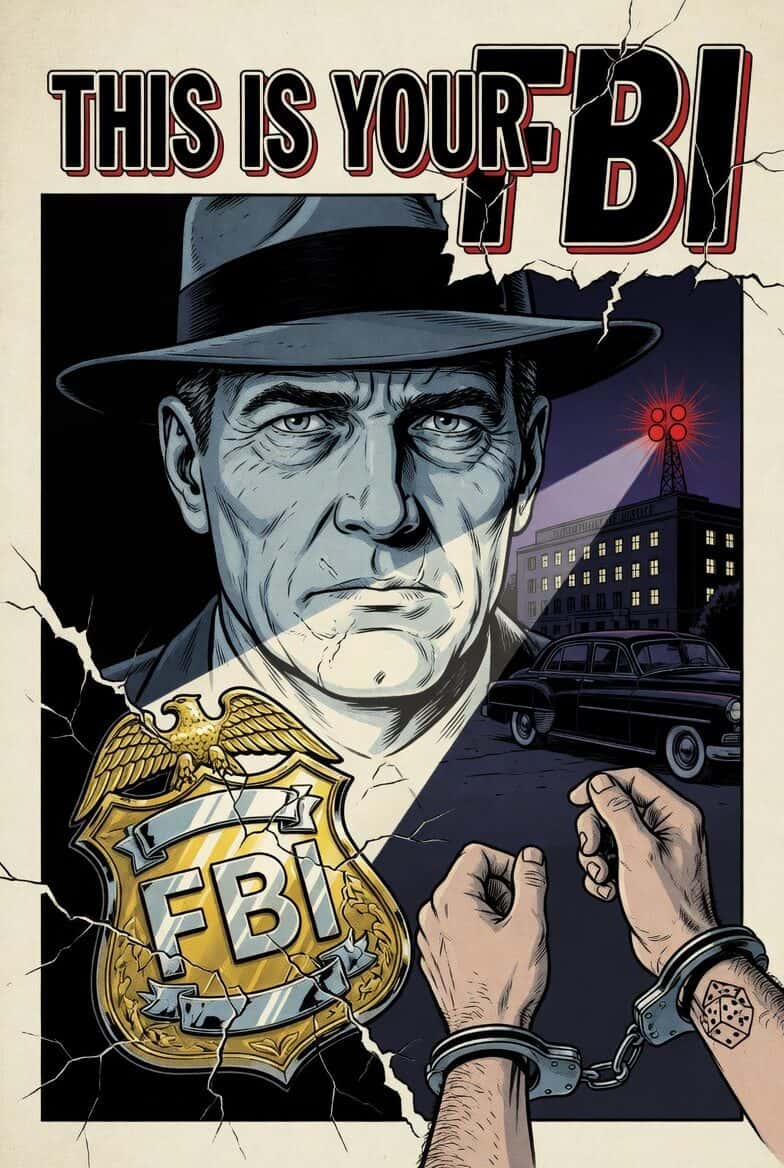
The Equitable Life Assurance Society presents, This is Your FBI. This is Your FBI. The official broadcast from the files of the Federal Bureau of Investigation. Presented transcribed as a public service by the Equitable Life Assurance Society of the United States and the Equitable Society's representative in your community. From time to time in the 30s and early 40s, most men and women ask themselves, What will I be doing when I'm 65 years old? What are my chances of being 100% self-supporting when it's time to stop work? Well, that's largely up to you and the decision you make right now. One such opportunity for an important decision will be offered to you in our middle commercial. It tells about the Equitable Society's Independent Sixties Plan. This plan means exactly what it says. Financial independence for you in your sixties. Do you like that idea? Then please listen carefully to this important message from the Equitable Society.
Coming in about 14 minutes. Tonight, the subject of our FBI file, hijacking. It's titled, The Roaring Twenties. Tonight's case from the files of the Federal Bureau of Investigation deals with organized crime of 25 years ago. Even then, large-scale crime was nothing new. It goes back to the days of the Greeks and Romans. But in our country... Big-time racketeering really took firm root in the Prohibition era when Al Capone, Bugs Moran, and Crime Incorporated became household words. The day of the lone wolf criminal was passing. Crime developed into big business. Today, it is estimated that the sum total of all damage done by lone wolf operators does not amount to one-tenth of the cost of streamlined 20th century crime. Tonight, As you listen to Agent Putnam, who has ably served the FBI for over a quarter century, tell what went on during the 1920s. Don't think of this as ancient history, as something that doesn't happen now. Prohibition came and went, but organized crime still goes marching on. Tonight's file opens in the coffee shop of a Midwestern City's railroad station.
FBI Special Agent Jim Taylor has just entered and approaches the table occupied by his agent in charge. Good evening, Mr. Quentin. Oh, hello there, Taylor. I thought you were in Brownsville. I just got off the train. Have you eaten? No, sir, I haven't. Well, sit down. Join me. Oh, thanks. How'd it go up there? Very well. A report will be on your desk in the morning. Well, you better give it to Williams. I'm on my way to Washington. Oh? Mm-hmm. I'm waiting for the train now. Do you wish to order, sir? Yes, please. I'd like some ham and eggs. You need coffee with? Yeah, please. Okay. Say, Mr. Putnam, I hear you got your 25-year key. Mm-hmm, that's right. Now, congratulations, sir. Well, thank you. Funny, when it came in, I had quite a time realizing it had been that long since I joined the Bureau. I guess it must have been a lot different back in 1926, huh? Oh, it certainly was. If I remember correctly, there were only nine field officers then and about 500 special agents, huh? What made you decide to become one, sir? Well...
Mr. Hoover spoke to the graduating class at my law school. He sold a few of us the idea of making law enforcement our careers. How long had Mr. Hoover been head of the Bureau then? Oh, a little over a year. People were just starting to believe the statement he made that he was going to free the Bureau of political influence. Tell me, what kind of facilities did you have in those days? Very few. There was no such thing as a crime lab. None of us had cars, including the director. I imagine working on a case then was more of an individual problem, huh? Yeah, it was. Jim, how about a piece of this bread while you're waiting, huh? Oh, fine. Thanks. I, uh, I was just thinking about one of my first assignments. Oh? Well, let's hear about it. Well, it's kind of a long one. I don't mind. And can fill in time till your train comes. Well, all right. You asked for it. I, uh, got on with a friend of mine, a police detective named Adams. I was sitting at my desk one day when he called. Putnam.
This is Adams. Oh, hello, Johnny. Can you use another case, Tom? Oh, what kind? Well, a motorcycle patrolman out on Route 9 stopped a truck for speeding. Uh-huh. Driver tried to shoot his way past. He didn't make it. He's in city hospital now. Who is he? I don't know. Nothing on him? A dollar thirty in cash and a girl's picture. What about the truck? Well, the motor number's been filed off. The license plates were from a stolen car. Oh. That's not what I called you about, though. Inside the truck, we... found some boards that looked like they used to be part of crates. Uh-huh. A few carried stamps from the Broadway warehouse. Mm-hmm. What it said on the labels, this was part of an interstate shipment, so I thought you might be interested. Well, I sure am. Any of your men gone by the warehouse yet? No, this word just came in. I thought I'd run over myself. Good. I'll meet you there. Oh, Tom! Over here, Johnny, by the loading platform. Oh. Find anything yet? Oh, the place has been robbed, all right. The side door was jimmied. The watchman shot.
How long you been here? Just a few minutes. I called the city hospital. They're sending an ambulance for the watchman. You, uh, you ask about that truck driver's condition? Yeah. Yeah, he's still unconscious. You found out yet who he is? No, we don't have his prints in our file. Hey, there's plenty of whiskey in this place. Yeah. The owner told me it's about all they use it for now. Well, when'd you talk to him? Well, after I found the watchman, I called him to tell him about the shooting and to find out when we could learn what's missing. Uh-huh. It'll be morning before they can start taking an inventory.
Say, where's that truck now? It's still out in Route 9. We've got it under guard. Johnny, would you mind waiting here for the ambulance? No. Where are you going? To call the FBI field office in Chicago and advise them of this. Well, Jim, the morning after we inspected the warehouse, they took an inventory. A little over a thousand cases of bourbon had been stolen. Hey, that's quite a haul. Yeah, even in those days it represented about $25,000. Here you are, sir. Oh, thanks very much. Oh, miss, may I have a napkin, please? Oh, sure. Here you are. Thanks. The warehouse watchman ever recover? Yep, but he couldn't give us any help. Then, to make matters worse, the only link we might have had with the bandits vanished. What was that? A truck driver. He died. Before you found out who he was? Mm-hmm. Salt, Jim? Yeah, thanks. That girl's picture he had on him turned out to be useful. Oh? Yeah, she was a nightclub singer named Betty Russell.
She worked at a nightclub named Paradise. I went to see the Russell girl that night. The head waiter pointed her out to me. She was sitting alone in the corner. Miss Russell? That's right. I'm from the FBI. May I sit down, please? Is this a pinch? No. Then don't sit down. I'm a singer here and I'm busy. I go on a couple minutes. I'm afraid I've got some bad news for you. Cops always got bad news. I understand you were Eddie Warren's girlfriend. Five years ago. Well, he died this morning. That's too bad. You don't seem very broken up. He was a nice guy, and I'm sorry he's dead, but I've seen him once in five years. When was that? A week ago. Oh, where? Here. He came in, and we talked over old times. At all? Yeah. Miss Russell, Eddie Warren was mixed up in the robbery of a warehouse. Did he tell you why he was in town? He said he came to work on a good job.
Did he tell you it was a robbery? He didn't say, and I didn't ask. In my business, you learn to listen. I've gone over Warren's record. This robbery was way out of his class. He must have been working for somebody else. Have you any idea who that was? I just told you. I didn't ask any questions. Did he mention any names? No. No, he told me he was staying at the Central Hotel. He wanted me to call him if I got lonesome. I never got lonesome, so I didn't call. I see. I've got to talk to my piano player before we go on. You're going to stick around for the show? No. No, I think I'll drop by the Central Hotel and have a look at Warren's room. If I need you for anything else, I'll come back. Sorry I'm late, Tom. Oh, that's all right. I went to the Paradise Club, saw Betty Russell. Oh, Warren's girlfriend. She used to be. At any rate, Warren came to see her last week and said he was in town to go to work on a good job. He wasn't lying. The only other thing he told her is he was staying at the Central.
You taking a look at his room yet? Yeah. Yeah, but all I found was a message slip. Somebody named Sherman called him. Sherman. He leave a number? No, no. Yeah, that could have been Al Sherman. Who's he? He's a muscle man for Pete Brown. Say, I think you hit it. Why? Well, I went over the hotel phone records. Right after checking in, Warren called the Club Hollywood. Uh-huh. That's Brown's club, isn't it? Yeah, but try and prove it. Officially, it's owned by some corporation. Does Brown have any connection with the Century Building? Yeah, why? Well, shortly after that phone call, Warren asked the doorman how to get there. His office is in the Century. Johnny, let's find Pete Brown. How about a little more coffee, Taylor? Yes, thanks. Go ahead, Mr. Putnam. Keep on with the story. Well, locating Brown wasn't easy. We followed his trail all over the city. Until about 5.30 in the morning, we got word he was at the arena.
They didn't have all-night fights in those days, did they? Oh, no, no. It was being used then for a dance marathon. Remember them? Yeah, Begley. Oh, it was a contest to see which couple could stay on its feet longest. Oh, yeah. The dancers were allowed 15 minutes off the floor every three hours. The big idea was to see that they didn't sleep. Why? Answer that and you can analyze the 20s. The marathon craze started in little ballrooms. Before it was finished, the arena wasn't big enough to hold the crowds. This particular marathon was in its 28th day. We went there and looked around for people. There's Brown, down in that box. Come on. Right. Morning, Mr. Brown. Oh, hello, Adams. You don't have to miss to me. Oh, I'd rather. Come on in, join us. Thanks. You know Al Sherman? Hiya. This is Mr. Putnam. How do you do? Hello. He's with the FBI. Well...
Nothing will happen to us tonight, Al, with this kind of protection. Hey, get a load of that number six team. They're killers. Mr. Brown, we've been looking for you most of the night. Hey, you should have tried this place first. I come here every night. Hey, Pete. Pete, the name of the number three team is collapsing. Look at the guy trying to drag us. They're being waved off the floor. Mr. Brown, can we go someplace and talk? About what? Business. Hey, stay on your feet. What's wrong with talking right here? It's a little public. Any contestants? Eddie Warren. Who is he? A truck driver who died at Mercy Hospital this morning. That's too bad. I'm sorry to hear about anybody dying. I'll be glad to throw in a couple of bucks for his family if that's what you want. Is that the way you take care of all of your employees when they get killed? I don't understand. Eddie Warren was shot after taking part in the robbery of the Broadway warehouse. He was working for you at the time. Doing what? Driving that truck. What would I need a truck driver for?
You don't have to be that cute with us. One of my men finally located the number you forgot to file off the chassis of that truck. I don't know what either one of you guys is talking about. About an hour ago, the detective who found that number traced it from the factory to a dealer here. It meant waking up a lot of people, but we found out the truck was bought by the World Express Corporation. Well, why come to me? Because you own the corporation. I own some stock in it, sure, but I own some in a lot of corporations. I'm practically a corporation myself. Nothing illegal about that, is it? Mr. Sherman. Are you talking to me? Yes, I'd like to ask you a few questions. Shoot. Did you know a truck driver named Eddie Warren? No. We hear you called him at the Central Hotel a few days ago. You hear wrong. Look, boys, I've heard as much as I want to. You think I was mixed up in a warehouse stick-up? Frankly, yes. Can you prove it? No. Well, let me know when you can. Right now, I'd like to watch the dance. Al. Yep.
Go tell the guy I'm putting up 50 for the next sprint. And tell him to make it twice as long. We will return in just a minute to tonight's exciting case from the official file of your FBI. But now, listen. Hey, Carrie, that's the mail. Our check from the Equitable Society is due today. Every month, right on the dot, those equitable checks come to members who have paid up their Equitable Independence 60s plan. Checks that mean financial independence for life. And here's Mr. Frank Bailey to tell us how this plan worked out for him. I started my plan 26 years ago. Now it's all paid up and I've quit work for good. In other words, Mr. Bailey, you're now enjoying the three freedoms that go with an independent 60s plan. First, freedom from money worries and job worries. Financial independence. I'm 100% self-supporting, Mr. Keating. I'll never have to ask my children for a penny. Second...
With an equitable, independent 60s plan, you're free to live anywhere you please. My wife and I still have our old home in Brooklyn, but we don't like cold weather, so we hit the trail for Florida every winter. Third, freedom to do the things you've always wanted to do. I'm a Dodger fan, naturally. Now, at last, I've got time to see all the baseball I want. Rather was it a lucky day for me 26 years ago when my equitable society representative proved to me that you don't have to be rolling in money to afford an independent 60s plan. That's a fact. You don't have to earn big money to begin an equitable independent 60s plan. Ask your equitable representative to explain why you probably have a big head start towards independent 60s because of your social security and the life insurance you already own. Often only a small amount of additional insurance is all that's required. A few dollars a week did it for me. Friends, why not profit by Mr. Bailey's experience? Phone your equitable society representative without delay or send a postcard care of this station.
To the Equitable Society. That's E-Q-U-I-T-A-B-L-E. The Equitable Life Assurance Society of the United States. And now back to our FBI file, The Roaring Twenties. Pete Brown, to whom Special Agent Putnam has introduced us tonight, is a typical example of the underworld big shot. A man with many enterprises. From nightclubs and horse parlors to even shadier ventures. Who supplies the money that fills the fat wallets of the Pete Browns of this world? Didn't it ever occur to you that you may be contributing your share? When you patronize the black market, when you place a bet with a professional gambler in a locality where gambling is illegal, you are helping to support organized crime. Part of your money goes to maintain the underworld's own enforcement department of gunmen and professional killers.
Part is used to corrupt police and public officials. Don't complain about crime waves while you yourself are helping to keep them going. Remember, as the criminal detection methods worked out by your FBI become more and more efficient, the criminal syndicates step up their own techniques in order to survive. Law enforcement agencies are still well ahead of the underworld. But even more progress would be possible if more of our citizens would make certain that not one cent of their money goes to swell the huge corruption funds of organized crime. Tonight's FBI file continues in the Railroad Station coffee shop where Agent and Charge Putnam and Special Agent Jim Taylor sit talking. Well, I gather you didn't get any place with Pete Brown, Mr. Putnam. No, not that night. What was the next development? The girl I interviewed at the club, Betty Russell? Yeah.
She was found dead in her apartment. Murdered? Yeah. Brown and Sherman? Well, that was our belief, but we couldn't prove it. So with Brown's truck driver and the girl both dead, we had no possible witnesses. I was in my office facing these facts. Putnam. This is Adams. Yes, Johnny. I just got a call from our ballistics expert. The bullet that killed Betty Russell was fired from the same gun used to shoot the warehouse watchman. Well, now all we've got to do is tie Pete Brown into both jobs. Yeah. I also got some word on the truck used in the hijacking. It came from the Bedford Avenue Garage. They service all the World Express Corporation trucks. Who turned it over to Brown's driver? Well, he walked in and said he was a new driver for World. He waited a few minutes till they finished an oil and grease job and drove it out. Do you know anything about this garage, Johnny? It's a legitimate outfit, if that's what you mean. Where are they located? Bedford and Broadway. Well, I'm going over there. That truck is about all we've got left to work on.
Oh, we've been in here an hour, Pete. I'm all steamed out. Another couple of minutes and we'll go get a massage. Okay. Oh, remind me to call the farm. When? As soon as we get back to the office. I want to move that bush. They're so quick. I don't like the heat those cops are putting on us. Yeah, but nobody can talk now. If Warren or the dame blew any whistles, the cop would have had us on the griddle already. Al, only suckers gamble. But it took four trucks to haul it out there. Where are you going to stash it? I got a place. We'll move it to Niner. Johnny, I think we got a lead. Oh, on Brown? On the warehouse robbery. The garage manager told me something about the truck Brown's driver picked up. After the oil and grease job, the garage took a speedometer reading. Leaving there, the truck's mileage was exactly 12,000. Well, how does that help us? When the truck was stopped out on Route 9...
The speedometer read 12,031. I drove from the garage to that spot. It's exactly 31 miles. Is the warehouse in a straight line between the garage and the arrest point? Yes. With no extra mileage on the truck speedometer, it means Warren got rid of the whiskey at some point along that straight line. Did you clock the distance between the garage and the warehouse? Yes, seven miles. That means the whiskey is someplace along those other 24 miles. Right. I'll get a car and we can start cruising. The minute we see any plates... Johnny, one of us ought to check at the Hall of Records. I'd like to know if Pete Brown owns any property out there. Well, suppose you do that, and I'll call in and leave word for you every half hour. Good. I'll do the same. If either of us gets anything, we'll pay Mr. Brown another visit. Hello? Mr. Putnam there. Speaking. This is Chief of Police Williams. Johnny Adams hasn't checked in for the last hour. That's not good. Have you found what you were looking for?
Not yet. I'm still going through the records. I'll call you back when I get anything. Good. Here's another batch of real estate records, sir. I'm just finishing these. Any sign of what you're looking for? Well, I haven't been... Wait a minute. I think this could be it. Huh? Yes. Yes, look, if the chief of police calls me, tell him I'm on my way to headquarters. Any call from Johnny Adams, chief? Not a word. Well, I think we found what we're looking for. How many men can you spare? Oh, as many as you need. Good. Get them. We're going out to a farm on Route 9. Those trucks are just like the one Eddie Warren was driving.
Then this should be the right place. Shall I have my men move in now? No, no, not yet. Hold it. Huh? There's a man in front of the barn door. Doesn't look like Pete Brown. It's not Sherman. He's going inside. Yeah. Looks like he's left the door ajar. Come on. Pretty busy in there. Yeah. Let's look in and see what's going on. They're loading a truck. And there's Adams. Where? Tied up in that corner. Oh, yes, I see him. That's whiskey they're loading. Mm-hmm. And there's Pete Brown and Al Sherman. You ready? Yeah, let's move in. Okay, hold it! Get your men front and center. You are not taking... Thanks, Chief. Now, the rest of you line up here. You're all under arrest. Mr. Putnam, why'd you go to that particular farm? I remembered Pete Brown talking that night at the dance marathon about all his corporations. Oh, yeah.
Most farms along Route 9 were small. So when I came across a deed registered in the name of an incorporated farm, I was pretty sure it was the place we wanted. You know, I've seen you on the pistol range, sir. How did it happen to be the chief who shot Brown? Well, I couldn't. Special agents weren't allowed to carry guns in those days. Oh, that's right. Chief kill him? No, no. Brown recovered and stood trial with Al Sherman for the murder of Betty Russell. Each of them got life. Oh, say, I'd better get moving. My train goes in a few minutes. Oh? Well, congratulations again, sir. Well, thanks, Jim. Thanks. Good night. Good night. There are other men in the Federal Bureau of Investigation who wear the 25-year key as a sign of their long devotion to duty. No matter what a special agent's length of service, however, he is a man who spends his waking hours working for you, protecting your life and your liberties.
taking his life in his hands constantly in his never-ending job of tracking down and apprehending America's most vicious criminals. He is, in short, a man who lives by the motto of his organization, the motto of your FBI, fidelity, bravery, integrity.
Two final questions on the cost of the Equitable Society's Independent Sixties Plan. Mr. Keating, I'm still in my twenties. There's plenty of time to start one of these plans later on, isn't there? Well, it's never too early to begin a good thing. Start your plan when you're young, and your yearly cost will be exceptionally low. Well, about how much would it cost me every month? The amount of your Independent Sixties Plan is strictly up to you. Your Equitable Society man takes into account your present salary, your future income under Social Security, and the life insurance you now own. A comparatively small amount of additional life insurance may be all that's required. Get the exact figure from your Equitable Society representative. Or send a postcard, care of this station, to the Equitable Life Insurance Society. Next week, we will dramatize another case from the files of the Federal Bureau of Investigation. Its subject, burglary. Its title, the connoisseurs of crime.
The incidents used in tonight's Equitable Life Assurance Society's broadcast are adapted from the files of the Federal Bureau of Investigation. However, all names used are fictitious, and any similarity thereof to the names of places or persons living or dead is accidental.