
The written record
Read the transcript
Read along with the recording · About 24 min to read
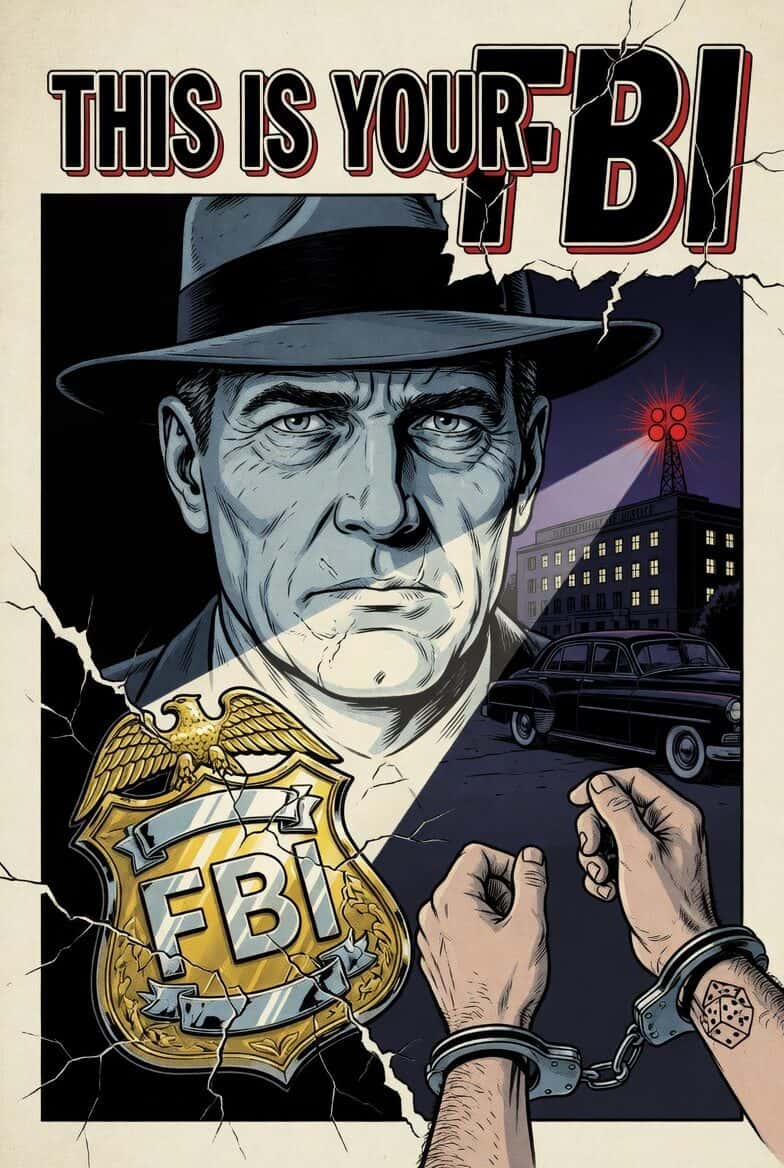
The Equitable Life Assurance Society presents, This is Your FBI. This is Your FBI, the official broadcast from the files of the Federal Bureau of Investigation. Presented transcribed as a public service by the Equitable Life Assurance Society of the United States and the Equitable Society's representative in your community. Fathers and mothers, may I have your close attention, please? If you're typical Americans, you firmly believe in education. You're determined that your children are going to have the best education you can possibly afford. The Equitable Education Fund is made to order for you. It's the painless way to pay for a college education. It's a plan that makes certain that your boy or girl will go to college regardless of what happens to you. Interested? Then please listen carefully in about 12 minutes when I give full details on the Equitable Education Fund, a plan created for opportunity-minded parents.
by the Equitable Life Assurance Society of the United States. Tonight, the subject of our FBI file, Misery Chiseling. It's titled, The Bad Samaritan. One of the difficulties of crime prevention is that the criminal makes all the early decisions. He picks his crime. He chooses the time and the place and also plans his getaway. Occasionally, he leaves behind some very obvious clues which make his trail easy to follow. But sometimes he is more careful, more difficult to locate. In tonight's case from the files of the Federal Bureau of Investigation, you see the men of your FBI in action as they attempt to track down a very slippery fugitive. As they concentrate their efforts, their knowledge, their training in a search for one person in a manhunt. Tonight's FBI file opens in a large western city. It is late afternoon as a man in the uniform of an army officer Knocks at the door of a small cottage. Coming. Good afternoon. I'd like to see Mrs. Mason. Hi, Mrs. Mason. Oh, my name is Major Bristol. I was your son's commanding officer in Korea. May I come in, please? Oh, of course. Thank you. The room isn't very tidy. That's all right, Mrs. Mason. Please sit down. I wanted you to be seated when I gave you the news. The news? Yes. That telegram you received was an error. Tommy's alive.
I know this is a terrible shock. Where is Tommy? Can I see him? Is he all right? I've prayed every night for this news. If you knew how I've prayed... I can imagine. It was my fault that you got the telegram. Your fault? Yes. I went out one night on a patrol with Tommy and three of my other men. We lost contact with the gooks. That's what we call the North Koreans. But they didn't lose contact with us. They machine-gunned us coming over a ridge. We scattered and... When only two of us came back through the lines, I reported the other men missing in action. Where is Tommy? When did you find him? We didn't. I learned just before I left Korea that Tommy was taken prisoner that night. Prisoner? It's not very pleasant, but at least he is alive. Yes, of course. I can't tell you how grateful I am to you. Well, be grateful to Reverend Jones. What does the Reverend have to do with it?
Well, on the way back from Korea, I somehow lost the slip of paper with your name and address on it. All I could remember was that you lived in this city and that Tommy had told me about going to the Hillside Church. Oh, yes. Tommy never missed a Sunday. So I called on Reverend Jones and he gave me your address. Else I never would have located you. Oh, I see. Well, I'm so grateful to both of you. I'll be able to sleep tonight. To sleep and not have any more nightmares about my boy. He's all I have. I'm sure he'd like to hear from you, Mrs. Mason. Well, can I write to him? What's the address? Well, it's not quite that easy. Oh. If you'd like to write a note, I'll see to it that it gets to Tommy through... Well, I'm not supposed to tell you this, but we do have an underground movement in North Korea. They deliver it. Oh, this is wonderful. Just wonderful. As far as sending him anything like food or clothes, I'm afraid that's impossible. Shipping space is at a premium. Yes, of course.
There is one way to provide some comforts for Tommy. Oh, how? Tell me. I'll do anything. The guards at the communist prison camp are open for bribery. If you had some money, you could send your son. I have a thousand dollars in my savings account. Would that be enough? If that's all you have. There was a man here yesterday looking at the house. I could sell this place. Oh, no, no. Tommy wouldn't want you to do that. You get the thousand dollars and we'll see that he gets it. Well, when should I get it? Well, the banks are closed now, but the morning will be time enough. I'm leaving for Washington to report on some secret work, but my plane doesn't go until 11. 11 in the morning? Yes. I'm staying at the Hotel Central. If you can have the money there by 10.30, that'll be time enough. Oh, I will, I will. And thank you. Thank you. The following week at the local FBI field office, Special Agent Jim Taylor greets Agent Mike Wayne.
Mike, we're working together again. That's fine with me, Jim. What is it this time? A misery chiseler. Oh? A widow named Mrs. Mason called in this morning. She got a letter from the grave registration unit of the army telling her where her son was living. Rough kind of mail. Well, she called the army to tell them that her boy was a prisoner of war and wasn't killed in action. She said a man named Major Bristol came to see her and she gave him $1,000 to send to her son. Not the old racket about bribing the prison guards. That's it, Mike. The army checked, and of course, there is no Major Arthur Bristol who came back from Korea. The victim give you a description? Yes, but we've got nothing in our office files on anybody with that description, and neither have the police. Maybe this woman was too excited to give a good description. No, I checked, Mike. She described him perfectly. Well, who'd you check with? Mrs. Mason's pastor. This major went to the pastor first and told him the story. What for? Oh, I guess it made his story sound better.
I called, and this Reverend Jones gave me exactly the same description. Well, maybe Washington will have something on Bristol. I hope so. I sent it through on the wire as soon as I got the confirmation. Oh, uh, Mike, can you get out for a while? Well, not right now, Jim. I've got to finish this report for the SAC. Okay, then I'll see you later. Where are you heading? To see Reverend Jones, find out if he can give us anything to work on. Good afternoon, Mr. Taylor. Hello, Reverend. Sorry I kept you waiting. That's quite all right, sir. Uh, um, sit down, please. Thank you. Shocking thing this man did. Terribly shocking. Yes, I was hoping you might help us catch him, Reverend. I certainly will if I can. Well, in your conversation with him, did he indicate where he was living? The Hotel Central. Yes, we've checked there. They've had no guest named Bristol in a month. I see. The probability is that he's left the city by now. Yes, I imagine so. He didn't indicate where he might be going, did he? No.
No one at any of the transportation terminals recognized the description that you and Mrs. Mason gave, but, well, of course, that's not conclusive one way or the other. Oh, I do so wish there was a way I could be of some help. Pardon me. Certainly, sir. Hello? Yes, yes, this is E. Oh, just a moment, please. That's for you, Mr. Taylor. Thank you, sir. Hello? Yeah, Mike. There. That takes care of that. Yeah, thanks, Mike. Yeah, I'll be back in a little while. Right. My office, they got a teletype from Washington. They have no file on anyone named Bristol answering that description. What a shake. Reverend, is it possible that this man touched a drinking glass or anything else that hasn't been cleaned since he was here? I'm afraid not. Well, thank you anyway, Reverend, for your time. Quite welcome. Oh, I say, Mr. Taylor, I just remembered something. Oh, what's that, sir?
You see, I keep a guest book. Major Bristol signed it. Oh? It's a new book, and, of course, the binding is rather stiff. I'm sure that he must have held the left-hand page down with one hand while he wrote with the other. Mm-hmm. We might have prints and enough on that page for a handwriting comparison. May I borrow the book to send to our laboratory? They'll take good care of it. Of course. Come along, and I'll get it for you. Just a minute. Pardon me, ma'am. I'm looking for Mrs. Parker. I'm Mrs. Parker. Of course, I should have recognized you. What's that? Well, you look just like your boy. Oh, did you know George? Yes, I have some news for you. May I come in? Oh, please, yes. My name is Major Bradley. I was George's commanding officer. What's the matter? Oh, it's just this shrapnel in my leg. On days like this, it seems to come alive. You said that you had some news about George? Please sit down, Mrs. Parker.
I wanted you to be seated when I gave you the news. The telegram you received was a mistake. George is alive. Alive? Oh, I can't believe it. Please, try to control yourself, Mrs. Parker. I have so much to tell you and only a few minutes to do it. I have to leave for Washington on the 130 plane. I won't interrupt. Fine. I went out one night on a patrol with George and two of my other men. We lost contact with the Gooks. That's what we call the North Koreans. but they didn't lose contact with us. Mike, we just got word from Washington on Major Bristol. His real name is Brown, Arthur Brown. Did they get this from the Reverend's guestbook? Yeah. He's done two terms for forgery. Well, let's get pictures and send out an I.O. Washington's doing that, but I don't know how much help it'll be. Why? His record shows he's pretty adept at changing his general appearance. Sometimes he grays his hair, or he'll wear glasses, use a hearing aid, you know, things like that.
No wonder nobody answered the alarm. Yeah, you know, he can keep traveling from one end of the country to the other if he likes. There must be some way to catch up to him. Modus operandi. That's our only chance, Mike. We've got to nail him while he's actually at work. Might be easier catching lightning in a bottle. Brown comes from Boston. Police there have been alerted just in case he does go home. It's been a week now since he swindled Mrs. Mason. If he was going home, he'd be there by now. No, excuse me, Mike. Special Agent Taylor. Yes, sir. It did? Yes, all right. Immediately. How about Agent Wayne? I see. Yes, yes, he's here. All right, sir, thank you. Mike, that was the SAC. A teletype just came in from Bedford City. Brown swindled another woman there. When? Three days ago. The SAC wants us to fly to Bedford City and stay on this till we get results. We will return in just a moment to tonight's exciting case from the official files of your FBI.
Now, for a moment, let's pay a quick visit to the home of Harvey Carson. In the living room, Mr. Carson, a man in his early 30s, is talking to Fred Barton, his Equitable Society representative. Fred, what about this college education insurance I've been hearing about? I had to leave college at the end of my freshman year. Always felt I missed a lot. I wouldn't like that to happen to my kid. Well, it can't happen, Mr. Carson, if you start an Equitable Education Fund for your boy. Well, how does it work? Well, it's quite simple. The Equitable Society writes you an endowment life insurance policy that's all paid up when your boy's ready to enter college. In other words, you set aside a little each month, and there'll be nothing to worry about later on. It's the painless way to pay for a college education. Sort of like buying an automobile on the installment plan, isn't it? That's it exactly. You spread the cost of your son's college education over 15, 16, or 17 years.
Instead of taking a beating during the four years, he's actually in college. Well, that certainly makes sense. Another point to consider is that if you should die before the plan is completed... What happens then? The policy becomes paid up in full. The Equitable Society holds the money for your son and pays interest on the full amount until he's ready to go to college. So an equitable education fund is the way to make sure your son gets a good education, regardless of what happens to you. My boy's three years old now. Is that too early to start? No, on the contrary. The earlier you start, the lower your yearly cost will be. What would that cost be? Well, that's strictly up to you, Mr. Carson, whatever you think you can afford. Your plan doesn't have to pay all his expenses at college. For instance, suppose you decide to start a plan that would pay him $800 a year for four years. At your age, that would cost... If you have children of your own, why not get the cost of an equitable education fund from your equitable representative? These equitable men don't go in for high-pressure methods.
They give you the information you need and let you make up your own mind. Get in touch with your equitable representative soon. Or write care of this station to the Equitable Society. That's C-Q-U-I-T-A-B-L-E. The Equitable Life Assurance Society of the United States. And now back to the FBI file, The Bad Samaritan. Tonight's case is an example of what inevitably happens when millions of men are wearing their country's uniform. Unscrupulous crooks and confidence men devise ways and means to misuse that uniform as a cover for criminal acts. Certainly no one wishes to lessen the natural sympathy and goodwill that every American feels for a man who is serving his country. But the mere fact that someone is wearing a uniform does not mean that you can neglect the ordinary prudence you should always observe in dealing with strangers. Tonight's file continues at the airport in Bedford City.
shortly after the arrival of Special Agents Taylor and Wade. Mike, the police here have worked up a lead. Good. Brown took a plane to Morgantown three days ago. He hits and runs. Well, the Morgantown police are working on it now. They're notifying all clergymen to be on the lookout. Yeah, Brown may not follow the original pattern that closely. Well, he contacted a minister here, too, for the name of his victim. Oh? Yeah. He used the name Bradley on this one. Bristol Brown Bradley. He's partial to that initial, anyway. Yeah. He swindled a widow named Parker out of $600. cut rate. Well, that's all she had. The police here are contacting every minister in the city and outlying districts. Yeah, but Brown's already left. Well, they're not too sure he was satisfied with only 600. He was here almost five days, and if he did contact anybody else, we may get another piece of the pattern. Could be. Mike, how about you helping them check the list, huh? Okay. Now, where are you going? Well, there's a plane to Morganton in 20 minutes. I'll catch it, and you'll meet me there.
Mrs. Carter, you have no idea what it means to be able to dance with a pretty girl after all those months in Korea. I'm glad I can help you enjoy it. You know, Freddy kept your picture over his bunk. I know. He wrote me about the kidding he took. Major, you're sure he's all right? Positive. He had no money on him when he was captured, but... Oh, forget it. Please tell me everything. I, uh... Well... I got lucky in a poker game at the officer's club and won a couple of hundred dollars. We didn't have anything to spend money on, so I took the $200 and saw to it that it got to Freddy. Major, I can't tell you how grateful I am. It wasn't anything. It was selfish, really. You do a good turn, hope someday somebody will do one for you. Will you let me pay you back? For what? The $200 you sent Freddy.
I can borrow it from my boss and let him take $10 a week off my pay. Well, that's awfully nice of you, Mrs. Carter, but you need that money. After all, there's you and the baby to feed. I can manage. I think I can anyway. No, no, the $800 you're sending Freddy is enough of a burden to carry. He can return the $200 after he's been home a while. Major, you did say he'd be home soon. I promise you. The minute I get into the Pentagon tomorrow morning, I'll get the ball rolling. Finally got out of Bedford City, Jim. Did you get anything? Two false alarms. That's why I've been so long. Well, we might have a lead coming in. Great. What did you hit? Nothing, but the front desk called a minute ago. They're sending some woman back to Simp. Finished checking the clergyman here? I've talked to every minister within 20 miles of Morgantown at least once. You suppose he's changing his pattern? Wish I knew, Mike. Put us in a nice box if he does. Yeah.
Hey, did you see the local papers? No, why? Well, Brown's picture's in them, plus the description of the racket. You release it? Yeah, I called the S.A.C. last night. Brown got to Morgantown five days ago, and the S.A.C. said not to wait any longer. Well, I finally interviewed the woman he swindled in Bedford City. Oh, she had anything new? Oh, Brown used the same M.O., but he faked a bad limp in his right leg. Korean shrapnel wounds, he said. Mr. Taylor? Yes, ma'am, that's right. The man said to talk to you about this... Well, this story in the paper. Oh, yes. Have you seen that man? Well, he didn't look like this. He wore heavy glasses and he had dark hair and... Did he say he could get money to your brother or somebody who's a prisoner of war in Korea? My husband. Oh, I see. I gave him $800. When? Two days ago. Can you take us to him? No. He... He's gone. I drove him to the airport myself. Do you know where he went? Thomasville. Mike, will you finish this interview? I'll call and make reservations for the next plane. Just a minute. I'd like to see Mrs. Everett. Oh, you must be Major Burnett. That's right.
How did you know? Reverend Clay's housekeeper called to say you were coming over. Oh. Please do come in. Thank you. Did she tell you the news? No. Well, I'm glad of that. I wanted the pleasure for myself. What is it? Please sit down, Mrs. Everett. The telegram you got about Johnny was a mistake. Your son's alive. What? Yes. I know it must come as quite a shock, Mrs. Everett, but... Let me tell you the whole story. Well, where is he? Can I see him? Is he all right? I'll answer all those questions as I go along. I was Johnny's commanding officer. Mike, any clergyman calling? Not yet, Jim. Maybe he's not using that angle anymore. He didn't on that last one. Mike, let's review what we've got so far. Okay. Now, the victim in each case was a widow. All three women were in moderate financial condition. None had anybody to turn to for advice. Right.
So obviously he chooses his people very carefully. Now, doing that takes time. It's our third day here, Jim. Well, that's about the time it's taken for research in the other towns. Yeah, but where does he get the names? We've covered the newspaper offices. Nobody's been in to check back papers or casualty lists. We've covered the libraries that keep back issues. Wait a minute, wait a minute, Mike. There's one other angle. In each case, the War Department notified the victims a few weeks before Brown showed up. However, the... Army didn't release the casualty list to the newspapers until just a few days before Brown's arrival. Well, I don't see what you're driving at. See, he must pick his victims one town ahead. Now, in each city, he could go to an out-of-town newsstand, get the papers from whatever place that he's headed for. That might be it. He always travels by plane. Let's check the stand at the airport first. Right. Wait a minute, I'll grab it. Special Agent Taylor. Yes, sir. What? Oh, yes, Reverend. She did? Where?
Mrs. Alice Everett. What was that number again? 11 Oak Street. Yes, Reverend, I understand. Yes, thank you for calling. That was the Reverend who forgot to tell his housekeeper about Brown and she directed him to a widow on Oak Street. Come on, Mike, maybe it's our turn to be first. This is at 11. I can't wait to give him that warrant. This is going to be a real pleasure. And Brown must have lived with friends every place he went. I hope we're through checking hotel registers for that handwriting. You can say that for both of us. Hello? Hello, Mrs. Everett? Yes, that's right. We're special agents of the FBI, ma'am. Here are my credentials. Oh, what is it? You received a call earlier today from Reverend Leonard's housekeeper? Yes. Well, has the man she called about been here? Major Burnett got here this morning. We'd like to see him. Oh, the major left two hours ago.
Mike, no ticket seller recognizes Brown's picture. I got the same with the porters and the gate attendants. If only Brown wasn't cute enough to travel in civilian clothes. If he even traveled under the name he uses with his victims, we'll have to leave. I know. If, if, if. That's all we've gotten on this case. Jim, we've never come up with a ticket seller who recognizes the picture, have we? Not yet. Maybe Brown uses travel agencies for his tickets. It's worth a try. Let's get a list and cover them.
It's a good idea, Mike, but I came up empty. I did, too. Fifteen planes have left since Mrs. Everett saw Brown. And he could have been on any of them. Yeah, and he's been making short jumps, so by now he must be at his next stop. No, we can't question everybody traveling by plane. Wait a minute, Mike. Maybe you're close. Let's get the passenger list of those planes and cross-check every name. Mike, I've got it. Hey. Flight 83, list of the Dr. Alex Hart at 19 Archer Drive. There's no such doctor and no such address. Well, that must be Brown. Where did he go? Centerville. Come on. It's good to hear you laugh. Oh, Major Boone, tonight's the first time I've laughed like that since I got the telegram. I can't tell you how nice it is to be able to bring you good news. How about another piece of cake? I couldn't. You'll never know what a home-cooked meal tastes like after what we ate in Korea. Oh, I do wish I could send Roy one of my cakes. Mrs. York, this is against my orders, but you've been so nice to me, I'll try to return the favor. You mean you will send one to him? Yes.
You understand, I hope, about a package getting through to the prison camp. Well, no. No, I don't. I'm afraid that'll take an extra bribe. Oh, but I don't have any more money. You asked me to get $900 from the bank. You mean you have no more here? That's right. But I could get some tomorrow when the bank opens. All right. You do that, and I'll come by in the morning. I'm afraid I'll have to be going. But the cake for Roy... Well, I'll pick that up in the morning with the money. Oh. And thank you so much for the meal, Mrs. York. Oh, it's little enough in return for the wonderful news about Roy. Good night. I'll see you to the door. Hello, Brown. Huh? We finally caught up to you. Thanks, Mrs. York. Mrs. York, who are these men? Well, this gentleman sounds like the one who called before. I am. Then he's from the FBI, Mr. Brown. We both are. Come on, Brown, let's get down to headquarters and we can all stop traveling. Arthur Brown was tried and convicted on a charge of impersonating a federal officer.
and sentenced to a term of 15 years in the penitentiary. In Centerville, the two special agents not only called every clergyman to warn him against the racket being worked by the bogus major, but also phoned every next of kin listed for servicemen from that area who were wounded, killed, or missing in action. Fortunately, Mrs. York's call came while Brown was at her home. Fortunately, that is, for your FBI, and therefore also for you, the people, since it removed a misery chiseler from your midst. Brown's arrest and conviction did not end this racket. People throughout the country with friends or relatives in the armed forces are being swindled by other men of that same stripe. Your FBI cannot put them out of business without your help. When a stranger brings you news of any unexpected good fortune or an unbelievable opportunity for outrageous profit, do one thing. Examine and weigh his every word. If you have any doubts, take one further step. Call your local police.
Now a quick review of the advantages of an equitable education fund. First, it's the painless way to pay for a college education. You spread the cost over many years instead of taking a beating in four. Second, it's sure. From the moment you start, you're certain your children will get the kind of education you want them to have, regardless of what happens to you. So why delay? Ask your equitable representative for full information on an equitable education fund. or right care of this station to the Equitable Life Assurance Society. Next week, we will dramatize another case from the files of the Federal Bureau of Investigation. Its subject, armed robbery. Its title, ghost town. The incidents used in tonight's Equitable Life Assurance Society's broadcast are adapted from the files of the Federal Bureau of Investigation. However, all names used are fictitious.
and any similarity thereof to the names of places or persons living or dead is accidental. Tonight, the music was composed and conducted by Frederick Steiner. The author was Jerry D. Lewis. Your narrator was William Woodson.