
The written record
Read the transcript
Read along with the recording · About 15 min to read
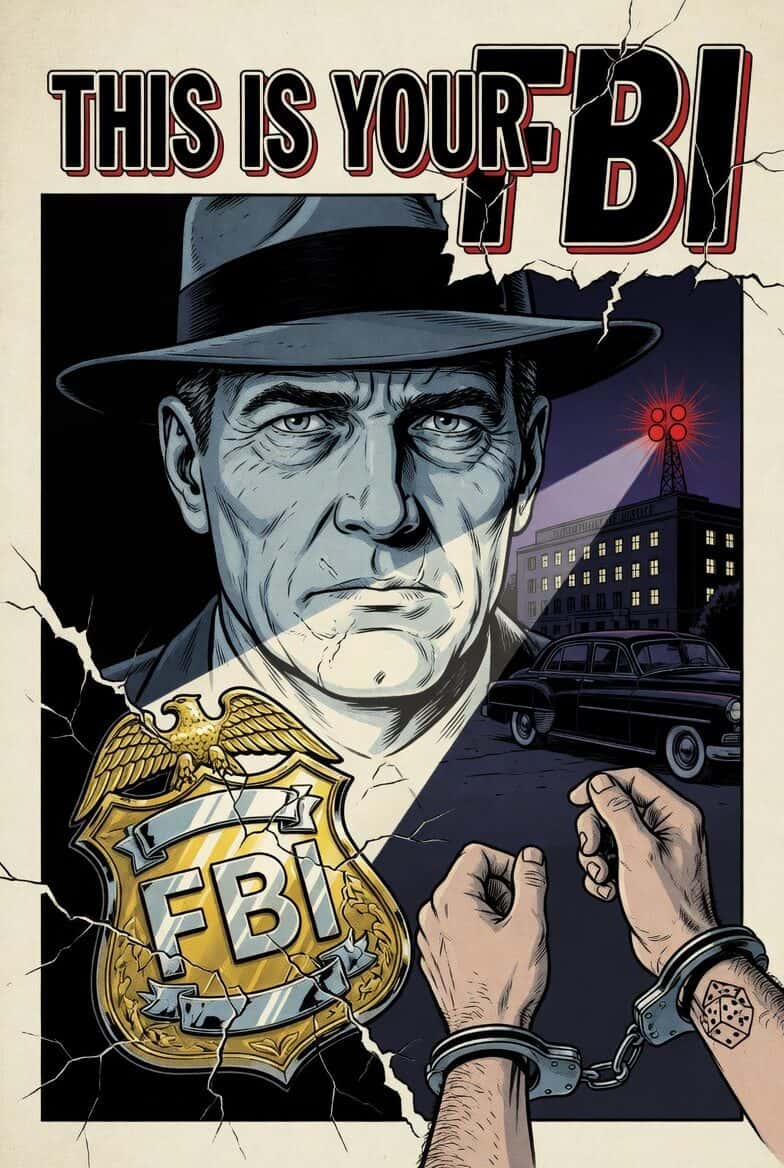
This is your FBI. This is your FBI. The official broadcast from the files of the Federal Bureau of Investigation. Tonight, the subject of our FBI file, Kidnapping. It's titled, The Payoff. Styles change in crime just as they do in automobiles or clothes. Less than 20 years ago, it was estimated that there were 3,000 kidnappings a year. or more than eight every day. Today, there are comparatively few. That happy situation has not come about because criminals became tired of collecting ransom. It was the direct result of two things. The first was the federal kidnapping law passed by Congress in the early 30s, which gave your FBI jurisdiction over any kidnapping in which the victim was transported across a state line. The second reason for the decrease in kidnappings is a man.
His name is J. Edgar Hoover. He is the one who realized that crime was being put on a business basis, and he determined to put law enforcement on that standard. Tonight's case is an illustration of how your FBI moves into action on one of the rare occasions that a kidnapping does occur. Tonight's FBI file opens outside the entrance of a suburban roadhouse a few miles from a large Midwestern city. It is early evening as a well-dressed middle-aged couple leave the roadhouse and start walking through the parking lot toward their car. Oh, Floyd, that was a wonderful evening. Yes, I enjoyed it myself. You know, we ought to go out like this more often. That's what we always say, Grace. Delmore! Delmore! Who's that? I don't know. Are you Miss Delmore? Yes. Phone call for you. For me? Oh, maybe it's one of the children. They said it was important. You know who's calling? No, sir.
Uh, Grace, you go to the car. I'll be right back. All right, dear. Sorry, I didn't find out who it was. Probably it was one of our children. Mrs. Elmore watched her husband start back toward the roadhouse with the young man in the messenger's uniform, then turned and went to the car. What she didn't see, what she didn't find out until later, was that her husband had been kidnapped. Later that night, at the local FBI field office... Special Agents Taylor and Nelson report to Agent in Charge Marshall. You sent for us, sir? Yes. Got a report a man named Floyd Elmore has been kidnapped. When? About an hour ago. Elmore and his wife had dinner at a roadhouse called The Grove. When they left and started through the parking lot to their car, a man in a messenger bellhop uniform ran up, told Mr. Elmore there was a phone call for him. He went back to get it. That was the last his wife saw of him. He didn't return to the roadhouse? No. Did anyone there know about this messenger? No.
Has anyone contacted Mrs. Elmore, sir? Yes, she's already received a phone call saying her husband had been kidnapped, telling her to wait for further instruction. I see. Have we got a description of this pseudo-messenger? Just what Mrs. Elmore remembered. Dark, curly-haired, chubby, thin pencil mustache. How about a picture of the victim? Oh, I have one here. Elmore has a bad heart condition. Unless he gets medical treatment at least once a week, he's in danger. That's not much margin for error. Now, Nelson, I want you to go over to the journal. Look through any clippings they might have on Elmore. He had some prominence as a real estate broker. Local? Yes. Then first thing in the morning, start checking his background, his friends, enemies, everything about him. Want me to work on that with Bill, sir? No, Taylor. You report immediately to Elmore's apartment with another agent. Stay there till the kidnapper makes a contact. Apartment building's a large one. You can go in safely without causing any suspicion. Mr. Taylor. Yes, ma'am? When will we hear something? Well, Mrs. Elmore, in a case like this, we can only wait.
This is terrible. Terrible. Hello, Jim. Hello. Hello, Bill. Mrs. Elmore, this is Agent Nelson. How do you do, Mrs. Elmore? Have you found my husband? No, ma'am. Mrs. Elmore, you really should try to get some rest. Won't you, please? Well, I'll try, but it's no good. I can't, please. If we get any word, we'll call you. Thank you, Mr. Taylor. You're welcome. Well, Jim, I've really combed Elmore's background. Doesn't seem to have a single enemy. How about his business? Everybody who works for him or with him seems to be genuinely fond of the old man. Get any idea of his financial condition? I'd put him in the well-fixed class. Not rich, but comfortable. He's always had a good reputation. Any indication it was an inside job? Well, almost no one knew the Elmores were going to the Grove last night except close friends and their two daughters. Where are the daughters? They're both married and living in California. How do they know about the Grove? The Elmores go there every anniversary. Mr. Taylor.
This letter just came. Our regular postman delivered it. May I see it, please? Yes, here. Thank you. It's from the kidnapper. What does it say? Your husband's safe. Kidnapper wants $20,000. What's the postmark? Mail last night at River Falls. $20,000. That's right, ma'am. Bill, let's get this note to the lab, see if they can lift any fingerprints. The investigation on the kidnapping really moves into action with the arrival of the ransom note. And this case followed the pattern. Mrs. Elmore managed to raise the necessary $20,000. A few fingerprints were found on the note. Two belonged to the victim, Floyd Elmore. The others could not be identified. They were put on file. Now there was another delay. The first note told only how much ransom the kidnapper wanted. There were no instructions on how delivery was to be made. A day passed. Two days.
Bill, we've gotten a second note. Does it contain instructions? Yeah, the kidnapper wants Mrs. Elmore to put an ad in the paper telling him how much money she could get together. What's the code? It's to be an ad for a used car. Dictated, Jim. I'll write it out. Okay. 1930 Buick, sedan, for sale or trade, $100. $100? Yeah, he instructed Mrs. Elmore to make the price of the car 1% of the amount that she had raised. Any signature on the ad? Not yet. We'll have to go to the vocation file first. What for? Well, among the instructions was this paragraph. Hire a motorcycle rider for a dangerous assignment. He'll deliver the money after I've decided you really mean to redeem your husband. I rode a cycle all through college. You did? That's great. Anything going into the ad about the rider? Well, put down your name and home address. Right. All right, what do we got? 1930 Buick sedan for sailor trade.
$100. Jim, shouldn't that be $200? He asked for $20,000. The SAC advised Mrs. Elmore to offer $10,000. Then if he doubles it, why, she's still got enough. Yeah, and that's it, except for my name and address. Okay. I'll call Mrs. Elmore now and have her insert it in tomorrow's papers. A kidnapping investigation cannot be hurried because it is FBI policy to advise that all demands made by a kidnapper be met until the victim is returned safely. In this case... The ad was inserted in the following day's papers. Then came another wait. The possibility rose that the kidnapper had missed seeing the ad, or that he was dissatisfied with the offer and had broken off negotiations. Patience was the only course. The next move would have to be the kidnapper's. Finally, three days later, he made it. He sent another note. Send for me, Mr. Marshall? Yes, Taylor. You got any lab report on that last note? Yes, sir. It just came.
The same fingerprints were found on this as on the other two. Including Elmore's? Yes, sir. Well, he's still alive. Well, this last note was typed, and from the lab report, we know a little more about the kidnapper. Well, what's that? Well, there were no erasures or errors, so he's a skilled typist. In addition to that, the language of all three notes shows that he has at least a fair education. The labs say what kind of machine the note was typed on? I don't have a note on that, sir. It's a Grody noise-free portable. It's a new model. It was put on the market just about, oh, two months ago. Well, where's Mrs. Elmore now? She's at home. Get an artist and go over there. Have him draw a picture of the kidnapper from her description. All right, sir. And have copies made. We'll cover all the typewriter shops in the city. In a large city, there are hundreds upon hundreds of stores that sell typewriters. Each outlet was called on. Each employee shown a vague likeness of the kidnapper. 150 special agents blanketed the city. And finally, the right store was found.
A sales clerk remembered the man. He'd paid cash. The clerk didn't know the man's name or address. He did remember waiting on him a few other times. That meant the kidnapper could have lived somewhere in the neighborhood. A circle with a one-mile radius from the typewriter shop was drawn on a map of the city, and your FBI began a discreet house-to-house canvas contacting the owners and janitors. The weather's as bad as our luck. Yeah. Well, let's hope one of them improves, huh? Oh, good afternoon, ma'am. Come in. Come in before you catch your death of cold. What a day. What a day. Ma'am, we're special agents of the FBI. Here are my credentials. I didn't have to see them to know you were fine young men. It'll be a pleasure having you in the house. Now, now, come right along and I'll show you the rooms. Ma'am, we're not looking for rooms.
Well, then, why would you be coming here? We thought you might help us find somewhere. Would you please look at this picture? You say you're looking for Mr. West? You know him? His name is Harry West. Whatever would you want with him? I'd like to ask him some questions. Does Mr. West live here? He used to. He moved out last Sunday. Do you know where he went? Now that I don't. I guess maybe he went someplace quiet. He was always squabbling with Mr. King in the next room, not to make so much noise. Tell me, ma'am, did Mr. West own a typewriter? Yeah, a new one. One day I went in to tidy his room, and he was riding away on that machine faster than a person could think. I say, ma'am, have you rented his room yet? No. May we see it, please? You surely may. It's room 26, second floor back. Go right up. It's open. Thank you. Come on, Bill.
An empty beer bottle was found under the bed in the room Harry West had vacated. And that was all. The bottle was sent to the laboratory. Fingerprints were found on it. Fingerprints that matched the ones on the ransom note. Now your FBI knew a name. Harry West. From there it built a more complete description. Bits and pieces were contributed by the landlady. A bartender at the corner saloon. an old lady at a newsstand. They added up to a man 5 feet 8 inches tall, about 35 years old, weighing approximately 190 pounds with blue eyes, stooped shoulders, and a harsh voice. That was as far as your FBI could go until the victim was returned. And now back to the FBI file, The Payoff.
there are some listening to this program who feel that the special agents have moved very slowly in this investigation. There is a reason for that. Your FBI strives for consistency rather than speed. It gathers every tiny shred of knowledge about the person it seeks. It hunts patiently, sometimes almost floodingly. But the important thing is it uses infinite care to protect the life of the victim. And it keeps hunting. In one kidnapping case as yet unsolved, more than 25,000 potential suspects have been cleared. That file is still under active investigation, as all unsolved crimes are. For your FBI recognizes only two reasons for closing any file. One is the capture of the criminal. The other is proof of his death. For so long as a fugitive lives, the FBI wants him.
and it keeps hunting till it finds him. Tonight's FBI file continues the following morning as Agent Taylor enters the office of Agent in Charge Marshall. Mr. Marshall, another note arrived from Harry West. You ready to accept the ransom? Yes, sir, and he's got final instructions for the payoff. Everything all set on our end? Yes, sir. The motorcycle's been painted white, and Agent Nelson will wear a white coverall, as West instructed. Good. Now, where's the payoff to be? Well, that part's indefinite. Let's see. Here it is. Nelson is to leave here at 6 o'clock tonight. He used to take Route 81 going north. He used to travel on an average of 35 miles an hour. At some point, a car will follow him and blink its lights three times. He used to drop the bag without looking back, then ride the motorcycle off the road into a ditch on the right-hand side, lay their head down for five minutes. Have you hooked up a way for Nelson to keep in touch with your car? Yes, he'll be wearing a throat mic, and he'll have earphones in his helmet. I'll cruise a few miles behind him. Did you double-check that equipment? We tried it out on the road last night, sir. It worked fine, even in the rain.
What does the note say about releasing Elmore? He's to be dropped at the side of the road exactly three miles after the money is picked up. You better take along that medicine of Elmore's. He might need some. I've already gotten a bottle of it from his doctor's. All right. Go ahead. You're coming in fine again, Jim. I must have caused an interfere. Nothing to report since we talked. I've gone an even 32 miles. You may be too close at a mile. Bring back. Face here 35. There's one just starting. How's the traffic? Very light. Jim, the car behind me. Speed up a little. Right. Base now 40. Now 45. Yeah. There go his headlights. He's blinking. That's two. There's three. I'm dropping the money bag. I'm heading for the ditch. Here I go. Money was picked up by the kidnapper, and Agent Taylor cruised the road three miles from that point, but without success.
Floyd Elmore was not released that night, or the next day, or the day following that. Oh, Mr. Taylor. Mrs. Elmore, has the last mail come? Yes, and there's no letter. Something's happened to Floyd. I know it. Now, Mrs. Elmore, I explained the FBI policy in kidnapping to you last week. We feel your husband's safety comes before catching the kidnapper. But where is he? What have they done to him? We don't know, ma'am. Kidnapper has the ransom money. He had to have been the one who picked it up. No one else knew the code. What can we do? Ma'am, we'd like your permission to send every bank the list of serial numbers on the ransom bills. Yes, do it. Fine. I'll call you the minute we hear anything. Sending out a list of serial numbers and getting reports that ransom money has turned up doesn't always go hand in hand. A hundred thousand copies of the list went to banks, police departments, Railroad ticket offices, airline terminals, steamship agencies, newspapers, radio stations. But not a single bill turned up. Three days later, there was a new development. Bill, get ready to ride again. Ride where, Jim? Destination unknown. Mrs. Elmore just got another ransom note, and this one asked for $10,000. He's not claiming he didn't get the bag, is he? Oh, no.
No, he admits picking up the $10,000. He says he wants another $10,000, though, or no Elmore. You told the SAC about it? Yeah, he's willing to do whatever Mrs. Elmore wants. She's got the money ready, hasn't she? Yeah. Tough thing to advise her on. Well, the kidnapper says he'll furnish proof that Elmore is still alive and healthy. How? Well, he doesn't explain that part. He merely promises that the day after Mrs. Elmore puts another ad in the paper, she'll get her proof in the mail. Not much market for his promises. I'll admit that, but... She's got no choice, Bill. The same code to be used in the ad? No code at all. We repeat the ad that she inserted last time. I see. So let's call the garage and have them get the motorcycle ready again. Mrs. Elmore's putting the ad in the morning paper, so we might be taking another ride tomorrow night. This time, the kidnapper kept his promise. After the appearance of the ad, Mrs. Elmore received another note. The instructions were that the payoff was to be made in the same way.
at a time to be specified by the kidnapper. By way of proof that Elmore was still alive,