
The written record
Read the transcript
Read along with the recording · About 23 min to read
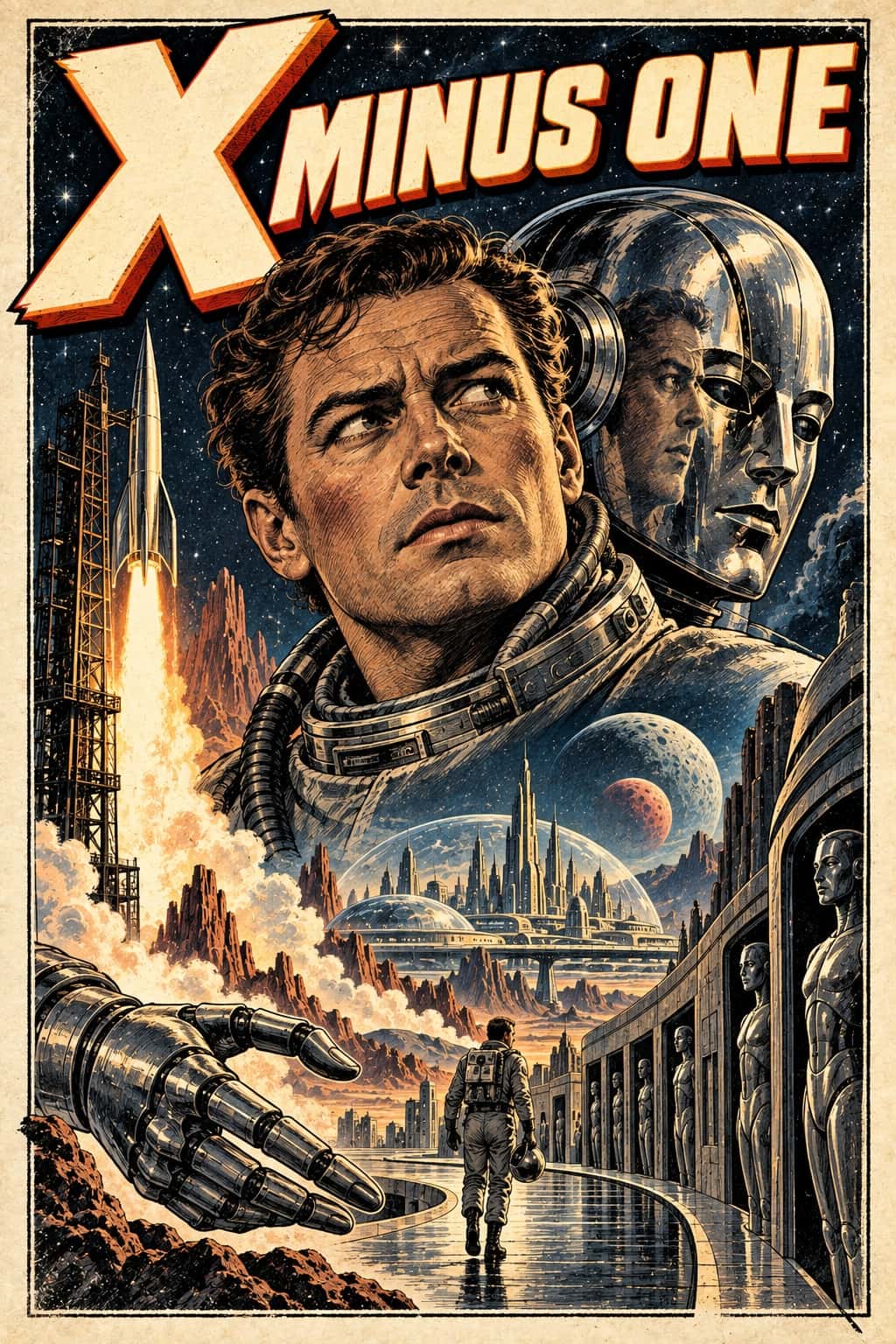
Countdown for blastoff. X minus 5, 4, 3, 2, X minus 1, fire. From the far horizons of the unknown come transcribed tales of new dimensions in time and space. These are stories of the future. Adventures in which you'll live in a million could be years on a thousand maybe worlds. The National Broadcasting Company in cooperation with Galaxy Science Fiction Magazine. presents X-1. Tonight's story, Pictures Don't Lie, by Catherine McLean. I had been writing science stories for the Times for a few years before the whole business of the aliens came up. I got on to doing science because I wasn't a very good sports writer, and the Guild made it clear to the manager that I had enough seniority to make it tough to fire me. So, when Masters went over to Life magazine, I was shoved into his spot. Now, Being the man from the Times on any given story is quite a responsibility. It's not quite as awe-inspiring as the London Times. You remember the butler announcing there were several reporters and a gentleman from the Times? But we're supposed to look as if we didn't specialize in axe murders and picking winners at Jamaica. Of course, it pays off. You find scientists, atomic energy commissioners, even congressmen will open up to the Times man. And that's how I got on the inside of this whole business.
I had met Joseph Nathan at a convention in the Atlantic City, and when he invited me to look over this work, I accepted. I don't think there's anything classified in this work, Mr. Schwartz, as long as I don't actually supply you the text of messages. I got a department clearance up to most confidential. That should do it. Hello, Max. Hi. You see, my job is radio decoder in the department here. Under the Pentagon directly? Department of Military Intelligence. Uh-huh. I use a directional pickup to tune in on foreign bands, record any scrambled or coded messages I hear. I thought the code department was handled under CIA. Well, I guess there is some duplication. Actually, though, I concentrate on the scrambled messages. Let's see. Here, I can show you. Come over here. Look out to the table. Anybody want coffee? I've got a piece of tape here. This is a typical scrambled broadcast. It's not military. It's a commercial message.
Wait a minute till I thread up the machine. Sure. You know the basic principles. You take a straight voice message, run it through on an electronic scramble circuit. It may come out something like this. My job is to pick a thing like that out of the air, analyze the patterns, and wire an unscrambler. I've got this particular pattern set up on the machine, you see. Code 7, estimated time of arrival at Galveston 30. You see? Now, that was just a commercial message. I do the same thing with military intelligence. Is it something like old-fashioned cryptology? Well, yes, except there's a small complication. You need a degree in advanced electronics, waveform math with a touch of quantum physics. I suppose it's quite challenging, then, every time you pick up a new signal. In a way. Actually, they do the same work in every country these days.
Everybody knows it's just a matter of time before any scrambled pattern is broken. It's pretty routine. Ever pick up anything exciting? Well, actually, most of the messages, when I unscramble them, are still in prearranged code and I have to turn them over to cryptology. It's something like copying Jabberwocky 500 times by longhand. Well, there is something interesting here. Listen to this piece of tape. I don't hear anything. Well, that was it. Oh? Now listen, there's another one coming up. That's it. Well, I get that on my car radio, static. Yes, but that's from the stars. You mean radio interference? That's right. I think you wrote about the work at Bell Telephone and RCA Labs about radio telescopy mapping the star positions by static. Hmm. You're interested in that? Not exactly. They've never been able to figure out why the static on these particular bands comes in such jagged bursts.
Just doesn't seem natural. You have any ideas? Oh, I don't know. I've been kicking around the notion that it's not a natural phenomenon. I've been trying to discard it, sort of like playing chess against yourself on the train in the morning. Well, that's about all there is. That's all it was then. Joe Nathan swindling a few parts in a little government time to ride a hobby horse of his. I wrote up his job for the Sunday magazine section. It got squeezed out for an article by a famous actress. on the ten leading roles I disliked the most. So I forgot about it, went back to announcing a miracle drug per week and conflicting theories of psychoanalysis. I don't know what I'd do without them. They're always good for a piece. I was at the office late one night. I didn't have any work, but I just didn't feel like going home and putting the kids to bed. Schwartz. Mr. Schwartz? That's right. This is Joseph Nathan. Do you remember? Yeah, sure. How are you?
Mr. Schwartz, can you come out to my lab? You mean Riverhead? Well, maybe we can make an appointment. As a matter of fact, I have to be out on Long Island next week. No, I mean tonight. Oh? What is it? I think I've found something that you might be interested in. Yes? You know those static bursts I reported? The ones that came from the stars? I've decoded them. When you write science for the Times, you don't often go dashing off on the trail of scoops, as in TV versions of newspaper life. But it was about a quarter to twelve as I drove out along the Montauk Highway, listening to Tex and Jinx on the radio to keep from piling up the car against the tree. Radio who keeps me awake. Nathan was waiting for me at the gate, and he had quite an argument to get me in past the MPs. We were challenged four times before we got to his lab. I'm glad you came, Mr. Schwartz. Oh, it's a nice night for a drive. I know, I know, but frankly, I wanted to ask you what I should do. You see, I requisitioned the supplies without authorization.
And I don't know how to explain it to my division chief. I mean, it isn't as if I took any of the equipment home. It's all right here. But I've got to tell somebody. I just thought you might have some experience in how to handle a thing like this. Like what? Well, you remember that static recording I played you? Here, I got it set up. Oh, yeah. Yes, I remember it vividly. Now, Mr. Nathan, it's very late, and this is far out on Long Island. Now, you see, there's an old intelligence trick, speeding up on a recording till it sounds just like that, a short squawk of static, and then broadcasting it. Undergrounds use that when they don't want their transmitters located by triangulation. When you receive the broadcast, you slow it down and get your message. Oh, now, wait a minute, wait a minute. You mean that you've decoded those static bursts from the stars? Well, no, not exactly.
I mean, they're not in code. You think there's somebody out there broadcasting at us? Well, no, it's not exactly that either. Everything all right in here, Joe? It's all right, Max. Mr. Schwartz has a clearance. See you in the morning. You see, if a star has planets, inhabited planets, and there was any broadcasting between them, they'd send it on a tight beam to save power. It's the same method we used to aim radio beams at the satellite stations. You don't lose power. But you couldn't aim from planet to planet. You can't expect a beam to stay on target over such distance more than a few seconds at a time. It'd be like trying to keep a flashlight on a bouncing ball from a mile away. Yeah, yeah, I see. So they naturally compress each message into a short half-second or half-length package and send it a few hundred times in one long blast to make sure it was picked up during the instant the beam swings across the target. You see? Huh? Well, uh...
Yeah, I suppose so. Was that what those static squawks were? I think so. I've got them analyzed up to a point, and they can't possibly be random. Oh? I recorded a couple of screeches from Sagittarius section, and I concentrated the work on them. It's taken me a couple of months to find the synchronizing signals and set the scanners close enough to the right time to even get a pattern. But I'm getting close to it now. Huh? You mean you've actually picked up messages from some form of alien life out there in the stars? Yes, you see, and this raises a tremendous problem. How am I going to explain to the division chief why I made all those unauthorized parts requisitions? I convinced Mr. Nathan that his supervisor was likely to overlook about $300 worth of electronic gear when presented with the fact that Nathan had discovered life in other star systems and was close to deciphering some of their messages.
The department put him on full time and gave him an assistant. They made me swear to sit on the story by promising to give me the first break on it when it was finally released. So I kept checking with Nathan as he worked. I don't think it's a voice message. What is it, a racing wire? Are we catching late scratches from some track at the edge of the galaxy? I don't think so. It's a TV signal. Oh? There's a definite scanning pattern. I can separate out the locking poles for a picture. Yeah? The only problem is I've no way of assigning colors to the various bands. Color? What makes you think it's color? Oh, it seems as if it's got to be. You and RCA. This is the year color is here. No, look at these waveform analyses. With a band spread that wide, it rather indicates a color transmission, don't you think? Well, sure, why not? Let me know when you get the Steve Allen show. And then, of course, he did. Not the Steve Allen program, but the equivalent of it.
He called me in about four months later. Had a monitor screen set up on a bare chassis with a wide band tape unit recording everything that came in. Here, wait till I turn on the set. See, this is what I've been trying to figure out for at least a month. You see this picture? Yeah, looks like a scotch plaid. Well, we finally assigned the colors so that they seem to give a rational picture. Wait a minute, I'll clear it up. There. Oh, there it is. What is that? That's the signal from the stars. It's a picture. Some kind of distorted broadcast. That's what I said. It's a broadcast, and it's coming from somewhere out past Sagittarius. Do you want to hear the audio signal? That's their language? That's right. We're sure about that. The colors were assigned arbitrarily, of course. You see that figure there, the tall one? With the green skin? Yes. That skin may be blue or pink or gray or anything.
We don't know what their color response is. The only thing we're sure about is the various shadings of intensity and the audio channel. What is it? What's it all about? Well, we haven't decoded the language yet. There's a team from Harvard working on that. We record everything that comes in, but I think it's a lending library. A what? It's all fiction. It's plays. And there are dozens of them, all at the same time. I think they broadcast them continuously, and anybody who wants a particular play can tune it in. With a short burst method of transmission, they've got plenty of room in the spectrum. A lending library? Of course. As soon as we break the language barrier, we'll know for sure. Oh, by the way, I thought you might be interested. I've sent them back a message. Look, Nathan, when are they going to release this? When can I use it? I don't know.
In the civil service, you don't ask questions like that. Now, look, I'm a newspaper man. This is the hottest story. I thought you were from the time. I know, I know, but it's still a newspaper. What is the message you sent them? How do you do it? Well, I took a print of a film. Yeah? As a matter of fact, it was Punky Ellie's Dance of the Hours from the Disney film. You know, with the dancing hippopotamus and crocodile? I think I remember it. Well, I scanned it with the same combinations and sent it back along the same line we were receiving from. Just testing. What do you think they'll make of dancing hippopotamuses and crocodiles out past Sagittarius? Oh, I recorded a prologue and I explained what it was. I thought it would please their library to get a new record in. Look, Mr. Nathan, please, will you find out when they'll release this? Well, as a matter of fact, I do have an idea. The project supervisor said there'd be big news when we get an answer back. When? When? When? Oh, at the rate of transmission?
Only about three or four years. That's what it was. Three or four years. I forgot about Nathan for most of the time in the interim. It was one of the few stories in which nothing leaked. I have a feeling if the Pentagon realized how much I knew about it, I never would have gotten out of the laboratory at Riverhead. And so this story seems a lot more direct than it actually was. An awful lot happened in the four years before Nathan called me again, landing on the moon for one. When he did call me, he had big news. Here. Now watch this. Watch. Is that the recording of the message you sent out? I've seen that before. No, no, it isn't. That's a message we've received. They're playing it back to us. Now wait. Wait. You'll see. Now look. You see? There's an auditorium. They've been showing our message on a screen. Look at them. What are they doing? Waving their hands in circles? Well...
That might be applause, you can't tell, but that isn't the most important thing. Do you realize what the intensity of this message was on an Omicron scale? 302.8. Yes. Now, you'll see what I mean. Now, watch. Their camera, or whatever they use, pans up from the audience. Look at that wall. Hey, it looks like a ship's hold. It is. It is. It's a spaceship. That accounts for the intensity of the broadcast. We've picked up an alien spaceship, and they've gotten our message. They're approaching the solar system, and we'll be able to contact them. Joe, you know, I just don't care anymore. You've strung me along with this thing for five years, and it's no use to me. Absolutely no use. Why didn't I tell you? The Department of Defense is releasing the story to the press.
You have it today, and there'll be a general release tomorrow. And of course, you remember the story. We had it first. And any paper or TV broadcast that picked it up before the general release had to carry my byline and the Times' copyright. I think it was the most important single newspaper beat that I've ever heard of. And of course, I did very well because of it. It was page one in the upper right-hand corner of the Times for eight days running. And then the arrangements were made to cover the landing of the alien ship. The White House press secretary handled the whole thing. There'd be one pool man on the inside in direct contact with Nathan, the linguist teams, and the brass. Naturally, I got the pool assignment. There wasn't any question of it, really. But the rest of the boys were in on the releases, briefings, and press conferences. On arrival day, we were all schlepped out to the apron at White Sands Rocket Base. The concrete is graded to stand the thrust of those three-stage giants that make the satellite moon runs. But they'd added a layer of molybdenum mesh.
sprayed with some kind of plastistella in the theory that the stresses of an interstellar ship might crack White Sands rocket port like a pane of glass. The communications equipment was set up in the old red-controlled blockhouse that hadn't been used since a whack corporal missile misfired in 58. First, they threw Nathan to the wolves in a press conference. The TV boys with ultra-portables were down on their knees in the first row, and the rest of us in the base movie theater. Nathan was up on the stage. Al Sullivan from the news let it off. Mr. Nathan, what do you think of the aliens? Are they friendly? Do they look human? Very human. Exactly where will the alien ship land? Well, that isn't exactly my field, but when you get out to the port, you'll see the strip. It's like a tic-tac-toe diagram. The release describes the precautions that have been taken, except for the grass strip along the runways. The light area has been remodeled. Do you know anything about their home planet? No, nothing directly. You think they're dangerous, then?
No, I don't think so. You realize, Mr. Nathan, that the 8th Atomic Artillery Battalion has been drawn up five miles north of the port, prepared for action. Well, no, that's not my department. I don't know what precautions the military has taken. But you think they're friendly. Those I know are. I've been in contact with the radio operator of the ship. Bud says, I call him Bud, that he's worked up quite a thirst on this trip. Of course, we don't know what he drinks. We've no common chemical terminology. We haven't been able to exchange spectroscopic standards because we can't change the wavelengths accurately enough on the broadcast. We've arranged for you to see some of the recorded broadcasts we have made. When you watch them, I'd like you to realize that these are plays, all fictional. We haven't dubbed in a translation of the soundtracks, although since these were recorded, we've developed an automatic translator. You'll see that later.
All right, I think we're ready for the showing. If somebody will please dim the house lights. Of course, I'd seen the films before, but I stayed at the back of the hall to watch them again. The almost human forms, half dancing, the colors bright but strange. The sound was a flowing language with many shifts of pitch, and there was that strange, odd motion, not slow, but somehow drifting. It had been bothering me for some time, the films. There was something in the way they walked. They were good actors. Even without knowing what was happening, you were interested. You could tell the hero from the villain sometimes, and you rooted for him. Finally, I went out to the lobby, and I found Nathan pacing up and down. What's on now? That recording that they returned with the Ponchielli. It's funny, you know. They're crazy about Ponchielli and Mozart. Can't stand Gershwin. Strange. Joe!
There's something wrong with the films. What do you mean? Well, something wrong with the whole thing. It's a hunch. I felt that way with the vaccine for the common cold. Turned out to be a bust, huh? And there's something about the way they move. Well, that bothers me, too. When I turn the tape faster, they're all rushing, and you begin to wonder why their clothes don't stream behind them, why the doors don't close quickly behind them, why things fall so fast. Well, we don't have to worry about it. We'll see them in about two hours when they land. He seemed a little too cheerful. Joe Nathan wasn't like that. He was usually too serious, took things literally. But he seemed to be trying to convince himself that nothing could go wrong. It was as if he smelled a rat but held his nose and went right ahead. At minus 30 minutes, we all took our places in the blockhouse. They had a monitor set up with the automatic translator hooked up on the audio channel so the alien operator looked as if he was talking English.
but the lip movement didn't quite match, like a bad foreign film with English dialogue. There he is. He's broadcasting. Throw on the translator unit. We've decelerated enough to enter the atmosphere. We'll be landing in three time periods. Hey, Joe, what is it? A murky-looking planet you live on? What does he mean by that? He's kidding. I've been talking with him for a few weeks. He's got a sense of humor. What does he mean, murky? Can't be raining over much territory on Earth. It rained here this morning, but it's cleared up now. There he is again. See the way he holds his mouth in an O? That's their laugh. There, you can see his view screen behind him. He must be just entering the atmosphere. There goes the green light again. What's that? Oh, we're not getting this broadcast direct. That light means they've sent a concentrated squawk broadcast. We record it, slow it down, and then play it back here. Just a minute, and we'll get what he said. Here it comes. Hey, Joe, it's dark. The atmosphere is thick. You didn't tell me that.
Approaching ground level. I didn't hear any rocket jets. We should hear a landing blast, shouldn't we? I don't know. I don't know. Another message in. We've landed. We're down. Well, they can't be. They can't be. There's nothing out there. Here he is again. Listen, Joe, we're down. We're landed, but our detection field shows no buildings near. Nothing. There's tremendous gas pressure. Our hull won't take it too long. There's no light at all. Joe, you didn't describe it like this. We've got a directional fix on the broadcast now. Where is it? There, on the field. We're trying repair. We're adjusting a view screen to pick up the long waves to go through this, Merc. The engineer says there's something wrong with the steam jets. We're sending a help call to our nearest space base. Joe, get us out of here. Where are they? Where are they? There's nothing out there. Nothing. They'll have to triangulate the next broadcast again. Joe, you've got to send a rescue party somehow.
Listen, we've got a viewing screen rigged now. We're in the middle of a half circle of cliffs. Around the horizon, there is a wide, muddy lake with swimming, pulpy things attacking and eating each other on all sides. We're almost in the lake on the soft edge. The mud can't hold the ship's weight, and we're sinking. The tubes are mud-clocked. When can you reach us? They're out there, aren't they? They're out there on that airport, on the empty field. We're sinking. I was wrong. The squawk transmission, by speeding it up for better efficiency, I was wrong. What do you mean? They don't speed up their broadcasts. They live that fast. Over an hour of talk and action in one squawk? Nothing of any size could move that fast against inertia. Joe, get us out. We're sinking. We're sinking into the mud, into the lake. Get us out. You can't, can you? How?
Get them out. There isn't a lake or a river within hundreds of miles from here. The direction finders. The broadcast came from out there. From the concrete spaceport. Possibly at the edge of the runway where the grass is growing. After all, it rained this morning. Do you think we could ever find them? Maybe. With a strong enough magnifying glass.
You have just heard X-1 presented by the National Broadcasting Company in cooperation with Galaxy Science Fiction Magazine, which this month features Rattle OK by Harry Warner Jr., which demonstrates that a time machine could be very useful for handling a department store's complaints, provided you don't go too far to please a customer. Galaxy Magazine, on your newsstand today. Tonight by transcription, X-1 has brought you Pictures Don't Lie. A story from the pages of Galaxy written by Catherine McLean and adapted for radio by Ernest Canoy. Featured in the cast were Joe DeSantis as Schwartz, John Gibson as Nathan, Sam Gray as a newsman, and Dick Hamilton as the alien. Your announcer, Fred Collins. X-1 was directed by Daniel Sutter and is an NBC Radio Network production. One of the best, one of the most popular programs on radio. That's You Bet Your Life with Groucho Marx.
And here's a reminder. Now Groucho can be heard on Saturdays. And he's on at a time when every member of the family, from junior to grandpa, can join in the laughter that goes with each question and answer session. A new day, a new hour, but the very same fun and good times that have made Groucho, and you bet your life, so popular throughout the years. Have you ever met a hamburger king? Or an earthworm farmer? Or a famous beauty contest winner? Well, these are some of those who have appeared as Groucho's guests. Who will be his guest Saturday? Well, that's a secret. But you can bet your life they'll be full of fun and surprises. Have you ever heard Groucho sing his classic Captain Spaulding or throw a romantic line at a pretty girl contestant? You'll enjoy all of Groucho's unpredictable antics again this season, Saturday, the day for Groucho Marx, and you bet your life. Check your newspaper. Hear music by Ralph Flanagan and Skinny Annis on Bandstand on NBC.