
The written record
Read the transcript
Read along with the recording · About 21 min to read
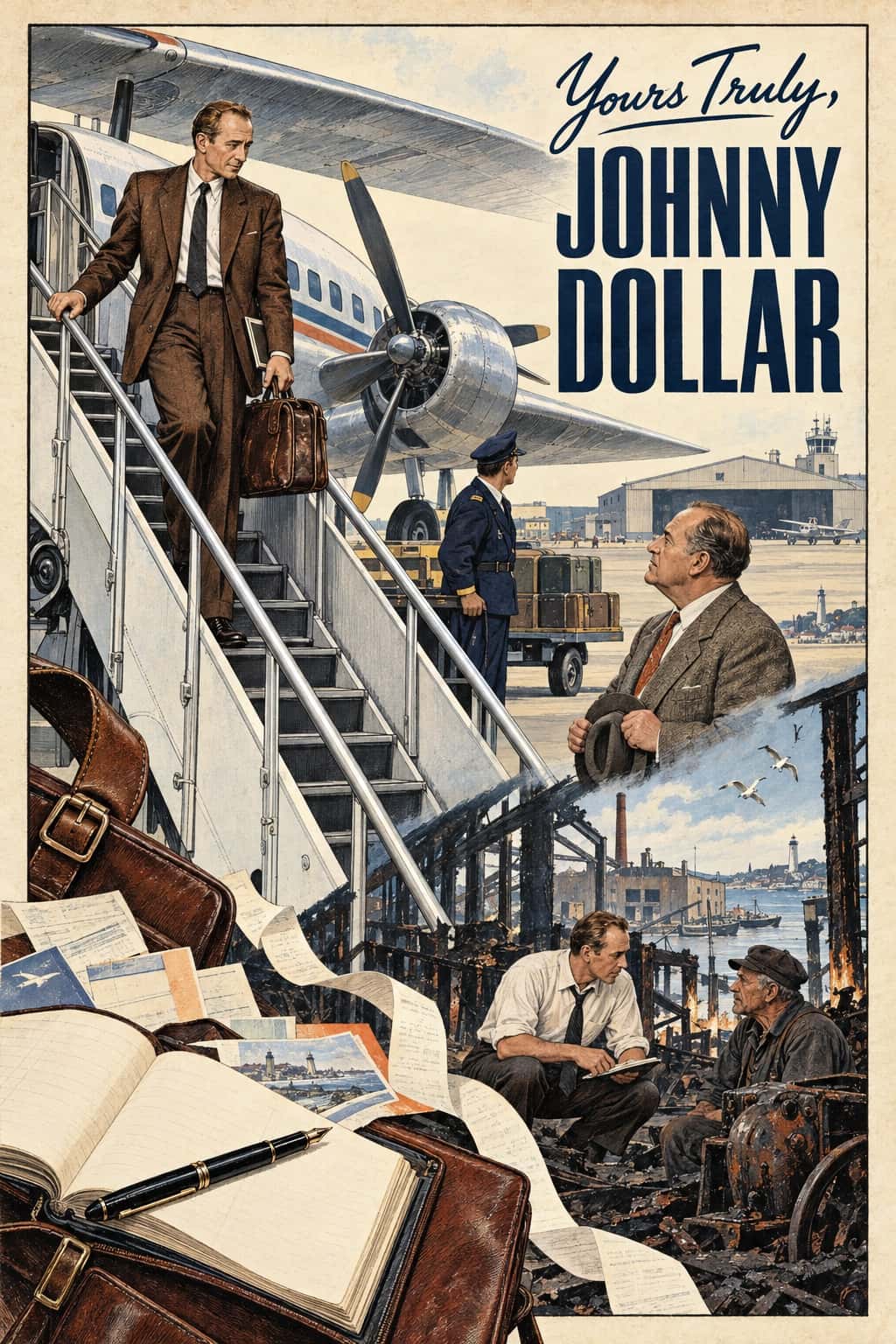
From Hollywood, it's time now for Edmund O'Brien as... Johnny Dollar. This is Edward Whiteman, Mr. Dollar. I understand that Mr. Soderberry's death brought you here. Yes, thanks for calling back. I've tried to locate the constable, Fred Remen, I believe his name is. Yes. I haven't found him, so I thought I'd talk with you. You were riding with Mr. Soderberry when he was killed, is that right? Yes, I was. I'll do everything I can to help you. As a matter of fact, I just left Constable Remen. Oh? Where is he? I'd like to see him. He thinks he's found the place from which the shots were fired. The roof of Goodwin's store. I left him there less than five minutes ago. If you'll meet me in front of your hotel, I'll show you. Thanks, Mr. Whiteman. I'll be down right away. Edmund O'Brien. In a transcribed adventure of the man with the action-packed expense account. America's fabulous freelance insurance investigator. Yours truly, Johnny Dollar. Expense account submitted by Special Investigator Johnny Dollar to Home Office Britannia Life Insurance Company, Hartford, Connecticut.
The following is an accounting of expenditures during my investigation of the Soda Berry, Maine matter. Expense account item one, $42.45, airfare, car rental, and incidentals between Hartford and Soda Berry. I, for one, had never heard of the town, but I found it a few miles from Portland, Maine. First two church spires, and then the small group of companion buildings, all set against a peaceful New England background. The first thing I noticed when I drove onto a single business street was that some bunting, a few Amer... The first thing I noticed when I drove onto its single business street was that some bunting and a few American flags were still standing, reminders of the ceremony during which its leading citizen, Gordon Soderberry, had been murdered. His personal secretary and assistant, Edward Whiteman, gave me the details after I met him in front of my hotel. The ceremony? Oh, yes, you wouldn't have noticed entering town from the east. You didn't know about the factory? No, I hadn't heard. No, Mr. Soderberry... No, Mr. Soderberry built it.
During the first year of World War II, we won some subcontracts from the shipbuilders and hoped to bring new wealth to the town. The ceremony was arranged this morning because it reopened. No, I'd hardly... could hardly have been called happy even before the tragedy. Oh? The town wasn't in favor of the factory? Definitely not. We crossed over here. These people are settled in their ways. The factory changed things. Outside, men came into work, married local girls and took them away. The farmers in the section, lost the free labor of their sons to wages and had to hire older men. I can see how it would upset a place like this. You think somebody could have been incensed enough over the reopening to have killed Mr. Soderberry? I have no idea. I thought I should mention the feeling of the town. He and I were in the first of three cars driving to the factory. We were in the rear seat. Suddenly, he stiffened. He made the sound that... I couldn't describe it. I didn't know what had happened. I don't think I heard the shots.
He slumped forward. It was all over. This is Goodwin's store. Where was the car? As closely as I can recall, it was directly in front. Straight out from here. Of course, the chauffeur stopped as soon as he realized what had happened. That'd be about up there, near the wagon. It was a limousine, I hear. That's pretty close shooting. Were the windows up or down? They were down. Open, that is. How do you get up in the roof of the store? There are stairs in the rear. Fred? Well, Constable, run! Yes? Who's that? Ed Whiteman. There's a man here who's been sent up from Connecticut to see you. Wants to ask you some questions. I have to go back to the office. All right. What can I do for you? Why did you pick this roof as the place where the shooting was done? Because Mr. Soderberry's auto was just in front. And none of the others, three or four doors either side, have stairs to them. Hmm. That's good enough.
Even resting a rifle barrel on the force front would be some pretty fancy shooting. There have been some fair riflemen in the section for a good number of years now, if you know your history. I've been proud of their shooting at some of the matches we've had, but I can't say I'm so proud now. Do you have any idea where to start? There's been a man in my mind. Ben Southern. He had a 16-year-old son killed by a bandsaw when the factory was open before. And now he's got another. Young Bill. He'll reach 16 next week.
We walked to the Sutherland house, which was only about a quarter of a mile away, and Fred Remen gave me the background of the town. The Soderberries had been in control of the town and the surrounding country for more than three generations. Always, they had been respected as thrifty, honest people, but never had they been well-liked. The death of 53-year-old Gordon Soderberry meant the last of the male lineage. The sole survivor was his sister, Beth, many years his junior. The constable didn't seem impressed when I told him that potentially she was some $60,000 richer in cash in view of Gordon's insurance policy. We crossed a bridge to reach Ben Sutherland's house and found his wife waiting for us near the front door. I know why you've come, Fred Brimman. I heard about the trouble. Mr. Sutherland wouldn't do it. He wouldn't do such a thing. Well, I didn't come to say right out that he did. Where's your husband, Mr. Sutherland? Could we talk to him? Who are you? He's Mr. Dollar. Gordon Soderberry insured his own life.
And this man is looking for the one that took it. You'll both do better to go some other place, we have questioned. We'd like to talk to your husband if you'll tell us where he is. He ain't here. And young Ben? Where is he? He ain't here either. Where did they go? We wouldn't come here if we didn't have reason to. The constable told me your husband has made threats against Gordon Soderberry because of the death of your other son. You must have known that. So now you must understand why we're here. So the lens of God fear in man and he wouldn't take the law into his own hands. You know that Fred Grimmins. He called you his friend. I'm nobody's friend now. If you're convinced he had nothing to do with the trouble, why don't you tell us where he is? Because he told me not to. I keep my husband's word. He said don't tell anybody, so I won't. Well, when did he leave? Last night. He drove his truck. I know the sound of it. And if he'd come through town, it would have woke me. So he went the other way. I know that road.
and where he'd pass through. Well, you don't leave me no doubt, Mrs. Sutherland. I'll have to put the state police after the truck. Your business, what you have to do, not mine. Don't you see you're making it worse by trying to hide the truth? Hide the truth? I'm keeping a trust, young man. And if you don't know the worth of a trust, you don't know the worth of anything. I went back with Constable Remmond to his house where he lived alone and which doubled as an office. He phoned the description and license number of Sutherland's truck to his county superiors. and with the typical disinterest higher echelons seem to maintain for lower echelon problems, they told him they wouldn't be able to take delivery of Soderberry's body until the following day. That left us with no better than a vague promise as to when we'd get such vital points as the caliber of the murder weapon, the entry angle of the fatal bullet, and the distance from which it was fired. Remen left me and went to talk with some of the townspeople, and that evening, soon after dusk, I went to the Soderberry home, hoping that his sister Beth would be in condition to receive me.
Yes? Is Miss Soderberry in? Yes, she's in. I wonder if she feels well enough to see me. Does she know who you are? Not yet. I've been hired by her brother's insurance company to look into his death. Tell her that, please. Oh, yes, of course. Won't you come in? Thank you. My name's Taft. I'm a friend of the family's. Taft? My name is Donald. How do you do? Beth is in the sitting room. I'll leave it to your judgment. That is, I hope that if you visit upset, so you won't press. I won't. All right. Beth? Yes, come in, Lawrence. Well, who was... Oh. This is Mr. Dollar. He's from the insurance company. I see. Please, sit down. Thanks. I don't believe I quite understand Mr. Dollar. Oh, of course. Then would you prefer that we talk some privacy? I'll leave that up to you, Miss Odoberry. I think Mr. Taffer stayed out of a sense of duty. No, I haven't. But at least this will give you a chance to leave for a bit, Lawrence. I'll be all right. All right, Beth. I probably should run home for a while. All right.
Thank you ever so much, Lawrence. You've been terribly helpful. I'll phone you in an hour. Good evening, Mr. Dollar. Good night, Mr. Tan. Now, Mr. Dollar, when did you arrive? About three this afternoon. Then undoubtedly you know more about this horrible thing than I do. I'm afraid it's not very much. I've been working with Constable Remen. He wants to narrow it down to one of the local men who is against the factory reopening. But from what I've learned, it refuses to be narrowed very much on that basis. Yes, I'm afraid you're quite right. My brother was not famous for making friends. I say that at the risk of sounding cold and unemotional. Emotion very seldom helps in my work. Which is veriting out the truth. I think Gordon understood what he was doing. I'm sure he did. He knew that our people detest change. They simply can't cope with it. Yet he forced it on them in 1942. You feel yourself to be apart from your people, Miss Sotheby.
Yes, but only by reason of inheritance. Change was forced upon me, too. I was much younger than my brother. I was sent to school in England, but I came back and found it quite easy to forget and settle back into this tiny world. I suppose the whole town did during the years after the factory closed. Of course it did. There was one particular man, Ben Sutherland. What do you think of him? I don't know. I suppose his name is in everyone's mind tonight. The death of his son because of the hated factory, it had a violent reaction on him. And why not? He knew his son hadn't been born to stand in front of the machine that killed him. What does he say? He can't be located. He left town last night. He took young Ben with him. I hope it isn't him. He suffered enough. What could be troubling the General? It's your dog? Yes, General Scott. He didn't alarm when you arrived, did he? I've heard from him.
Someone else's animal, perhaps. But it sort of happens. He's willing to fend for himself. He's a... By the time we got an oil lantern lit and I found the dog, he was moving silently toward the house, trailing what looked like a fractured front leg. I didn't know what to think when I told the surviving sister about it. She didn't seem frightened. But I couldn't help wondering whether her loyalty to her people wasn't misplaced and whether the killer hadn't decided to eliminate all the soda berries. from the town that bore their name. I phoned Constable Remen as soon as I got back into the house, but it was a needless call. The sound of the shots in the quiet village had aroused everyone, and those who cared seemed to know right where to come. The first to arrive was Edward Whiteman, the dead man's assistant. Less than a minute later, the constable and Lawrence taffed. After we'd made another swing around the house without turning up anything, and after we'd satisfied ourselves that Beth Soderberry was well protected, Remen and I started back to my hotel.
Tell me about Beth and these others, Whiteman and this man Taft. Which end do you want first? Whiteman. He's not a native, is he? No, he's from Bangor. Came here when Mr. Soderberry commenced to open up. He's not an old friend like Taft, then? Not hardly. Lawrence Taft was orphaned a good deal back. His folks died in the fire. Mr. Soderberry took him in, sent him to school in Brunswick. Taft helped him with the factory last time. He made a smart man out of him, but I wouldn't say a happy one. How come? Unless folks leave town and never come back, they're all mixed up. When they're twixt in between like Taft is, it ain't natural. That's pretty much what Beth told me. She and him have been sort of thick off and on. Well, I'll cut across here. You got your direction straight? Yeah. Where was Lawrence Taft this morning, Constable? You mean when the trouble broke out? That's right. With Miss Beth, most likely. Why? I guess we can check that then.
You aren't thinking he killed Mr. Soderberry, are you? I don't want anything to slip by us. You don't know us people. We pay what we owe if it takes all our life. The debt that was between them two was thicker than blood. Lawrence Taft would have killed himself before he would have killed Mr. Soderberry. You know them better than I do. That's the truth. I'll see you in the morning. I hope you sleep well. The next day, things moved along a little more according to the book. The county men arrived before noon to remove the body for autopsy. and ballistics examination, and soon after, they left a report. The county men arrived before noon to remove the body for autopsy and ballistics examination, and soon after they left, a report came in from the state police. Ben Sutherland and his truck had been spotted leaving a town five miles away. A car escorted them to Soderberry, and the constable and I were at his house when he arrived. Stop your nagging tongue. Go in the house where you're suited to be. I'll tend to your prying whenever I'm to. Yes, Ben. I was only worried how you got hurt for horrible.
From the look of your face and your clothes, Ben, you've been through one thing or another. Who might you be? My name is Dollar. I'm an insurance investigator. He's come to help me defend the laws of the state, Ben. Then it's true, Fred, that Mr. Soderberry was shot and killed. That's true. When did you hear about it, Mr. Sutherland? Those men that stopped me, they told me. They told me you wanted to talk to me about it, Fred. That's true. And I don't take to it, because we were friends. You left town the night before last, Mr. Sutherland. Where'd you go? Do I have to answer this? Stranger's questions? It'll be better if you do. That night I made up my mind what I had to do. I took young Ben away. That's my youngest son. I should have took my oldest boy. I knew I should have. But I listened to the talk about the factory and wages and such things. So I didn't take him. And that factory did. And I never got him back. And you've blamed Gordon Soderberry for it all these years. No, I've blamed myself. I knew what to do and I didn't do it. Didn't you make public threats against him? That was a coward's talk.
I talked big in front of my friends. I didn't know what else to do. I didn't kill him, Fred. Where'd you go the other night? I heard the talk start again. Young Ben talking about the factory, what the wages would buy. He'd be careful, he told me. And if he earned enough wages, he'd go to school like Lawrence Taft, crazy like his brother. And I put an axe handle to him and put him in the truck and carried him away. Where, Mr. Sutherland? He's on a farm where he belongs, up north, above Brighton. He's on a farm. We'll be safe. How far away is it? More than 20 miles. What time did you leave? After 9 o'clock. You got there before midnight, then? He slept in the truck. I left him with Alex Turner. Son of... Then you had time to drive back here before the factory... Then you had time to drive back here before the factory ceremony started. I went to Brighton. Your face is scratched and cut. Your clothes are torn. How did that happen? I fought with a man. What man? And why did you fight? I don't know what man. I don't know who. I fought because I was drunk. I went to Brighton to drink, and that's what I did.
Not for nine years has that happened. You didn't come back here last night and have to fight over dog at the Soda Berry place? I was in break. If you were, you'll probably be asked to prove it. That's where I was. And you'd better start remembering who you fought or who you were with. That's all for me, Constable. We were involved with approximately 280 people, most of whom were known to each other by sight at least. The work Constable Remen had been doing without me had alibied most of them. Practically everybody had been on the street during the start of the ceremony and at the time of the shooting.
Less than 40 were unaccounted for at 5.30 that afternoon when the county officers called in their report. The point of entry was just below the left armpit. The arm hadn't been touched. The angle of entry still made it look like the killer had fired from the roof of the store. And the murder weapon was identified as a not-too-common rifle, caliber .253,000. In an hour, the unaccounted-for citizens seemed to be trimmed down to four who owned that caliber rifle. Ben Sutherland was among them. It was close to noon the following day before the results of the test firing came back. The murder weapon wasn't among the rifles that were sent in. Well, then I did something wrong. I am no great shapes of trouble like this. It's not necessarily that we did something wrong, Constable. Maybe we just didn't do quite enough. One of those .253,000s got away from us. A man's rifle is no secret here. He's proud of it. What kind of rifle did Gordon Soderberry own? Why? The townspeople hated the factory. That's the motive we've given them.
But none of them owned the murder weapon. Not even poor Ben Sutherland with a stronger motive than anyone else. Unless he could have bought a rifle with just this in mind and kept it hidden. I don't know. We'll work on that, too. But for now, let's look at the people we've neglected. Edward Whiteman can't be involved because he was sitting next to the victim. You tell me Lawrence Taft is clear. He wouldn't ever kill Mr. Sutherberry. Then the sister. She seems to belong more to the town than to the family. She didn't approve of what her brother was doing. I can't hold a thing like that in my mind. We don't kill our kin here. There are some that have. Will you do this for me? Will you get the three of them in here and keep them for an hour? But how would I keep them? I don't know. Write up a statement for them to sign. Something about the ballistics reports. You can spend some time over them. Then ask the sister to go into detail about what she's going to do with the factory. I'll try to take less than an hour.
I ain't saying I can do it word for word, but I'll try. And if you will write that statement, I'll be obliged. I ain't so good with a pencil. It took me somewhat less than an hour, and what I found didn't make sense for a while. A rifle, well hidden beneath some torn clothes in the closet. The rifle's caliber matched that of the weapon that had killed Gordon Soderberry. I reached his home soon after his sister did. Why, yes, he's here, Mr. Dollar. How much do you know what... How much do you know what laid behind the trouble the other morning? I beg your pardon? If you know who killed your brother, you'd better clear your skirts. Two people are going to tear up any lies you tell. Mr. Dollar, if you know, please tell me. Lawrence Taft. Oh, no. No, he didn't. We... Why do you... Why do you say that? You'd better say that first line again. Oh. Oh, no. No, he didn't. Why do you say that? We've pretty much cleared our...
We've pretty much cleared the whole town of the murder. You can't do that without having something left over. Oh, but you're wrong. Lawrence wouldn't kill my brother. That's what I've been told. But would you react the same way if Edward Whiteman was dead and I told you Taft had killed him? I'm sorry, I don't... Lawrence! Lawrence, come here! I'm here. It isn't true. It isn't true, is it? I heard what you said, Mr. Diller. Reason would you have to say anything like that? I just left your house. In it, I found a rifle and some clothing that was torn by the dog last night when you evidently came back to overhear what I said to Beth. Lawrence. You didn't have any reason to kill Gordon Soderberry, did you? No. No, I didn't. But you hated Whiteman, didn't you? What reason would I... The factory, for one. You were important last time, but you were left out the other morning. Isn't that right? Always the factory. What difference did it make to you, Lawrence? Remen told me the people... Remen told me you people always paid your debts. Maybe that was it.
That an outsider came in and forced him out so he couldn't prove himself. Maybe he was afraid Whiteman would force him out of your life, too. I don't know. Lawrence, you didn't think that I... Yes. You did try to kill Edward Whiteman, didn't you? Yes. And Gordon Soderberry was killed by mistake. Yes. Lawrence, no. I didn't mean to. I know I'm weak and I'm mixed up. I don't know where I belong, but I knew he couldn't stay here. Whiteman was taking my place and I knew people were laughing at me because I failed. I did try to kill him. I thought it was for you. I didn't know until later. Later I found out. Later I found out it was Gordon. It was Gordon. I owned everything. Expense account item two, same as item one, transportation back to Hartford. Expense account total, $84.90. Remarks? None. Except that maybe the now wealthy Beth Soderberry may have been right. That anybody with generations of background...
In an insular village like that does take a gamble when he comes out. To say nothing of a half-generation Hartfordian when he goes in. Yours truly, Johnny Dollar. Yours truly, Johnny Dollar stars Edmund O'Brien in the title role and is written by Gil Dowd with music by Wilbur Hatch. Edmund O'Brien can soon be seen in the Paramount Pictures production, Warpath. Featured in tonight's cast were Robert North, Howard McNair, Virginia Gregg, Larry Thor, Sammy Hill, Herb Butterfield, and David Light. Yours truly, Johnny Dollar. Transcribed in Hollywood by Jaime Del Valle. This is Bob Lamond inviting you to join us next week at this time when Edmund O'Brien returns as... Yours truly, Johnny Dollar.