
The written record
Read the transcript
Read along with the recording · About 12 min to read
From Hollywood, it's time now for... Johnny Dollar. I slept most of the way. How's it going? Good that we've got George Foley on trial for setting fire to the building. Bad that we haven't connected him to Bennett yet. And Bennett's the guy we want. Well, once you get a conviction on Foley, you can go after Bennett. A lot of expert testimony's been thrown around here, and the jury's been sleeping through most of it. Besides that, Foley's got one of the best defensemen in the business, Jake Eggleston. Yeah, I've heard of him. He's pretty slick. Not if I can help it.
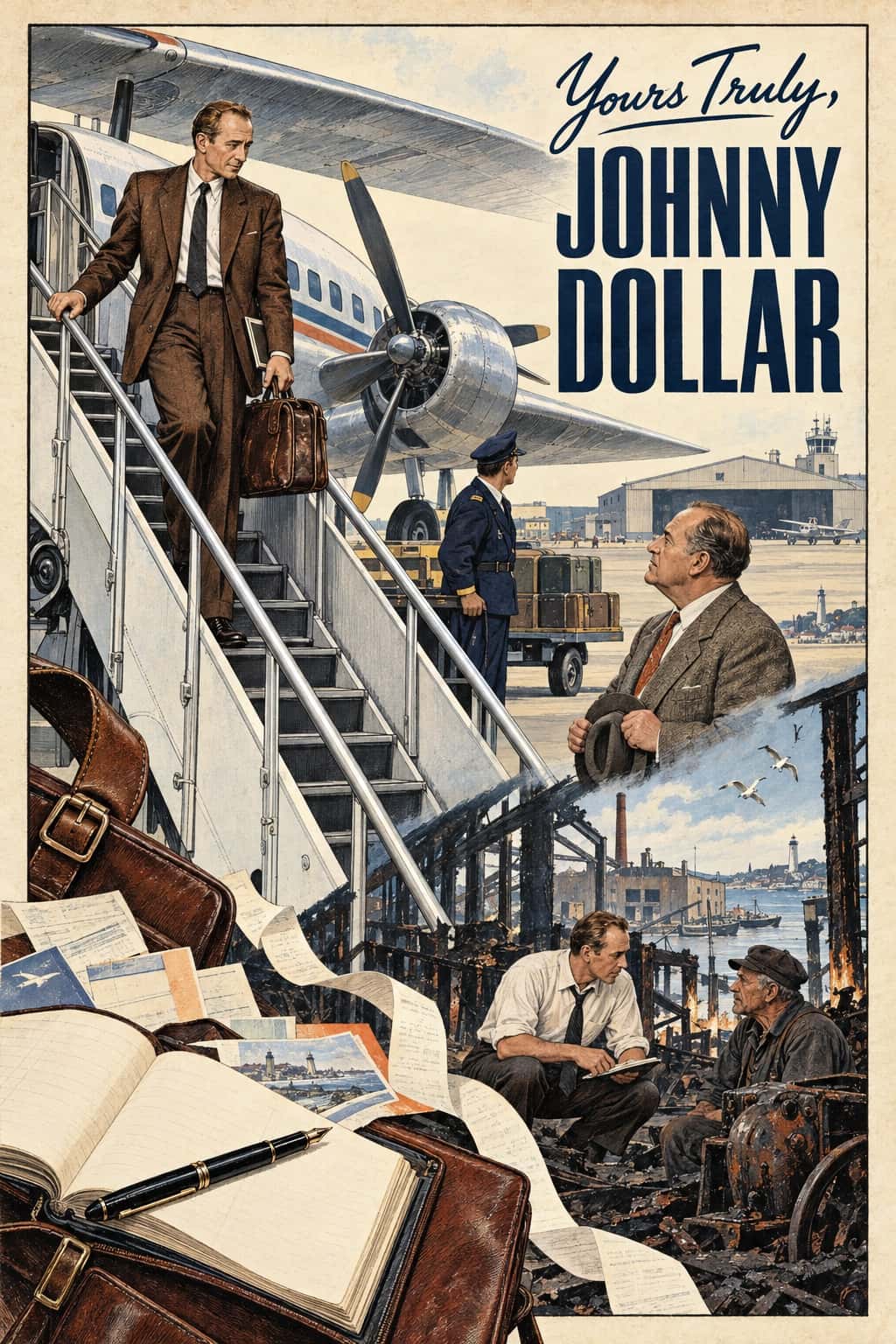
Tonight and every weekday night, Bob Bailey and the transcribed adventures of the man with the action-packed expense account, America's fabulous freelance insurance investigator... Oh, it's truly Johnny Dollar. Expense account submitted by Special Investigator Johnny Dollar to the Four State Fire Insurance Corporation, 4065 Speer Boulevard, Hartford, Connecticut. The following is an accounting of expenditures during my investigation of the Bennett matter. Expense account item 9, $124, air transportation, Hartford, back to San Francisco again. and the Bennett case, which I thought was finished with. I was at the Hall of Justice by 9.30. I met Andrew Court outside of the Superior Court. This may be the last day of the trial, gentlemen. Anything new since I talked to you on the phone, Andy? Well, I may be worrying for nothing, since Finley's handled it all pretty well for the state. He's one of the assistant DAs, but Foley's still holding on to a not-guilty plea. Well, isn't that just coaching? Oh, maybe. But you remember Foley didn't make any statement when we took him, and the police got nothing out of him at all.
Foley had something like 28 arrests besides two convictions. He knew the ropes. Yeah. Well, ice okay here? Sure. Oh, just in time. Yeah, seems to be the clerk now. Yeah. Court is now in session. His Honor, Judge William J. Bainbridge presiding. Everybody stand. Be seated. John Dollop. Hey. Oh, I didn't think they'd call you first. No. Raise your right hand. You almost swear the testimony you're about to give is the truth, the whole truth, nothing but the truth. I'll help you, God. I do. Be seated. As you know, I'm Charles Finley with the District Attorney's Office. State your name, please. Johnny Dollar. State your occupation, please. I'm an insurance investigator. How long have you been engaged in your profession as an insurance investigator? Ten years or more. Tell us, please, prior to that, what kind of work did you do? I was in the United States Marine Corps for four years.
Before that, I was Detective Sergeant Second Grade with the New York Police Department. Do you have any papers or letters in your possession that verify your professional status, Mr. Dollar? Yes, I do. I have letters of reliability from 13 insurance companies and adjustment bureaus I've been associated with, and my record as police officer. Thank you. Will the court clerk please hand these papers to counsel for the defense so he may examine them? Yes, sir. Thank you. Now, tell us what your connection with this case is, Mr. Dollar. I was employed by the Four State Fire Insurance Corporation of Hartford, Connecticut to conduct an investigation in regard to one of their policyholders. Arnold Bennett. Yes, Arnold Bennett. Will you please tell the court what the results of that investigation were? The Bennett building was destroyed by fire. I worked with arson experts from my own organization and with the police here to determine the cause of the fire. Go on, please.
At the scene of the fire, our expert, William Underwood, located certain items which we recognized as part of the paraphernalia generally used by professional arsonists. Will you please state what those items were? A scrap of celluloid and a paraffin wick. Anything else? Samples of the ashes, which were later analyzed and proved to be celluloid ashes. I wish to remind the ladies and gentlemen of the jury... that the public fire adjuster, the gentleman from the Skyline Laboratories, and the two gentlemen from the fire inspection department have previously testified as to the identity and uses of these items. Will you continue, Mr. Dollar? Well, these particular items suggested that the fire was of an incendiary origin. The next problem was to establish the exact method used in starting the fire. Were you able to determine that method? Yes, sir. In order to refresh the minds of the jury, would you mind describing what was established?
A heavy woolen wick. This one, Mr. Dollar? That one, or one like it. Exhibit C, please continue. This wick had been soaked in paraffin and then stuffed into a paper sack that was filled with celluloid. It's a simple method. The wick is lit and takes anywhere from three to ten minutes to burn down to the celluloid. Now, once that happens, the celluloid flares up and fires anything combustible in the vicinity. And that is the method you determined caused the fire in the Bennett building? Yes. And I'd like to qualify that by saying the arson experts from my own company and the gentlemen from the police and fire departments here in San Francisco determined it definitely. Mr. Dollar, by this means you connected the defendant, George Foley, with the fire you were investigating. Yes, we did. How? George Foley improvised the method I have just described. Improvised? You mean it is his method? I object, Your Honor. The prosecution is putting words into the mouth of the witness. I'll rephrase for Mr. Eggleston.
Is this method identifiable with the defendant? Yes, sir. Will you explain the identification? The police files here show that Foley has been convicted of setting two other fires in this state. On both occasions, he employed that method of firing. Your Honor, I object. The career of the defendant as a professional arsonist is a matter of public record. The defendant's previous record has no bearing on this case. I object. Mr. Dollar. Will you rephrase and delete any reference to the defendant's criminal history? The procedure in locating an arsonist is to first establish the method of operation. In this case, where the Wicks celluloid method was used, the defendant's name came up immediately. The defendant made an attempt to call on Arnold Bennett in the hospital. The defendant was positively identified by three witnesses as the man they had seen near the Bennett building prior to the fire. I remind the jury of the testimony of those witnesses. Go on, Mr. Dollar.
The police crime laboratory examined all of the clothing Foley was wearing at the time of his arrest and all of the clothing in his room. There was definite evidence that he had been in the Bennett building. Will you tell us what sort of evidence, please? Well, paint smudges on the soles of his shoes and metal filings in cuffs of his trousers, compared with samples that were still available in the building. where a certain painting and metal work had been in progress. You connected him with the improvised method of firing. You proved that paint smudges and metal filings came from the Bennett building. The defendant attempted to contact Arnold Bennett. What else? Arnold Bennett's niece, Elizabeth Bennett, informed me that her uncle, Arnold Bennett, hired the defendant to fire the building to collect insurance. I was on the stand all the rest of the morning.
When Finley ended his questioning, he turned me over to defense counsel Eggleston. Eggleston contested every bit of established testimony and recommended that my remarks be stricken from the trial records. The summations came right after that, and then the case went to the jury. Expense account item 10, $3, lunch, for Andrew Court and myself. Foley has to be convicted or we'll be on the defense when Bennett's insurance claim comes to court. And we'll probably get stuck with it. Hey, while the jury's out, why don't I go over to the jail and talk with Foley? Well, what good would that do, Johnny? Well, Foley must know. They'll give him the works if he admits something to us. He'll admit nothing. He sits there in court like they were talking about someone else. Oh, Johnny, it's too late. Yeah, but if he did, you could go ahead and file criminal charges against Bennett. Beat him to the punch. Well, I'd like that. Oh, we get Foley and we've beaten Bennett, and I like that. The job of getting to a prisoner who's standing trial isn't an easy one.
especially when he's under the surveillance of a smart defense attorney like Eggleston. I talked to Judge Brainbridge in his chambers and told him what I had in mind. I broke down the case against Foley as the insurance company saw it and a possible case against Arnold Bennett if Foley was found guilty. Judge Brainbridge arranged for me to see Foley. He was sitting on his cot. Eggleston was standing nearby. Hello, Dollar. Hello, Eggleston. Hi, what do you want? Well, I thought we ought to talk about this thing while there's still time. If it's okay with you, Mr. Eggleston. It's okay with me, Dollar. I'll be right here. Still time for what? To get you a pint of a break, Foley. Oh, that's a real good one. You sit on a witness chair all morning, you tell them what a bad boy I am, then you walk in here and tell them you want to give me a break. I do. Go away. Now, wait a minute, George. It won't hurt to listen to him. Oh, you're a great one, you. I'm the guy who's sitting in this cell. Both of you can walk out of here and have a good steak for dinner tonight. All right, George. Listen to him. This isn't a courtroom.
When you were first hauled in, Foley, you could have made a statement telling us Bennett hired you to fire that building, waived a jury trial, and thrown yourself in the mercy of the court. But you didn't do that. You made everybody work hard to give it to you. And that's exactly what they're going to do. That jury will come out pretty soon and throw the book at you. Is that true? I'm not so sure of that, Dollar. Tell us precisely why you're here. You both know my company's after Arnold Bennett. He's filed claim against us for not paying off his fire policy. Foley, we know he hired you to fire that building. Yeah? And if you're smart, you'll send for the guard and make a request for the court to come back in session before the jury returns. You can tell them Bennett hired you. You can change your plea to guilty and throw yourself at the mercy of the court. It'll probably save you five years on your sentence. And so I turn hero and make everything nice for you to go after Bennett? If you do that, his claim will be thrown out to the insurance commission and we'll prefer charges against him. And he'll be right up there with me, huh? Making little ones out of big ones. That's right.
You're overstepping your province here, Dollar. Oh, now, look, there isn't much time. Dollar, I... Only this man can advise you to wait until the jury comes in, and that won't be very long. But then it'll be too late for you to help yourself. I don't like this high-pressure stuff. I don't care what you like or dislike, Mr. Eggleston. Now, listen, Foley. They've got an eight-point case against you in there. Is he right, Eggleston? It doesn't make any difference. The jury decides... You say it saved me five years on my son. Yes. George. What do you think? Up to you, George. I've told you what I think. Ah, swell spot, swell. Oh, come on, come on, what is it? I'll risk it. You're crazy. There's a chance those 12 clunkheads will walk out and tell everybody I'm not guilty. Come on, get out. Those last five years will be pretty hard ones. Guard, guard. Thank you for the offer just the same, Dollar. You don't use your head much, Foley. If it hadn't been for you, I wouldn't be in here.
So don't worry too much about what happens to me. If it weren't for guys like you, I wouldn't be in business. And I'm not worried. Dollar? Yeah. Yeah, I hope they let me loose on this one. For your sake. Don't plan on it. On a kind of... I'd like to kill you or something. Now, here's our star to tell you about the final intriguing episode of this week's story. Tomorrow, a verdict in and out of a courtroom. The wind-up. Join us, won't you? Yours truly, Johnny Dollar. Yours truly, Johnny Dollar, starring Bob Bailey, is transcribed in Hollywood. Written by John Dawson, it is produced and directed by Jack Johnstone. Be sure to join us tomorrow night, same time and station, for the next exciting episode of Yours truly, Johnny Dollar. This is Roy Rowan speaking.