
The written record
Read the transcript
Read along with the recording · About 19 min to read
From Hollywood, it's time now for... Johnny Dollar. ...insurance trust company. Lee, my old fishing pal, you still holding down the Ohio branch of the company there in Columbus? Yes, John, I am, but now look here. Brother, I never will forget the great fishing you and I had over on Darby Creek a couple of years back. And long about this time every year the urge really gets to me. Hey, have the streams cleared up yet from the spring rains? No, quite the contrary. As a matter of fact... How about Little Raccoon Creek down there, Jackson? Boy, remember those big channel cats and the bass? Johnny...
Listen. Huh? Oh, sure, I'm all ears. The big river has gone on a rampage again. Flood. You mean the Ohio? Yeah, and every other... I see. Old towns are being watched. Destruction all over. Oh, I'm sorry, Lee. I didn't mean to sound so... Well, you know, mention fishing and I lose my head. Look, Johnny, I need you out here. Can you come right away? Well, sure. Bob Bailey in the exciting adventures of the man with the action-packed expense account. America's fabulous freelance insurance investigator. Yours truly, Johnny Dollar.
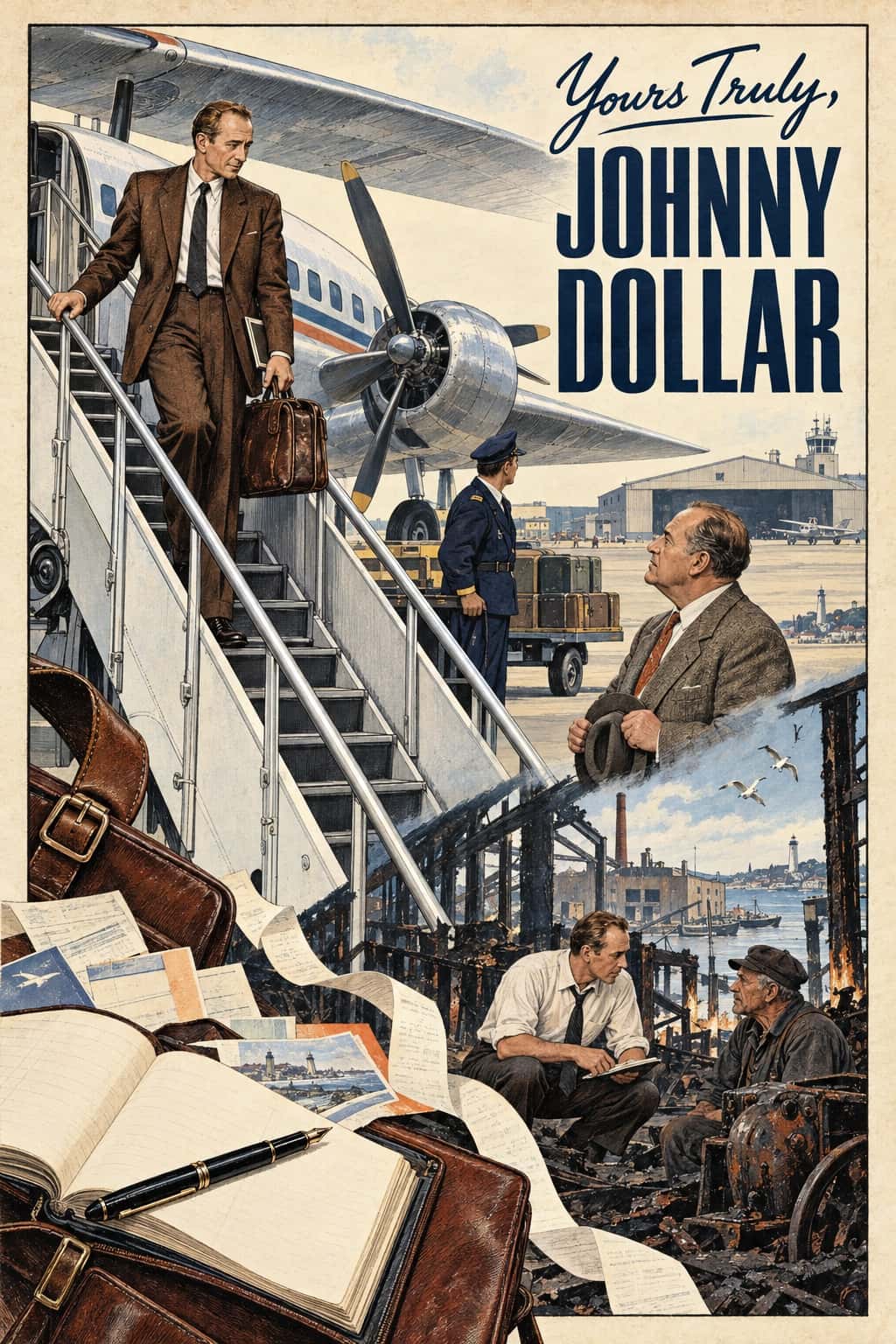
And now, act one of yours truly, Johnny Dollar. Expense account submitted by Special Investigator Johnny Dollar to the Continental Insurance and Trust Company, Columbus, Ohio office. Following is an account of expenses incurred during my investigation of the Wayward River matter. Expense account item one, $43.50 transportation to New York and a flagship to Columbus, Ohio. It was 5.30 p.m. and raining hard when the big four-engine plane set down gently at Port Columbus Airport some seven miles out of town. My plan was to go into the Fort Hayes Hotel and call Lee Harkins from there. So after picking up my luggage, I headed for the door in a taxi stand. But Lee, it seems, had other ideas. Here, let me help you with your badge. It's all right, son. I'm just looking for a taxi to... Lee! My car's right out here, Johnny. The sooner we get started, the better. Here, now. Right through this door. Yeah, well, wait. The sooner we get started, where? Where are we going? To the town of Carteret, about 100 miles or so south. Now, come on. Do you want to get soaked? Well, hey. Come on. Whatever you say. Come on, now.
Hop in. Oh, brother. Why didn't you tell me to bring a raincoat? Why don't you read the papers? Been raining like this for long? Off and on for three or four weeks. We may have a mean ride ahead of us. What's it all about, Lee? Well, the floods along the Ohio have been pretty severe this year, Johnny. They've been somewhat later than usual. Yeah, that much I did read about. Half a dozen of the big cities have been taking a real beating in spite of all their preparations for the big runoff. I know. It's been through all over the country. Though what you don't read about in the headlines, though, is the little places, like Carteret. It's my old hometown, Johnny. I've sold a lot of policies there, particularly to the local shopkeepers. You know, on their stocks and merchandise. So there's been a lot of flood damage, and your company's having to pay up a lot of claims. No, not yet. So far, the town's been lucky. Most of the recent bad storms have been across the state line, up in Pennsylvania or over in West Virginia. Same with true last year and the year before. So? So, the people down around Carteret.
Farmers, mostly, haven't gone ahead with their flood control project the way they should have. Is Carterette right on the Ohio? No, it's in a valley a few miles north. It's on the Crooked River. And parts of the town are actually below the riverbank. Now, you see what that means? Yeah, I sure can. Most of the year, it's a quiet, lazy stream about 50 or 60 feet wide. But when the feeder streams up in the hills start, pouring water down... And if it overflows? Half the town will go with it. It'll be swept right down into the Ohio. We, don't they know enough air for this sort of thing? Johnny, like I say, they've been lucky so far. This present storm has been bigger and longer than anything they've ever had. Well, what about the State Flood Control Commission, or whatever it's called? Can't they do anything? Let's face it. What's a little bird like Carteret when there are a hundred bigger and more important towns in the same fix? Yeah, I see what you mean. Before the lines went down, I got a call from Fred Norlock, one of my big accounts down there. Big hardware firm.
Unless the river goes down, he's going to lose the whole place. That means over a $100,000 insurance claim. But what can I possibly do, Lee? I don't know, Johnny. I just don't know. We were heading south on Route 23, and by the time we reached Chillicothe, the rain had led up to a drizzle. By the time we reached Jackson, where we left the main highway, it had led up entirely. But I noticed that every little stream we passed was overflowing its banks. Finally, it must have been after midnight, we pulled up on a low hill overlooking the town of Carteret. And it started to rain again. To rain hard. Below us, the crooked river was a terrible, terrifying thing to watch. Power lines were out, but maybe hundreds of kerosene and gasoline lanterns, flashlights and lights from cars showed only too plainly the perils of the brown, rushing, raging torrent that threatened the town. Men stripped of the waste, the banker and the ditch digger side by side, the farmer and the merchant, toiled frantically to reinforce the levee with bags of sand, stone, cement, anything they could find.
while the river lapped hungrily at their feet, trying to undermine the embankment as quickly as it was built up. Back in them were others, filling the sandbags, bulldozing additional strength to the levee, hauling truckloads of sand and rock and gravel, digging, shoveling, filling, anything they could do. I'd never seen a more dedicated group of people, men, women, children, all working in a common cause, not just for themselves, but for the survival of their neighbors, their town. And the ugly river was like a thing alive. pawing at them, seeking to destroy them. Huge, floating mats of debris flew by at express train speed, whirling now and then to strike out at the embankment, fighting to break it down. Thousands of tons of wreckage, parts of houses, chicken poops, trees and brush, anything that would float. I stood there appalled and almost overwhelmed by a feeling of utter helplessness. Can't they see? If they were up here on this hill, they could see.
But they're losing ground, Johnny. The river's rising faster than they can build up a levee. Yeah, Lee, it looks that way. What's the matter with you guys? Can't you see they need help down there? Anybody doesn't help, I'll be shot. He's right, Johnny. We ought to go down there and help for whatever it's worth. Wait. One section where they're all working. It's right above the cut in the ferry stream. If the levee goes there, it'll sweep the whole section down the valley into the Ohio River. But look, Lee. Look, back there. What, Highness? The reason why the water's piling up. Don't you see? That old railroad bridge.
The trees, the mud, the ruffle, it's piled up against it. That railroad trestle has become a regular dam. You're right. The more of that green piling up there, the stronger it gets. And the higher it gets, too. With the water mounting up behind it that way, the levee over Perry Street will go in a matter of minutes. Right. But break that dam somehow and the water will get through. Down the crooked river into the Ohio. Yeah. Break that dam and it'll save the town. Yes. Oh, but how, Johnny? How? Yeah. How? Act two. of yours truly, Johnny Dollar, in a moment. And now for another episode in the life of Sergeant Donald Bellwether, my husband. Reba, when are you going to serve dinner? Oh, in a few minutes, dear. Okay, I'll see you later. Wait a minute, Donald. I want you to hear my speech. You mean the safety speech for the PTA meeting? Mm-hmm. Oh, come on. Do I have to? You want dinner? Blackmailer.
Okay, where do you want me to sit, on the sofa? No, no, no, in the dining room. I've got to practice projecting my voice. Projecting your voice? Are you kidding? How's this? Oh, that's fine. Okay, now, after the president introduces me, I'll say, Madam Chairlady, parents, visitors. According to the National Safety Council, last year in the United States, 4,450 youngsters under 15 years were killed in traffic accidents. How many? Oh, please, Donald, don't interrupt. 4,450. Oh, that's an awful lot. Yes, dear, it is. Well, then I go on to say, ladies and gentlemen, how can we help prevent traffic accidents from killing and maiming our youngsters? We must remember that children will act like children. Therefore, when we drive by schools, playgrounds, and the neighborhoods where children are playing, we must act like mature adults.
and be on the sharp lookout for that sudden ball bouncing across the street with a little child running after. That's very good, honey. As soon as children are old enough to understand, it is up to us, the parents, to instill in their minds the dangers of playing near traffic. Children must be taught to obey all safety rules and safety patrols, to board and alight from the school bus without horseplay. And above all, we adults should obey all safety rules. because children mimic their parents. Honey, you act and talk just like a professional speaker. Well, thanks. You know, you're really good. I'm proud of you. Oh, that's my Donald. That's my doll. And now, act two of yours truly, Johnny Dollar and the Wayward River Matter. From our vantage point on the hill above the little town of Carteret, we could see why the Crooked River was rising so fast, threatening to engulf the town. You're right, Johnny.
The debris against the old railroad trestle has made a dam. And somehow we've got to break that dam. But how? Lee. Yeah? Any stores down there, any of them carry dynamite? Yeah, down there on Perry Street. Norlock Supply Company. Then come on. Norlock, one of my biggest clients. If the levee breaks, his place will take the brunt of the flood. Yeah, you see down there? He has men putting sandbags around. They won't mean a thing if the levee goes. Why doesn't he send those men back on up to the river's edge where they can do some good? Johnny, he's the only man in town looking after his personal property. The only one selfish enough to... Listen, he's also the man who's always opposed doing something about this river. Save your breath, Lee. We've got to get down there and get some dynamite. The groups we passed, still vainly trying to chink up holes in the levee, all but spat on us as we passed. Because we weren't working with them, trying to save their town from the raging crooked river. Or so they thought.
Finally, we slogged our way to the Norlock supply company on Perry Street. Get him in on up to the levee where they'll do some good. It won't be if we save the town. We need dynamite. Who are you? Oh, this is Johnny Dollop. Insurance investigator? What are you doing here? Look, look, there's no time to stand around and talk. We need dynamite, a lot of it. What for? For the wreckage from up the river. It's jammed against the old railroad trestle south of town. And it's made a regular dam. That's what's backing up the water. I know, I've seen. You gonna blow that up? That's right. Now, where's the dynamite? Anybody that go out on that trestle with the pressure of the river against it, he's crazy. Any part of that gold, he'll go with it. He'll be killed. He's right, mister. Be suicide to go up there. Come on, let's have the dynamite. And you men, get up above where you can help.
Load that truck with all the bags you can, but get up there fast. My place here. What about my truck? Norlock, where's that dynamite? I won't give it to you. Oh, listen, Mr. Norlock. I refuse. It'd be suicide for you to go out on that railroad threshold. But if we don't, the whole town will go. And I tell you, I... Mr. Norlock, are you threatening to shoot me? Put that away. Johnny, wait. Let me handle this, Lee. You're crazy, Norlock. Put that gun away. All right, Norlock, it's up to you. What do you mean? Unless you give us the dynamite, I'll blast the lock off this place of yours and get it myself. Well? All right. All right. In here. But I tell you, you're mad. Oh, is Norlock mad? A victim of the panic that all too often seizes a man when the going gets tough. But he did give us the dynamite. Then, with two of his workmen, Lee Harkin and I trudged through the mud and the night loaded with cases of dynamite. Back to the old railroad trust. And when we got there, I wondered if maybe Norlock wasn't right after all.
If it wouldn't be suicide to go out on it. The pileup of debris against it was huge. Back of it, the deadly brown water swirled and Eddie throwing telegraph poles, railroad ties, huge trees pounding against it, battering at the old framework at Impressa. If only they'd strike hard enough to break it down, break the dam. Perhaps they would. By that time, the town of Cotteret would be lost. Yes, somebody had to do the job, and it looked like I'd elected myself. I'm not quite clear on what happened during that next 20 or 30 minutes. They seemed like 30 years of nightmare. But I edged my way out on that rickety framework, a fused case of dynamite under my arm. It was dark, and I had to feel my way along over planks and boards and trees that the force of the water had thrown up on the trestle. The wires leading back to the plunger that would set off the charge would catch and drag. But I knew I had to reach the first long span to make the explosive do its work. And all the while, the old bridge...
creaked and groaned and shook from the impact of the wreckage being thrown against it by the angry water. But then, finally, the job was done. And I felt my way back to the bank. Hurry, Johnny! Hurry! Yeah. Yeah, I'm coming. Everything ready here? Don't you see? The levee above, it's starting to go back over the town. There's a gap. The water's rushing. Okay, Lee, the plunger. Yes. All right. All right, then lie down. Quick, get down. There she goes.
of yours truly, Johnny Dollar, in a moment. Do you know who said, my political ideal is democracy? Everyone should be respected as an individual, but no one idolized. I am convinced that degeneracy follows every autocratic system of violence, for violence inevitably attracts moral inferiors. Time has proved that illustrious tyrants are succeeded by scoundrels. Those words were written by the great scientist Albert Einstein. Einstein saw the weaknesses of a government in which too much power was centered in too few people. A government based upon violence. Einstein saw the danger of elevating a person to so high a level that he might seize power to which he was not entitled. Such a situation is not in the American tradition. Remember the words of Albert Einstein. They are part of your American heritage. Degeneracy follows every autocratic system of violence.
And now, Act Three of yours truly, Johnny Dollar and the Wayward River Matter. The charge of dynamite on the old railroad bridge had broken the dam that the angry river had thrown up against it, had released the little town from the threat of being washed down the valley into the Ohio River. The men and women and children, spent from having struggled against the raging water throughout the night and all the day before, went quietly back to their homes and farms to rest and sleep. And nature, defeated, gave up. The rain stopped, and the skies cleared. Even the charging yellow waters of the crooked river seemed to diminish in a sort of frustration. What damage had been done to the town could wait now until the people were rested, refreshed. As Lee Harkins and I plodded wearily over to the village inn, I noticed that the streets were deserted. Yeah. Even as the long, gray fingers of dawn reached up into the sky, the town, exhausted, slept.
unmindful of the rooster in someone's backyard who sought to rouse it. Nor did we rouse the innkeeper, but picked a couple of rooms and settled down to rest our weary bones. But I couldn't sleep. Somewhere in the back of my brain, a little worry began to form to peck away at me. In all of Carteret, the night before, there'd been one man and one man only who'd ignored the common good to look after his own selfish interests. I went into Lee's room and awakened him. Johnny, later. Come on, come on. I'm so dead I can hardly go back to sleep. No, come on. Just a couple of questions, Lee. Listen to me. Oh, why don't you let me sleep? Over 100,000 insurance, you said? Yeah. A hundred and... I don't know. Well, if you ask me, that's too much for a business of any kind in a town this size. Much too much. So maybe I gave him a break on his valuation. Yeah. You know, to help sign up some of the other merchants. But 100,000 of insurance money would give him enough to live on the rest of his life.
Oh, now, look. Why don't you go back to bed, Johnny? Lee, he knew about that dam at the railroad trestle. And so far as I could see, he was the only one who did. Well, everybody else was so busy at the levee. But did he try to do anything about it? No. Instead, he went through the motions of trying to protect his property. But he knew that if that levee broke, nothing would save it. All right, all right. Chalk it up to panic. Panic, huh? He fought to keep us from getting that dynamite, the one thing that could save the town. He kept those workmen away from where they might have done some good, at the levee. He alone wanted that levee to break. But good heavens, Johnny, you... You're right. You must be... Yeah, I'm right. I'm going out to look for Mr. Fred Norlock. Yeah, but there isn't a soul out there. Everybody... Maybe. That's what I want to find out. I found Fred Norlock, alone, up on the inner bank, the riverside of the levee, where anyone down below couldn't see him. And he was working with a shovel, a crowbar.
Beside him was a pile of dynamite. I'd given him that idea. All right, Norlock, lay down that shovel. All right. The river didn't do it the way you planned last night, did it? Maybe not. Because of you, but you're not going to stop me now. Oh, now put that thing down. I'll kill you, Dollar, if you come any closer. And nobody will know because there's nobody around. I'll throw your body in the river. Nobody will ever know. Sure. Set up a small charge, enough to breach the levee. That's right. It's all ready and you can't stop it. And the river will crash through, destroy that fiending business of yours down there. And take with it the homes in the valley, the livestock, maybe even the people. Keep your hand away from that pocket. So it's you or me, huh? And if I go, the town goes too. Yes. But if I can outdraw you... This pistol is aimed at your chest. Now you walk straight ahead to the edge of the river. What? No. No. Norlock's body was never recovered. He'd lived alone. He died alone. A crooked man.
in the Crooked River. Nor was he mourned in the little town he'd tried to destroy. Expense account total, including transportation back to Hartford, $100 even. Yours truly, Johnny Dollar. Yours truly, Johnny Dollar, starring Bob Bailey, originates in Hollywood and is produced and directed by Jack Johnstone, who also wrote today's story. Heard in our cast were Chet Stratton, Frank Gerstle, Bob Bruce, and Parley Bear. Special sound patterns by Tom Henley and Bill James. Be sure to join us next week, same time and station, for another exciting story of Yours Truly, Johnny Dollar. This is Roy Rowan speaking. Yours Truly, Johnny Dollar has been a presentation of the United States Armed Forces Radio and Television Service.