
The written record
Read the transcript
Read along with the recording · About 19 min to read
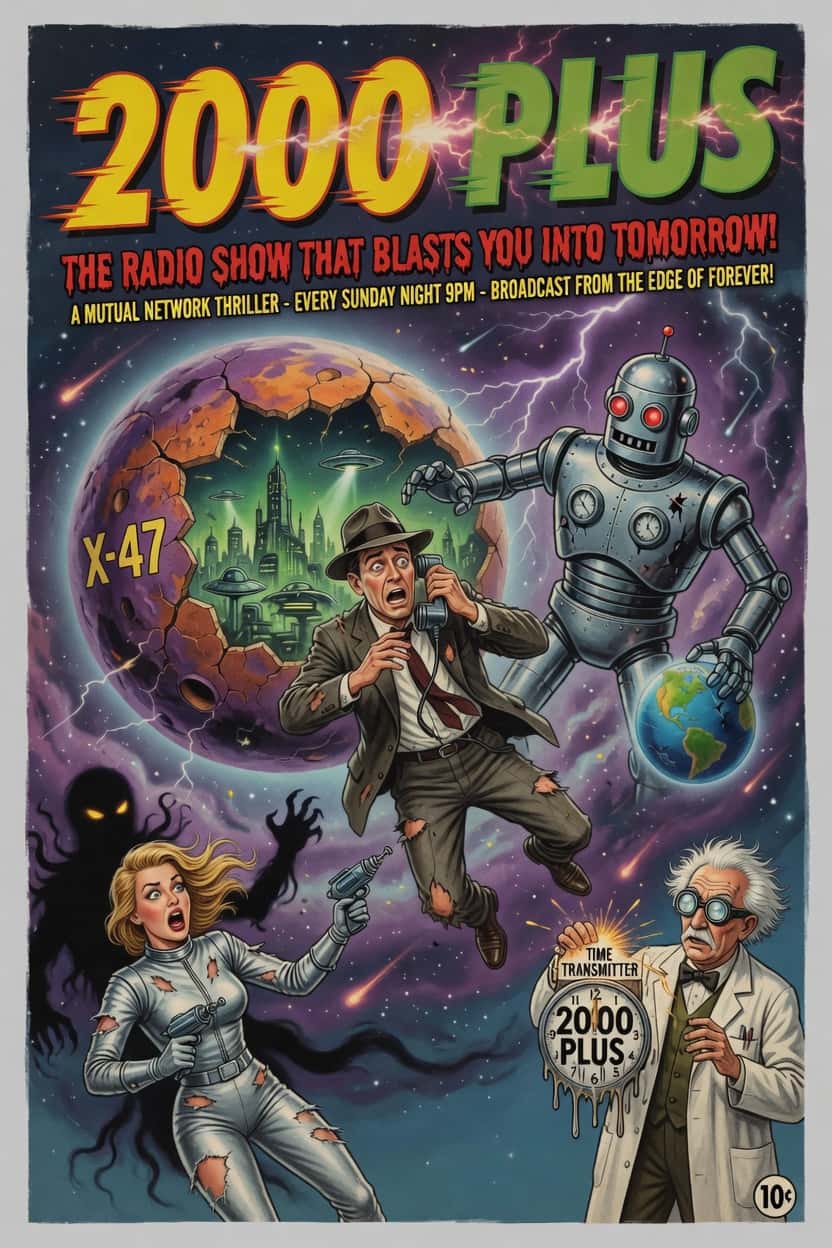
2000 Plus. Adventures in the world of tomorrow. Dramatic stories of the years beyond 2000 A.D. Today, a story of the world of 2000 Plus 60. A story called Alone.
I listened to my footsteps as I walked down the long corridor. Just my footsteps for the first time in so many months. No nurses, no doctors, no burly attendants at my side. I was walking alone. I was well.
I knew who I was, where I was, and what I was going to do. I walked past the photoelectric cell that operates the huge bronze doors. Out into the brilliant sunshine. And down the road leading toward my laboratory in the heart of Nuclear City.
I passed up the hospital limousine service. I wanted to walk, breathe in the air of freedom, to drink in the sunshine, the peace of the quiet countryside. I walked slowly because I realized that all too soon I would be engulfed by the noise and the tumult of the Earth's top research center. And finally, I reached the city proper. I started up the broad avenue lined with laboratories.
And then suddenly, something was wrong. Terribly wrong. I stopped a moment and listened. And then suddenly, something was wrong. Terribly wrong. I stopped a moment and listened. And then suddenly, something was wrong. Terribly wrong. I stopped a moment and listened. And then suddenly, something was wrong. Terribly wrong. I stopped a moment and listened. And then suddenly, something was wrong. And then suddenly, something was wrong. Terribly wrong. I stopped a moment and listened. And then suddenly, something was wrong. Terribly wrong. I stopped a moment and listened. And then suddenly, something was wrong.
Not a sound. On this avenue, normally bursting with activity, with the whine and groan of machinery and the roar and rumble of nuclear bombardment, there was nothing. Not a sound. Not a voice. Not a soul. Not a single, solitary human being.
For a moment, a wave of panic swept over me. How would you feel in my place? They had taught me well at the hospital. I fought it off in my mind. But my feet hadn't been psychoanalyzed. They began to go faster and faster, through the streets and down the alleys, looking, searching for some sign of life.
A cat.
I stumbled up the two steps and flung open the door.
Hey.
Hey, anybody here?
There was nobody in the shop.
It was empty.
Only the sound of that cat yowling in the back room.
I stepped over to the door, separating us.
All right.
All right, kitty, take it easy.
I'll let you out.
Just let me slide this bolt.
Ah, here we are.
Now, let's see what you look like.
Hey, kitty.
Kitty, where are you?
Where are you?
It was gone.
Vanished.
One moment, it was scratching furiously and yowling its fool head off.
The next, it had disappeared.
All that was left after that strange hissing noise was a small dark stain on the floor.
When something suddenly happens to your nervous system, when you find yourself with trembling fingers and a racing pulse, it's a good idea to do something physical, some familiar mechanical act.
There was a pack of cigarettes on the counter of that deserted shop, right behind the cash register.
I pounced on it eagerly, put a cigarette between my lips, took a quick puff to light it, and then drew in a deep breathful of the comforting smoke.
And then I heard it.
The sound of a motor, a big motor.
I dashed to the door, and it seemed to me that the bus must be terribly close.
But it wasn't.
It was fully two blocks away.
Only the unearthly quiet of Nuclear City made it seem so near.
I sprang to the middle of the street, waving my arms wildly, shouting with relief, Hey, driver, driver!
A bus, a 300-seater that would be bringing people, voices, news, news about this terrible silence that had fallen over Nuclear City.
It was 150 yards from me now, and my skin began to crawl.
There was something wrong.
Now it was 100 yards from me, 50, and still the juggernaut hadn't slowed down, or honked or swerved or given any indication that I was blocking its path.
At the last split second, I jumped, and then turned to watch it thunder past me, and catapulted over the pedestrian ramp and smashed into the concrete walls of the deep-space observation chamber.
The bus was a tangled mass of twisted steel and lucite.
That was all that was left of it.
And the people?
I forced my way in, threw a gaping hole in the side, and thrashed through the wreckage, looking for some survivor, straining to hear a cry, a faint moan.
There was nothing.
From the rear straight through to the driver's seat, there was not a sign of any human being, dead or alive.
It was a phantom bus.
And the passengers and driver who had sat in it when it started its journey had vanished into thin air.
I staggered away from the incredible spectacle of my senses reeling.
It would take more than a cigarette, more than a familiar mechanical act to quiet the rising terror that was beginning to grip me.
I had to find someone quickly, or my mind would give way again as it had once before.
I shook my head to clear it.
Voices.
Hallucinations.
This was one of the first signs of insanity.
I remember...
Please!
Slowly, I raised my head and looked up.
She was there, framed in the window.
A frightened woman with red hair and a desperate urgency in her voice.
You...
What's happened?
What's happened to Nuclear City?
You...
I bounded for the front door, tried the knob...
I'm coming down.
Don't go away!
I heard her fumbling with a bolt.
And at last I had found someone.
What?
Someone to talk to.
In another moment I would stand face to face with the first human being I'd seen in three hours.
The door swung open.
I caught a fleeting glimpse of red hair and then...
That soft, sibilant sound.
And after that, nothing.
No voice.
No red hair.
No woman.
Nothing.
All at once it dawned on me.
I knew now with a dreadful certainty exactly what had happened.
My mind had snapped again.
No, no, no, not snapped.
Swerved.
Swerved into that strange, rare condition doctors call Duval's Phenomena.
There were people on the street.
There were voices and sounds in the air.
But my sick mind shut them out.
Refused to acknowledge their existence.
A mind that blotted out all living things might lead to anything.
I was dangerous.
I had to get away while I still had some control of my movements.
I began to run.
Run, run, run, run, run, run.
Back to the one place where I knew I could do no harm.
Back to the safe, calm, composed climate of the psychiatric hospital.
Once more, the big bronze doors that I thought I would never see again clanged shut behind me.
And I walked slowly down the corridor with a feeling of relief as though a heavy weight had been lifted from me.
The elevator operator was not at his post, but I knew how to operate the pressure lift.
I pressed the button that would take me to my own pavilion on the 36th floor.
The therapy room where, just a few short hours ago, I had been playing a four-handed game of galaxies with my fellow patients.
I took three eager steps into the room.
And then I stopped.
For the room was empty, with a strange emptiness, as though time had stood still.
There was the table with the cards still laid out, the cigarettes still smoldering in the ash.
As I snuffed them out, I noticed the chess game in the corner.
The same game I had watched Phillips and Maxim start three hours ago.
Queen's Gambit declined.
Phillips was still a pawn ahead.
But Phillips wasn't there.
And neither was Maxim.
Where were Marquand?
And Lester?
And Randall?
And Rosen?
And Tien Chung?
And Ferrer?
I stepped out into the hall, plugged in the PA relay, and frantically tried to get someone.
Dr.
Franklin!
In all that vast space, which was the regional psychiatric hospital, in all the miles of corridors and acres of boards and pavilions, there was no one.
No one to hear my voice and acknowledge it.
I fled down to the main floor along the silent corridor and out into the open.
I jumped into the nearest vehicle, a turbojet that must have dated back to the year 2100, and made a nuclear city.
Something kept nagging at my mind, tugging at the strings of my consciousness.
But I shook it off.
I was afraid to think.
I could only keep moving, moving, moving, moving, hoping for...
I have no idea what.
In the city, nothing had changed.
I wandered through the streets slowly, searching for some sign of life, some...
I jumped at the six o'clock whistle.
In a moment, now, tens of thousands of workers should come pouring out of the tall buildings.
Shouts, cries, laughter should fill the air.
But the whistle only echoed through the empty streets, and the traffic lights clicked on and off idiotically in a mad cycle.
Red, green, cross.
Red, green, cross.
Red, green, cross. Suddenly, a sharp stab of fear knifed through me.
I thought of my laboratory, the project.
The project I'd been working on when I became ill.
The internal organs.
Organic dispersion.
A method of activating the energy within a mass, causing it to burst outward.
Something must have gone wrong.
My assistants had misread the formula and let the force get out of control.
Of course, of course, that could have done it.
I must get to the lab at once.
A burst of speed brought me to my intersection.
I leaped to the escalator onto the high-speed pedestrian ramp.
Slidewalk, the kids had called it when there were kids.
And a minute later, I was racing through the familiar twists and turns, the fission building, pushing through the doors to my own laboratory.
Panting.
I looked about.
Everything appeared to be in order.
From far below, I could hear the throbbing of the giant cyclotron and the hum of the huge electromagnetic dynamo.
The sharp smell of ozone filled the air.
I took a quick glance at the control panel.
It showed every machine, every piece of apparatus working perfectly.
There was nothing wrong, except the fact that they were working.
It was after hours and minutes.
It was after hours and minutes.
It was after hours and minutes. The machines should have been turned off.
I switched off the main controls.
And then...
A cold shiver ran down my spine.
There was a new sound.
A sound I hadn't expected to hear.
Someone was coming up the pressure lift.
The private lift leading from the cyclotron to my own laboratory.
I stood facing the cage, watching, waiting.
A man stood there.
A live man clad in the... ...usual anti-radiation suit.
I peered through the glass panel on the headpiece, and then I had to fight to keep the stereo out of my voice.
Davis!
Davis, it's you!
It's really you!
Sure, it's me, too.
How are you, John?
Welcome back.
We've missed you.
Davis, you're all right.
You're alive.
Of course I'm alive, John.
You're the one who's been sick, remember?
Davis, how long have you been down there in the cyclotron housing?
Two days.
I'm glad it's over.
Help me out of this, too.
We'll do the buckles, of course.
Yes, of course.
Of course, that explains it.
Explains what?
You were shielded when it happened.
Oh, pardon me while I...
There you are.
Thanks.
I can manage now.
What do you mean that explains it?
Explains what?
I watched him unbuckle the anti-radiation suit.
I felt I should say something.
I tried to, but nothing would come.
Finally, the suit was undone.
Davis started to step out of the suit, and finally the words came past my lips.
No, no, Davis!
Get back!
Get back into the suit!
Before my very eyes, Davis disappeared, and his anti-radiation suit crumbled to the floor.
My legs buckled, and I began to tremble all over.
I knew my hours were numbered.
No mind could stand up under repeated explosive shocks such as I had been through.
I staggered to the first aid cabinet for a plasma capsule.
As I tilted my head back to swallow the capsule, the building across the street caught my eye, and my pulses leaked.
Communications building.
Communications, Visifon, long-range tele-sonic broadcasting.
This was it.
My opportunity to establish contact with the outside world.
I dropped the glass and bottle and capsule and rushed out.
Two minutes later, I was in the main studio.
I plugged in the lines, world ascending and receiving controls to maximum range, focused the electronic visiscope camera, and switched on the power.
Nuclear City calling all stations.
Nuclear City to all stations.
Clear one.
Requires for disaster report.
Emergency.
Nuclear City calling all stations.
Please acknowledge.
I shifted the directional beam.
Nuclear City calling St.
Louis.
Omaha.
San Francisco.
Guam.
Tokyo.
Come in, St.
Louis.
Guam.
Tokyo.
Come in.
Nothing.
Not the slightest sign that there was anyone anywhere who could hear the sound of my voice or see my image.
I turned off the power.
And swung away.
With a slight movement, a tiny flash of light caught my eye.
The turntables.
The turntables that recorded every program sent out were still going.
Turning round and round and round, wearing deep, meaningless grooves in the wax platter.
I stepped over to the first table, moved the pickup arm to the start of the record, and switched on the playback control.
In another moment, I would hear the last sounds that it issued from Nuclear City's communication center.
Two days later, Rollo...
Shut up!
Shut up!
And by the next table, maybe I'll have better luck. ...pouring in from all corners, cause...
Once again, I heard it.
Recorded for posterity.
The quick, seething hiss.
And the silence.
I couldn't stand it any longer.
I suddenly went berserk.
I began smashing everything in sight.
The records.
Piles and piles of them.
The machines.
The tubes.
Everything!
Don't!
Don't hit!
You'll hurt yourself!
I hardly knew what I was doing.
For hours and hours, an explosive force had been building up inside of me.
And now it bursts loose.
Finally!
It's spent itself!
I calmed down.
And heard her voice.
That's better.
Much better.
My name is Volker.
Well, turn around.
Look at me.
No.
No, I...
I'm afraid so.
You'll vanish.
Like the others.
Not then.
I haven't vanished yet.
Turn around.
You see?
You...
You're beautiful.
Anyone would look beautiful to you now.
Anyone alive.
Anyone.
Anyone.
Anyone. Anyone. Anyone. Anyone. Anyone. Anyone. Anyone. Anyone. Anyone. Anybody.
Anyone.
Anyone!
Anyone.
Religion!
Religion!
Children! ост jinxed me!
What?
Talk to us!
I'm not going to listen to you.
I'm not talking!
I bet she won't believe...
We're all mentally ill too.
We're all mentally ill.
Well, you know what?
Women.
What of us?
It's hard to hide the Buals.
But try to block them.
Still...
How many children are in the home?
It's your ¿uh?
She's really, really ill.
Something terrible's happened to her.
Someone's died!
Uh? chance, Volta.
Come on, there's no time to lose.
Do you see anything, Volta?
No, John.
It's pitch dark out there.
No beacon.
No clusters of light.
Keep trying the audio box.
I'll see if I can pick up the landing beam.
Calling Chicago.
Calling Chicago.
Landing instructions requested.
I've got the beam.
No.
No, it's gone now.
Probably a radar reflection.
Move over quickly.
Let me try that scanner.
Chicago.
The skyscrapers.
The lakefront.
The boulevards.
What's happened to the lights?
What's happened to the airport?
It's no use, John.
It's reached here, too.
We might just as well have stayed in Nuclear City.
No, no, no, no.
We've got to go on.
We've got to find someone.
I won't believe.
I can't believe there's no one left but us.
Calling Detroit.
Calling Detroit.
Calling Detroit. Calling Detroit. Calling Detroit. Calling Detroit. Calling Detroit. John Rhodes of Nuclear City.
John Rhodes calling Detroit.
Channel 407.
Respond.
You're wasting your breath, John.
Turn back.
I'll never turn back.
John Rhodes to Harp City.
John Rhodes to Harp City.
Come in, please.
Come in, please.
Can you hear me?
Are you convinced now?
Sure, I'm convinced.
I'm convinced the stricken area is larger than I thought, but I'm not quitting.
Not quitting?
What are you doing?
Step on your safety belt and switch on the oxygen control.
I'm shifting into Nuclear.
Overdrive.
Where are we going?
The other side of the Earth.
The spaceport at Rio.
Steady now.
In less than 40 minutes now, we'll be...
What is it?
What's wrong?
I don't know.
Something's happening.
We're swerving.
We're swinging around.
Some tremendous magnetic force has caught us in its toe.
Turn back, John.
Turn back before the ship flies apart.
I can't, Walter.
I can't do anything with a plane.
She's out of control.
I lay there.
I'm looking at the clock.
I couldn't bring it into sharp focus, but I knew that the number three was slight hitch, and that when it chimed, there was distinct hesitation between the second and third note.
I knew these things because that clock was on the wall of the therapy pavilion on the 36th floor of the psychiatric hospital.
Yes, I remember the clock, but how had I gotten here?
What had happened to my plane?
Where was Walter?
Or was any of it real?
Had I ever gone down the long corridor?
Had I ever really left the hospital?
Was the awful experience I had lived through anything more than a very vivid nightmare?
And if I screamed now, would a nurse come running?
It's true, then.
Everything really happened.
I'm not dreaming.
And Walter?
What about Walter?
I've lost her, too.
There's no one left.
On earth but me.
I'll never see another face or hear another voice.
I know that now.
I will sit here in the silence and wait for the end.
Good evening, Mr.
Rhodes.
I am Dr.
Drenner.
Dr.
Drenner?
Do I know you?
No, Mr.
Rhodes.
Not yet.
But you will.
You will be in my charge from now on.
You've been very ill, and you're going on a little journey.
Here, take this capsule.
Take it, Mr.
Rhodes.
The trip you're about to make is long and difficult.
I'll look in again presently.
Dr.
Drenner?
You took it, Walter?
Yes, I believe we chose wisely.
John Rhodes is the greatest nuclear physicist on earth.
He will be of inestimable value to us and our people.
I think our work here is about finished, Doctor.
The final reports have just come in.
The molecular diffusion cloud worked perfectly.
And according to plan.
Those who are not directly affected by the cloud itself were disintegrated by contact with the cloud.
The cloud itself was disintegrated by contact with the cloud itself.
The cloud itself was disintegrated by contact with the cloud itself.
Some died immediately.
Some seemed to have a temporary immunity.
Like that woman, Nina, who called to Rhodes from the window.
Poor man.
Even though we protected him from the disintegration mist, he apparently was still capable of killing others.
But now the chain reaction is complete.
There's not a living human being left on earth, except Rhodes.
Perhaps it was wrong, Dr.
Drenner, to destroy these humans.
Wrong?
They were different from what I had expected.
As I guarded John Rhodes, I found him kind.
And intelligent and courageous.
Now I'm beginning to think the whole experiment is cruel.
I do not understand you, Volta.
You're familiar with the history of the planet Earth from the very first pages of recorded time.
These Earth men have bent every effort to kill each other off.
To create new and more efficient weapons of death.
We merely fulfilled their destiny.
But we did it mercifully.
The new inhabitants we bring here will be kind, as we are.
I suppose you're right.
Well, here are my notes.
On the six hours I spent observing John Rhodes' psychological reactions, you will find them very illuminating.
And now, what do we do with him?
This last human being left on earth?
What's the plan from the beginning, Volta?
You may notify our spaceship anchored beyond the magnetic field to send a tender for us.
Yes, Dr.
Drenner.
We and our specially selected earth specimen are ready for the long journey home.
Home to Mars.
2000 Plus is produced by Dreyer and Winn-Olson Productions, Inc. It's a nice cast. Ralph Bell played John Rhodes. Joan Shea was Volta. Nat Polin was Dr. Drenner. And Carl Eastman was Davis.
The script was written by Judith and David Buckley. The orchestra was conducted by Emerson Buckley. Music composed by Elliot Jacobi. Sound, Walt Shaver and Adrian Tenner. Engineer, Bob Albrecht.
This has been 2000 Plus. Excitingly dramatic stories of the future. These are events that you will never witness. Adventures into the world of tomorrow. Tune in again next week at this same time for another thrilling story. This is the United States Armed Forces Radio Service.