
The written record
Read the transcript
Read along with the recording · About 23 min to read
21st Precinct, Sergeant. Inspector who? Oh, yes, Inspector. The detail is assembling here. I don't know, sir. Lieutenant King of the 21st Squad is in charge.
You're in the muster room at the 21st Precinct. The nerves suffer. An important case is about to break. Superior officers have been notified. They're assembling from their homes, from social functions, from all over the city. You will follow the action taken pursuant to these notifications from this minute until the final report is written in the 124 room at the 21st Precinct.
Yes, sir. The brass has all been notified. They could start out any time.
Yes, sir. Any time now.
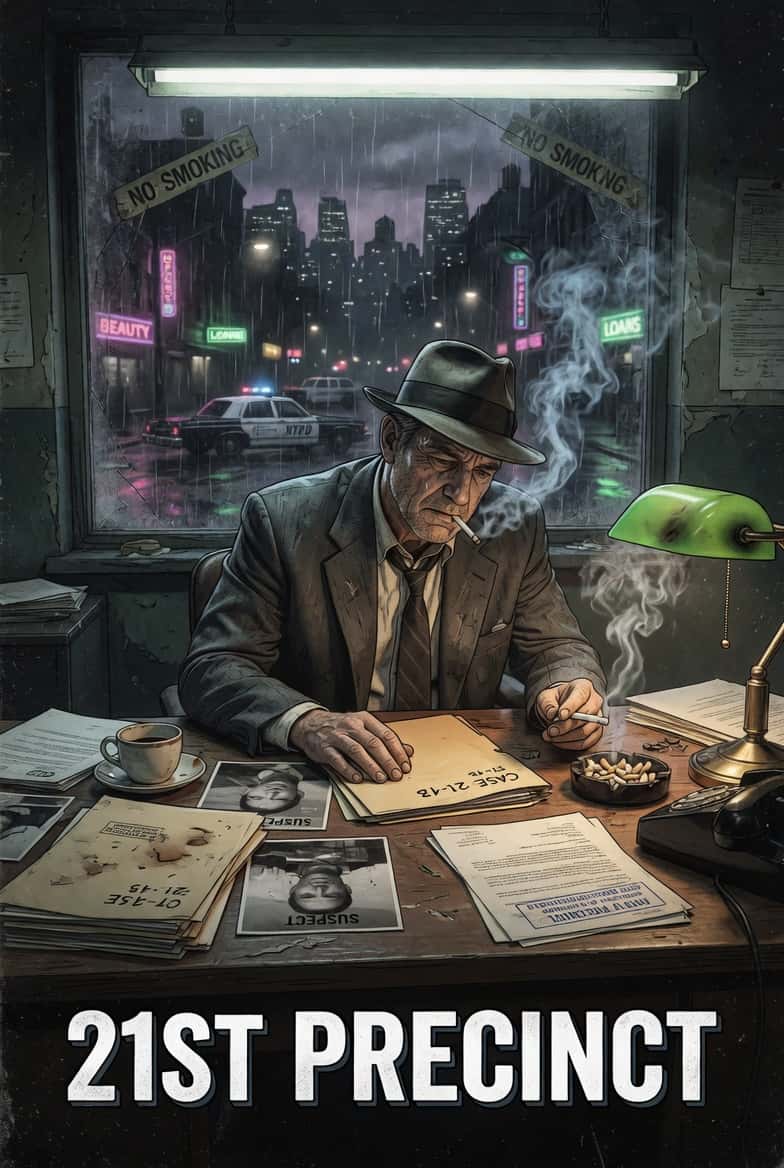
21st Precinct. It's just lines on a map of the city of New York. Most of the 173,000 people wedged into the nine-tenths of a square mile between Fifth Avenue and the East River wouldn't know if you asked them that they lived or worked in the 21st. Whether they know it or not, the security of their persons, their homes, and their property is at stake. It's my job. My job and the job of 160 patrolmen, 11 sergeants, and four lieutenants with whom I'm the boss. My name is Kennelly, Frank Kennelly. I'm captain in command of the 21st.
I'd been off duty since six o'clock. I was not due back at the station house until 4 p.m. the next afternoon when I would work straight through until late the following morning. At 6:30, I met my wife at Frank and Norman's, a steakhouse on 54th Street near Broadway. We had dinner and took a cab to the 46th Street Theater to see the hit musical, Guys and Dolls, an occasion we had both looked forward to for a year. The first act was fine.
Oh, it's wonderful, Frank. This is wonderful. I love it. It's certainly been worth waiting for.
You want a cigarette?
We go down to the lounge.
All right. I want to call in anyway.
Oh, excuse us, please. I'm sorry. Pardon us, please. I beg your pardon. Thank you. Thank you. Watch your step now.
I feel like dancing up the aisles. I can hardly wait for the second act.
Well, ten minutes isn't such a long time.
According to the manual of procedure, a precinct commander, although off duty, is never relieved of the responsibility of his command. Consequently, he is obliged to keep the desk officer informed regarding his whereabouts. If he's beyond the reach of a telephone, he's required to call in at frequent intervals to be notified of any matter that would... if any matter that would require his attention. Ellen and I went downstairs to the theatre lounge. I offered her a cigarette, lit one for myself. Then I stepped into the phone booth.
21st Precinct, Sergeant.
This is Captain Kennelly, Sergeant.
Oh, hello, Captain. What did you call? What have we got?
Do you know those three guys who were cheating in Federal Penitentiary in Pennsylvania and Ronald A. Diggins got him spotted? In the precinct?
Yes. 611 East 66th Street. Information came to one of our men walking a post over there.
Good. Are they sure it's them?
It must be. The detectives are getting ready to hit the place. I want you to notify Division on it.
Yes. And put me through to Lieutenant King. You've got a couple of messages here, Captain.
Well, hold them until I get in, Sergeant. Hold on. I'll take you up to your squad.
Let me talk to Lieutenant King, please.
Captain King's busy right now. Can I help you?
This is Captain Kennelly.
Oh, hold on. Lieutenant, Captain Kennelly on the phone.
Okay. Lieutenant King.
Hello, Matt. What do we got?
Three bank robbers. How does it look?
That's Captain. The man who came to one of your men's gun barrels.
Yeah, I know. What time are you going to hit the place?
Three or five a.m., probably.
All right. I'm coming in. I'll be there in 20 minutes. So long, then.
Frank, that took long enough. Did it? What happened? Did the roof fall in? You always say that.
I've got to go in, Helen.
Oh, Frank.
Now, you stay and see the rest of the show. It'll be over at 11 o'clock. Can't you stop by on your way home?
No, this is important. Here's the car keys, honey. You know the garage is parked in on 53rd.
And what time do you think you'll be back?
Oh, I don't know. I haven't any idea. I'm sorry, honey. Sorry to have to ruin your evening.
Why can't it ever happen when we're not having a good time?
Beats me, honey. I'll see you at home. Good night, Frank.
After 16 years in the job, Ellen was used to that sort of thing. She didn't complain. She just made the best of it. I went up to the street and flagged a cab to take me to the station house. Traffic across town was light. The cab had me in front of the station house in less than 10 minutes. I saw two patrol cars parked at the curb. One was ours. The other belonged to ESD. The street was quiet. I walked up the worn granite steps to the station house and into the muster room.
At the desk, Lieutenant Gorman was booking a prisoner in the custody of a detective I didn't know. Suspect looked like an addict. The detective must have been from the narcotics squad. A half dozen patrolmen were gathered in a group at the far end of the muster room talking quietly. I walked over to the far end of the desk where Sergeant Klein was on the box.
Hello, Captain.
Who are those men, Sergeant?
Oh, them. They were sent in here from the night before. 19th and 23rd on a special detail. You know, for the raid.
Excuse me, Captain.
Yeah.
21st Precinct, Sergeant. Yeah, where are you? Well, listen, walk around the corner to 331 and see the super. He's called in here twice about a couple on the third floor fighting and breaking the furniture. Yeah, okay. Let me know.
Those men know what they're here for?
No, sir, not yet. That's what they're probably trying to figure out.
I don't want them standing around in here jabbering. Tell them to go into the back room.
Yes, sir. Now, listen, you men.
Yes, Sergeant.
Go on in the back room there and make yourselves comfortable. You'll be here a while yet.
Okay. Thanks a lot.
You notify the division?
Yes, sir. I spoke to the division lieutenant. He'll get in touch with Chief Andrea.
Those are the guys holed up there.
That'll be a pretty good collar.
Yeah, it should be. What else is going around here?
Oh, nothing much. Pretty quiet tour otherwise. You got a couple of messages. One from CB over the teletype. A meeting of all precinct commanders in the lineup room at 240, Wednesday, 9 a.m. I left the communication on.
Okay. A fellow named Fox called twice. He wouldn't give his first name. He wanted your home number. I asked him what it was about. He said it was personal. I didn't give him your number. I told him you were due back on at 4 o'clock tomorrow afternoon. He'll call in.
All right. I'm going upstairs.
Oh, Captain.
Yeah?
It was Johnny Farrell who got the information.
Yeah, you told me that.
I did? Oh, yeah. Where is Farrell?
I'm sorry. No, sir. Lieutenant King said that since it was his line, he could come along when they hit the place. He's changed into civilian clothes and he's upstairs. I put a reliever on his post.
All right. I'll check with you later.
Yes.
I left the muster room and headed toward the stairs to the 21st squad on the second floor. In the back room, the special details from the 19th and 23rd were gathered around in little groups whispering, wondering what their job for the night would be. On the way upstairs, I grinned at the way everyone was so careful to point out that the information on the three bank robber escapees came to Patrolman Johnny Farrell. Johnny Farrell had been caught smoking on post by his sergeant the night before. The report was on my desk for disciplinary action.
Inside the 21st squad, nine or ten detectives were standing around in small groups. I recognized a few of them as men who worked out of the 21st. The others had been brought in from detective district headquarters and from the main office. In a corner near the fingerprint stand and sitting all by himself was Patrolman Johnny Farrell.
Hi, Captain.
Hi.
Hello, Captain.
Well, it's like a big night.
Yes, sir. I'd have to get a line on these boys.
No way in particular. Just through a kid on the block there, a kid named Wano.
Yeah?
Small Johnny? You know, I was going to give him up after last night.
You sure?
Yeah, I did. He's kind of little for his age, 13 or 14. He's not so good with the English. I pulled him out of a scrape last week with two bigger boys who were about to tear him apart. So I've been his best friend on the block since.
Yeah. Anyway, tonight about 7, I saw Wano on the street and he said, hey, police here. You, my friend, I got two dollars you owe to me, so they don't take it away from me, the big fellas. That's waving two dollar bills at me. I said, where'd you get it, Wano? He said, oh, I don't steal it, police here. I don't steal it. I earn it from the men. I said, what men? He told me about the three men who were staying in the flat across. I said, one of them opened the door when he came out in the hall, asked him how he'd like to make some money. The guy gave him three dollars, sent him over to Times Square to buy some Philadelphia papers, last week's papers. Well, he brought the papers back. They cost less than a dollar and the man told him to keep the rest. Two together, I saw the alarm, read about the bank robbery up in the Bronx yesterday. Well, I knew the same three guys had been made in a couple of jobs in Philadelphia. I knew they broke out of a federal penitentiary. I started asking Wano a few questions about the men. He looked pretty good to me, so I called in. Sergeant Klein about it, he connected me with Lieutenant King up here. Guess it looked pretty good to him, too. He told me to come in and bring Wano, and that's it.
Where's this kid, Wano?
Oh, well, Lieutenant King didn't want him on the block tonight. The lieutenant was going up to the stadium with his brother. His brother worked for Con Ed.
Yeah. When this came up, he couldn't go. He was trying to take the kid on the other ticket.
That was a great idea.
I do, too. How'd they make sure it was the right three?
Well, after Lieutenant King talked to Wano for a while, he sent one of his men over and got the super of the building, somebody else, another neighbor in there. Super got a good look at one of them, so it's definite.
Good. Good work, Johnny. I understand you're going along when we hit the place.
You bet.
Okay, I'm going in to talk to Lieutenant King. Who's that in there with him?
That's the super, Captain.
Oh, hello, Captain. Come in.
Can I shut the door?
Yeah. This is Mr. Albert Acosta, Captain Kennelly.
Oh, glad to know you. How are you?
Mr. Acosta, this is 609 and 611.
Yeah, that's right. We're just going over the layout of the buildings in that flat there in 611.
Yeah, that's right on the top floor, fourth floor rear. Let's see if I got this straight now. Those 609 and 611 are four-story buildings. The buildings to the east seem to be five-story.
Yeah, that's right, but that's not my building here, 613.
Does the fire escape, do all the fire escapes go all the way up to the roof, Mr. Acosta?
Oh, yeah, that's right, up to the roof and down to the ground. And from the windows, the flat therein?
Yeah, that's right. Your roofs are on the same level?
The same level, yeah. They're both four-story.
What separates the two buildings on the roof?
Oh, a little brick wall, a six-footer.
Three feet high?
Oh, three feet, three and a half feet, something.
And the roof to 613?
That's not my building, but it's five stories high.
Yeah, 613. In other words, from the roof of 611, you can't get to the roof of 613. There's a wall 10 or 12 feet high.
Yeah, that's right, 10, 12, 14 feet, something.
No windows in that wall?
Let's see. No, no, no windows.
Anything on your roof?
Oh, nothing, television aerials.
All right, Mr. Acosta. I want to talk to you again later. You hungry? Want something to eat? Should I get a drink? Can of beer? The luncheonette we take from doesn't have beer.
Oh. All right, coffee. Coffee and a danish.
Why don't you take care of Mr. Acosta, will you? Send down for what he wants to eat.
Right. That's the tech over there. I'll take care of you, Mr. Acosta.
Okay, yeah. Great to know you, sir.
Yeah, same here.
Well, how does it look, Matt?
Oh, Sam, there's no doubt about it. Into the kid and the super, we found three people who made positive identification, and there's two more guys in the flat. It's got to be the others.
Whose flat is it? Did they rent it?
No, it belongs to a couple of sisters, Marie and Lois Dunney. Acosta says they've been living there for three or four years. The one sister, Marie, has been in Bellevue Hospital for months, six weeks alcoholic ward. They're young, too, in their twenties. The other sister, Lois, is still living there. Acosta said he thinks she works as a waitress someplace, doesn't know where.
Is she up in the flat now?
Deep knee capping. Nobody has gone out or come in since we got onto this thing. Place is staked out. Two neighbors that know her with the officers. They haven't seen her.
How about Bellevue? Is she down visiting the sister?
We checked that out, too. Got a man there.
Well, how are you going to hit them?
There's three rooms in that flat, in the back of the building and on the top floor. These boys are tough, there's no question about that. They had two guns apiece when they hit that bank. They roughed up a lot of people around Philadelphia. They were doing 25 years each when they broke. They're not going to sit still for a collar. It's going to be a hot one.
They're on the top floor. You can't put anyone on the roof at 611. It'll be hard walking around.
I know. We'll have men on the roof at 609, 613, in case they come up the fire escape. The way they'll probably go when they hear the law at the front door.
Who's going to hit the door?
Myself, Johnny Farrell, if you want to.
You'll want to. And one or two others.
Including me?
Yes, sir. I've got two men from the emergency squad, you tell. They'll be there with axes to work on the door if they give it a fight.
All right. What time?
I figure 4 a.m. There'll be less people on the street and less people up and around in the building. Also, these guys might be found asleep by then. We can nail them when they're asleep or at least sleepy. There's not so much chance of fireworks.
How about your notifications?
They're all made. The brass will start streaming in here about midnight. There's six or eight cops from the 19th and 23rd down in the back room now.
Yeah, I know. How much of the show did you get to see?
Shame on me.
Come in.
Uh, Lieutenant, Whitey says the girl is on three. Want to talk to you?
Okay, thank you.
21st Squad, Lieutenant King.
Yeah, Chief. We got the girl. Uh, we got her.
Good, Chief, fine. That's the girl, Lieutenant. They were expecting her home at 11 o'clock. 11 o'clock is the latest.
Shall I bring her in, Lieutenant?
Uh, no. Where are you?
Later than 11. You can't wait until 4 a.m., Matt. You'll have to hit right away, as soon as possible.
What about all the brass that were notified for 4 a.m.?
We can't wait, Matt. We'll notify them again. After all, it's been moved up.
Okay. Whitey, Ben, Al, come in here, huh?
All right, now listen, we're making a change. We're gonna move and move quick. Gotta hit them as soon as possible. Ben, get hold of the ESD.
You are listening to 21st Precinct, a factual account of the way the police work in the world's largest city. Now back to 21st Precinct and Captain Frank Kennelly.
Although we knew hardly more than her name, Lois Dunney had become the key to the situation. The fugitives expected her to return by 11 p.m. Then together we drove up 2nd Avenue to Mix's funeral chapel.
Okay, Mr. Good.
Captain.
Go ahead, man. Find a place to park and walk on back here.
Yes, sir.
Okay. Yeah, great place to start out from in the takers.
Better to start out from there, man.
Okay, you got a point. Go ahead. It's a certain thing. There they are, back in the office. Looking ahead.
Hello, Steve.
Hello, Lieutenant.
Hi, Steve.
You know that, don't you, miss?
Yes, I suppose so.
No supposing about it, John. That's Carl Ross up in your apartment, isn't it?
Yes.
And the others? I showed you the pictures of all of them, Lieutenant. She identified them.
I wasn't doing anything wrong. I just rented out some rooms to those guys for a little money. Anybody's entitled to make a little money.
Not that much. How much?
They've been there three days. They've already given her $275.
I told you you were in a jam. If you don't start telling us the truth, you'll be in a bigger jam. I'm not kidding. Now, how about it? Who are you, anyway? I've got to know who I'm talking to.
My name is Lieutenant King. This is Captain Kennelly. Is that good enough for you?
I've been telling you the truth.
Listen, you're a pretty bad liar. I'm going to tell this officer to take you downtown. Steve, put her in the car.
Matt, wait a minute.
My new car.
For how long?
I worked in Pittsburgh a while, a couple years ago. I knew him then. But I didn't know he was anything like what he is. To be honest, I didn't. Not then.
When did you hear?
After he got in trouble. I was back in New York. Somebody wrote me. One of my friends.
If you have time to wait, the facts eventually will develop. But we had neither time to wait nor time to waste. There are two ways to get information quickly. One is to be stern, the other is to be full of sympathy. Most often, a lying witness will turn to the friendly officer and tell him exactly what he wants to know.
I haven't heard from him in years, but one day there he is. He just turns up in the cafe where I work, there he is.
By himself?
Yeah, by himself then.
When was that?
Tuesday, last Tuesday.
I read about him and about how he and those others broke out of jail and what they did in Philadelphia and all that. Weren't you scared?
No, not too. I told you, when I knew him in Pittsburgh, he seemed like a very nice boy. He was very nice to me.
Did you ask him anything about that?
Yeah, sure. Absolutely. He said that everybody had him and his friends wrong. They didn't mean any harm. Well, I mean, you know, he's good looking, he likes to spend money.
How'd they come to stay in your flat?
That was the first thing he asked me, did I know where he and his friends could get a place? Well, my sister's in the hospital, and I had a big place all by myself, so I told him, I told Carl, I told him, if you want to, I've got a big place with an extra bedroom and all that, and I slept in the living room, so I said, okay, and I was there.
How'd they know you wouldn't go to the police?
I don't know. Carl talked with the others, I guess. They paid me all this money, and they promised to give me 500 more when they left. I guess they figured I wanted the 500.
You did too, didn't you?
Well, I mean, my sister was in the hospital, I didn't have a nickel except what I made, sure.
They expect you home at 11 o'clock?
Around 11, yes.
Why 11?
Well, this is my late night on. I work until 10, Carl knows that.
You ever see any guns up there?
Well.
Did you, Lois?
Yes, too scared to get near them. I don't like them.
Have you got your key to the place?
Yeah, I got it, but it won't do you any good. They keep the door bolted from the inside all the time.
Listen, Carl told me, he said, no matter what, he wasn't going back. The others too. They said they'd die on their spot first and kill anybody who wants to argue with them about it.
Cops, they meant.
Yeah, I figured that's who they meant.
In another few minutes of interrogation, we had all the information we needed about the interior of Lois Dunney's flat and what we could expect to find there. Lois Dunney was taken to the precinct house in the custody of a detective. Meanwhile, nearly 50 uniformed officers and detectives assigned to the detail were given their posts and told of their duties. Four men were assigned to the roofs of 609 and 613. Eight men were posted in various places in front of and across the street from 611. Four men were assigned to the rear courtyard behind 611. Men from the emergency service division set up a portable generator floodlight on the roof directly across the rear courtyard of 611 so that the entire fire escape could be spotlighted. Another such unit was held in readiness for use in front of the house. Besides their service revolvers, these men were issued such additional arms as their particular situation called for. Submachine guns, riot guns, and tear gas.
Lieutenant King, myself, Johnny Farrell, two other detectives from the 21st squad, three men from the ESD, two carrying axes, another submachine gun, led the way into 611. Behind us followed a half dozen or so other officers. As we walked up the dim-lit stairs, two men dropped off on each floor to block any attempted escapes and to keep curious tenants out of harm's way. Two more were left at the top of the stairs in the fourth-floor hallway. The rest of us walked to the fourth-floor rear, up at the door. We listened. The radio was on inside.
We're police officers. Open up. Open up, police officers.
Knock it in. Use those axes. The lock. Get the lock. Push it in. Come on, let's go.
In the living room, there they are.
Hold it.
All right, throw that stuff.
Nail them, Johnny. Let's go. Bring that tommy up here. Get them. Let's go. There's the other one. Out the window.
Hold up. Hold up, Ross. Let's go.
Watch it, Matt. You okay, Matt?
Yeah, I'm okay.
Watch it up there, man. One's on his way. Up to the roof.
I see him. I've got to go to the ventilator. It's me. Run out here.
All right, you men. Put your light on the ventilator. That's fine. That's it. Run out here, Ross. Okay, let's go. We should have another one.
Stand there, Ross. Get up again. All right. Take it easy.
Nothing on him. Too many of you.
There's too many of you.
Maybe, but now at least there's three less like you.
The toll was heavy. Two of the three fugitives were dead on the floor of the living room. Ross had a bullet through his shoulder. They weren't the only ones. Detective Carmine DeFeo, 21st squad, dead. Patrolman John Farrell, 21st precinct, wounded. 45 slug in the left hip. Patrolman Ezra Davis, emergency service squad number four, wounded. 38 slug through the left hand. The medical examiner and ambulances were summoned. The top command of both the uniformed and detective divisions came to the scene. At 2:15 a.m. I arrived back at the station house. There I approved the unusual occurrence report and checked on the notification of the wounded personnel. At 2:35 a.m. conferences were held in my office. Subsequently the press sought additional material and photographs. At 3:50 I signed the blotter and left the precinct house. Deputy Chief Inspector gave me a ride. At 4:40 a.m. I unlocked the front door of the house. I was walking through the living room into the bedroom.
John?
Yeah, honey?
What time is it?
Late.
Are you tired?
Yep.
You know what? You missed a very exciting show.
Yeah, honey. I bet I did.
21st Precinct, Sergeant. Where do you need an ambulance? 822? Is that in the building or on the street? What apartment number? What's the trouble there? How is he hurt? Was he stabbed?
Incidents portrayed tonight on 21st Precinct occurred last year. Names were changed to protect the interests of persons involved. 21st Precinct is presented with the official cooperation of the Patrolman's Benevolent Association of the City of New York. Everett Sloane in the role of Captain Kennelly, Ken Lynch as Lieutenant King. Featured in tonight's cast were Joan Loring and Barbara Weeks, Lawson Zerbe, Bill Lipton, Wendell Holmes, and Mandel Kramer. Written and directed by Stanley Niss, produced for CBS Radio by John Ives. This is the CBS Radio Network.