
The written record
Read the transcript
Read along with the recording · About 23 min to read
21st Precinct, Sergeant Collins.
What do you mean he was robbed? Was he held up? A fellow what? Talking to the phone, I can't hear you. Well, what was he doing on the soup? Was he drunk? What's his name? What? How do you spell that?
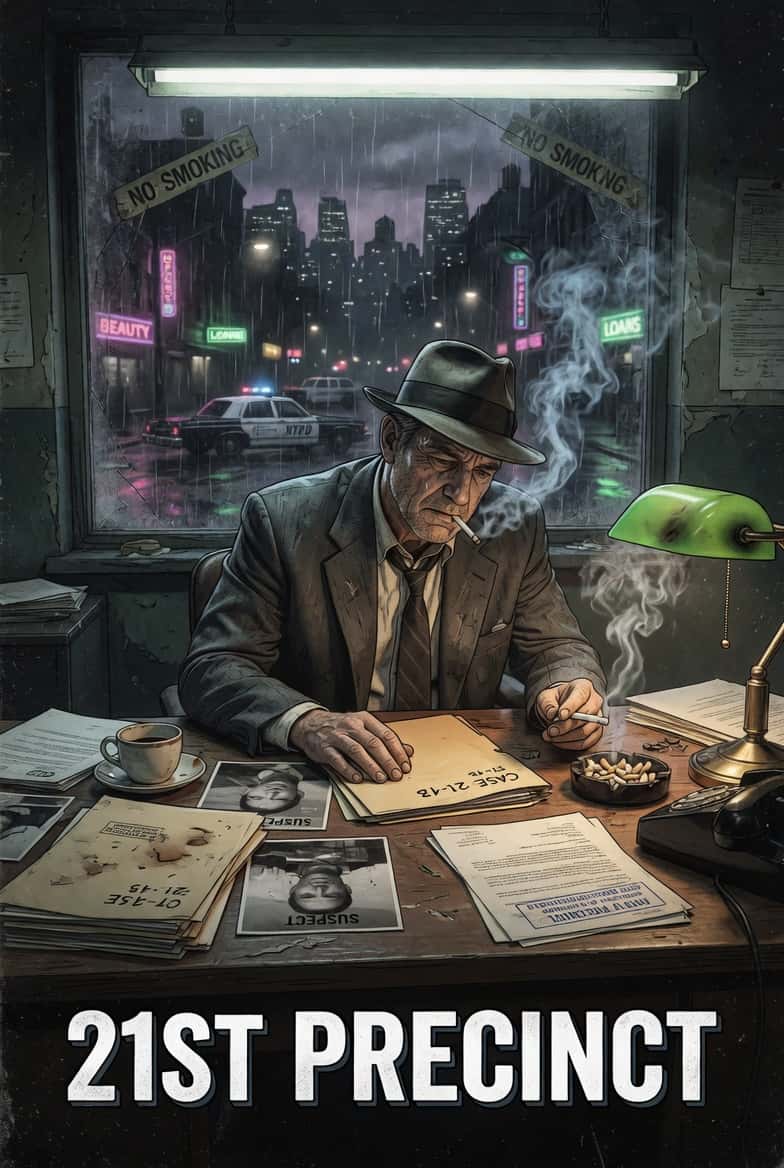
You are by transcription in the muster room of the 21st Precinct, the nerve center. A call is coming through. You will follow the action taken pursuant to that call from this minute until the final report is written in the 124 room at the 21st Precinct.
All right, tell him to stay there. I'll send the officers right over there. Where is that? The southwest corner? All right, they'll be right there.
21st Precinct. It's just lines on a map of the city of New York. Most of the 173,000 people wedged into the nine-tenths of a square mile between Fifth Avenue and the East River wouldn't know if you asked them if they lived or worked in the 21st. Whether they know it or not, the security of their homes, their persons, and their property is the job of the men of the 21st Precinct. The 21st. 160 patrolmen, 11 sergeants, and four lieutenants, of whom I'm the boss. My name is Cronin, Vincent P. Cronin. I'm captain in command of the 21st Precinct. I was doing day duty, 8 a.m. to 6 p.m.
After I turned out the platoon, I went into my office, where I read and signed reports and communications until nearly 9 o'clock when Sergeant Collins rang into my office to inform me that sector car number three had come by the house to take me on patrol.
Occasionally, the commanding officer of a precinct has unpleasant duties to perform. One of these is the investigation of complaints by civilians alleging delinquency or misconduct on the part of a member of his command. In connection with such a complaint, I instructed my operator, Patrolman Fowler, to drive to 521 East 66th Street, a new 16-story apartment building overlooking the East River. I got out of the car and crossed the sidewalk. The doorman admitted me, and I headed across the lobby to the elevator.
Going up?
Yes, please. Thank you. Thank you. Thank you. This is Edith Oakway. What apartment is that?
14-D.
Yeah. It's weather, right, Captain?
Yeah. Yeah, it's fine. It's about time.
Mm-hmm. You know Mrs. Oakway?
Yeah, I know her, too. Is she a young woman?
Yeah. Yeah. Maybe she thinks she is, but I don't. There's young and there's young. You know what I mean, Captain. She's like in her fifties.
What's the trouble, Captain? You got a problem with her?
No, no. No problem.
That's good. Because I don't advise you to tangle with that one. 14.
Yeah. That's the third door on your left.
Okay. Okay. Thanks.
Yes?
Mrs. Oakway.
Yes, that's right. How do you do? I'm Captain Cronin, the 21st [inaudible].
Yes, of course. Would you come in?
Yeah. I was just about to write a follow-up. Should we go in here? I have to excuse the apartment. It's a sunny day off.
Oh, I'll take your hat.
No, it's okay.
All right. I thought there'd be somebody here the very next day. You wrote to the police commissioner, Mrs. Oakway. Your letter was forwarded to the chief inspector and then down to the channel for me.
Well, I understand that. I certainly expected more prompt action than this.
Won't you sit down?
Oh, thank you. After all, that policeman was neglecting his duty and heaven knows what else. And when I see something like that, as long as I'm a taxpayer, I'm going to want to do something about it. Do you agree?
Well, if he was neglecting his duty, something will be done about it.
If I can depend on that. Not only neglecting his duty, but he was drinking.
Well, you can depend on it, Mrs. Oakway. Your letter to the police commissioner was dated the 14th. Now, you said that last night you observed the officer in the back room of this delicatessen with his jacket unbuttoned, smoking a cigarette, and drinking from a can of beer.
That's right.
Now, this was Friday night, the 13th, you're talking about.
Well, if I wrote the letter on the 14th and said it was last night, it must have been Friday night, the 13th I was talking about, don't you think? I just want to make sure.
I don't see what's so important about that, anyway. Exactly when it happened.
It's very important. It was Friday night, and I wrote the letter Saturday morning as soon as I got up. I went downstairs, and I mailed it. I went downstairs immediately.
Did you tell me just exactly what you did and what you saw on it or something? It's all in the letter.
Yes, well, I'd kind of like to hear a little more detail.
I don't see why. But I would.
All right, if you'd like to. You see, my husband was away on business, so I was here all alone. Well, that is, except for Bon Bon.
Who?
My poodle, Bon Bon.
Oh. A little miniature. Oh, here she is. Here, Bon Bon. Come on, Mama. Come on. Come on. Come on, Bon Bon. Come on, [inaudible]. Oh, come on up now. Come on. Oh, that's a good girl. She's very shy when I have company, Captain. She hides in the kitchen until I call her. Don't you, Bon Bon, darling. Don't you. Oh. Little [inaudible], most human, don't they, Captain?
Well, not quite, Mrs. Oakway.
Oh, she is. She's just a little high-strung, aren't you, dear? What time was it when you took the dog out for a walk Friday night, Mrs. Oakway?
Well, I'd say it was about 8.30. About 8.30. As a matter of fact, it was almost exactly 8.30. I had just finished talking to a friend of mine on the telephone. She was going to the theater, and she said, oh, my goodness, it's almost 8.30. I better hang up if I want to make the curtain. I can give you her name if you want it.
She's very good, thank you. No, no, that's quite all right. You took the dog downstairs, and you walked directly over to York Avenue, is that right?
Directly over to York Avenue.
Would you say it was about 20 minutes to 9 when you got there?
Approximately.
And what did you do, [inaudible]?
Well, I passed this delicatessen that was open, the Fairland delicatessen, they call it.
Yeah, yeah, I know the place.
And I said to myself, wouldn't Bon Bon enjoy a nice roast beef sandwich when we got home?
You don't.
Yes, he loves roast beef sandwiches. Of course, I don't let them put mustard on it or lettuce.
No, no. So I went into the delicatessen, and I was the only customer. The man asked me what I wanted, and I told him one roast beef sandwich on rye to take out. Bon Bon will only eat rye bread. You think that right, dear?
Yes.
Well, he was making the sandwich, and I just stepped back there to look over what else he had. Now, there is this little table in the back, and I saw the policeman in it, sitting down at the table, and his jacket unbuttoned, almost off. I mean, it wasn't a way to be presentable. He was sitting down there, and he was smoking a cigarette, and he was drinking beer from a can. Now, was that right? When that man was supposed to be out protecting the public, he's got no right in the back of a delicatessen drinking beer from a can.
Your story was the police.
Well, Mrs. Oakway, not a doorman, or, you know, somebody else in uniform.
Oh, he was a policeman, all right. I didn't recognize a police uniform and a police cap, and the man had a gun. He had it strapped right to his belt, there. Nobody could tell he was a policeman.
Would you know the man again, if you saw him?
Absolutely, positively, no question about it.
How close were you two?
I was standing at the counter there, and he was sitting at the table in the back room. I could see him right through the door.
How far would you estimate that to be?
Uh, no farther than some, oh, here to where that ottoman is. Over there. About, what, 12, 15 feet?
About, yes.
In your letter to the commissioner, you reported his shield number, 32489.
Yes, that's right.
You were able to read the number on his shield or a cap device from 12 or 15 feet away?
No, I wasn't able to, and that's why I waited outside.
Outside, of course.
Yes. I was really annoyed about this whole thing, so when the man finished making my sandwich, and I paid for it, I went outside, and I stayed on the sidewalk there. I waited 10 or 15 minutes until that policeman came out, and finally... When he did come out of the store, I said, I am going to get the number on his badge. So I saw him come out of the store, and I walked right up to him, and I asked him which way it was to Sutton's Lake.
Well, he was telling me I made a specific note of his badge number. You're sure it was 32489?
Absolutely. I'm positive of it.
When you spoke to him, did you notice anything unusual about his appearance, you know, his face, his manner?
Do you mean was he drunk?
Yes.
Well, I'm not an expert on such things. I just made a note of his shield number, but, uh, is that what you call it? Shield number badge, number what?
Shield number, yeah, something like that. Well, wrote it down in my little notebook that I carry in my pocketbook, and then I said, come on, Bon Bon, let's go. Come on, Bon Bon. We came home, and we came upstairs. I was so upset about the whole thing. I was so mad, I almost called someone right there, and then I decided, what good would it do to call? So I wrote a letter. Now, what I want to know is, what are you going to do about this? Are you going to take some action?
Uh, I'm making an investigation, Mrs. Oakway. If the results warrant action, they'll be action taken.
I only hope you will, because after all...
You don't have to hope I will, Mrs. Oakway. You can depend on it.
Complaints by a citizen against a member of the police force fall into two general categories. One, alleging abuse of authority or the unnecessary use of force. The other, alleging delinquency or misconduct. As the former is the most serious type of complaint, a special civilian complaint review board comprising three deputy commissioners of the department has charge of investigating and hearing the complaint. If the facts so warrant, the board recommends that the member of the force stand at departmental trial. In more serious cases, the evidence may be turned over to the district attorney of the county and criminal proceedings instituted. Complaints alleging delinquency or misconduct, such as the matter at hand, are referred to the chief inspector, who assigns a superior officer of the department to make an investigation.
On receiving the communication from Mrs. Oakway through channels with instructions to make an investigation, I determined that shield number 32489 was assigned to patrolman Paul Vaccaro. The charge that he had left his post and neglected his duty was easy to prove or disprove because of the extensive departmental records kept on the movement of members of the force. The second charge, indulging in intoxicants while in uniform, presented more of a problem.
At 10:45 a.m., I returned from patrol, walked into the muster room and behind the desk. Lieutenant Snyder was desk officer and Sergeant Collins was on telephone switchboard.
Hello, Captain.
Sergeant?
21st Precinct, Sergeant.
Sergeant Collins.
Hello, Skipper.
Lieutenant.
What's the problem over there?
Ah, what's going on? Good, good, Captain. Fine, huh? Well, good. Well, lady, if the landlord's gonna make repairs on the building, there's nothing to complain about.
Okay, Lieutenant.
Yes, sir.
Are you doing the hammering?
Oh, I'll be in my office.
Okay, Captain.
Well, what time did they start hammering this morning?
In a second, Captain.
Mm-hmm. Well, lady, 8:30 is a reasonable hour to start working. There's no reason for a suspended officer over there. Why don't you call the landlord and register your complaint with him? No, there's nothing we can do about it. Okay, you're welcome.
He's upset because the landlord sent a carpenter in to fix the stairs. He can't stand the pounding. What are you gonna do?
Yep.
Sergeant, have you got the telephone switchboard record for the 4 to 12 on Friday, the 13th, handy?
Yes, sir. Right here.
4 to 12.
Yep. What post was the car with [inaudible]?
Post number 8.
What time do you take his meal?
8:15 to 9:12.
Where? Go ahead, take it.
Yes, sir. 24. 21st Precinct, Sergeant Collins. Yeah. All right. 17. Where'd he take his meal, Sergeant?
861 York Avenue.
Are you familiar with the place? What is it over there?
Oh, yes, sir. I know it. It's a delicatessen. A Fairland delicatessen.
All right. Well, what's the car working?
He's not swinging.
Oh, no, sir. He's still on the 4 to 12, Captain.
We got some trouble, Captain?
Oh, the car might have some trouble. Now, put a note on the board from the [inaudible], Sergeant.
Yes, sir. As soon as you can send it to the house, the telephone switchboard record shows the hourly rings of patrolmen on post sent to the station house. Their meal period, and where they can be located during their meal period. Patrolman [inaudible] had not left his post without permission. I showed him the records. He was in the back room of the delicatessen where he had reported he would be during his regular meal period. Consequently, part of the complaint against him by Mrs. Edith Oakway had proved unfounded. But she had also charged that she had observed him drinking beer from a can. It is contrary to the rules of the department for a member of the force while in uniform to use intoxicants of any type, whether on his meal period or not. That portion of her complaint remained to be investigated.
The rest of the morning was quiet in the precinct and I completed some paperwork. At 12:30, a car came by the house to take me to a luncheon meeting of the Lennox Hill Kiwanis Club where I spoke to the members in answer to their questions concerning the police and community relations. After the meeting, I went out on patrol of the precinct once more and returned to the station house at 3:30 p.m. The men who had worked the 4 to 12 tour were coming into the house and heading to the locker room to change into uniforms. After I signed the blotter, I started toward my office. I saw a patrolman, Vaccaro, already in uniform, come out of the back room and approach me.
Captain?
Yes?
There's [inaudible] on the board you wanted to see me, Captain.
Uh, yeah, that's right, Vaccaro. Come on into my office.
Okay, go ahead. Vaccaro, I'll make another sentence to correct my mind.
Yes. Uh, Vaccaro, did you work the 4 to 12 last Friday, the 13th?
Yes, sir. Can you get out your memorandum book and the pages covering that tour?
Friday, April the 13th, 4 to 12 tour. Yes, sir.
And what time was your meal period?
Uh, 8:15, I rang back in at 9:12.
Well, where were you during your meal period?
At 861 York Avenue, Captain.
Yes. It's the delicatessen, the Fairland delicatessen. Do you eat there frequently?
Yes, sir, I do when I'm working the post at night. I'm not myself open on the post. During the day, there's a couple of other places I can eat, but on the 4 to 12, this is just about it.
That's, uh, it's not a delicatessen and a restaurant, too, is it?
No, sir, it's not. There's, uh, no tables out in front, but he makes sandwiches to go and he has a table in the back. He lets me and the other men that work the post, some doorman, people in the neighborhood he knows eat in back there. You know, have their sandwich.
Friday night, you have a sandwich in the back room?
Yes, sir.
What else do you have?
A mix of pretty good coleslaw, I had some of that, and a pickle, I think. And some of those cupcakes that come in a package.
Do you have anything else?
No, sir. That's about all I ate, as I remember.
Excuse me. 21st Precinct, Captain [inaudible]. Sergeant Collins, I'm T.S., Captain. The King is ringing downstairs for you.
All right. 21st Precinct, Captain [inaudible].
Lieutenant King, Captain.
Yes, Matt.
I have tonight a curing of drunk things.
Good, Matt. I can't watch.
Yeah. I'm watching them to see if anybody approaches. I'd like to see you to make an announcement about what we're going to do.
Yeah, sure. Be glad to, Matt. Fine with me. Oh, Clark.
Yeah.
Okay, Matt.
Oh, now, [inaudible], what did you say you had to eat after you done setting?
Well, if I remember, Captain, I had a cheese sandwich and some coleslaw and a package of those cupcakes.
Is that all? You didn't have any coffee?
No, it's not a restaurant, Captain. He doesn't have any coffee going over there.
Did you have anything to drink?
I had some soda. One bottle and two bottles?
One, Captain. But it wasn't a bottle.
Well, what was it, then?
The fellow that runs the place, the night man, Joe, he asked me if I ever tried any of the soda that comes in cans. I said, no, I hadn't. It was kind of good and he suggested it. He suggested grapes.
And you had a can of grape soda?
Yes, sir. It wasn't a can of beer. A can of soda. You've seen them. They just come out to soda pops and cans.
Yeah, yeah. Yeah, well, that's what I had.
Well, [inaudible], supposing I told you that we have a written complaint from a civilian that you were in the back of that delicatessen last Friday night drinking a can of beer.
Me? There was a letter to the police commission about a thing.
Well, Captain, I told you what I had. I had a can of grape soda. You can check with the night man over at the delicatessen. His name is Joe. He'll tell you what I had.
Well, I can tell you that the complainant reports that you were drinking a can of beer.
Captain, it might have looked like I was drinking a can of beer, but that's not beer. That's soda pop that comes in a can now. I don't drink beer ever.
No, sir?
No, sir.
You drink whiskey?
No, sir, I don't.
You never take a drink?
Well, I drink wine occasionally. It was always on the table when I was a kid. So, occasionally, I take a drink of wine. I never have any whiskey and I never have any beer.
That's pretty easy to check on, [inaudible].
But you can't check, Captain. I want you to check. I never drink whiskey and I never drink beer. I don't care for it.
All right, [inaudible]. You're back on it, John. I don't care what kind of a letter the commissioner got. That was a can of grape soda I was drinking. That's the truth, Captain.
I'm glad it's the truth, [inaudible], because you'd sure be in a jam if it wasn't.
After I turned out for platoon, I went in my office and telephoned Mrs. Edith Oakway from whom the complaint about Patrolman [inaudible] had been received. I informed her that I had made an investigation of the matter and had found that Patrolman [inaudible] was in the delicatessen during his regular meal period and what appeared to her to be a can of beer was actually a can of soda pop. I then called the clerical patrolman into my office and dictated a report of my investigation in which I stated the complaint was unfounded. I instructed the clerical man to prepare the report for my signature and be forwarded to the chief inspector to direct. I remained at the station house until 6 p.m. when I signed the blotter to go off duty. Lieutenant Gorman, the desk officer during the 4 to 12, was then in charge of the [inaudible] patrolling the precinct. Among these, of course, was Patrolman [inaudible].
At 8:15, he walked to a call box on York Avenue intending to ring into the station house.
21st Precinct, Sergeant [inaudible].
Box 14, Patrolman [inaudible].
Yes, Sergeant. Ready? 8:15. 861 York Avenue.
Hey, officer, excuse me.
Yes?
How do I get to the subway?
Which subway? Where are you going?
The one that takes me to Astoria.
Oh, the [inaudible]. 60th Street and Lexington Avenue. That's doing the wrong way. You were. Where is that? Am I four blind?
Well, this is York. First, second, third, and then Lexington. Down at 51st Street. You can get the cross-town bus there.
No, no, that's all right. I'll walk. It's nice, nice.
Yeah, it sure is. This is where I go. Well, I'm not too blind. It's all right.
Oh, hello, Mr. [inaudible].
Hi, Joe. I'll be leaving in a second, just as soon as I finish cutting this up.
All right, take your time. I'll see what looks good.
Everything looks good. It's the policy of the house.
Ah, how's it taking?
Brand new. Delicious. I had it myself.
Yeah, it looks good. There's some delicious stuffing in there.
On rye with a little stuffing on the side?
Yeah, yeah, good.
Well, go ahead. Tell me what you're doing.
Oh, it's just for a customer that calls. I'll be in here for it at 9 o'clock. I thought I'd get it ready. Isn't that a beautiful bird?
What do you want? White, neat, or dark?
A little of each.
A little coleslaw besides the stuffing on the side?
Yeah, a little.
And what about the drink?
Oh, you like that soda in the can?
I thought I did, but I don't.
What's the matter? It's good stuff. It's the latest thing.
Uh, give me some root beer and in a bottle.
Okay. Now, a second thought, you better not make it root beer. You got any cream soda?
What do you mean if I got any cream soda? If I didn't have cream soda, I'd have to close the door.
Uh-oh. The lady with the dog that don't like lettuce on the sandwich. Madam, you'll have to carry the dog or keep it out. I can tell her a thousand times.
Oh, my, [inaudible]. This is going to be mean. This is going to be mean. A root beer sandwich on rye, no lettuce. Very rare.
Yes, ma'am. As soon as I finish the other order, you hear.
Oh. Good evening.
Good evening. Say hello to the nice policeman. Did you see her? Did you see her nod?
Yes, ma'am. I saw her.
You want some pickle, Mr. [inaudible]?
Yeah, sure, Joe. Yellow salt. Either one.
Are you in this neighborhood all the time, officer?
Yes, ma'am. This is my post.
Well, that's nice. It's very nice to have a bright-looking, upstanding young man protecting us.
Thank you.
What was it you wanted to drink, Mr. [inaudible]?
Cream soda?
Yeah, that's right. Coming up.
Did you ever try that soda in [inaudible]?
Yes, ma'am. I tried it. I think it's very good. Don't you?
Oh, it's very good, yes. But I, uh, I prefer the bottle.
So do I. It's hard to get used to soda in cans. That's boring, isn't it? Now, just stop it. You get very restless. I don't know what's the matter with her lately. Stop it now. Here, a mix of a [inaudible]. All set.
How much is that, Joe?
Fifty-five, seventy-five, eighty-five, I'll call it a square.
All right. Out of a dollar.
Thank you, and call again.
Yep. Why don't you go in the back room? Make yourself comfortable.
Okay.
Do you, policemen, get regular lunch hours?
Yes, ma'am. That's right.
Well, I didn't know that. It's always nice to learn something new.
Yes, it is. If you want some dessert, holler.
I will, yeah.
That's roast beef on rye, lady. No lettuce.
No lettuce, but a little butter.
Okay. Unless you prefer something else tonight, Bon Bon. Would you rather have turkey? Turkey looks very good, doesn't it?
He'll have the roast beef.
Yes, ma'am. Very rare, she like it?
Very rare.
Yes, ma'am. A little butter?
Just a little.
Salt and pepper?
No, no, no. Absolutely not.
You want me to trim the sandwich? Does she like the crust?
No, never mind.
Yes, ma'am. Will there be anything else?
No, that's all.
No pickles?
No [inaudible].
I once knew a dog that loved pickles. Couldn't keep his head out of the barrel.
Well, that was a dog. This is a poodle.
Oh, excuse me, lady. I didn't know there was a difference.
Fifty-five cents. You're sure that's fresh roast beef?
Fresh as it comes.
All right. You are?
Fifty-five. Right. Well, good night and say goodnight to that nice policeman.
Yeah, I will. Goodnight, Bon-Bon.
Well, goodnight to the man, sweetie. Call again.
Oh, yeah. Fresh meat. It's fresh. Boy, it's not one I care to miss in a town.
Eh, she's hard. What do you want from us? She likes a dog.
Yeah, it'd be all right if she only liked him. She's nuts about him.
Say, how's the turkey? Good, huh? Didn't I say so?
Yeah. Fine. I'll tell you, that one could cause trouble. A game like that is a troublemaker.
Don't worry about her. She's harmless. Absolutely harmless.
21st Precinct, Sergeant Collins. Yeah? Where's that? They're meeting up a minute. Downtown corner, east side. On the east side? Did you see anyone?
And so it goes. Ah. Around the clock, through the week, every day, every year. A police precinct in the city of New York is a flesh-and-blood merry-go-round. Anyone can catch the brass ring. Or the brass ring can catch anyone.
21st Precinct transcribes a factual account of the way police work in the world's largest city. It's presented with the official cooperation of the Patrolman's Benevolent Association, an organization of more than 20,000 members of the police department city of New York. James Gregory in the role of Captain Cronin, Ken Lynch as Lieutenant King. Featured in tonight's cast were Alan Hewitt, Ted DiCorsia, Amzie Strickland, James McCallion, and Lewis Charles. 21st Precinct is written, produced, and directed by Stanley Nist. Dan Cumberley speaking. This is CBS, the Columbia Broadcasting System.