
The written record
Read the transcript
Read along with the recording · About 19 min to read
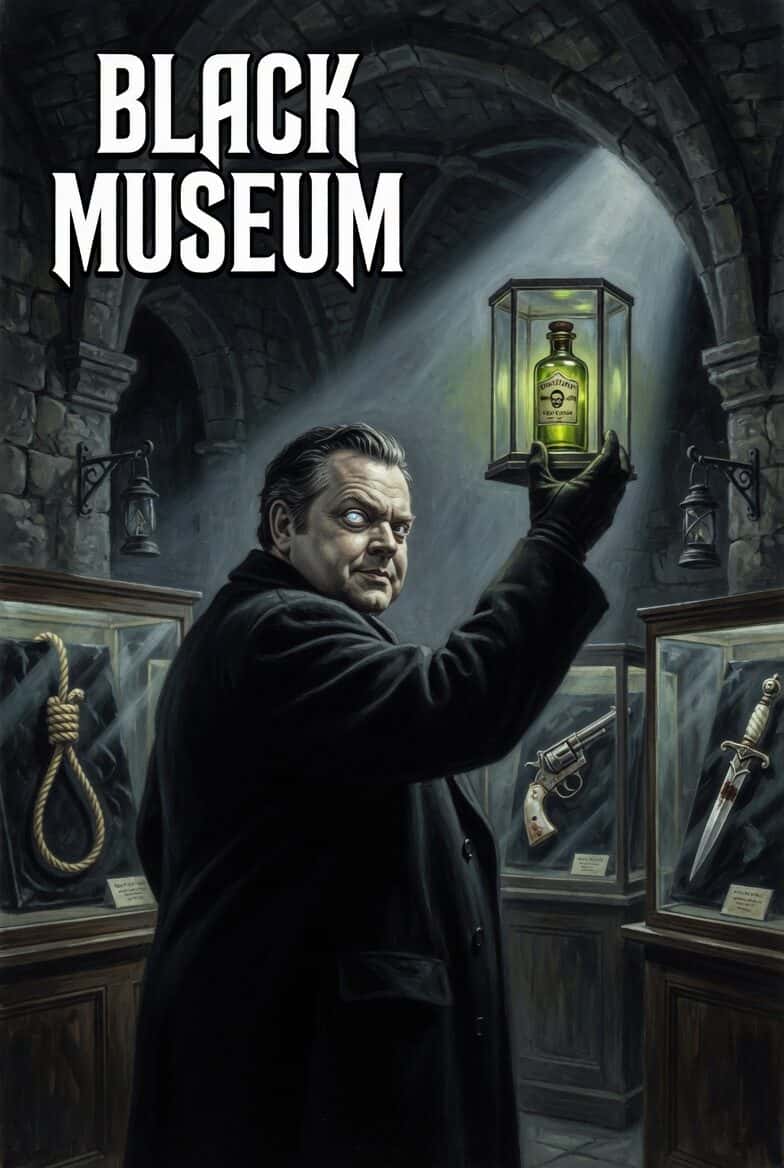
This is Orson Welles, speaking from London. The Black Museum. Here in the grim stone structure on the Thames, which houses Scotland Yard, is a warehouse of homicide, where everyday objects, objects like a sugar bowl, an ashtray, a portable radio, all are touched by murder. That's a familiar object. Everybody's used one at some time. A brad tack, a door nail, a loose in the window sash. What have you. Nearly everybody has, at one time or another, taken part in a conversation like this.
Beg pardon, ma'am. Could you pass me my hammer?
Your hammer? Oh, yes. Yes, of course. Thank you, ma'am. You're not going to use that hammer on the tiles over my fireplace.
No, ma'am. Not on the tiles over the fireplace.
Well, today, a hammer, an ordinary hammer, but with a very strange story attached to it, can be found... in the Black Museum.
...the annals of the Criminal Investigation Department of the London Police. We bring you the dramatic stories of the crimes recorded by the objects in Scotland Yard's gallery of death, the Black Museum. Scotland Yard's Museum of Murder.
Yes, within this room is proof that anything and everything may be part of homicide. As here lies death. Death entombed in glass. Death on endless shelves. Murder on exhibition. Tabulated, indexed, guarded, filed. Here's a length of wire. Wireless antenna, sleek, shining, coppery, designed to bring pleasure to the human ear. This wire missed the ear. Instead, it was wrapped around a soft, white neck. Twisted. Twisted. Perfect carotid. Here's a cigarette lighter. It's dainty. Jeweled, monogrammed, stolen from its proper owner, and then flicked, lighted, applied. To no cigarette. The victim had a bad heart. Who was to know this? Was it murder? Answer. Yes.
Ah, here we are. It's the hammer. It's a claw hammer, with two curved blades, designed for pulling nails. It's heavy, well-balanced, perfect tool. One Saturday morning, it rested in a canvas bag. The owner rang a doorbell in Oxford.
Sorry, ma'am. Did I take you by surprise?
Well, yes. You see... I was expecting a friend of mine, and... Well, to see a young man standing there when you're expecting an elderly lady...
Nothing to take amiss, ma'am. My card.
Oh? Oh, thank you. James Knight. House repairs while you wait.
Oh, well, thank you, but there's nothing wrong with my house.
That's what everybody says. Only I don't mean the house itself. I mean the household. Furniture and the like. It's the little things gets people talking.
Well, I'm sure I don't need anything done.
Now, you take your doormat, ma'am. Right there. Look, along the edges. The binding's going. You notice it now? A stitch in time, as the saying goes, and you'll not be needing a new mat in six months.
I do declare. You're right.
Now, ma'am, if you'd just let me check your house, I'd be willing to bet I'd find a dozen little items. Cost you a few pence now, helped me to earn my living, and save you pounds later. Now, can I come in, ma'am? Thank you.
You are a smooth talker, aren't you, young man?
Oh, I need to be in my business. Now, if you'd just show me your living room.
Through the portiere, right there.
Yes, a very nice room. Blends with your personality, if I may say so. Now then, right to work. Tools down. Well, we'll just look about. I'll bet anything you want, I'll find a dozen things need fixing.
Now he's inside. He notes the room. He's well aware of the brass crucifix on the mantel shelf. Of the prissy draperies at the windows, the antimacassars on the mahogany-framed horsehair chairs. It's almost a museum.
Now, you take this chair, ma'am. The leg's loose, bound to be. The glue dries out. The wood shrinks, you know.
Well, I never noticed it.
Ah, you wouldn't, ma'am. Takes an expert's eye. A drop of glue today saves a new chair tomorrow. And they don't build furniture like this nowadays.
No, I dare say they don't.
Oh, dear, that's my telephone. No one to answer it.
Well, the girl who stays with me has gone to the country. Bank holiday weekend. She won't be back till Monday night.
Well, you just answer it. I'll be all right.
Oh, beg pardon, ma'am. Could you pass me my hammer?
Your hammer? Oh, yes, yes, of course. Ah, thank you, ma'am. You're not going to use that hammer on the tiles over my fireplace.
Oh, no, ma'am. Just tap them with the wooden handle. See if they're loose anywhere. Oh, you can trust me, ma'am. You just answer your telephone.
Oh, dear, yes, of course, the telephone. Hello? Why, Caroline!
Mrs. Golden. That's her name. Answers the telephone. The young man in the living room, front room to Mrs. Golden. Taps the tiles merrily. And then he stops. He looks around. Looks at things and quickly pockets a few things. He shuts the desk just as...
Oh, dear, this is a disappointment. Something's wrong with my friend's car. She can't come for me after all, and it is such a nice day.
Oh, that is too bad. But not too inconvenient. Now I can really get some work done.
Oh, you've found a lot of things to repair.
About 50 pounds worth.
But you said only a few pence today.
That was earlier. Now it's going to cost you 50 pounds to get me out of this house.
I... I don't understand.
I think you do. You know, I know you had 50 pounds in the mail yesterday. You told a couple of your girlfriends, and I heard about it.
Oh, yes. You told a couple of your girlfriends, and I heard about it. Now then, Grandma, hand it over.
You get out of here, or I'll call the police.
50 pounds, here. I will call.
Don't try anything. I'm between you and the phone now. Now pay up, Grandma, or I'll have to beat it out of you.
No, you wouldn't. You couldn't.
You heard me. I'm through asking now. Now where's the money?
I can barely get it. I was just boasting.
Cut it. Put it down there, boss.
Don't. Stay away from me. Keep away.
Put it down. I'm through. Did it. Have you tried this?
Bank holiday in Oxford. No one due home until Monday evening. Someone tried late Sunday. Whoever it was kept trying. But only the bell sounded in the empty house. Empty, filled with death.
Monday morning, a man somewhat younger but not much than Mrs. Golden parked his middle class car in front of the house in Oxford. He had a worried expression on his face as he walked up the few steps. And pressed the door bell. Again, he tried. Ran down the steps around to the back. Knocked on the back door. Nothing but the sound of his own fists beating the thin panels. Now, he is upset. He peers in at the kitchen window. Finally, he wraps his hand in his muffler as he's seen them do in the movies. And punches a hole in the window. Reaches in, unlocks the window, lifts the sash and climbs in. Walks through the house toward the front. Silence. Save for his own strangely empty footsteps. At the portieres in the arch which lead to the living room. He stops.
Good heavens, what's this? It's, oh, it's, it's blood. Operator, please, hurry. Put me through to Scotland Yard. There's, there's been a, my sister's been murdered.
Well, that's how it comes, you know. First the bitter shock, the cry on the telephone, then the hurried, incoherent report, and then the cars racing through the streets, pulling up, the men piling out, invading a once peaceful home.
Mrs. Golden was your sister, Mr. Bevan.
That's right. I can't understand it, Inspector. I just can't.
I know how you must feel, and you want to help us all you can.
Of course, of course.
Well, well, then, time is very often the essence. I'll have to ask you a few questions right away.
I'll try to answer them.
You told us you broke the back window yourself, right?
Yes. That's right. When she didn't answer the phone Sunday evening, I began to worry. I drove here this morning. The doors were locked, and no one answered the bell. I, I broke in. I suppose I should have called a constable, but I didn't...
I understand. Tell me, Mr. Bevan, did your sister have any enemies?
Of course not.
Oh, pardon me, Inspector. We found this under the crucifix on the mantel. It's 50 pounds.
Thank you, Sergeant. Apparently robbery was the motive. Mr. Bevan, do you happen to know where your sister would get... 50 pounds?
She had a small income. Perhaps the money was a dividend.
Preliminary medical report, Inspector.
Go ahead, Doctor.
Well, death occurred about 48 hours ago. Make it Saturday in the morning. We'll tell more after the autopsy.
Saturday. Two days' start on us. Go on, Doctor.
She was struck on the head by a blunt instrument several times. A hammer, something of that sort. But the fellow was taking no chances. Her carotid artery was severed by something very sharp. That's why the blood. Whoever it was...
Well, it looks very professional, the way the place was ransacked. We've nothing much here. But, uh, shall we have a go at it, Sergeant?
Go at it, the Inspector and the Sergeant. There's nothing in the woman's house. Not even a smudged fingerprint. But, as Sergeant Marshall put it...
I've seen this sort of thing before. Looks like a house-to-house canvasser to me, Inspector. It has that familiar feel about it.
Routine, Sergeant. Routine. Door-to-door, up and down the street. Questions, questions, questions.
Did a canvasser call here?
Yes. Saturday morning, ma'am.
Leave a card or anything?
Do you remember anyone ringing the bell to leave a card, sir? Wanting to do repair work?
Thank you, miss. Yes, you've been quite helpful.
Five houses up the street, five down the street. And strangely enough, results.
A bit too careful, Mr. Knight.
Too careful, Inspector?
And too smart for himself. He left his card at all the houses on the street. And this one in the middle, he picked up the card before he left Saturday morning. Foolish. Bound to attract attention to himself. Knight. James Knight. It's familiar. Joe Knowles. His favourite alias is James Knight.
Oh, I remember now, sir. Two years in Dartmoor. Assault and battery on an elderly lady.
Right. Well, call for a car, Sergeant. We may as well check the address on this card.
Mr. Knight. Oh, yes. Used to live here.
I see. Used to live here.
Well, been packed up and gone these two months now. Quiet sort of fella. Though I didn't cotton to him much.
Thank you, ma'am. Thank you very much.
Welcome, I'm sure.
Not two days behind, Inspector. Two months.
We're not doing too badly, Sergeant. We know when and how he got in. We know how he committed the crime. And we've got a good idea who he is. Not too badly, Sergeant. Not too badly.
But the Inspector forgot to mention the most important clue of all. The murder weapon. That selfsame hammer. Which can be seen today in the Black Museum.
It looked like a long haul. Two months behind and no trace. Not a thing to place him in Oxford on the Saturday of bank holiday. The calling card's true, but they might have been left any time. And one confused witness would make any jury doubt the exact pinpointing of the date. Still, the man had to be found. Scotland Yard began its long, steady, methodical routine. Circulate Knight's description from his prison record. Have prints made of his picture. Somebody will remember him somewhere. They always do.
Well, they did. The landlord of a tavern in Oxford, half a mile from the house where death had struck that Saturday morning.
I remember that fella. Certainly do.
You're sure now?
Positive. Come in here, looked like he needed a drink. Took two whiskies, straight. One right after the other. Was carrying a tool bag of some kind, I think.
How long did he stay?
Just till a bus stopped outside. He threw the price on the bar and hopped the bus, real quick-like.
You happen to know where the bus was headed?
Aylesbury. No other bus stops right outside that door.
A break in the luck. Aylesbury. The town was investigated, to all practical intents and purposes. Before long, Inspector Graham and Sergeant Marshall were in the lobby of a small run-down hotel talking with a combination desk clerk and telephone operator.
Do you remember Mr. Knight, Miss Marsh?
Oh, I do that. Of course, he's not the kind I'd pay much attention to. But I remember him all right. Is he in trouble? Why do you ask?
Oh, well, sort of. Well, you know how it is. A man leaves here, sudden-like, after being in and out for a couple of months. Then a couple of fellas come looking for him. Well, you wonder, that's all.
We're from Scotland Yard, Miss.
Oh. Then he is in trouble.
Maybe, maybe not. We'd like a look at his room.
I'll show you. Just one flight up. Davy, watch my board, I'm busy. This way, gentlemen.
An obliging girl, Miss Marsh. Complete with passkey. She ushered the men up the walkway, then straight away along the dim hall. She fitted the key, swung open the door.
There you are, Inspector.
Thank you, Miss. Seem to have left a bit of baggage, Inspector.
So he has. This is Knight's, isn't it, Miss?
Oh. Oh, didn't I mention it? Oh, he said he'd probably be back. So would I mind if he left his bag? Even though he didn't want to keep on with the room rent. So I left it here, just in case he came back before we let the room.
Nice of you. Open it, Sergeant.
Oh, not locked. Well, careless type of fellow. A new hammer. Nothing much else. Look around, Sergeant. Look around.
Yes, sir. Oh, funny. This book, sir, in the bag. A dictionary. I dare say Knight isn't a bookworm.
It's odd. It's a dictionary. Look a bit further, Sergeant.
Yes, sir. Anything familiar about this, Miss Marsh?
I was waiting for you to ask me, sir. It's mine. He borrowed it one night after he came in with the newspapers.
Oh, newspapers.
Oh, yes, sir. He was a great one for the papers. Especially the Globe News. He'd be in a fury if we didn't save one for him at the desk.
I see. Did he do much writing up here?
Well, now that you mention it, sir, he did. Lots of letters, always to the papers. Do you suppose he wrote those dear editor things?
No, I doubt that. But I have a fair idea what he did write. Anything else, Sergeant?
Not a thing, sir. Clean as a whistle.
Back to the... Back to the Yard, sir.
Back to the Yard? And side by side with a dictionary, a possible killer writing letters to the editor. Or were they letters to the editor?
Inspector, tackle the hammer first. Canvas every ironmonger and hardware dealer in Oxford. Find out which carries this make of hammer. Check their sales slips for that particular Saturday. Try to jog the salesmen's memories. Find out where that hammer came from.
The dictionary. The newspapers and the mail. Ever look into the Globe News, Sergeant?
Sometimes, sir. Sir, I'm not much of a crossword puzzle fan myself.
Yes, Sergeant. Our Joe Knowles, alias James Knight, is obviously a crossword puzzle addict. I think we're due for a literary detail at the Globe News. With samples of our friend's handwriting from his prison record. Hop to it, Sergeant, and keep your eyes open.
It turned out to be quite a problem. Ten thousand entries per week in the Globe News' puzzle contest. With the average number... Not a pleasant prospect. Not at all. Stolidly, the crew from the Yard started to go through ten thousand... ten thousand puzzles, checking against the photostatic copies of James Knight's handwriting.
The second morning of the job.
Inspector Graham here.
Sergeant Marshall, sir, at the newspaper.
You found something, Sergeant?
Not in the file, sir. In the morning mail. From Brighton. An entry in the latest contest. Address, 112 Ledison, Kinder, Brighton.
They'll do it every time, won't they? Joe Knowles, James Knight, now John Kinder.
Yes, sir. Always the same initials on the aliases. J.K. this time.
Bring the puzzle and the envelope. I'll have him picked up in Brighton.
Uh, 112 Ledison Street, you say?
112 Ledison Street, Brighton, England.
The order moved swiftly now on the teletype, along the wires and the banks of the Thames, across the North Downs and the South Downs, to the famous resort city on the English Channel.
Quiggan, out, police.
No need for all the melodrama, sir. You were looking for me?
You're James Knight, also known as Joe Knowles and John Kinder.
You ought to know, officer.
You're wanted, Knight. You'll have to come along. I have to warn you, anything you say may be taken down and used in evidence against you.
You did a good job, Selden, picking him up so quickly.
He came along with surprising quietness, sir. The fellow probably knows we've little to build a case on.
Hello? What's this?
It looks like a hole in the floor, Sergeant.
I know, sir. But there's four more in the floor, sir. Square holes. Now, the floor is the ceiling of the room below.
Oh? Who lives below, Selden?
The landlady. Eccentric, sir. We warned her several times. She will keep her rent money in a jar on the mantelpiece.
Oh, that's why he watched her.
That's your theory, Sergeant?
Well, you can see every corner of that room, sir, through these holes. And they're recent. Well, the wood's still fresh and white, Inspector.
Square holes. Why?
When you dig a hole with a chisel, Selden, you not only get a square hole, you also can keep the shavings from falling in the room below.
A chisel? Where would he have ditched it?
Possibly through the window when you knocked.
A chisel, Selden. It's sharp enough. It's sharp enough to cut other things beside wood. A carotid artery, for instance.
So you prepared a statement, Knight?
Yes, Inspector. I've been informed of the charge you may lodge against me. I'm told it entails a murder in Oxford on the Saturday of the bank holiday.
That's correct. You'll find my movements for that day accounted for in my statement. It may be troublesome locating some of my witnesses, but I doubt if you'll have much difficulty.
You were in that room. That street in Oxford, though.
Oh, yes. Oh, yes, indeed. Trying to make an honest living, sir.
No doubt. Strange you failed to leave a card at Mrs. Golden's.
I rang several times on my way up and down the street. No answer.
And you didn't push it under the door?
No. Cards are expensive, Inspector. I prefer to explain my business first and leave a card if there's any interest.
You're having this taken down, aren't you, Inspector?
You got all this, Sergeant?
Oh, yes, sir.
Then we'll enter Knight's statement in the record also.
Yes, sir. I, uh, see no reason for holding me any longer. Do you, Inspector?
You'll be quite comfortable. No rent to pay, Knight. Just until we check your alibi and find your witnesses. After that, Knight, well, we'll see. All right, Sergeant, take this man back to...
The end of a trail. The suspect perfectly at ease, willing even, slightly overwilling. But they held him anyway. There was still some loose ends. Some loose ends to tie up. One of those ends might be the key to the puzzle. One of those ends just might be the end of a hangman's noose.
We've got a report on the hammer, Inspector.
At last, eh? Where? How?
An ironmonger in Oxford sold a hammer from his stock. Ah, here's a sample. To a fellow answering Knight's description on bank holiday Saturday, sir. The sales slip is dated and the salesman is prepared to identify. The slip also includes a chisel.
I see. It seems identical to the one we found. What's this label?
Ah, the salesman says it's all on this type. High-class steel forging. Nothing on ours, is there?
Oh, no, sir.
Let's have a look in that valise we found the hammer in at Adele's bag.
Yes, sir. An empty travelling bag. Just... Even dried dough or... Even breadcrumbs, Inspector. Or... Paper, Sergeant. Would you pass me the sponge there? The one for sealing envelopes? I think there's enough water in the dish.
Gently now, Inspector. Moisten the tiny pellets of dough-like substance on the glass top of your desk. Gently now. Roll them back and forth. Loosen them. Spread them out on the desktop. Gently. We'd better have this photographed, Sergeant. I doubt if we can preserve them for the trial.
Yes, sir. We've broken his alibi. Knight was in Oxford that day. He bought the hammer. High-class steel forging. He should have burnt this label, Sergeant. Not merely crumbled it in this way. I do believe our careful Mr. Knight, our clever... our cooperative Mr. Knight, is going to be hanged. Done very shortly at that.
Well, today, that hammer, complete with its proper label, can be seen in the Black Museum. Inspector Graham was right. The hammer plus the label did hang James Knight. His alibi was broken by the salesman in the hardware store in Oxford who sold Jim Knight that hammer on the Saturday Mrs. Golden died. Inspector Graham needn't have worried about his case, and I needn't you worry about the hammer in your kitchen drawer. If there is any moral to this story beyond the inevitable lesson that criminals are nearly always caught, it's this. Be careful whom you let in your house when you're alone to demonstrate a new gadget or even to fix your furniture. Your visitor might mean death.
And now until we meet next time in the same place for another story about the Black Museum, I remain as always obediently yours.