
The written record
Read the transcript
Read along with the recording · About 19 min to read
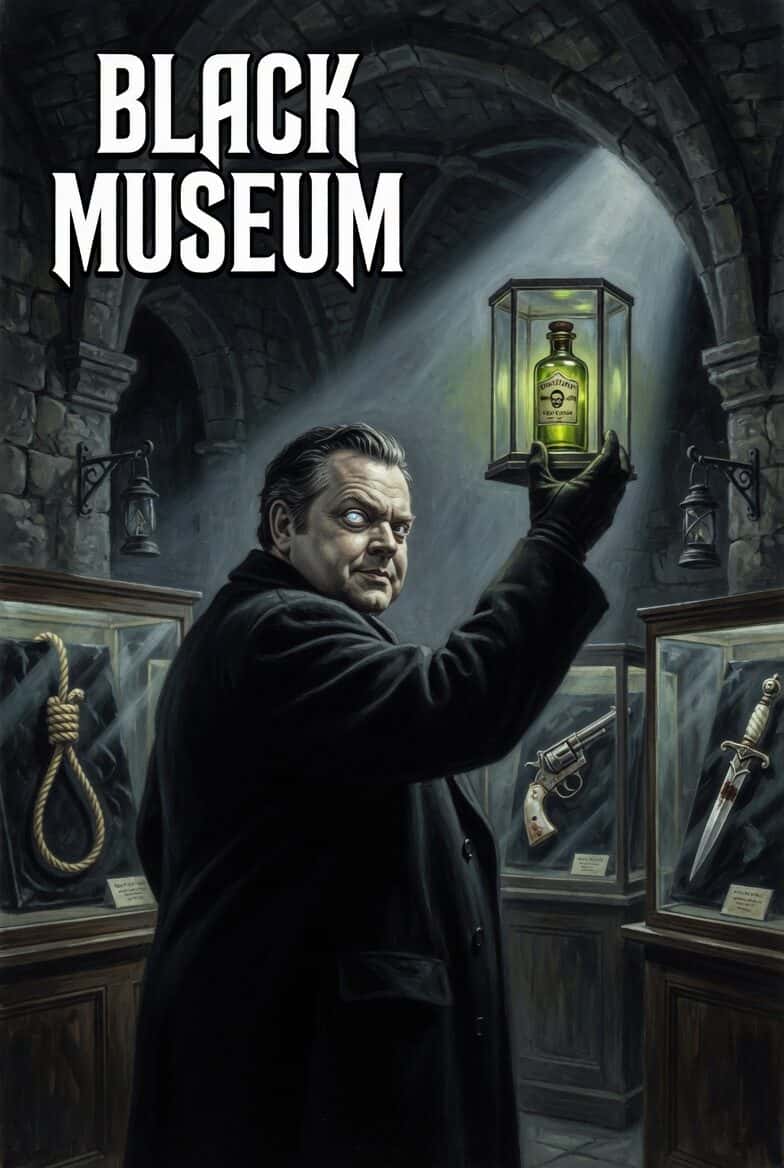
This is Orson Welles, speaking from London. Here in the grim stone structure on the Thames, which houses Scotland Yard, is a warehouse full of souvenirs. Where everyday objects, a skipping rope, a glass, an iron, a stepladder, all are touched by murder.
You take this key. This was on the floor beside the body, sir. A door key, the kind that fits only one lock. But whose? Perhaps the murderer's, sir. Today, this key can be seen in the Black Museum.
From the annals of the Criminal Investigation Department of the London Police, we bring you the dramatic stories of the crimes recorded by the objects in Scotland Yard's gallery of death, the Black Museum.
In just a moment, you will hear, The Black Museum. The Black Museum, starring Orson Welles. The Black Museum, starring Orson Welles. The Black Museum, Scotland Yard's museum of murder.
Here lies death, arranged neatly on the shelves and tables open to your view. Now here's a spoon. It's a simple household spoon. Our murderer was meticulous. With this, he measured out a careful dose of poison. That oar up there on the wall, that was used by the stroke of a famous rowing eight at Henley. Later, it was used in anger, swung at a man who stood on the edge of a pier, stunning him. The man drowned in the Thames very quickly.
Ah, here we are. Here's the key. An ordinary key. The kind used to open most of the front doors in London. Once, this key was in the pocket of a man who was waiting for another in his room at the Kingsley Arms Hotel in Surrey.
Regan? Oh, I... I'm sorry. I'm sorry. Excuse me, sir. I'll just turn the bed down.
Certainly. I'm waiting for Mr. Regan. You don't happen to know what time he'll be back, do you?
No, sir, but if you wait here, you're sure to catch him.
Thanks, I will. I particularly want to see him.
The conversation lapsed. The visitor sat down again. The maid completed her work and left, stealing a glance at the young man as she closed the door behind her.
Night fell. Lights came on in the guest bedrooms. But in one room, the number on the door was 22. A man sat alone in the darkness. Waiting.
The night passed, and morning came. In the hotel, there were beds to be made. Rooms to tidy. No answer from room 22. The maid was pleased her work had been accomplished without interruption. She was thinking of this as she opened the door. Stepped in, the bed was unused, turned down just as she'd left it. Sunlight was flooding through the two windows. And on the floor, a man lay dead.
The manager called the police. The police requested the assistance of Scotland Yard. And Inspector Sidney Russell and Detective Sergeant Hobbs were sent down to Surrey.
This is the room, sir, number 22.
Has anyone been in there since the maid found the body?
No one, Inspector, except myself and the local police sergeant. On his orders, I kept the room locked.
Good, ma'am. There you are. Thank you. I'll let you know when we need you, sir.
The two detectives covered the room, and in their quick survey of the murder scene, they found several leads.
His wallet, sir.
Let's have a look at the identity.
Identity card, sergeant. Here you are, sir. Hmm. Name's Thomas Regan. What else have you got there, sergeant?
Roll of notes, sir. The killer either missed that, or the motive wasn't robbery.
Oh, I don't think it was robbery, sir. His watch is still on his wrist.
Going?
No, sir. It stopped at 7:25. That might have been the time the murder took place. Though, on the other hand, the watch might have run down this morning.
He was shot through the head, sir. Surely somebody must have heard that.
You would think so? Well, here's a shell I found on the carpet.
Hmm. .22. We'll keep this for ballistics. What else, sergeant?
Oh, some silver taken from his trouser pocket, a handkerchief with the initials TR in the corner, and a cigarette lighter.
With the initials TR.
Hmm. He's well-labeled. And this was on the floor beside the body, sir.
The door key. The kind that fits only one lock. But whose? Perhaps the murderer's, sir?
Unless it belonged to Regan himself.
Oh, it's not the kind they use in hotels.
No. Was he wearing or carrying a keychain?
No, sir.
Then the key would have been carried in his pocket along with his money. Which hadn't been spilled onto the floor.
You may be right, sergeant. But to make absolutely sure, that key should be checked against every lock in Regan's home and his office and everywhere he might have occasion to visit. If it does not belong in any of those places, then it seems to me that when we find the door that key fits, we find the murderer.
The detectives went downstairs to talk once more to the hotel manager.
Inspector, this is a terrible business. Listen to those men in the bar.
What about them?
They're newspaper reporters.
Oh, this is really dreadful. The notoriety, the reporters, the headlines. It'll ruin my business.
It wasn't very nice for Mr. Regan, either.
No, I suppose not, poor devil. What can you tell us about him?
Only that he was a commercial traveler. He's stayed here before?
Several times.
A traveler, eh? Did he work for any firm in particular, would you happen to know?
Yes, I do know, because they always paid the hotel bills. He worked for a London firm, Hardian Sons Limited.
Thank you, sir. I'll leave the room upstairs locked until we have it photographed and checked for fingerprints.
Oh, Inspector, there's one other thing I'd better mention. I think it's important.
Yes?
A man called to see Mr. Regan last night.
Did you get a good look at him?
I didn't see him at all, nor did the desk clerk. The maid found him waiting in room 22 when she came in to turn the bed down.
Unusual, isn't it? Knowing Regan's room number?
It's just an acquaintance. Not necessarily, Inspector. Why do you say that?
We have a register here in the foyer. It's on that wall over there.
A room register?
Yes, just a card opposite the room number. Some people don't bother with it, but Mr. Regan always put his card up.
So that maid is the only one who saw this man?
Yes, Inspector.
Then I'd like to talk to her, sir.
Oh, I'll go and get her for you.
The hotel manager returned almost immediately with a maid. She was a young girl, very pale, her eyes still fearful from the sight she'd seen on the floor of room 22.
Annie Mitchell, Inspector.
How do you do, Annie? This is Inspector Russell from Scotland Yard.
How do you do, sir?
Annie, what time did you turn down the bed in room 22 last night?
It was going on for six, sir. And I believe Mr. Regan was not in his room.
No, sir, but there was a man there.
Could you describe him to me?
Well, he was tall, fairly young-looking, and dark hair. He spoke educated language.
I see. What did he say?
Just that he was waiting for Mr. Regan, and he particularly wanted to see him.
Tell me, would you know this man if you saw him again?
Yes, I think I would.
The Inspector was well satisfied. But Sergeant Hobbs, who had been questioning the guests, had not fared so well.
Now, sir, I'm sorry to trouble you, but I have to ask you a few questions.
Really, this is most annoying. I've been kept here all the morning, and it's extremely inconvenient.
I quite understand, sir. Now, can you tell me whether you heard any unusual noise or disturbance during the night?
The only disturbance of which I'm aware is the disturbance created by the police this morning.
You didn't hear a shot, for instance?
Certainly not.
And you were in your room the whole evening?
Yes. Can I go now?
Yes, that'll be all. Thank you very much.
Well, it's certainly not been a pleasure.
It seems nobody heard a shot last night, sir.
Nobody at all?
Not a single guest, even those occupying adjoining rooms.
Sir, that's funny. Anyway, I'm leaving you in charge here. The police surgeon will be arriving to carry out a post-mortem.
All right, sir. Are you going back to London?
Yes, I think the case winds up there. The next move is to London to check that key against every lock in Mr. Regan's home and his office, just to see if it fits.
I'm very sorry to bother you, ma'am, but I'd like to go right over the house, if you don't mind, trying the locks. And if there are any cases or cupboards, et cetera, that I might miss, I'd be very pleased if you'd point them out to me.
I've come along to see if you can help me, sir, in connection with Mr. Regan. I want to know if there's any desk or cupboard in his office, or the office door itself, which has a lock for which this might be the key.
I believe you've a lock-up garage here, formerly rented by Mr. Regan. It must, of course, have a lock, and I'd be glad if you'd allow me to compare the lock with this.
No, sir. I've checked every conceivable place connected with Regan, and the answer's the same everywhere. The key does not belong.
Hmm. In that case, we have our answer. Somewhere, someplace, Sergeant, there is a door, and behind that door, we'll find the murderer. You know, if I was a philosopher, I would say that it's rather symbolic that we have a key to which we must fit the lock. Still, I'm not a philosopher, I'm a detective, and it's our job, Sergeant, to find the lock, to find the door, and to find the murderer. And that's just what we're going to do, Sergeant. We're going to find the door that this key fits.
In time, they were to find the door. By patient, methodical methods, they came to the front door of a small flat. The key fitted. The same key that can be seen today in the Black Museum.
In just a moment, we will continue with The Black Museum, starring Orson Welles.
Now, we continue with The Black Museum, starring Orson Welles.
Inspector Russell went back to London, certain that the crime had motive, and that the motive would only be found by a search into the habits and associations of Thomas Regan. His first call was to the offices of Hardy & Sons Limited, where he was speedily ushered into the presence of the reigning Mr. Hardy.
Come in, Inspector. Sit down.
Thank you, sir. Shocking business. Now, who could have wanted to kill poor Regan?
That's what we're trying to find out.
Of course. Shocking. One of our best travellers.
What do you know of his personal life, Mr. Hardy?
I may be able to help you there, Inspector. I believe in taking an interest in my employees. I've always encouraged them to bring their troubles to me.
And Regan had troubles?
Yes. He was a bachelor. Rather a gay one at times. I suspect he, er... He was having trouble over a woman.
Yes?
A married woman. A married woman. She kept on ringing up to speak to him. And the thing spread in the office. He was rather embarrassed and slightly worried about it all.
Do you happen to know the woman's name, Mr. Hardy?
I'm afraid I can't help you there, Inspector. Though, er... Wait a minute.
Yes?
He did mention something. That's right. I've got it now. Er, he didn't want to tell me her name.
That's a pity.
But in admitting she was married, he did tell me that her husband was a doctor, on hospital duty.
A doctor?
Yes. And, er, one other thing I recollect. He mentioned her first name. It was Lyndall.
And I have information that the man we want to interview is young. That suggests a hospital intern.
Yes. With a wife named Lyndall.
Hm. Not very much to go on, Inspector.
It might be quite a help. He never told you, I suppose, whether it was a London hospital or not?
He never said so. But I'm quite sure it would be. At least the wife lives in London.
What makes you think that?
Well, the number of telephone calls that woman made to Regan. Nobody could afford that many trunk line calls.
So they began in London, St. Bartholomew's Hospital. An intern or a young doctor whose wife's name is Lyndall. The registrars of the big hospitals consulted their records, made special inquiries. St. Thomas', Westminster, Guy's. Each one of them returned to shake his head. There are several hundred hospitals in the London area. Big general hospitals, small private nursing homes, special hospitals, children's hospitals, maternity, infectious, orthopedic hospitals.
At the first forty-two, they drew a blank. Then at the London Royal Hospital at last.
A young intern whose wife's name's Lyndall.
That's a funny one, Inspector.
It's all the information we have, Doctor. It's useless to ask, I suppose, whether you might have this man on your staff.
But we do have him.
What?
Well, at any rate, one of our interns has a wife named Lyndall. Doctor Bowen, Doctor Felix Bowen. I'll send for him, shall I?
No, wait, Doctor. Could you give me some idea what this Doctor Bowen looks like?
Yes, I think so. He's young, thirty-one, I think, quite tall, dark hair.
Would you have his address here in your records, Doctor?
Certainly. I'll get it for you, Inspector. Thank you. And shall I send for Doctor Bowen?
No, I don't want to see him just now. And I don't want it known that any queries have been made about him.
Very well, you can depend on me. Is he in some kind of trouble?
Nothing to worry about just yet, sir. Now, if you'll get me that address.
Patience had paid off, the forty-third hospital. Now, to interview Lyndall Bowen.
Inspector Russell went to the address. He'd been given a small flat in a good residential district. The lock on the door fascinated him. The urge to try out the key in his pocket was almost overwhelming. But instead, he knocked.
Mrs. Bowen?
Yes?
I'm Inspector Russell from Scotland Yard.
Scotland Yard? May I come in?
Yes, of course. Thank you.
She was young, an attractive woman, but her eyes were frightened.
Mrs. Bowen, when did you last see Thomas Regan?
Regan? Thomas Regan? I think you know who I mean.
But I don't, Inspector. I'm very sorry.
Not at all, ma'am. Perhaps I'm mistaken. Well, of course, I've read about him in the papers. That is, if it's the same Mr. Regan.
It is the same. Mrs. Bowen, with your permission, I'd like to conduct a small experiment.
Experiment? I don't understand, Inspector.
It's quite simple. This key.
Key?
I'd like to try it in your front door.
But I...
Of course, if you choose to say no, then I won't be able to try it.
You won't? But I also ought to warn you that I can return in a very short time with a warrant.
All right. Try it.
Thank you, Mrs. Bowen. I'll just open the door and insert the key.
The key turned effortlessly and easily. Hope died in the woman's eyes. The inspector from the yard took out the key and closed the door again.
And now, Mrs. Bowen, you and I are going to have a talk about Thomas Regan.
That afternoon, several significant events took place. A gun was found beneath a pile of medical books. It was taken to Scotland Yard to the ballistics expert there.
The gun check, sir.
That's a murder weapon, right enough. Little wonder nobody heard the shot in the hotel. It's fitted with a silencer.
A silencer?
A silencer. Evidence of premeditation.
Late that afternoon, the record of its purchase was uncovered. The second significant event.
The gun was bought at a shop in the Soho district, sir. A secondhand shop two weeks ago.
By whom, Sergeant?
The description covers Doctor Felix Bowen, and the proprietor says he could recognize the man if he saw him again.
We'll give him that chance. Come on.
Where to, sir?
The hospital to pick up Bowen.
The main event was Bowen's flight across London. Somehow, in some way, the doctor learned of the net that was closing about him and made a run for it. He was gone when the detectives reached the London Royal Hospital. They drove to his home, but he wasn't there. Across England, the vast network of police communications went into action. The teletype carried the news of the fugitive. Wanted on suspicion of murder. The search was on. In a thousand stations, vigilant eyes searched for Bowen. On the streets, on trains and buses, in restaurants and hotels. Within twenty-four hours, he was picked up.
I really must insist. This is a terrible mistake. I really don't know what this is about.
And I'm sure you've got nothing to worry about, sir. Just answer a few questions, that's all.
Of course, I'm perfectly prepared to cooperate with the law. But I must insist on an explanation at once.
Yes, yes, of course, sir. You see, unfortunately, your appearance coincides with the description of a man wanted by the police. It's just a routine matter, sir. If you'll give me some proof of your identity, we can clear the matter up in a few minutes.
But I explained to the constable, it's no longer compulsory to carry an identity card.
Yes, I know that, sir. But before we release you, we must have proof of your identity.
Yes, but how can I? You see, sir, we must be sure you're not the wanted man. But I told you all that.
Now, Mr. Bowen.
Yes. Yes, Doctor Bowen. Inspector Russell. This is Sergeant Thompson, sir. I picked up a man.
Hold him, Thompson. I'll be there in a matter of minutes.
Inspector Russell hoped for an easy confession. He was disappointed. The doctor was defiant and tight-lipped.
I know nothing. I tell you nothing. Whatever. This whole thing is an outrage.
I must remind you, sir, that your wife has made certain admissions.
My wife? What has she told you?
That she and Regan were having a love affair, that you found out. And the day before last, you went down to Surrey to see Regan. You returned late that night.
Did I?
It was a long way. You had a file of medical books in your bookcase. We found the gun you used. The game is up, Bowen.
The game is never up, Inspector. Until it's lost.
The evidence they had accumulated was impressive, but juries are cautious and defense counsels are often very smart. There had to be no loopholes. There had to be complete corroborating evidence.
I think we've got our man all right. The next thing is to prove it beyond all shadow of doubt.
What's the next move then, sir?
You've got more than a passing glimpse of the murderer.
Oh, you mean Annie, the maid at the hotel.
Right. We'll see how Mr. Bowen fares in an identification parade. I have a feeling he won't fare too well.
May I expect you've heard of an identification parade?
Yes, sir, like they have on the films.
That's right, Annie, but this is not a film. This is the real thing. Before we go into the next room, I want to impress on you how important it is that you make no mistake. A man's life may depend on your judgment. So when you answer me, make sure, absolutely sure, beyond any shadow of doubt, the man you identify is the man you saw on the night of the murder.
Yes, sir.
Right, then. Now, in the next room, there are eight men. I want you to follow me into the room, take a good look at each of them, and see if you can pick out from amongst them the man you saw in room twenty-two waiting for Mr. Regan.
Very well, sir.
It's not the first gentleman, nor the second. But this is the man, sir.
That's a lie.
Yes, and that's his voice. I'd know it anywhere. This is the man, Inspector.
Now, Mr. Bowen, would you like to make a statement to us now?
I have nothing to say, except that I doubt that the evidence of a silly maid is likely to give you a conviction, Inspector, whatever you may think.
We're depending on more than that, Mr. Bowen. There are other witnesses, including a silent witness, a door key. That was careless of you, Mr. Bowen. Very careless indeed.
Bowen was identified also by the owner of the secondhand shop, as being the man who had bought the gun some two weeks before. With that, the case was complete. A door key had helped to find a murderer, and that selfsame key can be seen today in the Black Museum.
Orson Welles will be back with you in just a moment.
In person is Orson Welles. Bowen killed the man who had stolen the affections of his wife. His was not a clever crime. It was premeditated, without a doubt, but clumsily conceived. For the young doctor was no student of the art of murder. Yet he might have escaped justice had not a key fallen from his pocket. A key which ultimately brought the police to his front door. And now, until we meet next time in the same place and I tell you another story about the Black Museum, I remain, as always, obediently yours.
The Black Museum starring Orson Welles is presented by arrangement with Metro-Goldwyn-Mayer Radio Attractions. The program is written by Creswick Jenkinson with music composed and conducted by Sidney Torch. Produced by Harry Alan Towers.