
The written record
Read the transcript
Read along with the recording · About 19 min to read
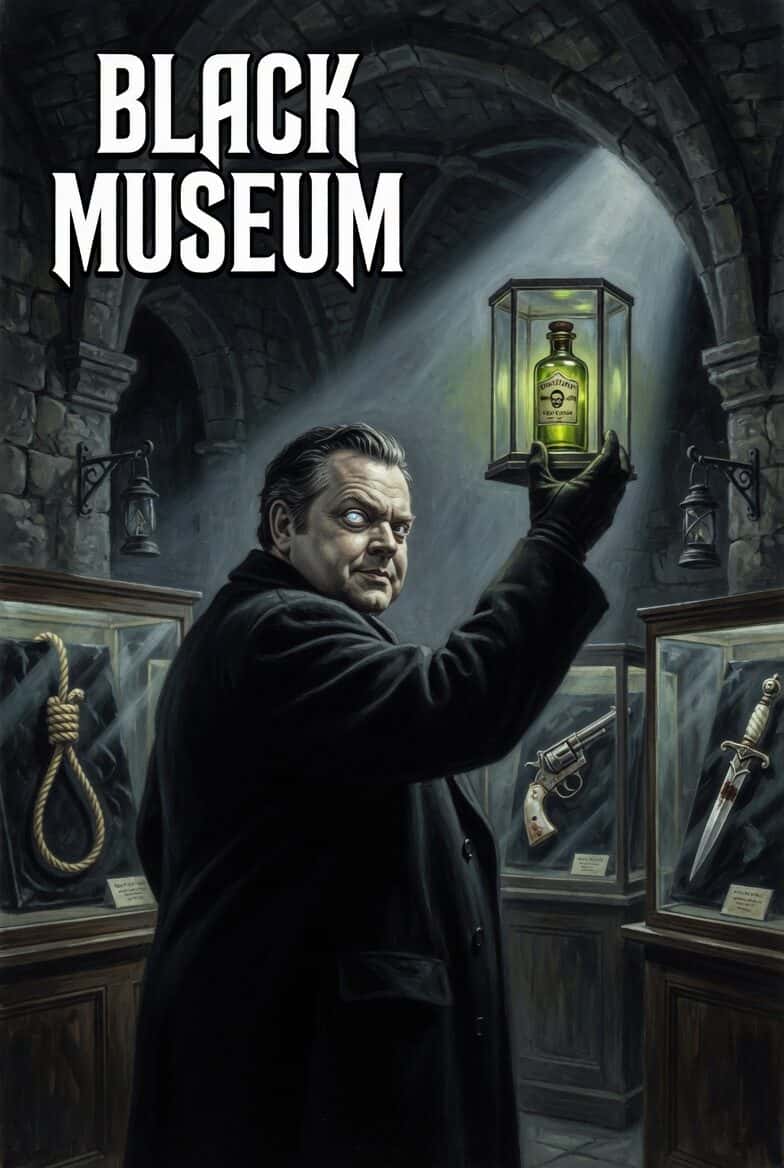
This is Orson Welles, speaking from London. The Black Museum, a repository of death, a repertorium of violence. Here in the grim stone structure on the Thames, which houses Scotland Yard, is a warehouse of homicide. Where everyday objects, a teacup and its saucer, a lady's parasol, a surveyor's chain, all are touched by murder.
Now you take this lady's shoe. It's a familiar object, high of heel, neat cross-straps, dainty design on the toe, an excellent sample of the art of the modern bootmaker.
Like my new shoes, Henry.
Lovely, my dear. Shows off your instep perfectly. And the way it breaks away from the curve of your arch. Enticing. Definitely enticing, my dear.
Henry, you're impossible.
And I love it. A nice couple. Talking about a pair of shoes. You'll hear more about that couple, and more about the shoes. One of those shoes, by the way, is to be found today in the Black Museum. In the channels of the Criminal Investigation Department of the London Police, we bring you the dramatic stories of the crimes recorded by the objects in Scotland Yard's gallery of death, the Black Museum.
In the Black Museum, Scotland Yard's mausoleum of murder. Here lies death. In two. A mausoleum of murder. A mausoleum of murder. A mausoleum of murder. Neatly with printed labels. With records of names, places, times. Each white card a kind of tombstone.
Very interesting collection in this museum. Here, there's a gardener's clippers. If you have a hedge around your property, you own one. Long, sharp, triangular blades. They're fine for clipping boxwood. Fine, too, it was learned, for clipping jugular veins. And here's a true weapon, a revolver, a lady's gun. Just a little .22, but the lady who used this one one summer evening made very sure of her victim. She coated the tiny bullets with cyanide.
The shoe, or the pair of them, of course, charming, delightful. That's the type of fragile footwear a lady of some means would be expected to own. Elizabeth Marlowe was just such a lady, and she bought the shoes to please Henry Higley, who had persuaded her that her age of nearly 40 was not too old for marriage. And she wore them as she drove through the stormy night, which marked the beginning of her honeymoon.
The storm seems to be getting worse, Henry, darling.
Don't worry, my dear. Here's the inn. The light's just ahead.
Too bad the house wasn't ready for us tonight.
Our first night in our own house? I'd have loved it, dear. It's so charming, so Elizabeth. And from half timber to the moat. Imagine a house with a moat.
I wanted something, Elizabethan, darling. After all, it'll be a setting for my Elizabeth.
Gay, happy conversation, honeymoon talk. In spite of the rain pouring over the windshield. In spite of the dramatic lightning and the rolling thunder. Henry helped Elizabeth out of the worst of the rain, handed her a fine little terrier named Patsy, which Elizabeth had insisted on bringing with her, and then knocked on the door, and the door of Webley's inn.
Sorry to keep you waiting. Come in, please.
I'm Henry Higley. This is my wife.
You're Martha Webley. I've given you up, what with the weather and all.
We wouldn't have missed this for the world, Mrs. Webley. The storm. Well, it's almost romantic.
Oh, the little dog. Oh, isn't he sweet?
Are our rooms ready, Mrs. Webley?
Of course. And a fire going against the storm. Oh, and may I take the opportunity, ma'am? Serve. Of wishing you all the happiness.
The Higleys stayed at the Webley Inn for several weeks until the house was ready. The Elizabethan house with the half-timbers and the moat standing on the edge of the moor. As Martha Webley put it, They were so happy. Middle-aged, but happy as kids. If laughter and enjoyment of simple things is happiness, then Henry and Elizabeth knew happiness. They drove over to their house each day and each evening, and discussed its progress.
Would you like the moat drained, dear?
But the water is part of it. Without the water, it would be just a ditch. I thought perhaps you'd like to make a rose garden out of it.
But there was a garden at the rear of the house, so the water stayed in the moat. The mock drawbridge was always down, and very soon, Henry carried Elizabeth across the bridge and into their home.
Home at last. It's going to be wonderful, dear.
Glad you bought the place?
We bought it, darling. With your money, Swede? But mine is yours. Ours, darling, always. Now, come along upstairs.
There's always a lot to do in a ten-room house. Nobody with any sense tries to run a place of that size without help. So Henry, with Elizabeth's approval, interviewed several local young ladies.
What's your name, young woman?
June Godwin, sir. And here's my reference.
Hmm. Yes, I see. Upstairs maid, also parlour maid. Any cooking?
Just plain cooking.
My wife and I are plain people. We thought we'd try to get along without a regular cook, for a while at least.
I'll do my best, sir.
I'm sure you will. Then I'm hired, Mr. Higley.
Why not? You've a good reference. That'll please your mistress, and you've your share of good looks. That pleases me. That was the way the wind blew, wasn't it? And so soon after the wedding. Well, well, well.
Little June Godwin went about her business dismissing the remark as the pleasantry of a new employee. Oh, I wanted to feel at home. Now Henry established the custom in that household of giving his wife her breakfast in bed. June prepared the tray and took it upstairs. She'd been doing this for about a week.
My, don't we look fresh and neat and beautiful this morning?
Please, sir, don't.
Shy, are you, eh? With those eyes and that figure. Come here, little one.
No, sir, please.
What do the boys hereabouts think of you?
I wouldn't know, sir. If you'll excuse me, sir, I'll take the tray to Mrs. Higley.
Handled herself well, didn't she, to a country girl. There's no nonsense about June Godwin. She needed the job. She was a loyal girl, loyal to her mistress and to herself, in a way. Maybe that's why she spoke as she did. She deposited the breakfast tray in Elizabeth Higley's bedroom.
Ma'am, if I can speak to you a minute.
Of course, June. What's the trouble?
It's about Mr. Higley, ma'am. Oh. He... Well, ma'am, it's not that I'm giving my notice or anything, but I'm a nice girl, ma'am.
Of course you are.
Mr. Higley, ma'am, he tried to take privileges this morning. Perhaps you'd better try to...
June finally managed to tell her mistress the brief details. Elizabeth was hardly pleased, but she showed nothing of her feelings to Henry, at least on that score. Of course, there may have been something more than a slight edge to her tone later that day. As she said to him...
There's a notice from the bank, Henry. It says my account is overdrawn.
Oh? How much?
Almost 300 pounds. This never happened to me before I added your signature to the account.
Oh, but there was plenty there.
Oh, I know. But there's a check here which I thought was for 30 pounds, and it turns out to be for 300.
But I thought I told you, darling. It was 300. In any case, dear, your dividends are due in a few days, so let's not worry about it.
A simple explanation, and very smooth. Just the type of explanation an infatuated woman can be expected to accept, but for Elizabeth, the infatuation and the honeymoon were over. They came to an abrupt end about a week later.
Excuse you. I want to see you a moment.
Can it wait till morning, Mr. Higley?
Please. Impossible. I must see you now.
I can't let you in. I'm in bed. I'm not dressed.
That doesn't matter. Let me in, June. I have to talk to you now. I'll use my master key.
Oh!
Come up and let me in. Shut up, you little fool. Open the door. All right. But we'll settle this and soon. Soon. You, Mrs.
I understand, June. It was my husband. Again. Wasn't it?
The end of the honeymoon. It came quickly after that. Elizabeth said simply, Henry, I'm leaving you. I'm going to London to talk with my lawyer.
After your talk, you'll change your mind. Taking a servant's word against mine. Really, my dear. What train are you making? I'll drive you into town.
A little while later, Henry dropped into the kitchen and told June quite coolly. I'm driving Mrs. Higley into the station. She's going up to London. I'll pick her up on the 9:45 tonight when she comes back.
At 9:15 that night, Henry told the servant girl. I'm going in to pick up Mrs. Higley. We should be back a little after 10.
And at 10:15, Henry came back. Funny. Mrs. Higley wasn't at the station. She must have missed the train and decided to stay in town for the night.
And then, the next day... I've had a letter from Mrs. Higley. She's staying with relatives in London for a few days. Nothing to worry about.
But June did worry. And she took her worries to her mother.
I'm sure he's lying, Mums. I'm sure of it.
Now, Junie, don't be excitable.
I'm not, Mums. I'm not. He told me he was going to the station to call for her. But I didn't hear the car.
Perhaps you weren't paying attention.
He said he had a letter. And the postman never called that morning. And last night, he tried to get into my room again. I won't go back, Mums. Now I'm home again, I won't go back.
Orson Welles will be back with you in just a moment.
This was gossip. Oh, yes, gossip indeed. But Mrs. Godwin restrained herself for a while. After all, there was only one other person in the village who knew the Higleys. That was Mrs. Webley at the inn.
Yes, Mrs. Webley. Now, what's all that?
What? Oh, it's the Higley dog. Patsy. Oh, here, Patsy. What's the trouble, doggie? Miss your mistress, is that it? Do you miss your mistress?
The shoe, by the way, reposes today in an honored position. A black museum. A dog howls at the back door and whines with fear. Then it wags its tail and snuffles in appreciation of a pat on the head. But mention its mistress, and the howling begins again. Is this a clue to a possible... ...criminal crime? Certainly, it'd have no meaning in a court of law. A clever defense counsel would have it stricken from the records within minutes. But it would have meaning among plain people who are sensitive to many of the laws of nature.
Another cup of tea, Mrs. Godwin.
No, thank you, Mrs. Webley. June, dearie. I couldn't touch a thing. I'm so upset about the poor little dog.
Oh, she's all right. I'm sure that...
But you said you called them out, House, and he came for the dog right away.
Oh, I doubt he'll hurt the little animal. He has other things on his mind. He has with that one working for him.
That Muriel, you mean.
Exactly. And glad I am that my June up and left him when she did. Have you seen or heard of Mrs. Higley, dear?
Not a word. No sign. But then, maybe she knows about that Muriel.
Three people knew about that Muriel by now. A new hired girl at Henry Higley's house. And before very long, others would know. But this held no foreboding for Henry Higley.
Now for that Muriel.
Now, Mr. Higley, you must...
Why not, my dear? Who's to know except you and me?
Oh, Mr. Higley, how you do go on.
Mr. Higley. Give us a kiss, pretty one. But never say I told you it went with the job.
Well, just one.
When are you going to stop calling me Mr. Higley?
A kind of mean paradise surrounded by a moat filled with water, reached by a marked drawbridge which was never raised, and into that pseudo-idyllic setting across that... bridge. There strode a caller. He rang the doorbell.
Yes, sir?
Is Mr. Higley at home?
Who might be calling, sir?
Inspector Sterrett, Scotland Yard.
Three people knew. And soon many more. Word spread, the police events, some interest. The inspector called and was invited in. He was offered a drink, tea. He refused politely.
Oh, thanks, Mr. Higley. No, I've only a short while.
Well, may I ask the whereabouts of Mrs. Higley?
Of course, you may ask. As far as I know, she's staying with friends in London. I've some letters, if you can't see them.
Oh, we'll take your word for it, Mr. Higley. But there's been some talk. Ugly rumours, you understand, I'm sure.
Yes, I had to discharge a servant girl.
We were given to understand she left of her own accord.
Not at all. The girl seemed a trifle hard of hearing. Couldn't hear my car on the driveway. Missed the postman's whistle constantly.
I see. And then there's the little dog. Seems to have been howling a bit. If you look out of the window, there, in the back garden, eh? Seems quite contented, doesn't she?
Yes, yes, yes, she does. Well, thank you very much for the courtesy.
The inspector took his leave. When the door closed behind him, Henry Higley did some thinking. The next day, he spoke to Muriel.
How would you like to take a trip with me, Muriel?
Oh, you mean close up the house?
Why not?
I'm not sure I want to go away. Oh, you're a sweet man, Henry, but I live here.
You've no idea how we could live. What fun we could have. I can draw all the cash from the banks in ten and twenty-five pound notes, so it wouldn't take too much room, and we could have a time in London, a real time. I'd buy you some...
So Henry planned a little trip, and he took the trip. Oddly enough, Muriel didn't go along. Her permanent tie was not in her plans at the moment. She stayed behind in the house with a little dog for company. All was quiet after Henry went away. Quiet, yes. Inactive?
Tell me, Miss... Mr. Marlowe, when did you last hear from your sister?
Elizabeth wrote us just after she moved into the house with her husband. I'm afraid we never answered her. The family disapproved of Higley, you see.
Oh, any particular reason?
Well, he was penniless. Elizabeth, as you probably know, has a nice income from quite a bit of capital. She bought the house, you see.
Yes, yes, we heard about that. That's one reason we sought you out, Mr. Marlowe. Are you intimating the possibility of trouble, Inspector?
There's always the possibility when a grown person disappears without a trace. And there have been rumours and a few odd coincidences. In any case, we checked the bank. The manager showed us these papers.
What are they?
A deed transfer giving full title to the house and property to Henry Higley. Is this your sister's signature, Mr. Marlowe?
Oh, let me see. I need my glasses, I'm afraid. Now then, looks like hers, but... since she's suddenly grown old, it wavers so. There, for instance, the L and the W in the Marlowe. Elizabeth Marlowe Higley. Inspector, I want to compare it with her letters, but I think I can say with reasonable certainty that this is not my sister's signature.
Thank you, Mr. Marlowe. Thank you.
To all stations, alert for one Henry Higley wanted for forgery. Notify all banks. The following serial numbers are of 25 pound notes connected with forgery cases. Appearance of any of these notes could be called to the attention of the local police at once in the usual manner.
At long last, the hunt was on. The charge pending: Forgery. The days passed. Nothing was reported. Though an occasional bank note with a proper serial number did turn up in the ordinary course of business. Patiently, the places where the notes appeared were charted. First, Ramsgate, then Dover. A week later, Folkestone.
I imagine we'll find he spent a few days in Paris. After that, Kingston. I expect we'll be hearing from London itself shortly.
From London itself. How long did it take to change a mere 25 pounds? One would think the Bank of England had that much cash in small denominations lying about.
I beg pardon, sir. Are you the gentleman wanted to change this note?
I am.
Would you mind stepping this way for a moment, sir?
I'm rather in a hurry. Is something the matter with it?
With the note? No. My credentials, sir.
I see. Detective Inspector Andrews. And you, sir?
Higley. Henry Higley. Why all the mystery, Inspector?
I'm afraid I shall have to ask you to come with us, sir. You see, the serial number of this bank note and several others have been published in a small matter of forgery.
Forgery? What's that to do with me?
I'm sure you had nothing to do with it, Mr. Higley, and that you will be most anxious to cooperate with the police. This way, sir, if you don't mind.
Henry did mind. His sense of cooperation became stunted quite suddenly. He found very little to tell Inspector Sterrett and Andrews.
Of course I drew the money. It was a joint account. I had a right to.
And what is your explanation of the transfer of the house?
There's none I can give you now. When Elizabeth returns...
Where is your wife, Higley?
She didn't say. Just staying with friends.
Any reason for that?
Well, we had a quarrel. A lover's quarrel. She'll get over it when she comes back.
You seem very certain she will come back. Have you any reason?
Inspector, do you doubt that she will?
No, not at the moment, nor any reason to doubt that you will be here awaiting her.
Do you mean to say you're thinking of holding me on charges?
Frankly, we are. You see, Higley, we did a little routine checking. We found that you'd been arrested three times. Convicted once. In each case, the charge was swindling women who were old enough to know better. So we are holding you, Higley. And the charge is forgery.
Now, the direction of the search changed somewhat. Henry Higley was safe, and he'd remain so until Elizabeth Marlowe Higley was found.
There's no right to take the house apart like this. Mr. Higley will be...
I'm sorry, my girl. We have a warrant.
I don't understand, sir. What are you looking for?
Not what, my girl. Whom. We're looking for Mrs. Higley. In the cupboards and under the floor.
No. Oh, it isn't true. It isn't. She went away...
They took the house apart and put it back together again. Nothing. They dragged the moat around the house. Nothing. Then they drained it.
There it is, sir, dry as it ever will be, and nothing. Not a sign.
Mud looks mighty deep.
It's a quagmire down there. Watch this. Takes that stone as if it were nothing. He couldn't have thrown a body that far out, and there's no sign of anything on the sides.
He might have waded out, Andrews.
The water wasn't particularly deep. He'd have gone in up to his waist if he'd tried that.
You know, it takes good soil to make mud.
Mud like that?
Yes, I noticed. Funny the way they let the garden go to seed.
Oh, it's not too bad. Except for that patch of stunted bush over there.
There, where the dog's lying. Let's have a look at that, shall we?
You never quit, do you, sir? Human beings can't disappear without a trace. They just don't, that's all. That's a good dog. There we are. There, there, there.
These aren't stunted, Andrews. These are new planting.
You're right. Look here, the whole area, straight to the moat. This earth was turned, and fairly recently. At least ten yards of it.
That's a ditch, Andrews, a ditch that has been filled in. I think maybe we ought to start digging hereabouts.
Eight hours now, and still nothing.
There'll be nothing. Another good idea gone wrong. Shall I tell the men to stop?
Yes, you may as well.
Sir! That dog! She's found something.
Yes, something she's recognized. Get those lights over here, man.
All right, sir, coming up here.
All right, you can start digging. But carefully now, all around that spot. It's pretty obvious, Andrews. There's a body attached to that lady's shoe.
And as I told you at the beginning of this story, that shoe reposes today in an honored position in the Black Museum. The medical examiner swore that a .32 caliber bullet had killed Elizabeth Marlowe. The ballistics expert testified the bullet had come from the gun in Henry Higley's possession the day of his arrest in the Bank of England. Another expert adjusted the noose, placed the white hood over Higley's head, heard the man whisper the admission of his guilt, and sprang the trap.
Martha Webley has Patsy now. The dog enjoys the fields around Webley's inn. A fit reward, I think you'll agree, for the faithfulness which brought her mistress's killer to final justice. And as I told you, the dainty shoe remains in its customary position. That big stone building on the Thames in Scotland Yard in the Black Museum. Now, until next time, until another story about the Black Museum, I remain, as always, obediently yours.