
The written record
Read the transcript
Read along with the recording · About 18 min to read
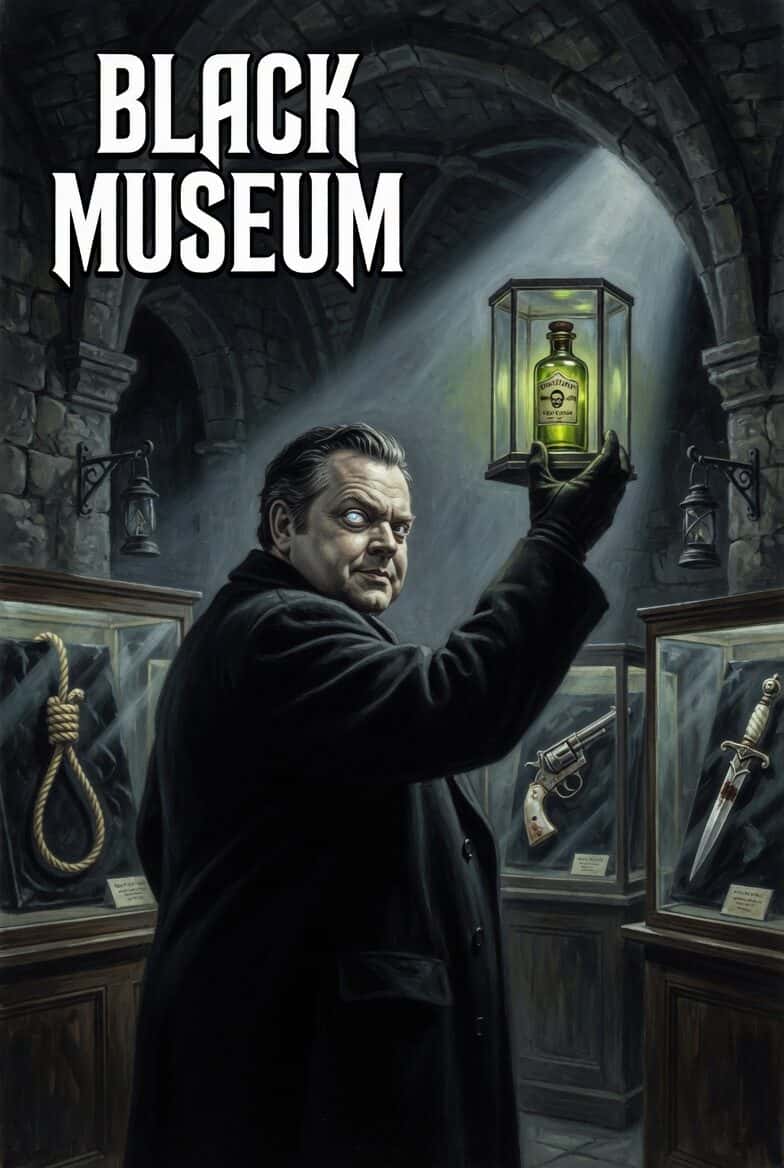
This is Orson Welles, speaking from London, the Black Museum. Here in the grim stone structure on the Thames, which houses Scotland Yard, is a warehouse of homicide. A warehouse where everyday objects, a phonograph record, a desk pad, a flashlight, all are touched by murder.
That's a familiar object. A doctor carries a bag like this, or a bank messenger, a payroll clerk. Neat, compact, light. That's the kind of thing to carry the weight of death. You know, Sergeant, I like to think of all our cases as wrapped up neatly in a bag, like this. One package.
I know what you mean, Inspector. This case now, it should have been open and shut, like that. Today, that leather bag.
From the annals of the Criminal Investigation Department of the London Police, we bring you the dramatic stories of the crimes recorded by the objects in Scotland Yard's gallery of death, the Black Museum. In just a moment, you will hear the Black Museum, starring Orson Welles.
Familiar place, at least to me. Two shatters, the stone brush and roulette, by chance. No chance in the game where this revolver was used. The victim was picked. The murder was... Ah, a leather bag. Part of a puzzle. A jigsaw puzzle involving life and death and greed, which was never quite completed. A puzzle which began in the railroad yard at... Coal District, around Newcastle.
You'll get used to this way of doing things after a bit, Jimmy.
I like the work, Bill. Yardman and all. Only I keep wondering where the trains come from and where they're going.
You'll get over that, my boy, when you've coupled and uncoupled as many cars as I have. It'll be just routine. Train comes into the yard, like this one. Climb aboard, check the carriages, each compartment. Do it like we're doing now. Then break it up, reassemble, have it on its way again. Here, now. What's all this?
Looks like paint to me. Somebody spilled something on the carpet.
Left what it is under the seat here.
Ain't that pretty? Have a look, Jim.
I've seen enough dead 'uns in the war to know about that.
This is where the police emerged.
Sure enough. His hat's here. Don't touch anything. This is for the police, like I said. The Alder. The Alder. The Alder.
The guardsman left his helper on guard and found his way to the nearest call box. Shortly after, uniformed constables took over, and within minutes, Inspector Hunt and Sergeant Lewis were on the spot.
Broken spectacles, Inspector. And the man's hat. Name, Warren King on the band.
Any other identification?
Pass to the premises of the Bannister Colliery. Worked for the mine company. And a return ticket to Newcastle.
Yes, he won't be needing that with five bullet holes in his head. Well, nothing else here, but we'd better broadcast the information we have on him.
Someone on a train. The steady, inexorable routine of the police. Notify the employer, the next of kin. Advise the newspapers and the BBC.
On the nine o'clock news broadcast, Inspector, and I have a bit of information which may be of value.
Oh, what is it, Mr. Rowley?
I saw King with another man in the station at Newcastle yesterday morning.
You're certain it was Warren King?
I've known him for years. Not well, but well enough to have seen him socially occasionally. I saw him with his little leather bag just as we went through the gate. For the Almuth train.
Leather bag? Why, yes. Five days' pay here at the Bannister mine. King was pay clerk. He always drew the cash to pay off the men and took it down to Almuth himself.
Oh, and the man with him. Did you get a good look?
No one I knew. But I did have a good look at him. On the tall side. Brown suit. Blondish hair. Quite well built. I should judge he was about 35 years old. Weighs about 180 pounds.
You got that description taken down, Sergeant?
Yes, sir.
Good. We'll have it at the station. We'll put an alarm on him and broadcast the description. They can't hurt at this stage of the game. Mr. Rowley, would you...
Another step in the routine. Another broadcast description. Wanted for questioning concerning the shooting on the Newcastle Almuth local. And now, of course, the rumours came in.
I saw him. On a bus it was. The exact description. Even the brown suit. And he looked guilty, if you ask me.
In a pub it was. On High Street. Talking to the bartender. Flashing a roll the size of your fist. I'd know him again in a minute.
He was sitting across from me on the train, right in the same compartment. Me in the same compartment that close to a murderer.
Of course, none of them had the right man. One person had a real lead, though. A woman friend of Warren King's.
I'd seen Warren occasionally. Nothing important. Just platonic. But he did take me out. And I came to know some of his friends.
Maybe you had their names, please, miss?
As far as I know them. Fred, oh, there was one. Yes, he's been in to see us.
Oh?
Then there was Larry Jones and Joe Evans.
He's the important one.
Why, especially?
Because he fits the description perfectly. Snappy dresser. Played the ponies, too, I think.
Oh, did he?
Yes, he offered to put down a pound or two for me occasionally.
Then you have his address?
Yes, I have. It's over Waddington Way.
Sergeant Lewis drove over to the address mentioned for one Joseph Evans. It was a polite inquiry.
Is there a Joseph Evans lives here?
Why, yes, sir. Second floor front. You can go up. He's at home.
The sergeant climbed the stairs. All the usual questions came to mind. Was this another wild goose chase? How will this Evans behave? Need I expect trouble? The sergeant knocked on the door of the second floor front.
Yes?
Mr. Evans?
That's right.
I'm Sergeant Lewis, CID. My credentials.
Oh. Come in, sergeant. I must say I've been expecting someone from your division.
Oh, sit down.
Thank you. Now, what can I do for you?
It's about Warren King, isn't it?
As a matter of fact, it is.
Oh, it was rather a shock reading about him in the paper and all the wireless broadcasts. You see, I was on that same train. Spoke with him on the platform, as a matter of fact. Ran into him as we both got on...
Rather a disarming fellow, this Evans. Eager to discuss the whole case, but none too helpful, however. Sergeant Lewis reported. The man matched the description we brought to him.
Inspector, he states here. He put it down in writing. We talked briefly, Warren and I, then he went on to the first car while I stayed at the rear of the train. I was on my way to see Campbell of Blue Colliery but I was into my paper so deeply I'm afraid I'm a little too too alert. I was a racing fan and it was Grand National Day that I rode past Stunnington, my station, and didn't quite realize it until the train latched at the curve outside of Morpeth. I got off at Morpeth and paid the extra fare.
Does that check?
Yes, sir. The ticket inspector at Morpeth remembers him.
What about Campbell, this man at the colliery?
I haven't been able to get him yet. He was in the shaft all morning.
Well, it might be just as well, Sergeant, if you took the train down there and saw Mr. Campbell personally. One never knows what there is to be...
The Blue Colliery was no different than any other local coal mine in the area. Same black tipple, same cage, same coal dust. Mr. Campbell was the engineer in charge.
What's that place, you say?
The CID Newcastle, sir. We're making inquiries concerning a Joseph Evans.
I know the man. What about him?
Did he have business with you this past Friday?
Not that I know of. He says he was on his way down here to see you.
I never got here.
Were you expecting him? Were such visits a part of his regular schedule?
Well... I was not expecting the man. He's a free agent. Comes and goes without hindrance. I have no control over his doings.
Thank you, Mr. Campbell.
Was this a discrepancy in Evans' story? After all, he hadn't said that Campbell was expecting him.
If you don't mind, Mr. Evans, Inspector Hunt would like to ask you a few more questions at headquarters.
Evans was quite eager to cooperate. He went along with the sergeant while he was at headquarters.
Mr. Evans is quite probably... furious by now. Held at the station, waiting for you, Inspector.
Yeah, no doubt. The place doesn't yield very much, does it? Just the pawn ticket so far.
Not unusual for a racing fan to have such things in his flat.
No, rather run-of-the-mill. We'll check them, though. One of the, uh, constables says you want me.
You run this building?
Run it and, uh, own it.
I see. Would you mind telling us whether Mr. Evans was regular with his rent?
No. He is now. He paid the three months he owed me last Saturday.
And a man carrying a missing payroll was killed on Friday. Or did Joseph Evans make his killing on the Grand National?
This would come out eventually, the Inspector believed. For the present, the question of legal identification was paramount.
There will be nine men in the room, Mr. Rolnick. All of the same description, approximately, as the man you told us you saw with Mr. King on Friday. We'll ask you to pick out that man if he's present.
I'll do my best, Inspector.
Well, Mr. Rolnick, so we're up from the left.
That's the man I saw. That's the man I saw with King.
That's the man we are holding. One question, sir. Did you see him enter the same car as Mr. King?
No, sir. I looked away for a moment. When I glanced that way again, they'd both disappeared. I assumed they were riding the train together.
Thank you, Mr. Rolnick.
The identification parade had yielded some results. Yet, all the time, the answer to the riddle lay in the plain leather traveling bag. The same bag which you can see today in the Black Museum. In just a moment, we will continue with... The Black Museum, starring Orson Welles.
We continue with... The Black Museum, starring Orson Welles.
Too much to go on as yet. Motive, opportunity, knowledge of the contents of the leather bag, and an identification. Nevertheless, the police felt that they had to take action.
We are holding you, Evans, as you'll be formally arraigned in the morning and charged with willful murder.
Evans seemed shocked, but made the best of a bad job.
I understand, Inspector. But I didn't kill him. Evans, that's the truth of it. I didn't kill him.
In the meanwhile, some miles from Newcastle, a routine inspection was taking place at the bottom of the shaft of the Bannister mine.
Oh, this section number three hasn't been worked in years.
Oh, these timbers seem sound enough. Company's expecting to open up here again. Oh, this defense effort and so on.
The shoring does seem all right. Let's get along.
All right. Please give me the creeps.
Hello. Oh, what's this? Shine the lamp over this way a moment, Marty. Oh, what's this done here?
Paymaster's bag, don't it? Let's have a look inside.
Nothing in it, but a few corpels.
I don't think anyone would do best to report this to the front office. What with old King getting himself done in the morning.
Yes, you would do best to report this to the front office, gentlemen. Bag in the first place. Front office will turn the bag over to the police. Inspector Hunt and Sergeant Lewis will take it from there. Chances are it is King's bag. It won't be too difficult to get it identified. It's a long way from Morpeth to number three shaft at Bannister.
Yes, I was thinking exactly of that. What train did Evans say he took back to Newcastle?
The 1152.
Well, it's mathematics and conjecture now, Sergeant. Did Evans have time to get to that shaft and back to Morpeth before 1152?
I have the timetable and a road map, sir. I'll figure it.
Good. Sergeant, how do you feel about the trial?
None too easy, sir. You, sir?
Well, frankly, I'd feel a lot better if we had the gun and could tie it to Evans. Too many loose ends in this one, Sergeant. Uncomfortable.
Joseph Evans was none too comfortable himself, nor was his defending counsel. They had the usual conferences in the lawyer's room of the prison where Evans was held pending the trial.
All right, man. You've admitted you spoke with King on the station platform. What then?
Well, he went on about his business. Said something about the forward part of the train being closer to his exit gate at Olmouth. I went to the rear for the same reason. The exit is at the rear at Stannington.
But you didn't get off at Stannington.
I told the police I missed the station. I was studying the racing form for the Grand National. I had a bet to make.
Did you?
I did. And I won. Worse luck.
Then that's how you paid your back rent.
Exactly. And not even a bookie stub to prove it. Once gambling is paid off in reverse, you win and you're in trouble.
Can you find your bookie?
No. He's disappeared. No trace.
It's flimsy.
Yes. But it would clean up part of what the Crown will claim was the motive. Look here. Can't you possibly remember anyone who was in your compartment with you?
I wish I could. I was in first. Sat at the window facing forward. Lost myself in the paper. I noticed no one.
Too bad no one noticed you. You haven't even a description. Nothing.
Everyone was noticing me. Not the other way around. King must have ridden alone with his murderer. No one seemed to know anything about him or his trip. Except that he was killed between Newcastle and Olmouth.
You went for coal, didn't you, too?
That's right.
Then you knew that the wages are paid every second Friday.
Of course.
That's going to be hard to beat.
It's not good. Your Mr. Campbell says he had no idea you were coming down.
I was. That's the truth.
You'd been there to see him before.
Several times. Always on Fridays.
If that was so, it would help. I would like to say that. I can't. Campbell wouldn't bear me out.
Oh well. We'll keep at it. Looks like our only hope is someone who remembers seeing you in that last car.
As I say, we'll keep at it.
It was a strange case. Everyone, prosecution as well as defense, seemed to be groping in the dark. Making use of intangibles. People were observant. People were blind. People volunteered information. Others stayed away or didn't realize they were part of the evidence. The Crown built a fairly strong circumstantial case.
I was present when he was identified. There is no question. He was on that train that Friday morning. He could have made it to the number three shaft. Tossed the bag down and made the 11:52 at Morpeth. I tried it myself one morning. I managed it walking. The next day I tried it from Stannington. It was impossible from there.
They knew each other, Mr. King and Mr. Evans. They all went on dates together three or four times. I can't imagine them meeting and not riding together on the same train.
Certainly having money trouble. I did no rent from him for three months. And all at once he paid his due and a month in advance. The Saturday after this here murder.
Added up. Evans was there. The timing seemed to fit the evidence. The two men were friendly. Evans had plenty of motive for a payroll robbery. He took the stand in his own defense.
Then the truth as you know it, and remember you're under oath, Mr. Evans, is that you did not ride with the deceased and you did not either rob or kill him.
That is the truth. The exact truth, sir.
Thank you. Your witness.
Mr. Evans. You stated under direct examination that you worked for Blue Colliery.
Yes, sir.
Then you know it is the custom to take the payroll monies from the business offices of the mines at Newcastle to the mines themselves.
Well, that has been the custom for many years. I did it myself for a time some years back. But I always drew the cash from the bank at Morpeth to avoid carrying the cash all that distance.
But it still was the custom in most cases to bring the money from Newcastle. And you knew about it.
It was not my custom.
You knew it was that of others.
Well, I never thought about it.
I submit, sir, that when you saw the leather bag the deceased was carrying, you realized its contents at once.
I never thought about that either. I had my mind on other things.
On your financial problems?
Among other things.
Which you hope to recoup by the Grand National Horse Race.
Well, one always hopes.
Isn't it possible your reason for going to see Mr. Campbell was to borrow money from him?
No.
What then? You must have had some good reason for this trip?
Well, it was in the line of business.
Will you state what line of business?
It was about some wages he was paying.
On that Friday?
I did not know if he paid on that Friday or the next one.
You were at the mine the week before?
I was.
Were the men paid that day?
I don't know. I don't remember.
Mr. Evans, are you familiar with firearms?
One time I was a guard. I carried a revolver in those days.
Where is that revolver now?
I don't know.
Did you lose it or sell it or throw it away?
I gave it back to the company with my uniform when I became an inside worker.
Does the company own those firearms?
Yes.
Do you know where they're stored?
Yes, I do.
I ask you, Mr. Evans. Did you take one of those revolvers with you on that Friday morning with intent to kill? Use it against Mr. King? Clean it and return it to its place before anyone noticed it was missing?
No, of course not. Why should I?
Can't you think of any good reason, Mr. Evans?
No, of course not.
I can think of several. Your financial problems, your intent to kill, even perhaps jealousy over Mr. King's attention to your mutual lady friend.
That is not so. There was nothing.
Five bullets were pumped into Mr. King's head. One would have been sufficient. This suggests the additional motive of revenge.
Well, Mr. Evans?
I didn't kill him. I didn't. You can't make me say I did. I didn't do it. I didn't kill him. I didn't.
Joseph Evans was not a good witness under cross-examination. He admitted nothing. But the impression that he knew many things which were left unsaid was vivid even in the stenographic record of the trial. The jury retired after three days of listening to the evidence. Two and a half hours later, they returned. Joseph Evans rose in the prisoner's box and faced them. The clerk asked, had they reached a verdict?
We have.
What was their verdict? Did they find the prisoner guilty?
No. I am innocent. I spoke the truth. I never touched him. I didn't do it. I didn't do it.
Who spoke the truth? The foreman of the jury or Evans? The only witness who could never speak. That witness, the leather bag, can be found today, as I've told you, in the Black Museum.
Orson Welles will be back with you in just a moment.
This is Orson Welles. As the inspector said at the beginning of this tale, this case should have been open and shut. Still, Evans was found guilty by 12 men in the jury box, and he paid for the murder of Warren King at 8 o'clock one morning in Newcastle Prison. The people who shared the compartment of that last car, the fatal train, the people Evans claimed could have cleared him, the people who may have seen him in the death compartment several cars forward, the people who may have seen him at the shaft, the people who might have placed him at the actual scene of the crime, despite that missing silent witness, the death weapon itself.
And now, until we meet next time, same place, and I tell you another story about the Black Museum, remain, as always, obediently yours.
The Black Museum, starring Orson Welles, is presented by arrangement with Metro-Goldwyn-Mayer Radio Attractions. The program is written by Ira Marion, with original music composed and conducted by Sidney Torch. Produced by Harry Alan Towers.