
The written record
Read the transcript
Read along with the recording · About 15 min to read
You don't remember me? We met at the 400 Club. Oh, yes. Yes, of course. You're the soldier with all the medals. That's right. Donald Smithers. I was just going to call a cab. Oh, let me take you wherever you're going. I'm not going anywhere in particular. Well, that's the best place to go. Come on.
Muriel Gerrard was 24, a pretty girl who had come up to London from a village in Sussex. She had a job as a receptionist in a Mayfair beauty salon. She was living in a furnished room near Marble Arch, and she had exactly four pounds in her handbag.
You know, you're very attractive when you're angry. I'm not angry. Oh, yes, you are. You're furious because you can't remember my name. It's Donald. Donald Smithers. There, you see? I knew it all the time. You're a very clever girl. Where are we going? I told you. Nowhere in particular. I think I'd like to go home. All right. Where do you live? Near Marble Arch. Fine. We'll drive around the park first. It's a lovely night.
They drove around Hyde Park for nearly an hour. Muriel Gerrard became increasingly uneasy. She had heard stories about girls who accepted lifts from strange men. But Donald Smithers seemed so respectable, so obviously a gentleman. And he was wearing the uniform of a lieutenant colonel.
I really must go home now. It's getting late. Of course. I'll take you straight there. What's the address? 14 Ashworth Street. It's just off Edgware Road. I know. Here we are. Thank you very much. Oh, don't go yet. I want to talk to you. I really can't. I have to be at work early tomorrow. Just five minutes. Please. Well, five minutes then.
But it was more than five minutes. It was half an hour before Muriel Gerrard managed to open the door of the car and step out onto the pavement. Donald Smithers followed her.
I'll see you to the door. There's no need. I insist. No, really. Good night.
She ran up the steps of the house and fumbled for her key. But he was behind her, his large hand covering her mouth, his powerful fingers gripping her throat.
Now, now. None of that. You're going to be a good girl, aren't you? Come along. Back to the car.
He forced her down the steps and across the pavement. A taxi passed, its headlights sweeping across them. For a moment, Muriel Gerrard thought of screaming. But his hand was tight across her mouth, and she could hardly breathe.
Get in. Go on, get in.
She got into the car. He slammed the door and walked around to the driver's side. As he started the engine, she made one desperate attempt to escape, flinging open the door and half-falling onto the street. But he was too quick for her. He dragged her back, and this time he struck her hard across the face.
Now behave yourself. I'm not going to hurt you. Not if you're sensible.
He drove north, out of London, along the Great North Road. The traffic was light at that hour. Occasionally a lorry would pass them, its headlights briefly illuminating the interior of the car. Muriel Gerrard sat huddled against the door, too frightened to speak.
Where are we going? You'll see. Please, let me go. I won't tell anyone. I promise. I'm sure you won't.
He turned off the main road onto a narrow lane. The car bumped and swayed over ruts and potholes. Branches scraped against the windows. After about a mile, he stopped the car and switched off the engine.
Get out. Please, I... Get out!
She got out. He took her arm and led her a few yards from the car. It was very dark. She could hear an owl hooting somewhere in the distance.
Please. I've got money. You can have it. All of it. I don't want your money.
He struck her again, and she fell to the ground. He was on top of her immediately, his hands at her throat. She struggled briefly, her nails scratching at his face. Then she was still.
When it was over, he stood up and looked around. The lane was deserted. He walked back to the car and opened the boot. From a toolkit, he took a torch and examined the ground where she had lain. There were no obvious signs of a struggle. He returned to the body and went through her handbag. Four pounds, a compact, a lipstick, and a powder puff. He kept the money and the powder puff. The rest he threw into the hedge.
He lifted the body and carried it to the car, placing it in the back seat. Then he drove on along the lane until he came to a disused quarry. He stopped the car and got out. The quarry was about thirty feet deep, half-filled with water. He took the body from the back seat and dragged it to the edge. It was awkward work in the dark, and he was breathing heavily when he finished. He pushed it over. There was a splash, then silence.
He stood for a moment, listening. Nothing. He returned to the car and drove back to London, arriving at his hotel at three in the morning. He went straight to bed and slept soundly.
The body of Muriel Gerrard was found three days later by a boy who was fishing in the quarry. The police investigation was thorough but initially unsuccessful. No one had seen her leave the club with her killer. The taxi driver who had passed them in Ashworth Street came forward, but he could only say that he had seen a man and a woman struggling, and that the man had been wearing a dark overcoat. The woman had been wearing a light-colored dress. That was all.
Then a remarkable thing happened. Doreen Wilson, the girl whom Hyson had nearly killed with the powder puff, read about the murder in her newspaper. She went to the police and told them about her encounter with Donald Smithers, alias Richard Hyson. She produced the powder puff that he had snatched from her, which she had kept as a souvenir. It was faded pink, with a torn lace cover. The police showed it to the proprietor of the beauty salon where Muriel Gerrard had worked. He identified it immediately as one that had been sold in his shop. More importantly, he remembered selling it to a tall, blonde man who had been with Muriel Gerrard on the day of her murder.
The net closed quickly. Hyson was arrested at his hotel in Bloomsbury. In his room, the police found the uniform of a lieutenant colonel, the medals, and Muriel Gerrard's four pounds. He denied everything at first, then confessed in detail, apparently proud of his cleverness. He even volunteered information about the murder of Joyce Parker, which had been officially recorded as accidental death.
So now we return to the death cell at Pentonville Prison. The warders have heard the whole story, or as much of it as Hyson chose to tell them. The time is approaching eight o'clock.
I suppose I'd better finish dressing. Yes, you'd better. Tie straight? Very. Collar? Clean. Shoes? Shined. You know, I think I'll wear the South African uniform. After all, it is the only one I was never cashiered from. As you please.
There was a knock at the door. The governor entered, accompanied by the prison chaplain.
It's time, Hyson. Yes, I suppose it is. Goodbye, boys. You've been very decent. I hope I haven't bored you. No, you haven't bored us.
They led him out of the cell and along the corridor. The other prisoners were silent, watching through the gratings in their doors. At the end of the corridor, a door opened onto a small yard. Across the yard was the execution shed. The morning was gray and cold.
As he walked, Hyson began to whistle softly. It was a popular tune of the day, something about dancing in the dark. The sound echoed strangely in the stone corridor. Then he stopped whistling and spoke to the chaplain.
I say, padre, do you think they'll put the powder puff in the Black Museum? I really think they should. It was rather a special powder puff, you know. Used on two victims. Well, one and a half, if you're being technical. Doreen Wilson didn't actually die, did she? But the intention was there. The intention was definitely there.
The chaplain did not reply. They reached the execution shed. The hangman and his assistant were waiting. Everything had been prepared according to the regulations. Hyson looked around with apparent interest.
Very neat. Very professional. I approve.
They placed him on the mark. The hangman adjusted the rope. The governor read the warrant. Hyson was still looking about him, as if hoping for an audience.
Any last words? No, I don't think so. Except... except that powder puff really should be in the museum. Do see to it, won't you?
The hood was placed over his head. The lever was pulled. The drop was clean and merciful. Richard William Hyson, aged 29, was dead.
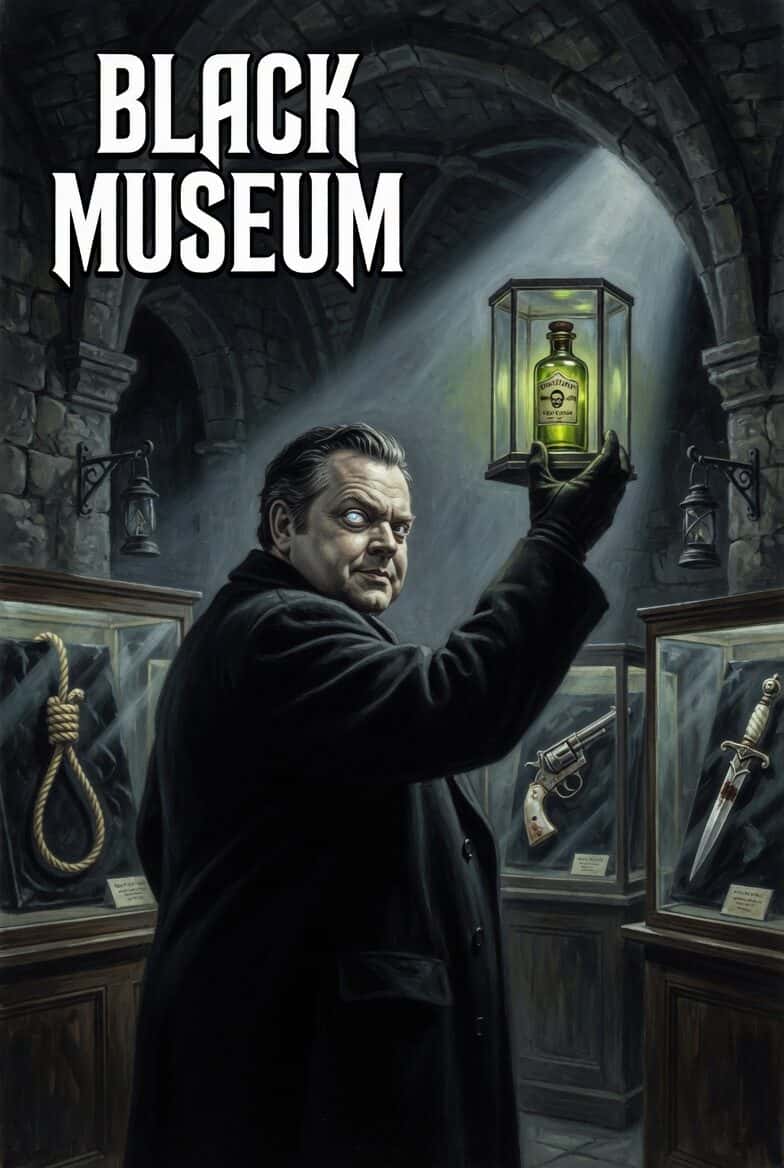
And so we return to the Black Museum, to the glass case where the faded pink powder puff lies on its bed of black velvet. The lace is torn, the stain is faded, but the story is still vivid. Two victims, or one and a half, as Hyson would have it. The powder puff that gagged them, that linked two crimes separated by years and by hundreds of miles. An everyday object, touched by murder.
This is Orson Welles speaking from London, from the Black Museum. Until we meet again, when we shall examine another exhibit from this gallery of death, good night.
The Black Museum, starring Orson Welles, is produced by Harry Alan Towers. This is the Mutual Broadcasting System.
Hello, honey. Come and have a drink.
Okay. Let's go up to the club.
Well, I haven't any money till the morning.
That's all right. I've got plenty.
Have you? I don't believe it.
Then look at this.
A handbag opens, stuffed with notes. The fate of Muriel Girton is sealed.
Look, sweetheart. I'm not the type of man who takes money from a pretty girl. Not even from you. If you'll come back to my hotel, we can get all we want on my bill.
So back to the hotel in South Kensington. And at the last moment, Hyson stopped abruptly, as if struck by a sudden idea.
We have to go gently, honey. I just remembered. They won't serve drinks to visitors after hours. We'll have to go in the back way, where we won't be spotted.
So in they went. Not into the hotel where Hyson was staying, but into another one where he had stayed sometime previously. Hyson knew the geography of the place perfectly. He took his unsuspecting victim through the deserted trade entrance and up the servants' staircase to the first floor, where he found an unoccupied bedroom.
Okay. In you come.
Thanks. Donald, are you sure this is your room?
Of course. Why?
It looks so empty. No clothes, nothing on the dressing table.
Well, I'm naturally a tidy person. Now come and sit down.
This was an invitation to a drink.
No, there are better things to do than drink. Come on, sit down.
Now, look here. I may be tough, but I'm not—
Sit down!
Why, you beast!
Scream! There's a... there's a present for you. Not a puff in your mouth. That'll keep you quiet. Oh, my beauty. I've got you exactly where I want you.
Again, those big, strong hands did their dreadful work. And when it was all over, Hyson removed the improvised gag from her mouth, took her money, and returned unseen to his own hotel where the chambermaid awoke him from a sound sleep at eight o'clock the following morning.
Morning, sir. Not a very cheerful one, I'm afraid. I'll pull back the curtains. Oh, it's pouring outside. And nasty and cold. Now, drink your tea while it's hot. And here's your newspapers.
Eh? Ooh. Oh, the papers, yes. Oh, thanks. Thanks very much.
Not at all.
The papers. Now, let me see. Woman found strangled in small hotel. Murder in South Kensington. Police are making widespread inquiries amongst the deceased's friends and acquaintances in the hope of tracking down the murderer. The staff and members of a well-known Kensington club are being questioned this morning.
They are, are they? Then the chances are that the swine who split on me to the South African War Department is going to open his mouth again. He'll remember I was with her. I must get out of London quick.
It so happened that Hyson's panic was needless. The RAF officer was posted now and he didn't come forward. Neither did the man who had introduced Hyson to his victim. But the scientists at Scotland Yard were becoming interested in traces of pink wool which they found in the dead woman's mouth.
There's no doubt we've got particles of face powder on this fragment. So the murderer must have gagged her with a powder puff of all things. But our own powder puff, which is white, was still in her handbag. That means the puff which was used by the murderer was taken away by him. The fibers are quite new. There's no dust on them and the powder hasn't had time to get into the material. Well, there's a thread of lace here, too. We'd better let the superintendent know right away.
Superintendent Brandreuth of Scotland Yard was then faced with the tremendous task of trying to trace an unknown man who might have bought a pink powder puff with lace trimmings. The information and the request for assistance was published in newspapers throughout the country and Hyson read about it in the seaside town of Eastbourne. For the first time in his life, Richard Hyson panicked. In a split second, he saw the net closing in. He reasoned that Doreen Wimson, the girl he'd bought the powder puff for, would very soon tell the police. If he was caught, he must plead insanity. To establish insanity, he must commit another murder. And this time, there must be no motive.
So that night, in a deserted street on the outskirts of the town, he waited for an unknown victim. The few houses were scattered well back from the road. For nearly an hour, nothing stirred while murder waited to strike in the shadows.
Go back, little girl, go back.
He's waiting with those big strong hands, tense and ready. It becomes a gag for the second time. The deed is done.
I might have got away with a lot if Doreen Wimson hadn't remembered the powder puff. She identified it, didn't she?
Yes, I knew she'd get me. The chaplain's here, Hyson.
Tell him to go to Blazes. I'll be waiting for him. Got another cigarette?
No, thanks. I was picked up by the police the next day. Even then, I nearly convinced them that they'd got the wrong man. They held me from three in the afternoon until two the next morning before I told them I was Richard Hyson and proud of it. But still, they couldn't really prove I'd killed the two women until they had my coat pocket examined in the laboratory. Then they found traces of face powder and little shreds from the puff in it.
Tough, that.
Tough, wasn't it, Padre? Why, what are you looking so mournful about? I'm the one to worry. So the hangman's here at last.
Yes, Hyson. It's nearly over.
If nobody's going to say anything, I will. Come on, boys, get the straps on and let's get going.
And so Richard Hyson is led to his appointed place on the trapdoors of the scaffold, a white bag is slipped over his head, the rope lodges under his chin, and while the chaplain intones the service of the dead, the trapdoors open and Hyson goes fluttering down into the dark cavity below. Justice has been achieved and all because of the faded pink powder puff which can be seen now in the Black Museum.
Orson Welles will be back with you in just a moment.
Now here, in person, is Orson Welles.
Hyson loved the limelight and he was nothing if not bold. He did serve in the Army and the Air Force, but his decorations and his tales of gallantry in action were all lies. He lived on lies, forever hoping that they would never catch up with him. But, one by one, they did. And with them came the evidence. From the bad check he gave to the general in the Middle East to the pink powder puff he gave to the one girl he admired. He hoped, of course, that the world would believe him to be insane. That would have spared him the final horror of the scaffold. And he might have been alive today in the grim fastnesses of Broadmoor, the criminal asylum. Was he mad? You've heard the story.
So, another chapter of murder is closed and the little pink powder puff, faded now, has its place in criminal history. And now, until we meet next time in the same place, I tell you another story about the Black Museum. I remain, as always, obediently yours.
The Black Museum starring Orson Welles is presented by arrangement with Metro-Goldwyn-Mayer Radio Attractions with original music composed and conducted by Sidney Torch. Produced by Harry Alan Towers.