
The written record
Read the transcript
Read along with the recording · About 19 min to read
This is Orson Welles, speaking from London.
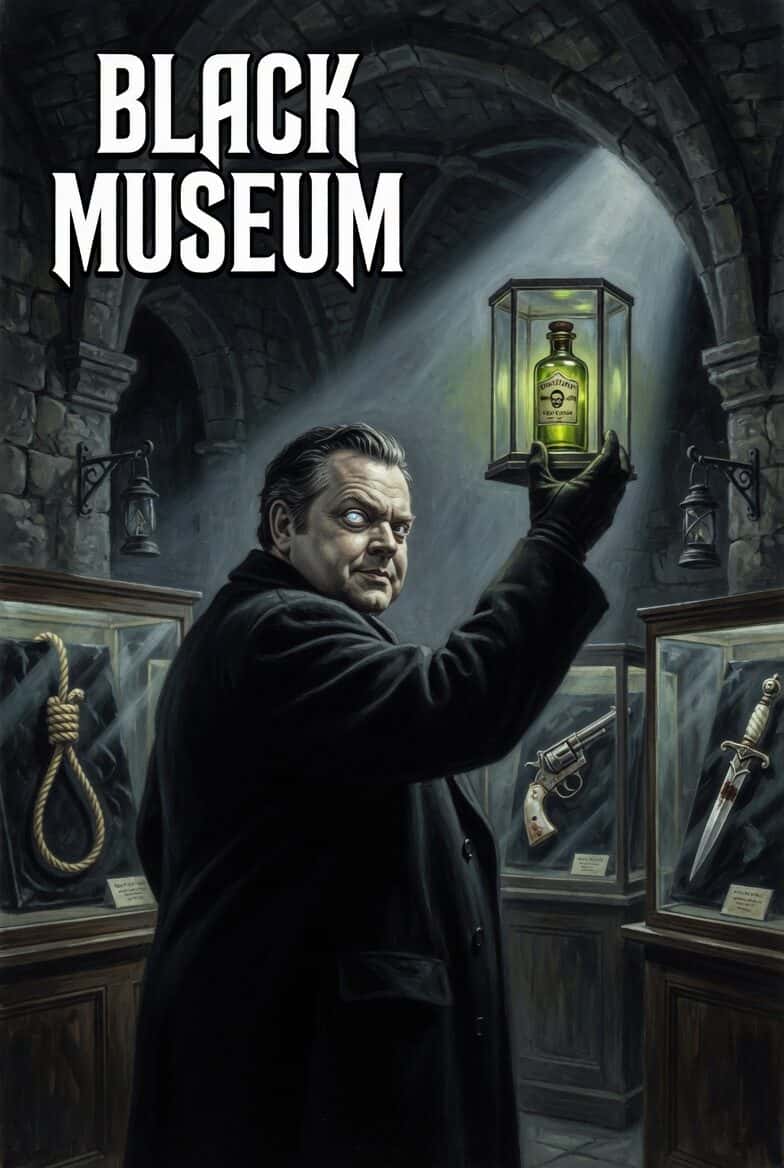
Repository of death. Museum. Yes, here in the grim stone structure on the Thames, which houses Scotland Yard, is a warehouse of homicide, where everyday objects, a cigarette lighter, a young girl's diary, a broken perambulator, all are touched by death.
Familiar objects, hand-stitched, soft leather, the gauntlet type of this glove.
I found something, Inspector.
I see, a glove. Lady's glove, sir.
Yes, pigskin. Very nice, too. I wonder now, do you suppose this dainty object fits a killer?
And today, that woman's glove can be found at the Black Museum. From the annals of the Criminal Investigation Department of the London Police, we bring you the dramatic stories of the crimes recorded by the objects in Scotland Yard's gallery of death. Death, the Black Museum.
In just a moment, you will hear the Black Museum starring Orson Welles.
Oh, the Black Museum starring Orson Welles. Museum of murder. Yes, death. For example, there's a pen at the sharp point. Words it wrote dripped metal on human heart. Made for a tender hand, made to grace the costume of a lovely woman. And a tea. That's when our tale begins. In Matfield, England, in the lovely countryside, at tea time. At just past tea time.
In fact, it was just past tea time that Mrs. Michael called.
Elizabeth! Elizabeth!
Yes, ma'am?
Have you seen Miss Mary yet?
No, ma'am. It's long past tea time. The tea is cold.
There's no sense in making fresh until we know if my granddaughter is coming. Hurry now. Use the telephone.
Yes, ma'am. One, two, three, four.
Elizabeth was a good girl. Bit of the slavey type, perhaps, but a good girl. Obediently, she asked the operator for the number of the cottage where Miss Mary lived, with her mother, Dorothy Fredericks, who was Mrs. Michael's daughter, and her housekeeper, Martha Patch.
There's no answer, ma'am.
Hmm. If it was busy, I'd understand it. No answer. Hmm. Well, it's still warm outside. They may be having tea in their garden and forgotten all about me.
Oh, ma'am. Miss Mary would never forget her grandmother.
Hmm. Well, in that case, you'd better run down the road and find out what they're up to. Go on, now. You can make my tea when you get to it. Get back. Now, go on.
I didn't...
Did as she was told. She deposited her apron in the hall, left by the back door, and hurried down the road. High hedge into the garden of the Fredericks' cottage.
Why would you be lying on the ground, Miss Mary? Where's your mother? Where's your mother? Where's Miss Dorothy? Miss Dorothy? Sitting against the stones, Miss Dorothy? Oh, you'll be cold, Miss Dorothy. Oh, Martha. Martha. Where's Martha? The house. The doorstep. Martha. You were... You were bringing out tea. You were...
However, a short while later, Inspector Seymour and Sergeant Layton took charge for Scotland Yard.
How far along are we, Sergeant?
Oh, a lot of details, sir. Multiple murder makes a lot of work. Three women, all shot once. The medical examiner is on his way. The regular crew is working on fingerprints and all the usual, sir.
Very well. Um, which one do you suppose went first, Inspector?
I've been thinking about that. It looks as if the youngest was picked off first. Then the mother was caught as she tried to climb the wall we found her against.
Oh, and the servant?
Probably an afterthought. Or no witness, something like that. That would account for the dropped tray and the smashed crockery. Methodical, careful, clean thinking, just as methodical as the men searching the house, covering the ground inch by inch, missing nothing.
After a while, that job was done. The inspector sat at the kitchen table with many pieces of glued together crockery in front of him.
See what I see, Sergeant?
Oh, just cups and saucers, a teapot, sugar bowl, cream pitcher.
We have three bodies, Sergeant, and four cups and saucers.
Yes, sir. It's possible, then, that our murderer came to tea.
Any sign of the weapon, Sergeant?
Oh, not a thing, sir. Not even a spent cartridge.
Ah, probably a revolver, then. Well, we'll hear about that after the medical men get through. Anything else?
Yes, sir. I found something, Inspector.
I see, a glove. Lady's glove, sir.
Yes, pigskin. Very nice, too. I wonder now, do you suppose this dainty object fits a killer?
Oh, I've no doubt we'll find out, sir.
Then you're a bit more optimistic than I am. One never really knows at this stage. Where do you find this gauntlet?
In the garden, sir, between the mother and the daughter.
Oh, very well. Next step's one I dread, Sergeant. Never could stand it, even to the constable. Notification detail in those days. Well, nothing else for it. Notification detail. So-called by the police who are sent to notify relatives that someone is injured or dead.
That part was over and done with by now, of course. But its equivalent was upcoming, a business of questioning Mrs. Michael, mother of Dorothy Fredericks, grandmother of Miss Mary.
You have a job to do, Inspector Seymour. Stop fiddling with your fingers and get it done.
Thank you, Mrs. Michael. You've a murderer to catch. I want him caught, too.
I admire your courage, Mrs. Michael.
Not courage. I'll cry myself silly as soon as I go to bed. Just angry. What do you want to know, Inspector?
Was your daughter a widow?
Separated. Not divorced. Just separated. About five years now.
Any particular reason?
Yes. She was too particular. Expected to hold a man by chaining him. Can't be done. He left her. I've been working on getting her... I've been working on getting them together for Mary's sake. Waste of time now.
Where's her husband living?
Piddington, Oxfordshire. Has a nice farm. Doing well. Pretty decent chap. But liked to look at the girls. You know what I mean. I told Dorothy, let him look. But no. She wanted blinders on him. So off he went. Now this.
Did they quarrel ever?
Not since they've been apart. They rather agree to disagree. But no one gets younger. They should... They should have been together again. Soon.
Anything else, ma'am?
You want me to do your work for you? Get along with you. You're dying to get on over to Piddington. It's written all over you.
Of course, Inspector Seymour did just that. He travelled to Piddington and stopped at the pub. A pint of ale and conversation with the bartender.
Know anything about a fellow named Fredericks hereabouts?
Yeah. Quiet chap. In and out of here occasionally. Works a farmer here?
That he does. Seems to like it out there. Not in town much.
Live alone?
Usual hired hands. Usual cook. Unusual housekeeper secretary, sort of.
Oh? So? Why? You one of those private detectives? Fredericks' wife wanting grounds?
No, no, no, no. Nothing like that. Matter of fact, Fredericks' wife is dead. Just interested. That housekeeper now. Anybody would be interested. Good looking. Open air. Tallish.
I see. Now what road's the farm on? I might drive by. I'll just have a look myself.
Right fork, about a mile north.
Right fork, about a mile north. The inspector drove his car in that direction. He knew that Paul Fredericks, estranged husband, was in Matfield by now. With his mother-in-law. This youngish woman, from all descriptions, would be alone in the house. She was. Except for the elderly, waspish cook who admitted the inspector.
Miss Jean's laid up. Fell yesterday and bruised herself. Mr. Fredericks' gone to Matfield. What do you want?
My credentials. I'd like to speak to Miss Jean, if you don't mind.
Come in, if you have to.
Inspector Seymour was asked to wait in the front room. And he was permitted upstairs. To interview an extremely attractive woman.
I won't stay long, Miss...
Moore, Jean Moore. This is such a nuisance, Inspector. I'm a big girl now. Imagining tripping over my own feet and bruising myself so badly, I have to stay in bed.
I'm sorry to hear that. This, of course, is merely routine. My visit, that is.
I understand. How can I help you?
Did you know Mrs. Fredericks?
Of course. And quite well. Her daughter, Mary, too. I've often thought Mr. Fredericks a fool to stay away from them.
Did you see them recently?
No, I'm sorry to say that I haven't. I understand there was a market in town day before yesterday. And Mr. Fredericks spent the whole day there. Is that correct?
Why, yes, that's correct. And your day, day before yesterday, Miss Moore?
I was here all day. Cook will tell you. Sure you don't think I had... Why, it was that evening I fell. I remember it distinctly because Mr. Fredericks was so upset about it when he came home from the market.
Thank you, Miss Moore. You'll forgive me if I check up with the cook, won't you? Purely routine, but we find it...
Oh, ma'am, you do remember her being here all day, then?
I said so. Well, is there any incident you recall to fix the day in your mind?
There is one. She was upstairs. She called from the window. Mum, she called. Will you bring a couple of logs in from the fire when you're done with the chickens?
Mum? Is that what she called you?
Why shouldn't she, seeing as I'm her mother?
Well, don't gawk at me. She gets her salary and so do I. We each do a job. Anything wrong in that? Even if Fredericks doesn't know it.
No, nothing wrong.
The inspector was struck by this fact. He filed it for future use. Then? Then, almost as an afterthought, he went back upstairs to the bruised woman's room.
Sorry to bother you again, Miss Moore, but, um, would you mind trying on this glove, just for size?
The glove? Oh, yes, yes, of course. Nice bit of pigskin. Seems a trifle snug to me. About half a size too small. Whoever owns this must have lovely hands, mustn't she, Inspector?
Back in Matfield. In that field, the medical examiner gave both Inspector Seymour and Sergeant Layton plenty to think about.
The mother and daughter were both shot from behind. The housekeeper was struck in the chest. Excellent shooting.
With a revolver, I suppose. No shells about the place.
Not a revolver. The bullets we recovered were small bore from a rifle. My guess is a single shot, small game gun. The kind where each exploded shell must be removed from the chamber by hand. That would explain why there were no shells about, Inspector.
It also explains how Mrs. Fredericks had the time to run as far as the wall before she was hit. It explains a lot of things.
Glad to have been of help, Inspector.
Oh, you have been. It may interest you to know the kind of gun you describe. I saw it leaning against the kitchen wall in a farmhouse in Piddington just this afternoon.
And the woman's glove. Yes, that has its place today. In the Black Museum.
In just a moment, we will continue with The Black Museum starring Orson Welles.
And now, we continue with The Black Museum starring Orson Welles.
The theories began to take flesh on their bones, but they were still theories. True, it seemed peculiar that a young woman would bring her mother into a house as cook and not tell the fact to the owner. True, a glove which seemed a perfect fit. Well, it might be half a size too small. True, a woman in bed with bruises might have tripped and fallen in the house where she lived. And many thousands of people owned single-shot, non-ejector, rabbit guns. Together, these items might make a confounding composite, but a good defending counsel could still make mincemeat of them. These were some of Inspector Seymour's thoughts on the subject of his obvious and prime suspect.
Then another fact was added. A fact with several possible meanings.
They found a bicycle, Inspector. About a half a mile down the road toward the railway station from the Fredericks' Cottage.
Whose is it?
It was Mrs. Fredericks' bike, sir.
Any fingerprints?
Only Mrs. Fredericks'.
Of course. Well, there's nothing for it, Sergeant. We'll have to canvass the area. Might as well get started.
First stop, the railway station at Matfield. The ticket agent was a blank. The washroom attendant was a blank. The reporter was, however, somewhat helpful.
Repeat that for me, will you please?
I remember her because the parcel she was carrying seemed kind of peculiar for a woman.
Long and wrapped in brown paper. She got up at twelve-eight. Real sporty looking she was with kind of reddish hair and wearing trousers. Thank you. Thank you very much.
Then there was the newsboy.
You're not making this up, are you, son?
So help me, sir, I'm not. Like I said, I was delivering the afternoon paper. I saw this party watching through the edge of the Frederick's place. I kind of thought it was a man on account of the long pants. Then she stood up straight and I saw it was a woman. She had a kind of long package with her. It wasn't none of my business. I stayed on the own side of the road.
And the obliging truck driver.
I heard about this from the porter down at the station, Inspector. So I figured to come in and tell you.
Go ahead.
I picked her up around quarter of four. She stood in the road and waved. I pulled up for her. She asked would I take her into town seeing as she had to catch a train. I gave her the lift.
Did you have a parcel of any kind?
Yes, sir. Sort of long and wrapped in brown paper.
Oh yes, it's helpful when honest folk have good memories and come forward with what they remember.
These memories sent Inspector Seymour back to Piddington, back to the farm.
My daughter isn't here.
Where is she? Where is she? It's important that I verify certain facts with her at once.
She's gone to London to see a doctor.
I see. What train did she take?
11:15.
Why she be so obliging as to answer you, I can't say.
Could you tell me what she was wearing?
I could, but I won't.
Here now, this sort of thing gets no one any place. Why don't you leave her alone?
As it occurred to you, she may have knowledge dangerous to herself and that we want to protect her.
Oh, that's a bit different. Well, Mrs. Moore?
She was wearing her hunter green suit. Brown shoes and brown bag. No hat. Jean doesn't like hats.
Thank you, Mrs. Moore.
The voice on the telephone at the yard travelled much faster than the train to London from Piddington.
I've got it, Inspector. Hunter green suit. It was in safe hands.
He left the house, wandered out to the farmyard. There in the large orderly barn, he found a hired hand.
May I trouble you, sir?
Oh, no trouble. Not yet, anyway. I'm interested in a few points. You might be able to help a bit.
What, me? Help Scotland Yard?
Well, you... That's what matters. You may be able, Joe.
Far away, sir. Always interested in police work. Like on the wireless.
Yes, I suppose it is interesting, like anything else when you're not used to it. Oh, now then. Do you see much of Miss Moore around here?
Oh, every day, of course. She keeps the egg and milk books. Checks with me every day. Nice woman. Friendly.
Ever known her to go rabbit hunting, anything like that?
No. But funny you should ask that, sir. She's been interested in shooting lately.
How did it come about?
Well, I was cleaning my rabbit gun out in the yard. She stopped by. She thought it was a funny-looking shotgun on account of it only had one barrel.
You set her straight.
You bet. Anyway, we got talking.
Was it dangerous?
Well, I told her it wouldn't kill anybody unless you got real close.
What, just a little gun like that? Real close?
Yes. She asked how it worked. So I showed her. Well, the next thing, she's bought some shells and she's asking me to teach her to aim and fire.
Did you, Ralph?
Well, I did a bit. Uh-huh. But you know how it is. A woman like that and all. You can't teach a body to aim a rifle without putting your arms around her. But I know my place, I do.
Of course you do, Ralph. Anything else about the gun and Miss Moore?
Well, around last Wednesday, she asked to borrow it. Well, I lent it to her. Why not? Then I needed it back, see? Well, I asked her for it. She gave it back and said I'd have to clean it. She'd had it in the rain or something. So I did.
One more question, Ralph. Did you ever see Miss Moore ride a bicycle?
I seen her try about two weeks ago, wobbling around on an old one of Mr. Frederick's. She got better, but, well, not near good enough to travel on it.
I see. You've been very helpful, Ralph.
Really?
And you're sure it was last Wednesday she borrowed your gun?
Oh, certain. It was Friday I had it back.
And on Thursday, three women had died at Matfield of gunshot wounds.
I beg your pardon.
You're Miss Jean Moore?
Why, yes. I am. Why?
My name is Leighton. Scotland Yard. My credentials.
I see. Inspector Seymour asked me to meet you here. Seems he'd like your assistance on the Frederick's case.
But I told him all I know.
Well, something else has come up, Miss. So, uh, if you don't mind, we'll just cross the platform and go back on that train. Not a bad train. Practically an express. Through to, uh, Matfield.
A train ride to Matfield was made in a rather stony silence. Sergeant Leighton watched his fellow passenger carefully. Failed to see what was going on behind the rigid mask into which her lovely face had set.
At Matfield, Inspector Seymour was waiting.
Kind of you to come right back, Miss Moore. My car's waiting just over there.
Silently, she got in. Inspector Seymour carried on an almost solo conversation until they reached the local station house.
There. You'll wait in there a few moments, Miss Moore. We'll be with you.
Jean Moore found herself in a room with half a dozen other women of about her build and coloring. One spoke. Unknown to Jean, a panel slid open in an adjoining room.
All right, Porter. Do you recognize any of these women?
Uh, yes. Yes, sir. I do.
Which one?
Second from the left, sir. She's the woman who got off the train with that brown parcel, like I told you the other day, sir.
Well, young fella?
I know that one. She just got up and moved over there. That's the lady who was looking through the hedge the other day.
Sure, Inspector?
Sure, I'm sure. That's the dame. I'd know her in a million.
If she'd been less striking in appearance. Perhaps if she'd used a pistol instead of a long rabbit gun. Perhaps Inspector and the Sergeant faced Jean Moore alone.
I must make some inquiries of you, Miss Moore. And I must warn you, anything you say may be taken down in writing and given in evidence.
But did you hear me, Miss Moore? This is no laughing matter.
I won't hang, you know. I'm not right, never have been. My mother was away for years. Paul was sweet. Not much of a man. Not as much as he thought he was, but sweet. And he had some money. Then they wanted him back. Why should I give him up for a prissy wife and a stupid kid and a harridan of a mother-in-law? It was a nice gun, a nice gun, but I couldn't get the shell out with my gloves on. Oh, you were smart. You found him. You found me. You found me. So I lost him. But she didn't get him back, did she? All she got was a bullet in her back, like a rabbit. She ran, like a rabbit. She tried to jump the wall. She fell back. I'm getting out of here. Get away from me. I'm getting out of here!
Move it out, Sergeant. I'll call the matron.
And today, the woman's glove still offers its silent testimony in the Black Museum. Orson Welles will be back with you in just a moment.
Now here in person is Orson Welles. Jean Muir was certified insane. Her own cunning, her craftiness, were not the operations of a normal mind. Her complete breakdown substantiated the testimony of the alienist. She was put away for the rest of her life. And so the case was complete. But each part of the story fitted together as neat and as well-fitting as that dainty pigskin glove.
Now until we meet next time in the same place and I tell you another story about the Black Museum, I remain as always obediently yours.
Black Museum, starring Orson Welles, is presented by arrangement with Metro-Goldwyn-Mayer Radio Attraction. The program is written by Ira Marion with original music composed and conducted by Sidney Torch. Produced by Harry Alan Towers.