
The written record
Read the transcript
Read along with the recording · About 20 min to read
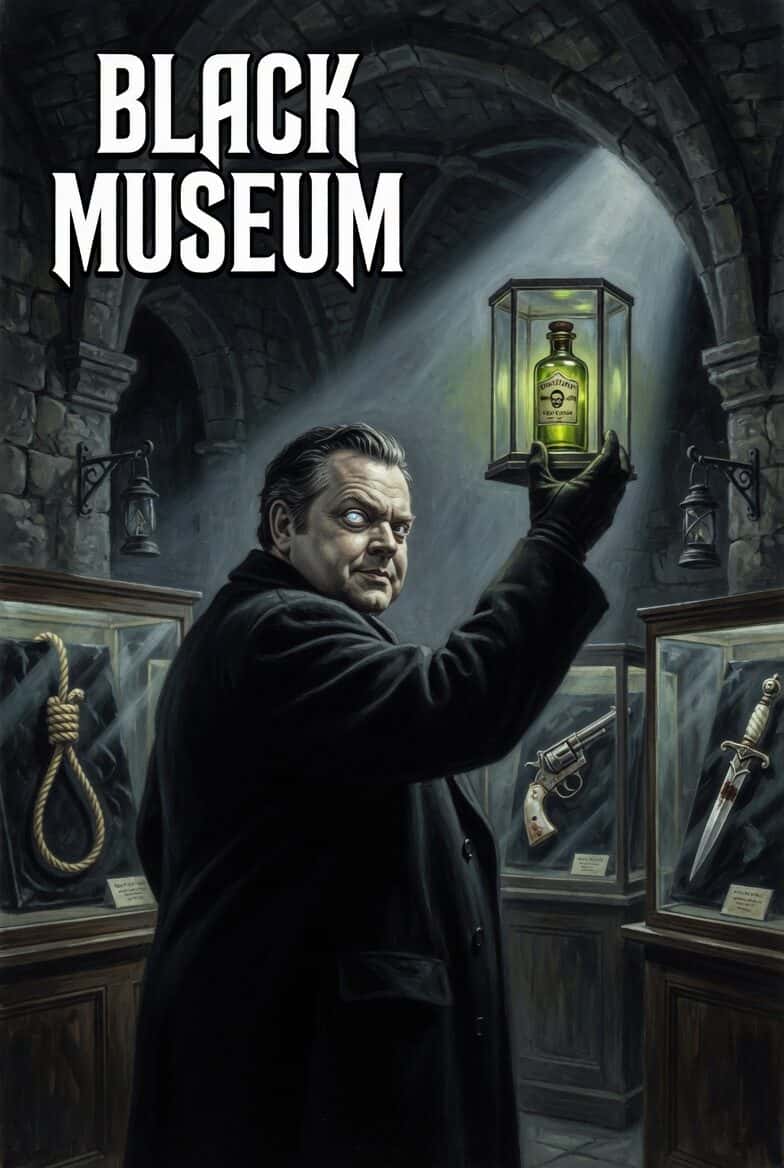
This is Orson Welles, speaking from London, from a black museum, a museum of death. Yes, here in the grim stone structure on the Thames, which houses Scotland Yard, is a warehouse of homicide. A warehouse where everyday objects, a paperweight, a broken wine bottle, a shaded lamp, all are touched by murder.
You take this jacket, woolen, hand-knitted, a baby's garment, dusty with age, and only half completed. Sleeves are missing, Inspector, and it still has to be stitched up. Yes, looks rather pathetic, doesn't it, Sergeant? It does, sir, yes. Better put it back in the attaché case. Probably have been needing it before long. Today, that jacket, sleeveless and unstitched, can be seen in the black museum.
From the annals of the Criminal Investigation Department of the London Police, we bring you the dramatic stories of the crimes recorded by the objects in Scotland Yard's gallery of death, the Black Museum. In just a moment, you will hear The Black Museum, starring Orson Welles. The Black Museum, starring Orson Welles. The Black Museum, Scotland Yard's museum of murder. Why's death dressed in its Sunday best?
Here, for example, is a nail file. It was once used by a manicurist to trim the dainty fingernails of a beautiful woman. Later used by an insane killer. Here's a length of cord, weighted with lead, at either end. Harmless enough to look at, but lethal in its effect as a weapon of murder.
Ah, here we are. Here's the jacket. Mottled and dusty. Somewhat inconspicuous in its place. A tragic relic of passion and violence.
I'm going to take you back quite a few years, to a warm Sunday morning in June of the year 1921. We're outside a small chapel in the London suburb of Kensal Rise. The service has not long ended, and the congregation files slowly from within out into the brilliant sunshine. A young girl emerges, waves to a few friends gathered near the entrance, and turns along the dusty yellow road in the direction of the township. She's gone but half a block, when she hears an unfamiliar voice calling after her.
Miss! Miss!
She turns, and finds herself face to face with a man she's never seen before. A stocky, broad-shouldered young man, with a round face and black, penetrating eyes.
I beg your pardon, miss, but I think you dropped this.
Oh, my hymn book. It is yours, then.
Oh, yes. I wasn't quite sure. Thank you ever so much.
Oh, that's all right. I don't know what I'd have done if I'd lost it. Mother never forgiven me. She gave it to me for my twelfth birthday. I've had it ever since.
Well, in that case, it's a good thing I happen to be looking your way.
It certainly is, yes. Well, I must be off. Thank you again.
You're going towards the village?
Yes. I live on the other side of the rise.
I'm going that way myself. Perhaps you wouldn't mind my walking with you.
Not at all. It's funny, I thought I knew most of the folks about these parts, but I don't ever remember seeing you before.
That's not surprising. I'm a newcomer to Kensal Rise. I've only been here a few days.
That explains it. Yes, I've been transferred to the bank here. Do you expect to be staying long?
No longer than I can help. I'm trying to save enough money to buy a chicken farm.
A chicken farm? It probably strikes you as being a queer ambition for a fellow to have, but I've always wanted one, ever since I was a youngster. I've even got a small piece of land picked out. Half an acre at Crowborough in Sussex.
Crowborough? I have a friend who lives there.
On the land?
Yes, it's a wonderful spot. I stayed there for a week once. I loved every minute of it.
Then you probably know more about the place than I do. I've only just passed through it. That's when I saw the land for sale.
How long ago was that?
About six or seven months. What if it's been sold in the meantime?
That's hardly likely. You see, I spoke to the agent. He told me it had already been up for sale two years and looked like staying that way for the next ten.
Oh, I see. I only hope he knew what he was talking about.
They walked on in silence for several moments. Then suddenly the young man laughed.
I say, I've been walking along telling you my inmost secrets and I haven't even introduced myself.
I was just about to say the same thing.
Well, the name's Moon. Trevor Moon.
And mine's Evelyn Rose. But everyone calls me Evie.
And that's how it all began. A romance destined to flower with all the beauty of young love, only to wither and die a tragic death. But let us not anticipate. Let us follow the course of that romance, or rather, let us pick out the more pertinent of its developments.
After their first meeting, Trevor Moon and Evie Rose spent most of their time in each other's company. For twelve months, they were rarely seen apart. And then, one evening, while strolling in the moonlight, Moon asked Evie to marry him.
To offer you, darling, and, well, apart from what I've put aside for the farm, I've no money. If there is such a thing as love, I've really fallen victim to it.
Oh, Trevor. Darling. You're sure it's what you want?
My dearest Evie, if it wasn't, I wouldn't have asked you.
No, no. I don't suppose you would. It's just that... Just that what?
Well, I wasn't expecting it. You took me unawares.
Well, to be quite truthful, darling, I took myself unawares, too. Well, you haven't given me your answer yet. Now, to be or not to be, that is the question.
Oh, silly. Of course I'll marry you. Just as soon as you want me to.
But Moon was in no hurry. On the contrary, he was the type who could not be hustled. And a further twelve months passed, during which time he remained as devoted as ever, but appeared singularly reluctant to take the proverbial plunge. Evie, on the other hand, became more impatient as the days went by. And when informed by her suitor that he had at last saved enough money to leave the bank and purchase his precious chicken farm in Sussex, her emotions gave vent to words.
Oh, Trevor, but I'm so tired of all this waiting. How much longer must we go on like this?
Just a few months, darling, till I get the farm straightened out and ready for business.
But why can't we be married right away? Then I could help you straighten things out.
You can help me most, darling, by being just a little more patient. The moment I get things in order down at Crowborough, I'll send for you.
Evie had to consent to go on waiting. Two weeks later, matters having been settled, Moon bid his sweetheart a fond farewell and left for Sussex. A month passed, and no word from him. Evie had done her best to be patient as he had asked, but this was too much. Packing her bag, she took a train for Crowborough and upon reaching her destination, checked in at the local inn where she made inquiries as to the location of the Moon property. Within the hour, she was knocking at the door of a small shack on the outskirts of the village.
Evie! Trevor, darling, please don't be angry with me, but I had to see you.
How did you get here?
By train. I had to come, darling. If I'd waited another day, I'd have gone out of my mind.
You can't stay here, you'll realise that.
I thought I'd stay at the hotel.
No! You're catching the next train back home. I'll walk with you to the station.
No, Trevor. I'm not going.
You're not going?
I'm staying in Crowborough till we're married.
I see. And if I happen to decide against going through with it?
I'm afraid you haven't any alternative, Trevor.
Why?
You see, I'm going to have a child. Your child.
You'd better stay.
The scene changes. It is three months later. We're in the office of the Crowborough police station. Constables Harris and Vernon are playing checkers.
Oh, didn't see that one coming. Been playing for that all along. Puts me in a bit of a spot. Hey, does that all right. Right enough. I'll get it. No fancy moves while my back's turned, neither.
As if I would.
Well, it wouldn't be the first time.
Crowborough police station. Constable Harris speaking. What's that? Yes. Yes. Hold it a tick while I get me notebook and take down a few particulars. Now, what name was it again? Rose. Mrs Lena Rose. Yes. And the missing girl? Daughter. Evelyn. Known as Evie. Address? 14 Marsden Parade, Kensal Rise. Yes. And how long has your daughter been gone, Mrs Rose? Since Saturday morning, I see. Yes. Well, let you do with the pram, Mrs Rose. You'll be hearing from us. Yeah, that's right, yes. Good night, ma'am.
Trouble?
Oh, nothing it won't keep. Another missing girl, that's all.
But Constable Harris was in error. It was not simply a case of another missing girl who disappeared for a few days. It was a case of a missing girl who disappeared for good. Today, evidence of that fact can be seen here in the Black Museum.
In just a moment, we will continue with the Black Museum starring Orson Welles.
Now we continue with the Black Museum starring Orson Welles. Just another missing girl. Yes, that's how the reported disappearance of Evie Rose was first described. Nothing particularly unusual about such a report. The week someone or other vanishes without any apparent reason or cause to show up again in due course for the perfectly simple explanation for the supposedly mysterious absence. But of course, there's always the exception. Which is why the police waste as little time as possible in checking up on such matters.
So it was that the following day, Mrs Lena Rose received a visit from Sergeant Cross of the Crowborough Police Station.
Now then, Mrs Rose, let's get the facts straight, shall we? According to this report, your daughter came home early on Saturday morning. That's right, Sergeant, two days ago. She told me she was going down to Crowborough for the day.
Crowborough?
Yes, to visit her fiancé. He has a chicken farm there. Not a very big one, I understand. He only bought it a few months ago, but he's doing very well.
You've been in touch with him, I take it?
Oh yes, he said he was expecting Evie for lunch on Saturday. But she didn't arrive.
Hmm. Was she in the habit of visiting him often?
No. Several weeks ago, she went down to see how he was getting along. She returned the same day?
Just in time for tea. I come to think of it, it was just about that time that she changed so.
Changed?
Yes. She used to be such a happy sort of girl, you know. Always laughing and joking. Then suddenly she became moody. Sullen. As though something was worrying her. Something she couldn't speak of. Even to me.
You've no idea what it could have been, I suppose?
Well, perhaps I shouldn't tell you this, but I had a feeling it was something to do with Trevor.
Trevor?
Trevor Moon, her fiancé. Oh. What kind of something, Mrs Rose?
That's what had me puzzled. I just can't imagine. Trevor was such a nice boy and so fond of Evie. I'm quite sure he wouldn't have done or said anything to hurt her. Well, not intentionally, that is.
How long have they been keeping company?
About two and a half years. As long as that, eh? And when were they to be married?
Well, I... I'm not sure, Sergeant. As far as I know, they... they haven't actually set a date.
I see. Well, I think I might pop down to Crowborough and have a chat with Mr Moon. He may be able to tell me something. Thanks for your help, Mrs Rose. And don't worry. We'll find your daughter. You'll probably be hearing from me again in a day or two.
With an encouraging smile, Sergeant Cross took his leave of the anxious mother and set out for the railway station, a thoughtful expression clouding his wrinkled brow. The sun was still present when he stepped from the train onto the platform at Crowborough and headed along the lonely lane that led to the Moon chicken farm. The gate was open, and seeing no one about, he made his way up to the front door of the shack and knocked.
Yes?
Mr Moon?
That's right. I'm Sergeant Cross. I wonder if you could spare a few moments of your time.
By all means, Sergeant. Come right in. The place is in a bit of a mess, I'm afraid.
That's all right.
Well, sit down, won't you?
Thanks.
Well, I have a fair idea. It's about Evie Rose, isn't it?
Yes. Still no sign of her?
I'm afraid not. There are just a few questions I'd like to ask you, Mr. Moon. Routine, you understand. Nothing more.
Of course.
I've just come from Kensal Rise. I've been talking to Mrs. Rose, who gave me fuller details. I suppose she's almost out of her mind with worry.
Well, under the circumstances, I think she's taken it very well. I understand that you and the missing girl are engaged to be married. That so?
She was on her way down here to visit you when she disappeared.
Yes, I was at the station to meet her, but she wasn't on the train.
What train was that?
The eleven o'clock. I waited an hour for the next one, but she wasn't on that either, so I came back home.
Were you worried at all?
No, not unduly. I just assumed she'd changed her mind about coming.
You didn't think it odd that you hadn't heard from her?
No, I can't say I did.
How long is it since you last saw her?
Oh, roughly speaking, about two months.
That was when she last visited you?
Yes. She only came here once.
I see. How did she seem then?
How did you mean?
Well, did she seem depressed or worried about anything?
Oh, not that I can recall. No.
Hmm? Why?
Oh, no particular reason.
Not for one second during the interrogation did Sergeant Cross shift his gaze from Moon's face. He had never trusted black eyes, and he wasn't quite sure he liked the look of this young fellow. But, despite this, the inscrutable Mr. Moon gave no indication that he knew any more about the missing Evie Rose than he was ready to admit, and certainly did not appear to have anything to hide. The contrary, in fact.
Back at the Crowbury police station later that same day, Cross admitted as much to his superior, Divisional Inspector Broughton.
So you think he's told all he knows, eh, Sergeant?
Well, sir, let's just say that he gave me that impression. It was those black eyes of his that set me thinking. They've got a shifty look about them.
You can hardly hold the colour of a man's eyes against him, Sergeant.
Perhaps not, sir, but even so, I... I think the best thing we can do at this stage is to give the newspapers a photograph of the missing girl and a description of the clothes she was wearing on the day of her disappearance.
Just as you say, sir. I'll attend to it right away.
Thus it was that a photograph of Evie Rose, together with her description, found its way onto the front page of three London newspapers.
Well, sir, that should do the trick.
Yes, let's hope so, Sergeant.
Two weeks passed, during which time no information regarding the missing girl was forthcoming. Yet a third week went by, and still there was no trace of Evie Rose.
Well, Sergeant, looks as if we've drawn a blank.
It does rather, sir. What's to do now, that's the question.
I think I might pay your friend, Mr. Moon, a visit.
I doubt if you'll get much more from him than I got.
Possibly not. No harm in trying.
To this day, Inspector Broughton could not say exactly why he so suddenly decided to pay Moon a call. Perhaps it was the prompting of fate, or perhaps he acted simply on a blind impulse. Whatever it was, he wasted no time about it. And that same afternoon, he made his way out to the Moon farm, found Moon seated on the narrow verandah, thoughtfully puffing at a much-smoked pipe.
Hello there. If you're another of those damn fool reporters, you can go to...
Oh, no, no, no. I'm not a reporter.
Well, that's a relief anyway. They've been showing up here in a steady stream for the past three weeks.
Oh, is that a fact?
Yes. You know, I'm convinced they really believe I murdered that girl, that Evie Rose.
Oh?
Ah, prying fools that they are. The way they ask questions, you'd think I was on trial.
Perhaps you are.
What?
I mean, perhaps they think you know more than you're telling.
Now, why should they think that?
She was supposed to be on her way to visit you when she disappeared.
Well, it doesn't mean I murdered her.
No. I mean, anyone could have done it.
Oh, done what?
Murdered her.
Who said she was murdered?
Why, no one. Not in so many words, but that's what they're inferring.
Who?
Those wretched reporters.
You sure you're not imagining it?
Of course I'm not imagining it. Why should I imagine it? Who are you, then?
Well, matter of fact, I'm a detective.
Detective?
Inspector Broughton's the name.
Oh. Well, I'm glad you stopped by, Inspector. What brought you here?
Oh, I just wanted to have a look about the place.
Why?
Curiosity.
I suppose you wanted to question me, too.
Well, frankly, I did want to, but I don't want to anymore. I think you've given me all the answers I need.
I think I'm going to have to turn and walk back down the path.
He didn't look back, but he could feel Moon's eyes staring after him, the eyes that had told him so much so convincingly. It was just like that, almost like the sort of stuff one reads in a cheap detective fiction magazine. Well, this was cheap, but it wasn't fiction. It was life, life in its birthday suit.
That was quick, Inspector. How'd you make out?
As I am of the fact that we'll see the end of the Evie Rose case tonight.
You think he killed her?
Well, if he didn't, I'm going to be out of a job in the very near future. But, uh...
Because I'm banking everything on the hunch that he did, my reputation included. And don't ask me why. If I told you, you'd say I was mad. We're wasting valuable time. Go on, get a squad together. We've got work to do.
Work?
We're off back to Moon's place, and we're going to search every inch of it. If we don't find anything inside the house, we start in the grounds. And even if we dig all night, Sergeant, we're going to keep on digging till we strike oil.
So, less than an hour later, Inspector Broughton was back at the chicken farm. And with him were Sergeant Cross and four constables. The shack was searched from top to bottom. And, finding nothing on the inside, they started on the outside. With picks and shovels and everything they could lay their hands on. Broughton was risking his career on an intangible impulse, and he knew it. But somehow he didn't think it was much of a risk.
Nothing so far, Inspector?
We've got a lot of ground to cover yet, old chap. I hope you're not making a mistake, sir.
So do I. But if I am, you won't suffer for it. I can promise you that.
I wasn't thinking of myself.
Don't worry about me. My shoulders are broad enough.
The digging continued. But it was too dark to see. Lanterns were lit. Four hours slipped by, and even Broughton was ready to throw in the towel when shortly after 1 p.m.
Inspector? Hmm?
What is it, Sergeant?
Just look what Hanson has dug up.
An attaché case. Get an eyeful of the initials on it. E-R. Seems as if your hunch might have been right after all.
Yeah, come on. Open it up. Open it up. Maybe something in it.
Right. Doesn't feel like it. Hello. What's this?
Looks like a jacket of some sort.
A baby's jacket. That's what it is, all right. Only half completed. See? Sleeves are missing, and it still has to be stitched up.
Yes. Looks rather pathetic, doesn't it, Sergeant?
It does, sir, yes. Yes. Better put it back in the attaché case. Probably been needing it before long.
With the discovery of the attaché case, the search was renewed with an added vigour and stray articles of clothing were brought to light, one by one. Clothes identical to those worn by the missing girl on the day of her disappearance. A green scarf, a yellow jumper, a brown skirt, and leather shoes, and a brown beret.
Doesn't leave much to the imagination, Inspector.
No, not much. But we still have to find a body.
Yes, they still had to find a body. But they felt it couldn't be far away. And they were right. Except that it wasn't a body, but rather a scattering of bits and pieces that once had been a body.
Confronted with the evidence, Trevor Moon made no attempt to deny the charge of murder that was subsequently levelled at him. He seemed, in fact, somewhat relieved to relate his gruesome story of how he had sent for Evie Rose and knowing that she was soon to bear his child, strangled her, later dismembering her body and burying it, together with her clothes, and the attaché case, the contents of which today occupies its place in the Black Museum.
Orson Welles will be back with you in just a moment. Now here in person is Orson Welles.
Moon's defence, if it could be called a defence, was a great letdown to the hundreds who kicked and shoved their way into the Old Bailey to witness his trial. For Mr. Moon pleaded guilty, there wasn't much more to it than that. Oh yes, he had an excuse. Plenty of excuses. There are no excuses for murder. The jury's verdict was never in doubt. Trevor Moon was found guilty of murder in the first degree and two months later to the day he was hanged.
So there you have it. And now until we meet next time in the same place and I tell you another story about the Black Museum, I remain as always obediently yours.
The Black Museum starring Orson Welles. Orson Welles is presented by arrangement with Metro-Goldwyn-Mayer Radio Attractions with original music composed and conducted by Sidney Torch. Produced by Harry Alan Towers.