
The written record
Read the transcript
Read along with the recording · About 24 min to read
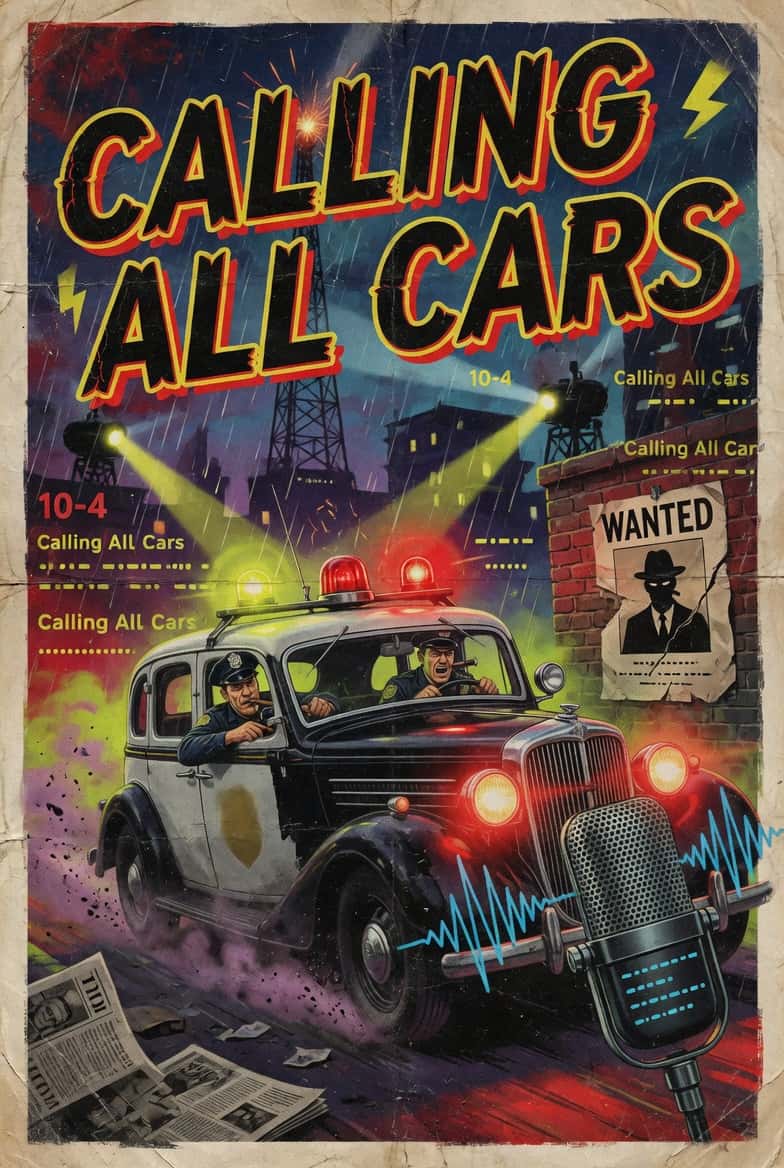
This is a program created for the Rio Grande Oil Company.
Attention all cars, attention all cars, broadcast 11. Regarding the murder of Officers Brett and Fletcher, who were shot dead tonight in Boyle Heights. The suspect is driving a battered Ford. The suspect is of medium height, has thin hair, wearing a tattered suit. Get him, boys. That's all.
You buy gasoline for only one or two cars. What would you do if you had to supply thousands of cars? You'd check pretty carefully all the different brands. You'd analyze their many claims. And not satisfied with claims, you'd make actual tests yourself to see which gasoline is most powerful, which is the fastest, which gasoline really does give more miles to the gallon. That's how the buyers for large cities like Los Angeles and Oakland select the gasoline for their thousands of police, fire, and emergency cars. By actual tests. What gasoline wins these tests? Nearly everyone knows that Rio Grande Cracked Gasoline has won them for years. And thereby won the contracts. This is why gasoline for more police, fire, and emergency cars than any other brand in this market. It is an honor to have the finest, fastest, most powerful motors on the road using your gasoline. Rio Grande is able to hold this leadership only by producing a gasoline which actually outperforms others. No other gasoline can equal this performance because Rio Grande holds the exclusive patent right to manufacture cracked gasoline by the Sinclair process. Millions of dollars have been invested in special refinery apparatus, which breaks gasoline drops into unbelievably small atoms, so they'll burn more efficiently in your car. Rio Grande balanced cracked gasoline so it starts quicker than other brands. So it generates more power. So it speeds up faster. And this cracking and balancing ensures that Rio Grande Cracked burns evenly and completely. So there's no waste, as in gasoline made by the ordinary refining process. You can actually feel the difference in your own car when you change to Rio Grande Cracked Gasoline. One tankful will convince you that there's a difference. There's a world of difference. Please try it.
And now we are pleased to present Chief James E. Davis of the Los Angeles Police Department.
Chief Davis. Good evening, friends. Life and property. Not many of you realize how dangerous, and how thankless, this life is. The brutal killing of two men with whom I worked in the first auto patrol in the city of Los Angeles 15 years ago, startled me, as it did the entire police personnel of the state, into such a realization. Tonight's dramatization of that fiendish slaying, and the manhunt that followed it, will, I sincerely hope, impress upon you the peril in which your police officers work. I hope, too, that it will serve as a warning to those who live outside the law, that it is far more dangerous to shoot a policeman, and take a chance on getting away, than it is to surrender. For although a detective will do his best, no matter what the case is, he will do a little better than his best. Go with less sleep than the little he normally gets, follow clue after clue, never giving up, when he is searching for the murderer of a fellow officer.
It is the night of December 6th, 1921. In Mosley's auditorium at Grand Avenue and 16th Street, the annual police ball is being held. Clad in severe black and white evening dress, accompanied by their ladies in dazzling colorful gowns, the guardians of the law are at this moment being led by Mayor George E. Cryer, in the Grand March. Immediately behind the mayor marches Police Chief Charles E. Jones. Just as the march is drawing to a close, an attendant approaches.
I beg pardon, Chief.
Yes, what is it?
Important telephone call, sir. They said to get you to the phone at once at headquarters.
Certainly, go right ahead.
Yes, thank you. Chief Jones speaking. Stop the music, Professor. I have just had a call from headquarters. It was a report that Officer Bill Brett and Officer Harry Fletcher have just been murdered.
Where's the cop?
I guess the party's over for them.
As the grief-stricken officers file out of the auditorium, newsboys are already swinging the headlines of extras, heralding the death of the two policemen. Chief Jones goes to headquarters immediately, followed by the shocked officers, many of whom have not stopped to change from evening dress to uniform. A citywide manhunt is ordered at once for the brutal killers, who, not content with riddling the bodies of Brett and Fletcher with bullets, have deliberately driven the car backwards and forwards over the already dead bodies.
The next morning, Detectives Jesse Irvin and Harry Hickok are assigned to assist Harry J. Raymond, night chief of the theft bureau of the Automobile Club of Southern California, in investigating the crime.
You know, boys, I'd rather capture the murderers of Brett and Fletcher than any criminals I have ever brought in. These boys were close friends of mine, who've worked on plenty of cases together, and a finer pair of thoroughbreds I have never known.
Yep, that's right. They were great guys. They'll have to pay for that.
Did you get any more dope on it down at headquarters?
Well, not much. They found a couple of girls who saw it happen from the front room of their house, but they were so scared, they didn't remember much. Just isn't any clue. Personally, I think an outside mob did it. I'll bet they high-balled out of town right afterwards.
No. It doesn't sound right to me.
So why?
Well, it seems to me they needed some quick dough, or they never would have been working Boyle Heights. Big dough to knock over up there. My guess is they're still around. Let's go out in the neighborhood and look the place over.
The residents in the neighborhood of the scene of the crime failed to reveal anyone, save the two girls who had seen it happen. But Raymond will not admit defeat. Two nights later, he returns by himself and continues his questioning. This time, he is successful. He finds an old, ex-gold miner, who had not been home on his previous round of the neighborhood.
Yep. Yes, I seen the shooting. I was sitting on the porch smoking my pipe when I see these two cars go by. One was an old... There was a police car, I suppose.
Yes, and what happened?
Somebody from the rear of the first car yelled, "Boys, don't do that!" And there were two shots, and the man fell out of it. The policeman in the second car got out and ran up. And just then, another guy gets out the Ford and starts running across the vacant lot.
How was he dressed?
He wore a light checkered suit, like a gambler, I'd say. And I saw him in the street light, and his hair was light and thin.
Would you know him if you saw him again?
Yes, yes, I'm certain I would.
Good. What else happened?
Well, the policeman called to this fellow to halt. And instead, the hombre in the check suit fired a shot at him. Then there was a shot in the back of the car, and I heard the glass splintering. Then the man in the check suit, he come back to the car, and they drove the Ford over the bodies of the policemen, and then they drove away.
How many men were there in the car?
Oh, I don't know, I guess about four.
Man, why didn't you report this to the police?
Listen, mister, I've lived in the West a long time, in the gold camps and the silver mines, and I've seen a lot of shooting scrapes. And I'm alive now because I don't meddle in other people's business.
Next day, Detective Raymond returns to the scene of the crime, searching for clues. In a pile of rubbish along the curb, he finds a small, irregular piece of glass. Elated at this discovery, he brings it to the chief.
Well, Chief, here's a clue.
What's that?
A piece of broken glass. My guess is that it's from the windshield that was shattered by a bullet the other night.
Any fingerprints on it?
Hardly. It was shot away. All you have to do is find the car with a broken windshield. It will fit that piece.
Yeah, but I wouldn't... With all the automobiles in Los Angeles, that's quite a job.
Yeah, there's no doubt about that. But I've got two clues. One of the guys wore a check suit. And this piece of glass fits into a windshield someplace. And if it's humanly possible, these two clues are going to avenge the murders of Brett and Fletcher.
Go do it, Harry. You've cut out a big job for yourself, but I'm all for you.
Two nights later, Raymond and Irvin are cruising through the Central Avenue district on their routine job of searching for automobile thieves. Suddenly, as they turn to Fortier Street...
Turn off your light. See those two cars down the street there?
Yeah. Oh, I get it. Tire thieves, huh? Well, we'll just take those...
The windshield has a sticker on it like it comes on new windshields.
Well, what of it?
Hey, what are you driving past for? Aren't you going to pinch him?
Nope. I've got a hunch, Irvin.
What's the matter with you?
Listen. I may be crazy, but there was a new windshield in that Ford. This old prospector who saw the shooting said they used an old Ford. And that one of the bullets shattered the windshield. Those guys might be the ones we're looking for.
Yeah, they might at that. Well, we're going to follow them and find out.
Irvin and Raymond tail the suspected car to Hermosa Beach, where it enters the garage behind a house a block from the ocean. The windows of the house are lit up, and the two detectives remain on watch until the lights go out at 4:30. Next morning, they have to stake out early, accompanied by Hickok. And their vigil is rewarded when three men and two women come out of the house clad in bathing suits and go down to the beach. Leaving Hickok on watch in front, the two detectives go around to the back door. They enter by means of Raymond's passkey.
Say, Harry, here's an article.
What's that?
In this drawer here. Look. Revolver. Automatic. And look at this sawed-off shotgun and all the slugs.
Hey, let's get a look at the garage.
Okay.
There's the old Ford in the garage.
Yeah. Now I want to take a look at this windshield. By gosh, Irvin, I'm right.
What's that?
This is a new windshield. Here's the price on this sticker.
Say, Harry. Here's the old one here. And it's busted.
Where?
On this bench.
Oh, boy, this is more like it. Hey, what are you fumbling in your pocket for?
That piece of glass I picked up on the street. Wait a minute. Here it is. Here it is. Now. Irvin. It fits. This is the gang that murdered Brett and Fletcher.
The next day, the three detectives return and watch until the same three men and two women go to the beach for their swim. Then they interview the occupants of the adjoining house.
Could you tell me who lives next door?
I don't know. Why are you asking?
Well, we're interested in men.
Well, I don't know nothing about them. They just moved in a couple of weeks ago. They keep to themselves, and so do I. Seems like a step might be late, though.
I see. So you never met them then, huh?
No. I don't do no visiting with neighbors out here in California. Now, back in Grand Island, Nebraska, where I come from, it was different.
Oh, yes?
As a matter of fact, we're police officers.
Really? Police officers? Well, I declare. And we'd like to keep watch on these people next door.
Why? What have they done?
Well, we don't know, but we're interested in finding out. I wonder if you could let us occupy a room on the side of your house next to theirs.
Well, I don't know. I'll have to ask Pa.
What is it?
Well, what do you want?
These men are police officers.
It's the law, Pa.
What's the address for?
They ain't, Pa. They want to watch the folks next door.
It's all right?
Well, I suppose so. Have they shown you their badges?
Oh, yes, of course. Here you are, sir.
That looks sure enough like the real thing. You can come in.
That's fine. Go into the room here, Gus. We've got to plant that machine.
Right.
It is a simple matter to plant a dictaphone behind the curtain in the house of suspects and run a line over the shifting beach sand to the house next door.
All day, the detectives lie in hiding, alternately taking turns listening at the dictaphone. Late in the afternoon, the party returns from the house and the detective is in the room. The detective is in the room. The detective is in the room. The detective is in the room. The detective is in the room. The detective is in the room. The detective is in the room.
And then as they sit around the dinner table, the detectives get an earful.
Hey, get a load of this. Hey, you better never doubt Pilsner when he's around.
Do we yell?
Yeah. Curly and Pilsner will be down tonight to talk things over. Ask him about that time in your time.
Yeah, yeah. That's right. Curly and Pilsner have been living in this room. Oh, come on, boys, cut the arguing. Have some more potatoes.
Sure. Reach for them. Where's Babs, Marge?
She's lying down. She's got a headache in the sun today.
Hey, here's Curly now. He just let himself in.
Hiya, Curly.
Hi, Curly. How's the boy?
Hello, boys. Hiya, Marge. Where's Bill?
I couldn't make it so early. He'll be down later.
Hey, got some grub for me?
Sure, Curly. Here you are.
Got any angles, Curly?
Yeah, a couple. Hey, and get this, Kel. You know, we've got to get busy and get some dough.
Sure, that's right. Just as soon as you line up the jobs, we'll pull them.
Oh, yeah?
Yeah, well, we've had some good jobs lined up, and we'd be getting the dough right now if you had any nerve.
Nerve? What do you mean I ain't got no nerve? I had Pooley tonight. We bumped off them two coppers over in Boyle Heights, didn't I? Didn't I go to the receiving hospital and make sure them two guys were dead? Didn't I? The rest of you monkeys didn't have no doubt about it.
Those are the birds that killed Brett and Cluster. Come on, let's knock them over right now.
Yeah, come on, Harry. Let's go.
Now, wait a minute. We've got these mugs any time we want to take them. Let's wait until this Bill fella comes. Let's get them all at once.
Later, Bill, the apparent leader of the mob, arrives and they discuss a job they have in mind that will net them some Christmas money. When Curly and Bill leave the place, Raymond follows Curly and Irvin and Hickok tail Bill, thus discovering the Los Angeles addresses of both men.
The next night, the three detectives decide to arrest the gang, but Jess is missing. They plan to get an early dinner and hoping Jess will have arrived by the time they get back to knock the place over then. But on their return...
Hey, this is funny.
Well, what's up?
The house is dark. Do you suppose that, uh...
Pardon, Constable.
Yes?
They moved out while you was away.
They did?
Yes. They all left less than 15 minutes ago. A baggage man came and took their stuff away and they all piled into that old car there. I couldn't stop them.
No, no, of course not. We should have knocked over the six of them while we had a chance.
Yeah. But I did find one thing out. It's that I got the license number of the car and the name of the express man.
Through the quick-witted cooperation of the old lady, the detectives were able to pick up the trail once more. The express man, when questioned, tells them the address on South Hope Street where he transferred the baggage for one of the girls. They raid the girl's room and take her to headquarters. Heedless of her loud protest, they question her half the night. Finally...
Now, look here, Marge. It's up to you. You can tell us the truth and save yourself or you can lie to us and sure as I'm standing here, you'll hang just as all the rest of your friends are going to hang.
Listen, boys. You got me all wrong. I ain't done a thing. Honest, I ain't. I come from a good family, I do. I do. I'd never harm a living thing. Not even a copper.
Yeah, but what we want to know is what do you know about these other guys? Now, remember, if you want to talk, it'll save your neck. You're innocent. We want to believe.
Well, I guess they bumped off the bulls all right. That's what they claimed, anyway.
Who are these guys? Who's Curly?
Well, his real name is Willard Thompson.
And Bill, who is he?
He's Bill Binkhurst. They both served time up in Utah.
Well, what about the rest of them?
Jim Wheaton, Cal Rowell, and Jess Wendell are their names.
Jim Wheaton, Cal Rowell, and Jess Wendell.
Well, tell me, why did you leave the beach so suddenly?
The boys just got a hunch. That's all.
Where are they now?
I don't know. Honest, I don't. I wish I'd never seen them. How straight I am. I was trained to be a nurse, and if things hadn't been so tough, I'd never taken up with them. I wish I was a nurse.
Through Marge's information, the detectives arrest Babs. Her story agrees with Marge's, and every substantive detail. Then the roundup is on in earnest. Curly is the first to be awakened from a sound sleep and taken under arrest. A stakeout of additional detectives is left in Curly Thompson's room, while Raymond, Irvin, and Hickok raid Binkhurst's dwelling. He, too, is captured before he can shoot, and a short while later, Wheaton is taken, as he walks into the trap in Curly's room. Next day, Rowell, too, walks into the arms of the law as they are staked out in Thompson's room.
With the entire gang, excepting Jess Wendell, rounded up, the detectives proceed to question the suspects. Under the drilling, Wheaton and Rowell quickly confess their participation in the crime, though stoutly maintaining neither had shot the two policemen. Thompson is questioned next.
Listen, you big flatfoot. You're just wasting your time. I won't talk no matter what.
Now, look here, Thompson. Remember that time an informer sent you back to the old gang in Utah?
Ah, what's that got to do with this rap?
Nothing much. Do you know who squealed on you for the $25 reward?
No, and I don't care.
Well, maybe you don't care. I'm telling you anyway. It was your pal, Binkhurst.
You're a liar.
No, I don't think so, Thompson. Here's the reward receipt for $25 paid out to William Binkhurst.
Well, I'll be... Why, he was my best friend.
Yeah, that looks like your business. Now will you come clean?
No. Just because he was a dirty stool pigeon, you don't just think I'm one. You'll never get nothing out of me.
And Curly Thompson stoutly maintains his silence. Binkhurst is next to be questioned. He claims he was helping his wife. His wife with the washing on the night of December 6th. Mrs. Binkhurst is brought in to face her husband.
Mrs. Binkhurst, your husband tells us that he was helping you do the washing on the night of December 6th. Is that true?
Go ahead, Molly, and tell him about it. That was the night you had such bad rheumatism in your left hand. Remember?
No, Bill. It won't work this time. I covered you up. I lied for you for the last time. You've got to face it alone now. Bill, I've given you the best of myself. There's nothing left now. I'm burned out, Bill. I'm through protecting you. I'd like someone to protect me for a change. No, officer. My husband was not home that night.
Two days before Christmas, Detective Raymond locates the estranged wife of Jess Wendell, the only member of the gang still at liberty. She gives the officer a picture of Wendell and the license number of his Ford Coupe. Raymond returns in high spirits to the office of Secretary Mitchell of the Auto Club.
Mr. Mitchell, I've got a picture and a complete description of the last one of that gang.
Good. What do you propose to do?
I want to run him down.
Well, aren't you satisfied with the four you have?
No, sir. I'm going to get every one of those guys that killed my pals. This one, Jess, is the toughest of the lot. I'm going to broadcast the Westwood Circulars announcing the $10,000 reward offered dead or alive.
Go ahead.
It's going to cost money to print a million of these flyers.
I'll send through an order to advance you whatever funds you need.
Thank you. That's great.
For a printer, Raymond finally finds one willing to undertake such a mammoth order on Christmas Eve. Twenty traffic officers are dispatched from headquarters to augment the clerical staff of the Auto Club and the circulars, ink still wet, are in the mail by midnight of Christmas Eve.
The day after Christmas, the phone rings on Raymond's desk.
Sergeant Raymond speaking.
I don't know what you're calling.
Hello?
You're speaking to him.
Good. This is Constable Harris. I'm in charge of the road here in New Orleans.
You did? Are you sure? I heard the prisoner was scared and what was the number? Fine, Constable. And thank you for your information. Nothing right now. If you can, I'll get in touch with you. Goodbye.
Now we can start to move. Get me Western Union. I want you to take a telegram to every Western Union office in Southern California, beginning at Maryland and then to Arizona, New Mexico, and Utah. Never mind that. Charge it to the Automobile Club of Southern California.
At Raymond's request, Santa Fe Railroad dispatcher sends Wendell's description to every station on the Santa Fe throughout California, Arizona, and New Mexico. Every brakeman, conductor, porter, engineer, and fireman is furnished with a copy of the message describing Wendell and his automobile. The message which begins one of the widest manhunts in the history of the Southwest.
While hundreds of detailed officers in every town and hamlet in three states are searching for the fugitive, word comes from Yuma that the man answering Wendell's description stole a pair of Arizona license plates and is heading east. Then from Oatman, Arizona comes a report that Wendell's coupe had passed through that town. Raymond, Irvin, and Hickok, missing the Eastbound Limited, jump in their car and race it to San Bernardino intending to board it there.
Arriving ahead of the train, Raymond telephones Sheriff Mahoney in Kingman, Arizona.
Hello? Sheriff Mahoney?
Yes?
I'll try. This is Sergeant Raymond of Los Angeles. Did you get my circular describing Jeff Wendell?
Yes.
Well, this Wendell was last seen heading east through Oatman. Detectives Irvin and Hickok and I are taking the 1040 in a couple of minutes, but I'd like you to start after him right away.
The Eastbound Limited. Coming out of the Eastbound Limited. I've got some key things to do. There's another.
Seated at a table in the dining car, they scan the highway that parallels the track.
Might as well eat while we're working.
Quiet.
What can I get you, gentlemen?
Let's see. We'll get some of this Virginia ham and sweet potatoes.
That's mighty good to be good, Yago. Make mine the same.
Yago, I'll get it. Why do we have much traffic out on the highway today?
No. Too cold to drive across the desert this time of year. That's the people traveling by train if you can sample.
Yep.
Hey, Mahoney, look up ahead there.
What?
That black speck on the road. That might be it.
Yeah, it might. Well, keep your eyes open. It, uh...
Yep. It's a Ford and it has bedding piled on the back. That's it. Pull that emergency cord.
I have no idea of pulling a cord.
Can't stop to explain, conductor. I'm sheriff of this county. Come on, Red. Get your gun out, Red.
Got it empty, Red. Let's ask the section hands about it.
Right.
Hey, buddy, where's the guy that owns that Ford coupe?
Oh, him? Oh, he's from Safford. I can't...
Tell him to go to the section house. My woman's feeding.
Well, go in there and tell him to come out with his hands in the air.
There is the door, Mahoney.
No, he's disappeared.
Come on, let's take him.
Come on, Mahoney.
I'm afraid it's too late now. Bumped himself off.
Look, he only wounded himself with the first shot. Then he had the nerve to pump three more into himself.
Hold on, he's moving. Take that gun from him.
Don't worry, boy. I'm through bumping off coppers. But the joke's on you, boy. You can't hurt me now.
Wendell died on the westbound train bringing him back to Los Angeles. Jim Wheaton and Cal Rowell were given life by a jury that took into consideration their confessions. And on April 21st, 1924, Binkhurst and Thompson were hanged in San Quentin.
By agreement among themselves, Raymond, Irvin, and Hickok, whose splendid detective work brought this case to a successful close, split the $10,000 reward and gave one half to the widow of Officer Brett and the other half to the widow of Officer Clash.
Thank you, Chief Davis.
Police officers realize that their lives are at stake when they speed up their emergency cars to capture a criminal. They can't take chances on ordinary gasoline and lift a stalled engine, a foul spark plug, a sluggish motor. That's why many thousands of operators of emergency cars agree on Rio Grande and specify it exclusively. Drive your car into your neighborhood Rio Grande station, and you'll get exactly the same cracked gasoline that police and emergency car drivers prefer above all others.
You'll also get some novel new coins with your change called police money. Boys and girls everywhere are saving this free police money because they can exchange these valuable coins for a complete junior detective outfit. So while you're enjoying police car performance in your car, you're also helping some boy or girl to get 14 free gifts.
If you're with the Calling All Cars News, which you can get free from any Rio Grande dealer, you will find a full description of these gifts together with fascinating, illustrative, true crime stories and late movie and radio news. Get your free copy of the news right away.
All Rio Grande dealers are now recommending Sinclair Motor Oil. Sinclair not only eats the sludge, but also has certain features found in no other oil. Before you get your crankcase filled again, ask your Rio Grande cracked gasoline dealer about Sinclair Motor Oil's advantage.
For the Rio Grande Oil Company.