
The written record
Read the transcript
Read along with the recording · About 23 min to read
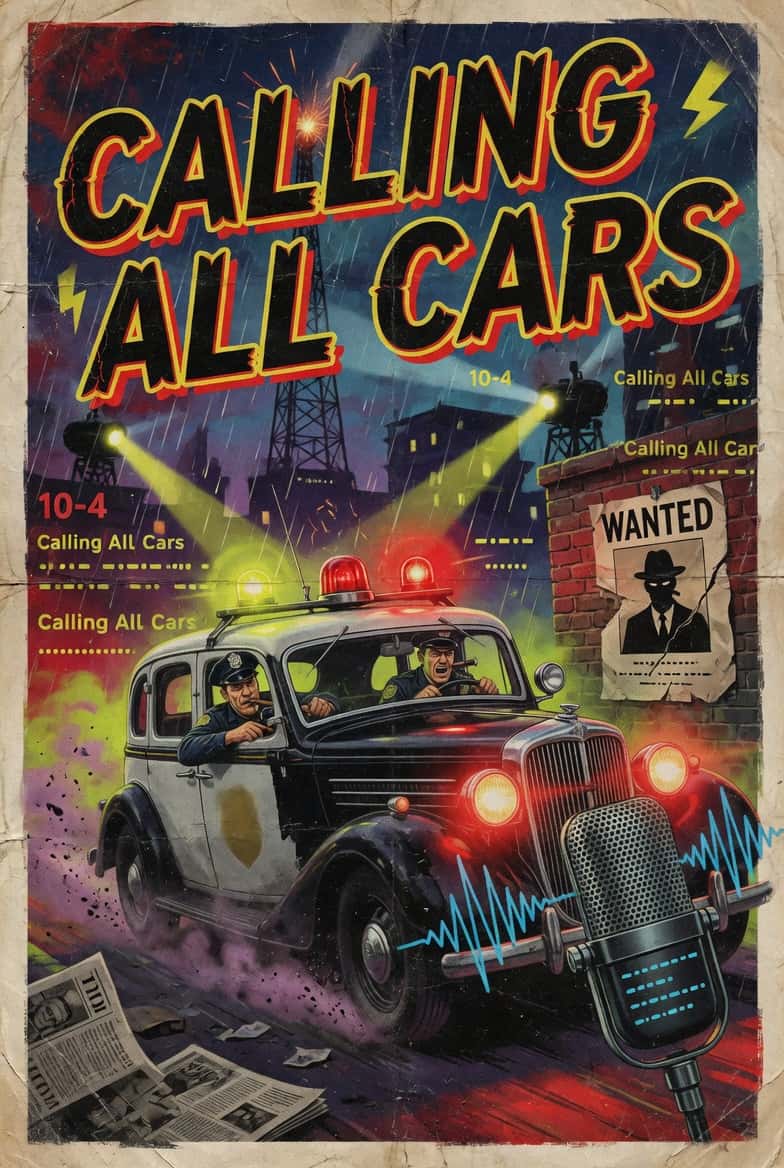
All Cars, a copyrighted program created by the Rio Grande Oil Company. It takes us back 26 years when policemen were walking their beats. When it took an hour or more for police to arrive at the scene of a crime. When horses were considered more dependable than motorized firing. When ambulances usually arrived at an accident too late to help the victim. Today it takes most radio equipped police in two minutes and less than 60 seconds to answer your call for help. And police give much of the credit for this greater speed to Rio Grande Cracked Gasoline. No other gasoline in this market, they point out, can start so fast, accelerate so rapidly, develop so much power as Rio Grande Cracked. Because Rio Grande is the only refiner in the West licensed to refine gasoline by the patented Sinclair Cracking System. This exclusive process breaks up the atoms of gasoline so that the inefficient, lazy, slow burning units are extracted, leaving only concentrated energy. There's no waste. With Rio Grande Cracked, for the cracking process ensures that every atom is turned into power, so that you consistently get greater mileage with Rio Grande Cracked Gasoline. As proof of the superior efficiency and many advantages of Rio Grande Cracked, we point out that contracts have been placed for the cities of Los Angeles, Burbank, San Diego County, Maricopa County, Arizona, and many, many others. Certifying that Rio Grande Cracked Gasoline exclusively be used in all police cars, fire engines, ambulances, and other emergency equipment. So when you... So when you get Rio Grande Cracked from your neighborhood independent dealer, you can enjoy police car performance at a lower cost per mile.
And now it is our pleasure to present Chief James E. Davis of the Los Angeles Police Department.
Chief Davis.
Good evening, friends. Every large American city seems to have some great catastrophe in its history, which its citizens never forget. In Chicago, it is the Iroquois Theater Fire. In San Francisco, it is the Great Fire, which followed the earthquake in 1906. Here in Los Angeles, we have been fortunate in escaping such tremendous calamities. But we do have our own past, a horrible holocaust which can never be erased from the memories of living men. I refer to the dynamiting of the Los Angeles Times building in 1910. Consistent with my effort to show you citizens how your police force operates, I am presenting tonight the story of this famous case only from the point of view of the Commission of the Crime. And the splendid detective work which finally resulted in the apprehension and conviction of all the criminals involved. In doing so, it is not my purpose nor intent to champion either side of the argument. Tonight, in telling the story of the Times, we are interested in facts, not opinions. In police work, not economic propaganda. So, with this brief explanation, I turn to Frederick Lindsley, who will carry on with the story of the Times.
The Times building. It is one o'clock in the morning of October 1st, 1910. While the city sleeps, a band of men who toil by night and rest by day is working at top speed. From the far corners of the world, another page of history's book has been assembled. The morning paper is going to press. In the composing room on the second floor of the Times building, a line of men, green eye shades clamped to their heads, clatter up a line of type machines. In the engraving room on the sixth floor, mercury lamps blow their ghoulish glare. The dog watch in the city room gently eyes the clock, hoping that no big story will break to disturb their fun and ease until 30 comes for them at half past four. Seated by their silent telegraph keys, two men stand by in the wire room for last minute news flashes. In the basement, the huge presses hungrily await the plate for the final edition. Horses and wagons stand ready in the alley to dash away with the ink-wet edition to carriers all over the city that Los Angeles may have her news with her morning coffee. The hands of the clock slowly move on. Activity increases as press time approaches. It is now one-five, one-six.
Alley to the press room, another clock ticks ominously. Unnoticed by any of the busy workmen in the building. The seconds pass. The clock is one-seven. And then...
...and the iron building blows up. The floors of the explosions, not flickered as the first and second and third floors, as though they were leaflets in the hands of some super power. Down is another gaping hole, fertile with heavy line of type and stereotyping machinery, carrying their operators to a crushing death. The gas main, which feeds the building, is ripped open and instantly ignited. A searing fountain of flame leaps through the building. Within a moment, the entire structure is ablaze. Workmen clutched in the freezing maw of horror rush to the fire escape, to be met by a fiery wall through which escape is an impossibility. But two telegraph editors trapped in their rooms slowly burn to death. Composers and linotype operators, horribly maimed, arms torn off and legs broken, lie helpless on the floors, the vicious fire creeps toward them. Their pitiful cries reach the streets below, where all the downtown fire apparatus has already arrived, but rescue is an impossibility. No man can enter that speeding funeral pyre and live. A report has been edited from the jobs locked in the city room of the third floor for the jump to the street. Those who survived the jump were crippled for life. Within a few minutes after the explosion, the last cry of the helpless victims trapped within the building has been smothered in the fevered embrace of the flame. In an astonishingly first time, the entire building is gutted. And then a new danger threatens. As one after the other, the walls, lacking in support, swaying, rattling, cracking, and a huge power of concrete hurls from the breadth of the molding, screaming at the hastily rigged guardrail. All night long, the fire rages, unspeakably ruining the plant of the Times. Yet just a little later in the evening of the next morning, the Times is delivered to its subscribers, printed at an emergency plant for the battered, bruised, and bandaged survivors of the catastrophe.
And early the same day, early in the morning, Sam Browne, the crime on telegraph order from District Attorney John D. Fredericks, who is in Mexico on a vacation. Brown and his force hold a council of war.
Huh? You all saw that thing burn last night. We've all investigated as much of the ruins as you could. Anybody got any ideas?
I'm not the one. It's a mystery to me.
There is one lead, though. Or a guess, I should say.
What's that?
Well, General Otis, they all know the Times. Big labor or something.
No. No, you're right on that hunch. That burning wasn't blown up on that account. My guess is that it's a labor battle.
Well, you might be right, sir. Hey, Sam, here's a lovely little clue. What do you got in that suitcase?
Dynamite. Eighty percent dynamite.
Well, for the love of Mike, keep it out of here.
No, it's all right now. I disconnected the firing cap on it.
Oh. Where'd you get it?
It was left at F. Zeehandelaar's house.
F. Zeehandelaar? Who's he?
Secretary of the Merchants and Manufacturers Association.
That proves that this is a labor battle.
Well?
Well, let's see what this thing's made of.
Right here you are. Packed full of sticks of eighty percent dynamite. It's a simple mechanism. Two dry cells produce and the circuit breaker welded to the alarm handle of this clock here.
Let me see that, Doc. Let me see. Set for one o'clock. It was to blow off at the same time as the Times blew up. They must have used the same kind of bomb there.
What we did to them is try to say it's going on the alarm clock. The spring on this one wasn't strong enough to make the electric connection.
Just a minute.
All right, then. District attorney's office, Sam Browne speaking.
Yeah? Well, listen. It's the same kind as we've got here.
Yeah. Open it up and disconnect the batteries. That's right. Then bring it in here. Okay.
That was a patrolman. He just answered a call from General Otis's hall. They found a strange suitcase hidden in the shrubs under the general's window this morning.
Whoever blew up the Times sure wanted to make a complete job of it.
Well, he sure did. Let's take a look at this dynamite.
Mammoth Powder Company. Marin County, California.
I sort of expected the plot started in San Francisco.
Well, is dynamite the lead?
Well, it's packed up. We're leaving for San Francisco tonight.
Accompanied by a staff of operatives, arrives in San Francisco and sets up headquarters at a downtown hotel. That afternoon, he interviews Mr. Loder, manager of the Mammoth Powder Works across the bay.
And as far as you can remember, all your sales of dynamite during the past two months were to legitimate buyers, huh?
Yes, Mr. Brown. Now, I can't recall sales for anyone but my regular customers.
I beg pardon, Mr. Loder.
Yes, Miss Evans?
There was that man who came in a launch with some dynamite. Said he was blasting stumps on his ranch.
Oh, yes. Yes, that's right. I'd never seen him before, and I... Do you remember I remarked on the fact the launch had new letters on it?
Who was it?
Oh, I should say about six weeks ago. Oh, let me see. Well, just a minute. I have the order in the file somewhere. Sorry, Mr. Loder. Well, I remember he was medium height, had brown hair, had brown eyes, and, of course, it's so long ago.
Yes, I understand. But, uh, can you remember anything else about him?
Let's see. Oh, yes. He cocked his head to one side when he talked to you. Like this.
Here it is, Mr. Loder. The man's name was J.B. Bryce.
J.B. Bryce, huh? Did he give any address?
No, he called for the dynamite in the launch. There was another man with him, seemed to have a cast in his eye. He might have been Greek.
The two of them loaded the dynamite in the launch and went away.
Oh, that's... This invoice shows five cases.
Oh. Hey, uh, you said there was something strange about the name of the launch.
Yes, it seemed as though the original name had been painted over and a new name spelled on it.
What was that name?
It was the Peerless, and the name was spelled in bright new metal letters.
Oh, you mean, uh, those aluminum letters that you can buy in hardware stores?
Yes, that was the kind.
Mm-hmm. Well, that's fine. I'm afraid that's not much help.
Well, indeed it is, young lady. You've helped us a great deal.
Well, he split his force and set one half searching every hardware store in San Francisco with an effort to find the one which had sold aluminum letters spelling Peerless. The other half he sent scouring the waterfront for the missing launch. A hardware store is found which had sold the letters to a man who gave his name as J.B. Bryce, and a day later the launch is discovered at a pier in the Mission District. This launch had been rented to one J.B. Bryce. Brown and his men gather in the hotel room to decide the next step.
One thing is clear. The man we want is J.B. Bryce, who probably that's not what his real name is. Undoubtedly, it's phony, but... I'd just as soon arrest him under that name as any other.
I'd agree. Good variation of these descriptions, though.
Yes. But they all have one characteristic in common. This man Bryce cocks his head on one side when he talks to you.
Face down here, the leader.
Huh?
Good cab driver. He'll know you're down there in time.
You do? Well, I don't know him, but I carried him in my cab plenty of times.
Where did he live?
I don't know that. I used to take him to Singapore gyms down on the Barbary Coast. He was nuts about music, and there was a violin player down there who used to play him the Traumerei or something until he fell asleep.
Yeah? What?
Well, he went around to the dame. Well, look at she was. He called her his doll of a minute girl. I never knew her by any other name.
Doll of a minute girl, eh?
Yeah.
Anything else you know about him?
No, that's about all.
Hmm. Outside the hotel here?
Good. Well, thanks very much. Dollar movement girl, huh? That's a funny thing to follow, dame. Maybe she was. Just thought, maybe. But I got a hundred-dollar lead there. Dollar movement girl. I wonder if her name could be Ingersoll. Ingersoll? What do you mean? Well, Ingersoll is the name of a dollar watch, eh? Ah, come on, Sam. That's too easy. You're not solving a crime like a dime novel. Maybe so, but I've got a hunch I'm right. I want you guys to cover the mission district for a woman by the name of Ingersoll. Maybe I'm crazy, but I think we're on the right track.
His men finally discovered an attractive young woman who admits knowing Blythe. Brown questions her.
Well, uh, Miss Ingersoll, when was the last time you saw Blythe?
Ah, about three weeks ago.
You haven't seen him since?
No.
Well, where's he been the past three weeks?
Well, he said he had to go to Los Angeles on some business.
What was he saying?
I don't know. He never told me. And I didn't ask. He always had plenty of money, and he treated me wonderfully. He bought me a fur coat just a month ago.
Oh, handy. So, where'd he live when he was in San Francisco?
I don't know.
Well, didn't you have his telephone number?
Yeah, I believe I did have it around here somewhere. Let me look in this drawer. Ah, here it is. On this thing's a cardboard. Hmm. That's the sort of cardboard the laundry's put into men's shirts, isn't it?
Yeah, I guess it is. They changed these shirts here one night. That's all. Then he left me this number.
The telephone number is that of the Argonaut Hotel. Inquiring, Brown discovers that Blythe had lived there while in San Francisco. There he interviews the room clerk, the bellboys, the bartender, all of whom had known Blythe. From each, he gets a description, discovers in him, facts about Blythe's habits, even to the name of his favorite cocktail. However, his investigation in San Francisco fails to reveal Blythe's present whereabouts. So, Brown returns to Los Angeles, where his case against Blythe is found to be so complete that the attorney for the Merchant and Manufacturers Association is able to appear before the Grand Jury and obtain an indictment for murder in the first degree against one J.B. Blythe, fugitive.
Once the identity of the suspect is established, Brown makes the first step toward the apprehension. In one of the rooms of the floor set aside for the time, he finds Blythe. In the morning investigation, Brown has a table several yards long and six feet wide. It is covered with papers. Brown is working over it intently when one of his colleagues approaches.
Hey, with a love of Mike, Sam, what are you doing?
Huh?
Setting place cards for a banquet?
No, Bob, I'm trying to describe Blythe.
What do you mean?
Well, when we were in San Francisco, we ran down dozens of people who had seen Blythe and got a description from him to meet one. And almost every description varied.
Well, that doesn't explain, a table a block long.
It's simple. I've broken down the descriptions into their elements. See? Over here, each sheet of paper in this section has one person's description of Blythe's eyes. Then comes the description of his hair. I'm trying to reconstruct Blythe from all these descriptions. When I get through, he'll have the eyes the majority said he had, and his hair will be the color most people thought it was. So long.
Well, I'll be... Say, I never heard of a good description like that.
Well, there they are. I just figured it out.
Working day and night, Brown finally arrives at the description of the missing Blythe, which is a cross-section of all the descriptions given him by various witnesses in San Francisco. Then he has more than 200,000 circulars printed, reading, wanted, dead or alive, and describing Blythe. These circulars are mailed to every post office in the world, from New York City to the Khyber Pass, from St. Petersburg to Sierra del Fuego. They go to every steamship dock, to every railroad station, and every hotel and saloon in North America.
Then one night in...
Yes, sir? What's the matter with you, Tom? You think my friend and me are camels? What's the big idea? What's the big idea? I thought I was...
Something's wrong, sir.
Something wrong? I say something's wrong. Why don't you take that bottle away, boy? Now, come on and bring it back and fill up these glasses again, you big harp.
It's right away, sir. Right away.
Yeah, you see, it is right away. I'll be in some of those teacups.
What?
Now, look here, mate. This sign here. Wanted dead or alive for dynamiting and murder. J.B. Bryce. Height 5 feet 8, weight 140. High cheekbones and chopped features and squinty blue-gray eyes and brown hair. Can you imagine that? Jim McNamara to a T... Right after the job, didn't he? Sure, he blew. Say, you know, this Sam Brown is a smart dick. Or else he's a mighty good guesser.
Here you are, sir. Good, well. Jim ain't got nothing to worry about, mate, so long as they ain't got a picture of him. You know, they're looking for a J.B. Bryce. Jim McNamara is safe enough.
Hey, what are you napping for? Come on, now, go about your business.
I beg your pardon. I just wondered if I...
Oh, you can when you can out. Come on, now.
Very good, sir. Very good. Eddie, take over for a minute, will you? I'm going to the washroom.
Sir. Get me the police department. Yes. Hello? Listen, Sergeant. Listen. Tom Henry speaking. Yes, down here. The check is in the loop. Say, I got a line on that guy that wanted for bombing in Los Angeles. Yes. Yes. Well, will I get the reward? Why, sure. It's on the up and up. Okay. You'd better hurry over here right away.
Tipped off by the bartender, Chicago Police shadowed the girl as Artie McManago. When a few days later, McManago boards a train for Detroit, two Chicago detectives sit a few feet behind him, and Detroit detectives are on the platform when the train arrives at the destination.
You Chicago boys that are shadowing the guy?
Yeah, I worked on the case with Harris. I don't know the other guy.
Hey, Frank. You know that guy with the black suitcase waiting there at the passenger exit?
Yeah, he's wanted in Los Angeles.
Yeah, he does. Come on, let's take him in.
Wait a minute. There comes Harris with his partner coming down the platform. Let's see if the guy there shadowed knows us all.
All right. Yeah, he's shaking hands with him. Harris and his partner are moving in. I'm out.
In the suitcase of J.B. Bryce, arrested with McManago, is found material for making six clockwork bombs, several revolvers, and a demountable rifle with Maxim silencer. Bryce stoutly maintains his innocence, but McManago's quick confession to numerous other dynamiting jobs identifies Bryce as James B. McNamara and implicates him in the dynamiting of the Times. McNamara, stoutly protesting his innocence, is extradited to Los Angeles to face trial for murder in the first degree. McNamara maintains a stubborn resistance to his captors, refusing to cooperate with them in any way, refusing even to be fingerprinted.
Sam Brown, resourceful, has a plan to obtain fingerprints. He calls Priscilla Hitchcock, attractive young operative, into his office.
Did you want to see me, please?
Yes, Priscilla. I, uh, I'm going to make... What? You mean you're leaving? But, uh, I want you to go over to the jail and talk to McNamara. Tell him you're a reporter and you want to... Yes, and then what?
For several days, Priscilla visits McNamara daily.
Oh, please. Instruction. I can't say that I like this assignment. He's heavy and palmy.
What do you mean? What does he do?
Well, if you ask me, he's woman crazy. It isn't what he does so much as what I read in his eyes.
Well, nothing. I talk to him, and when I get up to leave, he always grabs me by the arm.
Where's he grab you?
Just above the elbow. And he looks into my eyes real deep and says, uh, goodbye, cutie. The way he looks at me, that I don't like.
Well, don't worry. I think this will be your last visit. You know what lovely white kid gloves. Are they a present to me?
No.
Oh. Just another of my crazy ideas. Put them on, will you?
Oh, gee, they're lovely. And they go way above my elbows.
Yeah, that's just it. Now, uh, run along and see your friend, Jim. I'll run later.
Priscilla's back in Brown's office.
How'd it go?
Oh, the same. Do I have to go back there again?
Yes, and dirty's my nice white glove. Let's see. Oh. Fine. That's just what I wanted. Now. What's the razor blade for?
Don't move, Priscilla. I'm about to ruin those nice new gloves, is your?
Oh, don't. I can get them clean.
Who dare? Wait till I get these sleeves cut off here. There. Now, don't touch them. Look, Priscilla. You do ever see a prettier set of fingerprints in your life, huh?
As the court convenes for the selection of jurors to try McNamara, Brown begins the first mental third degree in police history. Each day, he has several seats preserved in the first row, opposite the counsel's table. And each day, these seats are unobtrusively occupied by some of the many witnesses he discovered in San Francisco who were known to McNamara. One day, a bellboy and a cab driver. The next, the bartender who mixed McNamara's favorite highball. And the tailor who pressed his clothes. And while McNamara, more and more unnerved, watches these violent figures from his past who give no sign of recognizing him, Brown sits facing the bomber, never taking his eyes from his face.
Finally, McNamara...
Your Honor, I want this man Brown removed from the court. And he sits and stares at my client. He makes him nervous. Yes. He's trying to force me to a false confession. Bringing all these witnesses in here. He's trying to intimidate.
I can see no objection to Mr. Brown's remaining in the courtroom, nor do I understand the defendant's reference to witnesses. We are still in impaneling a jury. No witnesses have been introduced as yet.
McNamara's nervous objection to Brown and Brown's mental third-degree methods is a fatal mistake. His reference to witnesses against him infers his guilt. Brown does not relent. The following day, McNamara's jaw drops. His eyes widen. Drops of perspiration materialize on his forehead as his dollar movement girl, clad in God knows what beautiful fur coat he himself had bought her, walks into the courtroom and takes her place in the front row. McNamara cannot take his eyes from her. And then, faintly, from an empty room across the hall where Brown had placed him, the vile, the villainous, the wrath, the trauma I, the sight of his beloved free heart, the sound of his favorite song, are too much for the nerve-wracked McNamara.
Your Honor!
Sit down, you fool! What are you going to do?
Your Honor!
Yes?
Your Honor, I'm guilty! Stop all this waste of time! I can't prove my innocence when even she's against me! I did it, Your Honor! Sentence me now! I dynamited the Times!
...for McNamara's plea of guilty.
...for it sentenced him...
...to San Quentin for life.
Sam Brown's splendid detective work, combined with the operations of William Burns and his men in the East, brought justice to the entire dynamiting ring, whose operations had destroyed more than seven million dollars' worth of property in all parts of the country. The guilty conspirators paid for their activities with jail sentences from seven years in the penitentiary to life sentences.
Thank you, Chief Davis. Since the days of the Times bombing, the Los Angeles Police Department has grown tremendously. There are now hundreds of police cars in 24-hour service, all of them powered by Rio Grande Cracked gasoline, exactly the same gasoline that you get whenever you drive into a Rio Grande station. Rio Grande furnishes this gasoline year after year because Los Angeles, like the many other cities and counties which specify Rio Grande Cracked for all emergency cars, has yet to find any gasoline to equal its economy and performance.
If you think that all gasolines are pretty much the same, we ask you to make a 10-gallon test of Rio Grande Cracked and learn the meaning of police car performance. It costs not a cent more to enjoy the quicker start, quicker acceleration, and maximum power of Rio Grande Cracked. Ask our independent dealers for a free copy of the calling order so you can get greater enjoyment from these radio programs. Ask about the Rio Grande Junior Police Department and learn how you can get 14 valuable free gifts to boys and girls of your acquaintance. A complete junior detective outfit at no charge.
Tim Claremont Oil is another example of the extra value you'll get at no extra cost when you patronize Rio Grande dealers. For these rare, all impurities and waste matter are removed, leaving concentrated pure oil that is guaranteed to give positive lubrication in any weather at any speed. This is the same oil specified by 150 leading railroads by leading airplane lines, yet it costs over the lowest 25 cents a quart in refinery sealed cans. You'll find Tim Claremont Oil everywhere Rio Grande Cracked gasoline is sold.
This is your narrator, Frederick Linslow, bidding you goodnight for the Rio Grande Oil Company.