
The written record
Read the transcript
Read along with the recording · About 34 min to read
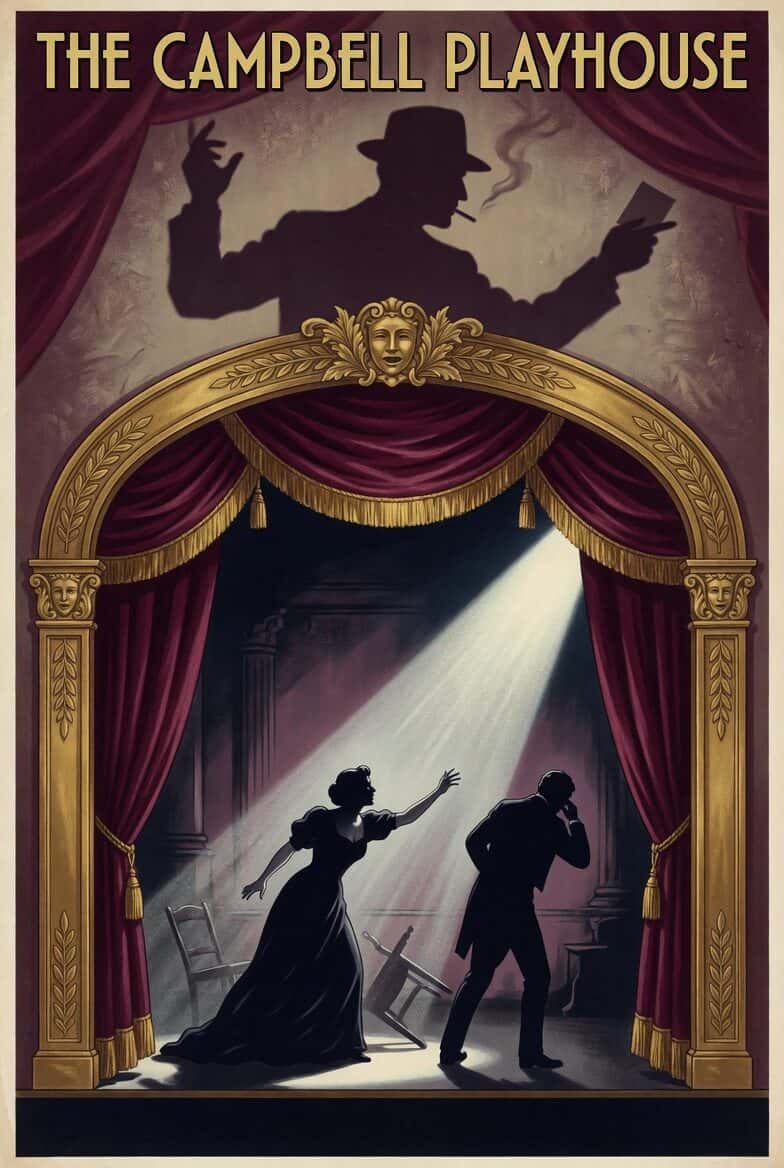
The makers of Campbell's Soups present The Campbell Playhouse. Orson Welles, producer.
Good evening. This is Orson Welles. Our broadcast tonight is The Garden of Allah. Few items of entertainment, novel, play, or motion picture — The Garden of Allah's been all three — have stood up under the test of public approval so well and so long. We regret that Claudette Colbert could not be with us, but we regard ourselves as very fortunate in having tonight for the role of Domini, a very lovely lady who has been with us before, and whom you have recently had a chance to admire in that delightful and highly successful picture, Honeymoon in Bali, Miss Madeleine Carroll.
And now before The Garden of Allah and Miss Carroll, Mr. Chappell has an interesting word for it.
Thank you, Orson Welles. The next time you're having a meal in a fine hotel or restaurant, take just a moment, if you will, to ask your waiter what one dish, in all his experience, he has most often written down on his order pad. See if he doesn't say, with scarcely a moment's hesitation, why chicken in one form or another. Because there's no denying that for most of us, any dish that includes chicken does hold a special appeal, whether we're eating out or eating at home. And I think it must be because our liking for chicken almost, well, it amounts to a national taste, that Campbell's chicken soup continues to grow in popularity so steadily. People who remember the chicken soup their grandmothers fondly ladled out of home soup kettles, when they've tasted Campbell's, say it equals the best chicken soup they ever had. It has the deep flavor of chicken clear through. Every golden drop gleams with chicken richness. And even the fluffy white rice holds the good taste of chicken. And there are pieces of tender chicken meat in the soup to add still more to your enjoyment of every fragrant plateful. Have you tried chicken soup as Campbell's make it? In the old home time, old home way? And if not, won't you do so tomorrow? I don't know. I promise you, just as sure as you like chicken, you'll like Campbell's chicken soup.
And now, The Garden of Allah, with Orson Welles and tonight's playhouse guest, Miss Madeleine Carroll.
It is the greatest love, the love of God. This knowledge comes to all. I myself have had it since my first breath. I, Father Roubier, and that is why I have been happy to serve God as his priest in all my days here in Beni-Mora, at the very edge of the great Sahara Desert. This is the story of Domini, who came here in search of peace, and found it, and of Boris, who finally regained here what he had almost forever lost. It would be untrue to say that when I first laid eyes on those two, Domini and Boris, I had even the faintest idea of what was to come. I first saw them on the very day of their arrival among us, at the Hôtel du Désert. She was by herself at one of the tables. He was alone at another. She returned my greeting of that past in a direct and friendly fashion. She had a strange, unusual beauty, to which I could sense, even in that first moment, the sincerity and earnestness of the enormous depth I was to learn in the days to come. I did not see his face. He did not look up, and I did not repeat my greeting. It is one of the early lessons we learn on the desert, that each one has a right to his own concerns, to revoke his life in the behavior that seems best to him.
That afternoon, later, I saw her again.
Good afternoon, Father.
Can I help you, my daughter?
Thank you. I'd like to sit here for a moment, Father.
You are a Catholic?
Yes. If there is anything I can do for you while you are here...
There will be, I know, but for a few days I intend simply to rest.
Ah, that is wise. It is a long journey here from... England. You are alone here?
Yes, Father.
There is someone else here who is also alone.
Yes. He came in the same train with me. You don't know him?
No, no. We traveled in the same compartment all day, and yet, oh, perhaps I may be a lot of nothing. It was a feeling he gave me rather than what he did.
What was it that he did?
Nothing really, I suppose, and yet, as I was getting on the train, he was standing in the doorway of the carriage. He paid no more attention when I tried to get past him than if I had not existed at all. He simply stood there and blocked my way. He almost made me miss the train. And then all the way to Beni-Mora, he never said a word. He just turned his head away whenever I happened to look at him. It was as if he didn't want me... as if he didn't want anybody to be with him, to be near him, to make it necessary for him to know that there were other people.
That is not uncommon in this part of the world. Perhaps he has something to hide.
He has, Father. I could tell that. Sitting there in that railway carriage, he looked like a criminal bracing himself to escape detection. He was afraid, I almost thought, of himself.
That, too, is not unusual. We have many here who try to hide from others, my child, just as many who try to hide from themselves.
I think I know myself what it is to suffer, but I have never seen such a tortured face as his. Peace will come to him, my child, as it does to all.
In this desert, I like to pretend to myself that I have within me no envy of anyone or anything, but I have known for years that this is not so. When I think of Count Anteoni's desert garden, I have always a small pang of envy of the people whom I send to see it. Nowhere else in the world is there such beauty. Since I have been in Beni-Mora, I have been there, what, a thousand times? Five thousand times. And yet, one can only see it for the first time, once. As Domini saw it that day.
It was good of you, madame, to come to see my garden.
It was Father Roubier who told me about them, and about you, Count Anteoni.
Yes, the father and I are old friends. Our beliefs are not the same, but he has done much good here among these people. Come, madame. Now I will show you our desert under the sun. You must see it also by night, by moonlight. Tonight I will send a guide, he will take you up to the tower. After that, you must send him away. To see the desert at night, one must be alone.
Oh, it's almost too much beauty. This is my first visit to Africa. I don't know if you can imagine what I think of your garden, what I feel in it.
What do you feel in it, madame?
May I tell you something, Count Anteoni?
Please, madame.
My father died a year ago in London, of a broken heart. He had been a man of devout faith until some years before, until my mother suddenly left him, for a reason that nobody was ever able to discover. A month later, she killed herself. From that moment on, he lost all his religion. He tried to make me lose mine. Since his death, I have been neither with nor without belief, without the consolation of faith, without the strength of disbelief. I came here to the desert to renew my heart, to find myself. I came here to find myself.
Peace. There is peace here. The desert always has peace.
When I'm in Beni-Mora, I usually come here, where I can see the desert. The Arabs have... The desert is the garden of Allah.
The garden of Allah.
Who is that man?
The diviner of the sand. He wants to divine your future for you.
My future? The sand tells him secrets.
No.
Would you like to test him?
Oh, no, I'm not sure.
Mind, I do not press it if you are afraid.
What is he doing now?
Speaking with his ancestor.
His ancestor? The sand.
Do you understand what he says?
The life of madame as it is in the sand. The life of madame in the grand desert of Sahara.
Oh, please, please, go on. Translate it for me.
Exactly as it is?
Exactly as it is.
Whatever it may be?
Whatever it may be.
Whatever it is, you shall know it.
He's speaking about the desert. He sees a great storm. Everything is blotted out. The desert vanishes. It is day, yet there is darkness like night. There is a train of camels waiting by a church.
A mosque?
No, a church. In the church, there is the sound of music. The roar of the wind mingles with the chanting and drowns it. You cannot hear anymore. It is as if the desert is angry and wishes to kill the music. In the church, your life is beginning.
My life beginning?
He sees the train of camels that waited by the church start on a desert journey. The storm. The storm has not abated. He sees them going toward the south.
By what route?
A long road. A great road to the south. On one of the camels, there are two people protected against the storm by curtains. They are silent. One of them is you.
And the other?
Manitani. He cannot see. The caravan passes and is lost in the desolation and the storm. Now you are far away in the desert. Among the dunes, there is a tent.
A light tent?
Yes. It is night and you are quite alone. But you cannot sleep. You go out of the tent upon the dunes. The jackals are howling all around you and the skeletons of dead camels are white under the moon. And a figure among the dunes is coming toward you.
Who is it? Who is it?
You watch this figure. It comes to you walking heavily. The gates shrivel on the palms. The strings dry up. The flowers droop and die in the sands. The red fire fade away. All is dark and silent and now he sees. Wait, wait. He sees. I don't want to hear anymore.
You said whatever it might be.
I don't want to hear anymore. He sees it plainly.
Just because you don't want to listen.
No, no, no. I don't.
See, madame. A gleam of light there to the west is the moon, madame. Shining on the mask of cities azure. Beyond that are the roofs of the greatest caravans going south to Damatul. And there, madame, to the east is a great desert that has no end. And there to the north, madame, are the mountains. Beyond the sea, where are the great ships that will take you home.
I feel as if I had never been home until today.
What did madame say?
Leave me now. Wait for me downstairs. There is someone else on the parapet.
A man, madame.
Where?
Oh. Looks like the stranger, madame. The one from the hotel.
Go down, Batouch. If I want you, I will call.
Yes, madame.
Have you been here before? It's wonderful here, isn't it?
Very wonderful, madame.
We seem to be the only travelers here.
Yes, madame. There are not many here.
Madame.
Yes?
I have something to say to you. Not much. Yet it is much to me. Pardon me, madame, for yesterday. My silence in the carriage. I did not mean to be rude. I was unknowing.
Unknowing?
Unknowing. That's all I can say. But it is the truth. I simply do not know. I have forgotten how... You must forgive me, madame.
I do forgive you. Don't think of it anymore.
Thank you.
Those Arabs down there. They look almost like one of our own religious orders when they wear their hood. One forgets their religion. All men are... They are like with or without their hoods. With or without their religions.
Oh, I do not believe that, monsieur.
But I... I know that, madame. Each one of us has his happiness to find. With or without what other people need for theirs.
That should be easy in the desert, then. One ought to find happiness here.
Why?
Why should you suppose so?
It's so beautiful and so calm.
How?
Wait a... In the depths of the desert, there must be peace. Far away. Far away from modern men and modern women. And far away from all the things to which we are accustomed. And in which there is no peace.
You think it lies out there, far away in the desert?
I think it must. For there is peace in nature. There is peace.
I will go down now, madame. You wish to be alone, I know. And I'm still ashamed.
Of what?
Of my conduct. Of my awkwardness. And I'm with you. I'm not accustomed to the society of women. Anything. Anything I've done to please you. I have already forgotten.
Thank you. Good night.
Good night. You will shake hands with me?
Of course.
My name is Domini Enfilden.
I don't think you told me your name.
I too am partly English, madame. My father was a Russian, but my mother was English like you. My name is Boris. Boris Androvsky.
I've learned much from you in these few moments.
From me? You will never know how much. In a village like Benimora, there are no secrets. In the day of good fortune... I was told that Dominique and the stranger were spending much of their time together. Long rides in the desert to the neighboring oasis. Peaceful walks together in the cool of the desert night. Often I saw them together on the street. His tall dark figure beside her slender beauty. Almost it seemed to me that he was avoiding me. Until we met one day at Count Antione's. We had never spoken till that day.
It was also on that day that I received a letter from a young French officer. Named de Trevignac, whose father I had known. If only I could have foreseen the things he told me in that letter. Things seemingly so far removed from the lives of Dominique and Boris. Were someday to decide their destinies.
In the letter, Lieutenant de Trevignac informed me with understandable anger. Of a regrettable occurrence at the monastery of El Larraguin in Tunisia. Which he had just visited. A Trappist monk. Many years trusted with the secret of the famous... ...Larraguin liqueur. Broken his vows. And disappeared. It was an offense that shocked him as it did me.
I told you, Madame. I do not care for priests. Still, for once, for an hour, you could surely have... I prefer not to be with priests. Oh, if I had known Father Rubio was coming, I would have told him. Father Rubio hates me. How can he hate you when he has never seen you before? Madame, forgive me. I've suffered much. I'm suspicious of everybody. Forgive me. You will always suffer if you cannot govern yourself. You will make people dislike you, be suspicious of you. Suspicious? Who's suspicious of me? Who has any right to be suspicious of me? I'm a free man. I'll do as I will. No one has any right. I'll do as I will.
I am not suspicious of you. I want to help you. I know. I felt that. That's why you're the only person. Person? There it is. That's Lardy. He's always playing. Who is he? One of the gardeners. The Count says he's perpetually in love. That's why he's always playing. Is that a love song? Don't you think it sounds like one? How should I know? I must tell you something. The song, it does move me, but I don't like it. Why not? It seems to me almost like an intrusion. There are things that should be left alone. There are dark places that should be left dark. It seems to me that...
Pardon me. I would not interrupt. Oh, please, Count Antione. Word has come for me. I'm leaving at sundown today on a journey. I'm going to city Hassan across the desert. Madame, if you'll excuse me. But I haven't yet shown you... Good day, Count Antione. Thank you for having let me see the garden. I must go. Let me show you to the gate, Monsieur. Thank you. Good day, with the sooner. As you wish. Goodbye, Monsieur Androsky. Goodbye. Your friend, I... I don't think he likes me or my garden. Perhaps he has something that's troubling him. I think you're right. If you'd only let other people help him a little, I... No one can help you with something that is really important.
Where is city Hassan, where you are going? To get there, one takes the caravan route to the south. My road. Yours? And I shall travel on one day. If it is the will of Allah. But if one does not believe in Allah. It will still be his will. And now I must go. My companions are waiting for me. Goodbye. And thank you for all your kindness. This garden is yours, day and night. May Allah have you in his keeping. And when your summons comes, obey. And when, if you ever make your long journey on that road, the road to the south, I wish you allah's blessing in the garden of Allah.
May I speak with you? My child? Father, do you think it is right to try and avoid what life seems to be bringing? To seek shelter from the storms? Is it not our duty to help others who cannot help themselves? I have known people, my daughter, who seemed almost to think it was their mission to convert the fallen angels. They confuse their powers with the powers that belong to God alone. Yes, but if a friend, someone whom you... For whom you had great sympathy. Were possessed by torture, by the devil perhaps, would you not try... A friend? This person of whom you speak, it is Boris Androvsky, is it not? As a friend, I warn you most solemnly not to make friends with this man. Will you give me your reason for this warning? I cannot. I have no reason to give. My reason is my instance. Do you think he is evil? I don't know if he is evil. I don't know what he is. I know that he is not evil. My daughter, you know your own strength. Only this. I beg of you. I beg you to pause and to think before it is too late. Thank you, father. I know what you mean. And I think I know now what I want.
Madame, I've come to tell you. I've made up my mind. Yes? Tonight I'm leaving Benimora. Tonight? I've come to say goodbye. I think I knew. That I'd be leaving? That it would be like this. That you would come here into this garden one day, and bid me goodbye. And that I should feel as I do. I've been standing where you couldn't see me and watching you for a long time. Your face was not happy. You will stay here? I will not stay here. I will make my journey into the desert. Alone? What else can I do? Once you said to me that peace must dwell out there in the desert. It was on the tower the first time we ever spoke to each other. I remember. Why did you speak to me? We came into the desert together. We had to know each other. And now? And now? Now we... We have to say. Dominic. I love you. I love you. Don't listen to me. You mustn't hear it. You mustn't hear it. I must hear it. Hear it. I love you. I love you.
You are listening to the Campbell Playhouse presentation of The Garden of Allah, starring Madeleine Carroll and Orson Welles. This is the Columbia Broadcasting System.
This is Ernest Chappell, ladies and gentlemen, welcoming you back to the Campbell Playhouse. In a moment, we shall resume our presentation of The Garden of Allah. But first, a reminder. Some of us will be observing Thanksgiving Day this week, others next week. But whichever date we may be keeping, the fact remains that on this day, our thoughts naturally go back to the hardy pioneers who first established it. And we're apt to think, too, of the simple homey dishes that nourished our forefathers and that they delighted in. Home-spun dishes like corn pudding and Johnny cake and good pork and beans and hearty, wholesome soups. Soups of the kind we like today. Now, it's true that changes have come, but they are changes chiefly in method. The tractor, for example, has replaced the ox-drawn plow of the pioneers, but the same corn grows in the fields. The soup kettle is fast disappearing from the home kitchen, but the same fine, nourishing soups are served and enjoyed as Campbell's soups are welcomed in home after home. So let me ask you. Are your family enjoying the fine flavor of Campbell's soups? If not, won't you try them? I know that you and your family will find them the good home-kitchen kind. And now Orson Welles continues our Campbell Playhouse presentation of the Garden of Alla starring Madeline Carroll.
Repeat after me. I, Dominique, take thee, Boris, for my lawful husband. I, Dominique, take thee, Boris, for my lawful husband. From this day forward, to have and to hold. From this day forward, to have and to hold. For better, for worse, for richer, for poorer, in sickness and in health, till death do us part. For better, for worse, for richer, for poorer, in sickness and in health, till death do us part. for riches, for poor, in sickness and in health, who doth do us part. Ego coniungo vos in matrimonium in nomine patris de fili.
I had done what I could. I did not appeal to Domini again. It was her right to do what she pleased with her heart. And so, on the morning of a day still memorable for one of the worst sandstorms that has ever come to Benimora, with a heavy heart, I married them in my little church at the edge of the desert, Boris and Domini, those two whom the desert had brought together. Even as I spoke the holy words and placed her hand in his, there came over me once again the feeling that here before me was a man with a nameless fear, a man haunted by an agony too great to be born alone.
Well, madame, a fastened attempt. Now, even if the wind rise again, you are safe. Thank you, Batush. Boris, our tent, yours and mine, our home. Stay here beside me, Domini, by the fire. Oh, Boris, are you happy? For me, there will never be another hour like this. All my life is tonight. I've had no life yet, but tonight I'm alive. Flesh and heart and soul. There's nothing here. There can be nothing here to take my life from me now. The life of our love tonight. It frightened me. To receive so much from you. You make everything I have and am seem small and yet great. No one is small who loves. No one is poor. No one is bad who loves. Love burns up evil. Only the beautiful remain. You know what is in my heart, don't you, Boris? Do I? All that is in your heart. My heart is full of one thing. Quite full. Then I know. And yours? Mine too. I have never felt the presence of God in this world as I feel it. Tonight. Even in the church this morning, he seemed farther away than now. I think I have always known the deeper I would go into the desert, the nearer I should come to God. Why should you think that? Because there is love in the desert. That's why the Arabs call it the Garden of Allah. The desert shall be your garden tonight. There will be nothing in it. Only you and I. You and I. The fire is going out. All the circle of flame. All the darkness is creeping up about it. The desert is sending us into its darkness. Sending darkness for you and for me. Because of our love. It has gone out. Tell me, Dominique. Tell me that you love the darkness.
Madame. Oh, Annie, what is it? Madame, it is not the master. These are soldiers. All are soldiers. Madame. Yes, monsieur? We have been lost for three days in the great dunes. This morning our water gave out. And just as we were giving up hope, suddenly we saw the light of your fire. Oh, you must rest, gentlemen. My husband will be back soon. He has gone out to game. Thank you, madame. These are my soldiers. I am lieutenant de Trevignac.
Dominique. Down there by the well. Yes. Tonight we have comrades in the desert. Comrades? Arabs? No, French. An officer and his soldiers who had lost their way in the dunes. He is eating with us. You asked him? Why, why, yes, of course I did. I am sure that if you had been here when monsieur de Trevignac arrived... De Trevignac? Yes, the officer. That is his name. What is it, Boris? Nothing. Nothing. I am afraid my men are lifting their voices very loudly, madame. Oh, let them. It is a long time since we have had strangers with us. They are grateful for being alive. They owe it to you, madame. And you, monsieur. Tell me, monsieur Androwski, haven't we met before? Your face seems familiar to me somehow. I seem to remember... It is impossible that we should have met. We have not met before. Then I am mistaken. You are mistaken. You have been here long, here in the desert. It is my good fortune. Let me offer you a toast. If you will permit me, I have a flask of liqueur. May I stand for it? Of course. Batouche. Yes? Yes, monsieur. You will ask the corporal to give you the bottle of Lariguin. It is in my pack. Yes, monsieur. Lariguin? Yes. You know it, perhaps? No, no, I... Oh, I see. It was the finest of our African liqueurs. Why? Unfortunately, yes. Lariguin. But why? It is a tragic story, madame. This liqueur has been made for 18 years by the Trappist monks of the monastery of Lariguin in Tunisia. Every summer, from the first grapes, the monks have distilled a small amount of this priceless liqueur. The revenue going to the free hospital in Tunis. The formula was never written. Always it was known to one single monk in the order who, on his deathbed, would deliver the secret to his successor.
Well, monsieur, the last keeper of the secret broke his vows.
A monk?
Yes. Early this year, he disappeared.
Perhaps he was a very young man. Perhaps a hard life, the rule of silence must have been...
No. He had been a monk for 20 years.
A servant of God for 20 years, and then to... Oh, how terrible. Oh, my God. How could a man? What reason?
A man had a very good reason.
There could be no reason for a man to desert his God.
Here it is, monsieur, the flask you sent me for.
Thank you.
The flask, madame.
Thank you. If you don't mind, will you excuse me? I should go down and see if your men need anything.
You are very kind, madame.
Your glass?
I love you.
Don't be long, Dominique.
I love you. I love you.
Where is he, Lieutenant de Trevignac?
The liqueur. The bottle has been smashed.
What is it, boys? What happened?
Nothing happened. Nothing.
Did you really care whether that officer is here or gone? Do you want anyone to be with us to break in on our lives? Aren't we happy alone?
Dominique, have you perfect trust in me?
I have given my life to you. What more can I give? I have nothing but you, Dominique. Nothing before you, though. Nothing ever without you again.
You are troubled, Boris. There is something between us.
There is nothing between us. You have all my love.
I had hoped by becoming one, you and I, we could bear your burden of misery together. Give me your sorrow, Boris. I can give you everything I have. More than I have. But I cannot give you that.
There can be no happiness for us unless I know your misery. Unless I bear its burden with you. Tell me what it is, Boris.
You must let me alone for a while to think, Dominique. Perhaps if you pray.
Pray. I'll try. I'll try to pray alone. In the night, I'll try to pray.
Boris.
I have returned to you, Dominique. I have waited for you all night. I have prayed all night for you. I was on my knees. I was alone in the desert. I tried to make my confession to it as if it were a priest. I could only make it to you, Dominique. Only to you.
Take care, Dominique.
Tell me whatever it is I will understand because I love you.
Dominique.
You want to know what it is that makes me unhappy?
Women are loved. It's perfectly unhappy. I'm God. And I have insulted him. Woman love. The love of you, Dominique. Higher than my love for him. Haunted by the thought of him. When I was young, I gave myself to God solemnly. The vows I made.
You gave yourself to God? How?
I gave myself to God. You've had my love. Your hatred believed that I never loved you as I love you now. Give me your truth. And as a child, Dominique. Even as a child, I was... It seemed to me that there could be nothing more than that I should give up. The earliest moment that I could, I went into the monastery.
Dominique, I was happy. Happy. It was a lonely sort of happiness, but it was happiness. It came time to take the eternal vows. I did not hesitate. Then some of them went out again into the world. Wondered that they could be so blind about their own happiness. I lived in the sun and the rain close to the earth day after day. And at night, where God seemed to hang me, there was nothing to mar my peace. I lived in his love. Lord, how they died. They put me in charge of the little house where visitors are received. And from my vow of silence for other people, to other people, for the first time since I was a child, I listened to the voices of men and women.
One summer, we sheltered a man who was torn by his love for a woman. He talked to me of her day after day, of the beauty of it, himself from his torture, but only, I'll be me of my own. And then one day, the woman came to the monastery, longer to enjoy her own torture, seeking him out. To other's arms. It was unending to think of what I had seen. The pain, the misery, the torture of love. And all of them together were the things that were denied to me forever. Every man, every woman. What was their life? What did they do? What did they feel? Got at the monastery walls, toward the lights of the city and think, they are living there. Those people, living. For months I fought with my obsession. Then, at last, fled the monastery.
Now I've given you my truth. Now you know. Now you can pray, Boris.
Yes. I will pray with you. Our father who art.
Pray with me, Boris. Our father.
Our father.
Our father who art in heaven.
Our father who art in heaven.
Our father.
The Lord be thy name.
The Lord be thy name.
Thy kingdom come.
Thy kingdom come.
Thy will be done on earth as it is in heaven.
Today is Dominic.
Not yet. Don't take your heart away from me entirely. Dominic, don't do that. Do you know that since I spoke, you've never come near to me?
I know.
And yet I have never loved you, Boris, as I do now.
Now I will tell you where we are going. We are going back to Beni-Mora. You must attain your peace. Not with me, but with God.
Dominic.
We cannot think of afterwards, Boris. God knows what is in your heart and in mine. Perhaps in our hearts already here for the secret knowledge of the end.
The end?
Yes. The end.
Where shall I drive to, monsieur?
Tell him, Dominic.
To El Laguen.
To the monastery, madame?
Yes, to the monastery.
Where will you be, Dominic?
I don't know. I can't think of that now. In these last few minutes. If I could feel... If I could feel that I could, I could sometimes see you. Even far away. Like those lights down there. But never, never to see you again.
We will see each other every day. In our prayers.
Dominic.
Till the end of my life I will think of you.
No, Boris, don't tell me, don't.
Dominic, Dominic, I cannot regret that we have loved each other. That we will love each other forever.
I regret it. That I was sinning against God and you. Against myself, my eternal vows. See it now. To you, Dominic. I never really knew God. Now I know him. In the worst moments of the agony that is to come. I know what God is. Because of you.
I too. Wherever I go. That will be the glory of our happiness, Boris. We will learn to say to ourselves. We are unconquered. We are unconquerable.
Here we are, Monsieur Androvsky. El Laguen.
This is the monastery. Stop here, driver.
But, Monsieur, it is not allowed. The visitor's entrance is over.
Stop here.
Go, Boris, quickly. Let me touch your hand. My darling. Goodbye.
Madame.
Drive back to Tunis.
Madame does not wish to wait.
Monsieur.
Drive back to Tunis.
We do not count time in the desert, as does the world elsewhere. And so, in truth, I could not say now how many years it has been since Dominique came back to us here at Beni-Mora. She and Boris first met. I know that she is a gentle and gracious lady. And that I spend my afternoons sitting quietly with her in the garden on the edge of the desert. Her child. A child that Boris can never know. Happily at our feet. I know that her eyes are turned almost always in the direction of that hill many, many miles away across the Tunisian desert as the Trappist monastery El Laguen, to which Boris returned. And I know that he has often, because I hear every now and then from the abbot of the monastery, that the two of them, Boris and Dominique, found their happiness firm and enduring. A joy which in the end all men must return. The greatest love which is the love of God. Amen.
This concludes our Campbell Playhouse presentation of the Garden of Allah. In just a moment, Orson Welles will return to the microphone with tonight's playhouse guest, Madeleine Carroll. Meanwhile, I'd like to leave just a thought with the mothers listening, and it's this. Why not build a nourishing school day meal for your children around bowls of Campbell's famous chicken soup. I love chicken, and they'll taste the flavor of chicken in every gleaming spoonful of this good chicken soup, fluffy rice, and tender chicken meat. Wouldn't you like to try it? See if you and your children don't take to it eagerly, because just as sure as you like chicken, you'll like Campbell's chicken soup.
And now, here is Orson Welles.
Ladies and gentlemen, it gives me great pleasure to present to you now our guest of the evening, Miss Madeleine Carroll.
Thank you, Orson. Good evening, ladies and gentlemen.
Madeleine, I can't tell you how glad we are to have you with us again tonight. Ever since you did the Green Goddess last spring, we've been hoping to have you back.
Back is right. I've been in jungles ever since last spring.
Jungles?
Paramount jungles. First I was in the Balinese jungle. In Honeymoon in Bali.
Yes, you were wonderful. And now I'm acting my way through the African jungle in Safari.
You have no idea how happy I was with you just now in that nice, clean desert.
Besides, I've never been in a jungle in my life, and as a matter of fact, I have been in the Sahara Desert.
So have I.
What a pity we never met. You and I on the great road to the south, our desert caravan under the moonlight. Did you ever ride one?
I beg your pardon?
A camel.
Indeed, I did. It's still a matter of lively comment among the natives. Did you?
That's not a matter I care to discuss, Orson. However, what I will discuss gladly is how very much I've enjoyed both the times that I've been here with you on the Campbell Playhouse. There's a very special quality about these shows of yours that makes it a real pleasure to act on them.
Thank you, Madeleine. And next time you'll emerge from one of your jungles, you'll please let us hear from you, won't you?
I certainly will. Meantime, shall I give your regards to Dr. Livingston?
Good night, Orson.
Good night, and thank you, Madeleine Carroll.
Ladies and gentlemen, tonight in our Campbell Playhouse production of The Garden of Allah, Madeleine Carroll played Dominique Felton. Everett Sloane played the Count George Anteoni, with Father Roubier, and Ray Collins with her as Lieutenant de Trevignac. The music, as always, was arranged and conducted by Bernard Herrmann.
And next Sunday. Next Sunday, we bring you Dodsworth, which bears the unique distinction of having been written by a great American novelist and made into a play by a great American playwright. The work of Sinclair Lewis, the first American winner of the Nobel Prize for Literature, was dramatized by the late Sidney Howard, twice winner of the Pulitzer Prize for Drama. First as a book, then as a play, and finally as a motion picture, this story, successful American and his wife, and their trip abroad. What happened to them has never failed to move American audiences. Our guests, we're very proud to have with us the two ladies who, in the original New York production, created the parts of Edith Cortright and Fran Dodsworth. Miss Nan Sunderland, whom you've heard with us before on The Magnificent Ambersons, and that well-known American actress of the stage and motion pictures, Fay Bainter.
And so until then, until next Sunday in Dodsworth, my sponsors, the makers of Campbell Soup, all of us here in the Campbell Playhouse remain obediently yours.
The makers of Campbell Soup join us in what we call the Campbell Playhouse. The Campbell Playhouse. The Campbell Playhouse. The Campbell Playhouse. The Campbell Playhouse.
Well, in inviting you to be with us in the Campbell Playhouse again next Sunday evening, when we bring you that great American story, Dodsworth, with Fay Bainter and Nan Sunderland as our guests. Meanwhile, if you have enjoyed tonight's presentation, won't you tell your grocer so tomorrow when you order Campbell's chicken soup? This is Ernest Chappell saying thank you and good night.
This is the Columbia Broadcasting System.