
The written record
Read the transcript
Read along with the recording · About 46 min to read
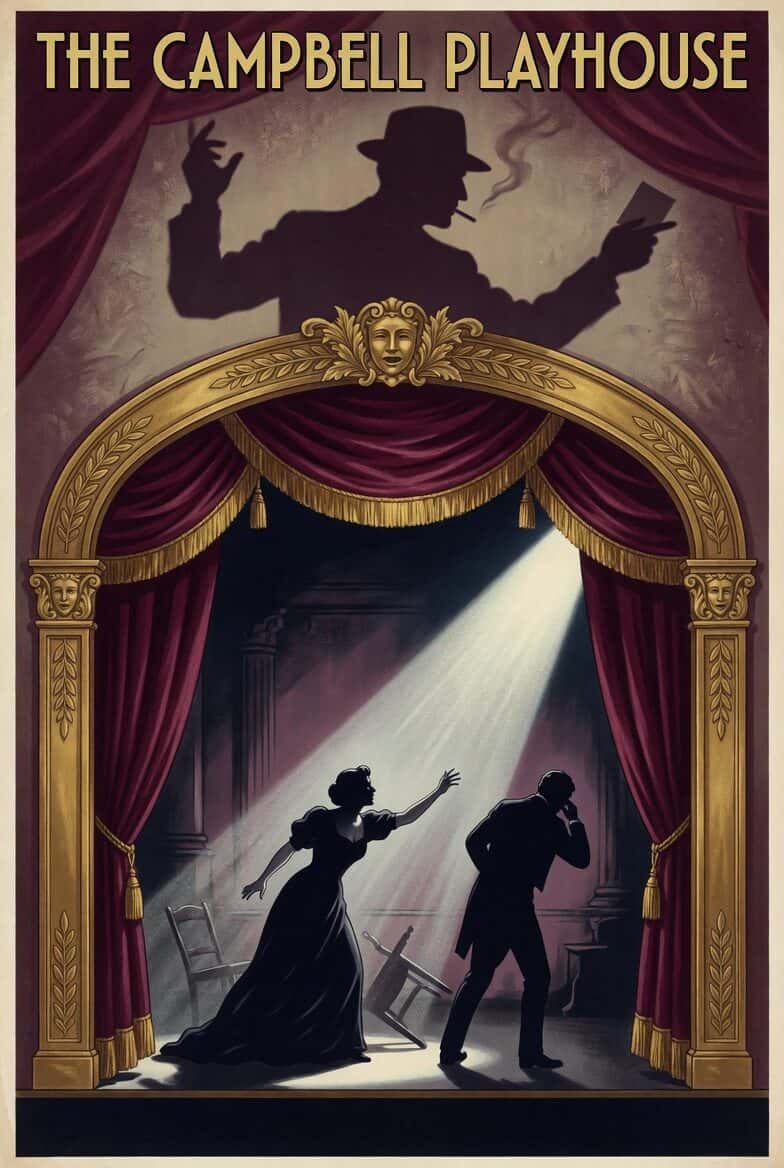
The makers of Campbell's Soups present The Campbell Playhouse. Orson Welles, producer.
This is Orson Welles. Tonight we broadcast our version of what is generally regarded as one of the greatest of the modern mystery murder novels. In some peculiar fashion, it seems to have become necessary to defend the murder mystery as a form of entertainment. Heavy artillery is brought up in its behalf. President Wilson, it is proclaimed loudly, could not go to sleep—or could go to sleep, one does not remember the point exactly—until a certain number of conflicting clues had managed to efface the day's worries from his mind. And with a mystery solved only after suspicion has been aimed at every adult in the neighborhood, it's not particularly shameful. I have never understood the need for this defense. Murder mysteries are, among other things, our most moral form of entertainment. The wrongdoer is regularly apprehended. If he is not, I have incredibly missed some fascinating black sheep of an orphanage, rare in a flock otherwise startlingly white. And one learns an obvious lesson: that to be suspected wrongfully is in due course to be triumphantly cleared of suspicion. Life doesn't always proceed according to this admirable pattern. The apologist would do better to defend life, I sometimes think.
To help us solve the mystery of the murder of Roger Ackroyd here tonight, we are fortunate in having a very powerful ally, a most distinguished lady and one of your favorite actresses. A lady in whose ears a nation's applause is still ringing. For her latest brilliant success in "Drums Along the Mohawk," Miss Edna May Oliver.
But before we delve into the mysteries of this night's doings, Ernest Chappell has a comment to make on something which appears to be no mystery at all. Mr. Chappell.
Thank you, Orson Welles. I'd like to ask all of you if you'll do this. The next time you're out in the car driving along the highway, just note the great number of eating places that display as their main invitation to you the words "chicken dinners." The reason, of course, is simply that the proprietors of these eating places know by long experience that to nearly all of us, one dish that is a symbol of good eating is chicken. Now, because chicken is a favorite dish with nearly everyone, it's really no mystery at all why Campbell's chicken soup continues to grow steadily in popularity. You see, in every drop of the glistening golden broth, there's the rich chicken flavor you like so much. Deep. The best in deep chicken flavor, too, is fluffy white rice in every fragrant plateful. And you'll also enjoy the pieces of melting tender chicken meat that Campbell's adds. Yes, here is chicken soup, deep and full and rich. And you'll appreciate that from your first brimming spoonful. If you've already enjoyed this homey old-fashioned chicken soup as Campbell's make it, won't you remember to have it again soon? And if you haven't yet tried it, won't you do so at dinner tomorrow night? Because I'm going to have it again. Because I promise you, just as sure as you like chicken, you'll like Campbell's chicken soup.
And now our Campbell Playhouse presentation of "The Murder of Roger Ackroyd" with our guest of the evening, Edna May Oliver.
And ladies and gentlemen, before we begin, I think you'd like to know that we have with us in the studio tonight as a surprise visitor, none other than the celebrated Belgian detective, Mr. Hercule Poirot.
Ladies and gentlemen, I bid you good evening. If we had time, which we have not, I'm sure nothing would please us more than to hear from Mr. Poirot. Unfortunately—
Why unfortunately when we have here a microphone?
But, Mr. Poirot, you don't understand—
I understand only that since my arrival in your country some weeks ago, I observe that there is circulating an impression of my person which I must now publicly refute. I trust that the embarrassment of my presence here tonight in Mr. Welles' studio will ensure for me an honest and lifelike portrait. It has been said that I am a little man. Regard for yourself that this is not so. I am a little man. I have five feet, two inches of eye. My head is perhaps egg-shaped and I carry it perhaps a little to one side, the left, but my eyes shine green when I am excited. Beyond this, my mustaches are the largest in Europe and my force is in my brain and not in my feet. If these things are made clear and Mr. Welles' is a tribute to Hercule Poirot, I will be satisfied. The results of my little gray cells will speak for themselves. If you will show me where I am to sit, please. I thank you.
This is Mr. Poirot.
How do you do? Mr. Oliver, you have often wanted to meet me, I am sure. I compliment you.
Please, please, Mr. Poirot.
Ladies and gentlemen, our Campbell Playhouse presentation of "The Murder of Roger Ackroyd."
Well, let me just start with giving you some idea of the little village of King's Abbot, of which I have for so many years been the leading—I must admit, also the only—physician and surgeon. My name, by the way, is Sheppard, James Sheppard. We have a large railway station, a small post office, two rival general stores, a very few able-bodied men, a staggering number of unmarried ladies, none of whom are getting any younger, and an amazing number of retired military officers, all of whom are getting older. In fact, the only newcomer for many months lives next door to me, concerning whom little is known despite the earnest and tireless investigations carried on in respect to him by my sister Caroline. Caroline and her little group of earnest ferrets, or maiden ladies like herself, have been forced to content themselves with the simple fact of his nationality, which is alien; of his name, which is Poirot; the obvious fact that he putters around his garden all day growing cucumbers; and the suspicion based chiefly on malicious deductions of his retired hairdresser.
Let's see, now. The main house of any importance being there is Fernly Hall, owned by Roger Ackroyd, who's always looked more like a country squire than any country squire could really look, but who's actually an immensely wealthy manufacturer of wagon wheels. Nearly 50 years of age, rubicund in the face, and genial of manner, and generally the life and soul of our, to this week, peaceful village. The other house of any importance has been left to Mrs. Ferrars by her late husband. Mrs. Ferrars died on the night of the 16th, September, a little less than a week ago. It seems longer than that. I was sent for at 8 o'clock the morning of the 17th. There was nothing to be done. She'd been dead some hours. I turned to my home as soon as I decently could, looking forward happily to the warm breakfast I had missed, and rather unhappily to the certainty of a relentless cross-examination by my sister Caroline.
Is that you, James? What on earth are you doing out there in the hall?
Just hanging up my overcoat, my dear.
Oh, Mrs. Ferrars died in her sleep, didn't she? Bacon is cold.
How did you know?
Out of the dawn, securing information instead of warming the bacon.
Bacon, is it? I suppose you're going to tell me she died of heart failure.
Annie told me. The milkman told her. He had it from Ferrars' cook. Since you're bound to hear sooner or later, Caroline, from the greengrocer or the postman, I might as well tell you myself. She died of an overdose of sleeping medicine. She hadn't been sleeping well lately.
Nonsense. She took it on purpose.
Well, why on earth should Mrs. Ferrars wish to commit suicide? A widow still fairly young, very well off, in health, nothing to do but enjoy life. And looking forward to marrying Roger Ackroyd. Don't forget to leave that out.
That's an item of fact only in your local gossip circle.
A fact's a fact. And there is such a thing as remorse, James, even if you're as wealthy as Mrs. Ferrars.
Remorse? I have always been convinced she poisoned her husband, and I'm more than ever convinced of it now. If you'd arranged an inquest a year ago, as I suggested, you should have...
You're talking nonsense, Caroline.
Then you're absolutely satisfied it was an accident?
I'm satisfied this bacon is not going to get any warmer by itself, and it's time I went to the surgery to see my patients.
All right, James, you don't have to be grumpy about it. Oh, by the way, Mr. Ackroyd's butler, Parker, called.
What about?
Mr. Ackroyd wants to know if you'll dine with him this evening. He says he'd regard it as a great favor if you'd cancel any other engagement.
Of course I'll go, and don't worry, Caroline, I may tell you all about the dinner tomorrow.
Oh, then I'll give you something to tell Mr. Ackroyd tonight. Ralph Paton is back.
Yes?
And he's staying at the Dog and Whistle. I know he's taking particular pains to be sure that Mr. Ackroyd doesn't find out about it.
I wouldn't dream of telling him. Roger Ackroyd's relations with his stepson—
That's on his own affair.
Believe me, Caroline, according to every interpretation except your own—
I can't help it if people tell me things.
In answer to questions.
Well, you'd better rush along to that precious surgery of yours. You've got four patients waiting.
How do you know?
Well, one can't help seeing through a window if one is looking through a window.
The distance from my house to Fernly Hall, Roger Ackroyd's home, is a little over two miles. I remember that evening as I walked that the subject of Caroline's latest piece of gossip kept returning to my mind. Ralph Paton was in King's Abbot. Ralph Paton, whom I'd known and liked since he was a child. Adopted by Ackroyd upon the death of his mother, he'd grown up to be a handsome, but what our narrow little village regarded as a rather wild young man. There'd been many stormy scenes between his stepfather and himself before he finally left for London. According to Caroline, he was secretly engaged to Flora Ackroyd, Roger Ackroyd's niece, who, with her mother, was now living in Fernly Hall. According to Caroline, I say, and Caroline's information, I'm afraid, is always exact. However, illegitimate her source may be...
What's the trouble, Ackroyd? A bit under the weather?
Yes, Doctor, I've had a little of that pain after food lately. You must give me some more of those tablets of yours.
I thought as much, Ackroyd. I brought them up with me. My bag's in the hall. I'll get them.
Oh, don't trouble. Make certain that window's closed, will you, Sheppard?
Of course. The latch one's open.
Now put the latch across, will you?
All right. I think what's really bothering you, Ackroyd...
The, uh, the door's closed, isn't it?
Yes. Sheppard, nobody knows what I've gone through in the last 24 hours.
What's the trouble?
Well, you're an old friend, Doctor. My oldest friend, perhaps. You attended Ashley Ferrars in his last illness, didn't you?
I did.
Is it ever into your mind that he might have been poisoned?
Frankly, Ackroyd, I don't think I should—
He was poisoned. By who? His wife. She told me so herself yesterday.
Yesterday? You mean a few hours before she died, she told you?
Yes. Some weeks ago, I asked Mrs. Ferrars to marry me. She refused. Last week, I asked her again, and she consented. Yesterday, I called upon her. I noticed that she'd been very strange in her manner for some days. Now, without the least warning, she broke down completely. She told me everything. Her hatred of her swine of a husband, her growing love for me, and then, a year ago, the dreadful means she had taken to free herself. Murder in cold blood.
Murder? Are you sure, Ackroyd?
That wasn't all. It seems there's one person who's known all along what she did, who's been blackmailing her for huge sums. It was the strain of that that drove her nearly mad.
Who was the man?
She wouldn't tell me his name.
Have you any suspicion?
I don't dare have a suspicion. Something she said made me think that the person might actually be a member of my household. But that can't be so. I won't let it be so. I must have misunderstood her. What did you say to her?
What could I say? She made me that promise to do nothing for 24 hours, and she refused to give me the name of the scoundrel who'd been blackmailing her. I never dreamt she'd kill herself.
Shepard, will you hand me that letter on the table there, in the blue envelope?
This one? Thanks. Thanks. It's from her. It arrived during dinner. She must have written it just before she...
You think she wrote you the little bit she didn't tell you, did she? Name of the man.
Yes, I think so. I've got to open it, and yet I'm afraid...
What's that?
What?
I thought the letter the door gave a bit.
Yeah? I'll see if there's anyone there.
No one.
No, thanks, Victor. Are you sure you'll shut the window?
Yes, of course.
Well, I'll read it. If I read it to you, it won't seem so bad. I won't be facing it alone, no matter what the name. My dear, my very dear Roger, a life calls for a life. I see that. I saw it in your face this afternoon, so I'm taking the only road open to me. I leave to you the punishment of the person who made my life a hell on earth for the last year. I would not tell you the name this afternoon, but I propose to write it to you now, dear Roger, now that I have nothing more to fear.
Will you forgive me, Shepard, but I see I must read this alone. It was meant for my eyes and my eyes alone.
Do you think that's wise, Roger? I'd rather wait.
Well, if you insist on not letting me help you.
If you must put it that way, yes, my dear friend, I do insist.
...a quarter to nine from Fernly Hall to my house in Texas is a rule about three quarters of an hour. The night of the moon shining and I did it in less. On the road, I noticed the lights blazing in our parlor. Caroline was entertaining me.
...with a window I caught sight of an egg-shaped head partially covered with suspiciously black hair, two immense mustaches and a pair of watchful eyes.
James! Come in, come in, come in. You're just in time for hot milk and crackers.
Oh, thank you, Caroline. Oh, excuse me. This is my brother, Dr. Shepard.
I am in charge here. James, this is Mr. Hercule Poirot.
How do you do, sir?
Mr. Poirot is our new neighbor.
If I may be permitted the one slight correction, my name is Hercule Poirot, your good sister, the procedure and the familiar English assumption that we are not English do not know how to pronounce our own silly names.
He's just making fun of me, James, but he has a very dry wit. We've had quite an interesting conversation.
I question that it was two-sided. And do you know what Mr. Poirot told me? He's a policeman.
Uh, pardon, mademoiselle. Not yet, I see. Do you appreciate Hercule Poirot? It is true, earth, the name Poirot, mademoiselle, is known today in every continent, every land, in every city of the world. I am become the most, the last word. I am as much a specialist as a gnarly street physician.
Well, that's what I said, didn't I, a detective?
A consulting detective.
That's what I said. I'm afraid, Mr. Poirot, you find it little to occupy a man of your talents in this village.
Mr. Poirot tells me what he's looking for just now is peace and quiet.
Precisely, mademoiselle. That and the correct soil which you have in so great abundance here in King's Abbot for the cultivation of cucumbers.
I'll answer it. It's probably Mrs. Bates and her rheumatism.
Never mind, Caroline. I'll take it.
Oh, all right.
Hello. Hello. Of course I will at once. What is it?
It's Parker the butler calling from Fernly. Just found Roger Ackroyd murdered. Dr. Shepard.
Where is he, Parker?
I beg your pardon, sir.
Mr. Ackroyd, don't stand there staring at me if you notify the police.
The police, sir?
I said, what's the matter with you, Parker? You call me to tell me your master's been murdered. Your master murdered? Didn't you telephone me not five minutes ago and tell me Mr. Ackroyd has been found murdered?
Me? Oh, no, sir.
Your English is not of the best, Dr. Shepard, but there seems to be a peculiar misapprehension.
Why, Dr. Shepard, I never...
I'll give you the exact words I heard just now on the phone. This is Parker the butler at Fernly speaking. Will you please come at once, sir? Mr. Ackroyd has been murdered.
But, doctor, I...
Where is Mr. Ackroyd, Parker?
Why, he's in the study, sir.
If you don't mind waiting down here a moment, Mr. Poirot, I won't be a minute.
This way, sir.
But of course, of course. I, uh... I'd rather not intrude on him, sir, if you don't mind.
Well, I will, then.
Door's locked.
Mr. Ackroyd must have locked himself in and possibly just dropped off to sleep, sir.
Ackroyd! Ackroyd!
Look here, Parker. I'm to break this door in, or rather, we are.
But, Dr. Shepard...
I'll take your responsibility.
Oh, if you say so, sir. All right, here we go. Together now.
The inspector set it sideways, forbidding the dagger to penetrate the jugular. Death was instantaneous.
Has the body been moved?
We are making certain that life is extinct. I haven't disturbed the body in any way.
You didn't touch the dagger, did you, doctor?
No, inspector. No, good. Well, we'll want that for fingerprints. Ah, a rummy-looking thing, isn't it? Foreign-looking. Moorish silver. Mr. Ackroyd was quite a collector. There are his silver cases over against the wall. Eh?
Who are you?
My name's Raymond. I'm Mr. Ackroyd's private secretary.
That's right, inspector. He's been in the directorate almost two years now.
Oh, very well. Now, doctor, how long should you say he's been dead?
Half an hour, at least. Perhaps longer.
You had to break down the door, eh? What about the window?
The English people, they have many for the fresh air. The big air is all very well outside where it belongs. Why admit it to the house?
Hey! Who are you? How did you get in here?
You call yourself unfortunate man and inspector of police and you say to me, who am I? Hercule Poirot, master detective, possessed of the finest brain in Europe, known in every continent, in every land, in every city.
Not in my part of the world, you ain't. I never heard of you.
How about, Mr. Poirot, inspectors, my house, the phone call came to Ackroyd's desk.
Oh, well, all right then. I can stay. But this is my case and don't you forget it. Now then, when was Mr. Ackroyd last seen alive?
I don't know, probably by me and I left, let's say, a little before nine.
Mr. Ackroyd was certainly alive at half past nine. I heard him in here talking.
Who to, Mr. Raymond?
I don't know. I just heard his voice but I know it was 9.30.
You didn't hear any of their conversation, did you, Mr. Raymond?
I did catch a fragment of it that did strike me as a trifle odd.
Remember, please, the words exactly. It is very important.
No, no. I'm not sure that I can.
But the words exactly.
Wait a minute, Mr. Poirot. Who's conducting this case? You or me?
Now then, Mr. Raymond, what was these words you heard Mr. Ackroyd say at 9.30?
Well, come on. I'd swear under oath the exact words were the calls on my purse have been so frequent of late that I find it impossible to accede to your request.
Thank you, Mr. Raymond, very much. I beg pardon, Inspector.
Well, what is it, Parker?
I just remembered. Miss Flora saw Mr. Ackroyd later than 9.30 at about quarter of ten. She was just coming out of this room.
You mean she was just closing the study door?
No, sir. She'd already closed the door when I saw her. She told me Mr. Ackroyd was not to be disturbed again tonight.
Where's Miss Flora?
Upstairs in her room. Shall I ask her to come down?
No, no. I'll go up.
One moment. If I might be so humble, Mr. Inspector. Could I ask our friend Parker for a little information?
Well, well, what is it?
Thank you for your so gracious permission, Inspector. Tell me, Parker. Is this room exactly as it was when you entered it with Dr. Shepard?
Well, to tell you the truth, sir, I felt myself that this chair here was drawn out a little more. It has been puzzling.
The grandfather chair between the door and the window.
That's right, sir.
That's very curious. No one would want to sit in a chair in such a position.
What are you talking about? When a man wants the city, sit, don't he?
Who pushed it back in place, I wonder? Did you, Parker?
No, sir. No, sir. I was too upset at seeing the master.
It isn't important, is it, sir?
It is completely unimportant. That's why it is so interesting.
You're very late for breakfast, James.
I was up quite late, Carol. I'm afraid I forgot your natural anxiety to learn details you're not supposed to know.
Well, don't worry about me, James. Mr. Poirot was working in his cucumber at daybreak this morning. 6.37 it was. And I've been with him ever since.
Good. Perhaps you have some information for me, Caroline.
Perhaps I have. Perhaps I have. Or are you going to pretend you know what suddenly occurred to Mr. Poirot in the night so that he couldn't sleep for an hour or two after he got home?
Inasmuch as I haven't seen our friends, he went to bed.
Well, I don't feel very much like telling you either. If I didn't know that he'd tell you himself, I don't think I would. Well, he was worrying about the prints of some shoes outside the window. The way the rubber studs were worn down, he says, should mean something to him. But he doesn't know what.
Did you explain it to him, Caroline? Hasn't the cook been of any help to you or the milkman or the ladies' aid society or...
You needn't always be facetious, James.
Yes, and the bacon needn't always be cold, I dare say, but it is, and so am I. Not cold, but facetious. James, James, you know what, Mr. Poirot? James.
He says I have the makings of a born detective in me. He particularly admires my wonderful instincts into human nature, and he told me a lot about the little gray cells of the brain. He says his are of the first quality, slightly above that, in fact.
I'm sure they are. He thinks you're very intelligent, too.
Ah, good morning, good shepherd. Good morning.
Good morning, Mr. Poirot. A beautiful morning, is it not? See, how is this for a cucumber?
Beautiful, my friend. It is yours. I give it to you.
All together, my good shepherd, I have a wonderful morning. Everywhere I learn things new and wonderful things. And all the timely gray cells of Hercule Poirot, they are working, working.
Miss Caroline, she tells me so much about this. Ralph Paton, this morning, I go to the hotel, it's what you call it.
Don't...
Thank you, Miss Caroline, and I think I will talk myself to Ralph Paton. Then they tell me at the dog and weasel that was here last night another gentleman asking for Mr. Paton.
Why, gee, I certainly think you might have...
You must know, Caroline, I thought someone ought to inform Ralph that his uncle's dead. The least one could do, and since no one but myself and the members of your intelligence service knew he was in King's Abbot at all.
Matter of fact, Ralph Paton left the dog and weasel at nine o'clock last night, never came back.
Well, what on earth do you think happened to him?
Ralph Paton has a right to come and go as he pleases. He might have gone anywhere. He might even have gone back to London.
Leaving his luggage behind at once.
Oh, by the way, my good shepherd, that telephone call...
Oh, you mean the one that came while you were at the house of the...
Exactly, Warren. Tell me, do you think it is possible that someone could have telephoned you and imitated Parker's voice sufficiently to deceive you?
Well, he said it was Parker. James really doesn't know Parker's voice well enough.
Of course, of course, but the telephone call was traced this morning by my friend, Inspector Hempstead. It didn't come from Fernly Hall at all. It was put through to you at 9.50 last night from a public call office at King's Abbot Station and at 23, the night mail is for Liverpool. It is the inspector's opinion that the murderer may have left King's Abbot on that very train.
Ah, then you do believe that Ralph Paton...
I believe nothing, mademoiselle.
Well, then, what do you think?
I think that the murderer in that Roger Ackroyd was murdered. Outside of that, I think that I will have to think a good deal more.
Oh, it's an outrage. That's what it is. A little man, not even an Englishman, a foreigner with moustaches coming to this home, a British home, a house of mourning, uninvited, unwelcome.
Oh, Mother, do be quiet.
No, I will not. He comes in here into my own brother-in-law's house, questions us like a lot of criminals, besmirches our kids and kids.
Mrs. Ackroyd.
Mr. Poirot, you must excuse my mother. My uncle's death was a terrible shock.
I understand, mademoiselle. It is very little that Hercule Poirot does not understand.
Honestly, though, Mr. Poirot, you're on the wrong track. This Paton has nothing to do with this crime. To me, the fact that he was hard-pressed for money...
Was he hard-pressed for money, Mr. Raymond?
Oh, Mr. Raymond, now you've made it seem as though...
Miss Ackroyd, I'm merely telling the truth. Yes, he was hard-pressed. He was always applying to his stepfather for money.
But, Mr. Poirot...
Please, had he done so of late, Mr. Raymond, during the last week, for example...
Mr. Ackroyd didn't mention such a fact to me.
Of course, Mr. Paton will never again have to apply to anyone for money.
You mean that Mr. Ackroyd's will...
Exactly. After paying certain legacies and bequests to servants, charities, and so on...
Aha, including yourself.
Mr. Ackroyd was good enough to remember me to the extent of 1,000 pounds.
Well, it's not surprising. Go on, please.
Well, Miss Flora Ackroyd inherits 20,000 pounds outright. The rest of the estate, including this carpet, in and out, standing in control of the business, goes to Ralph Paton.
You've been familiar with this will for some time past, Mr. Raymond.
Roger Ackroyd's confidence is second.
Of course, of course. And Mr. Ackroyd possessed a very large fortune indeed, in art. A fortune that would have been regarded as large even in less tax-ridden times.
Then the immediate inheritance of such a large sum would have eased very considerably the present difficulties of Mr. Paton.
Mr. Poirot, you don't think...
Is that so, Mr. Raymond?
Yes, that is so.
You awful little man, talking that way when you know how Flora feels about Ralph Paton. The idea that you suspect him of killing his...
Him no more than any other, madame.
You know what I think? I think Roger's death was an accident. Roger was so fond of handling curios. His hands must have slipped or something. He was really a very strange man. Would you believe it? He never gave Flora and me an allowance. Family! And of course we didn't have a penny of our own. At this very moment...
If you need any ready money, Mrs. Ackroyd, Mr. Ackroyd cashed a check for a hundred pounds yesterday for wages and other expenses due today. The money was never spent.
And where, if you please, is this money?
He always kept his cash in his desk. I suggest that we see if the money is there.
Why, Flora, surely...
Am I to understand, you miserable little foreigner, that you're intimating I took the money?
I merely intimate, ladies and gentlemen, that we see if the money is still there.
Ladies and gentlemen, there are here only sixty pounds.
Oh, that's impossible. Let me see. Ten, twenty, thirty. The man's right. Here's sixty.
This is terrible. Dr. Sheppard, Mr. Poirot, I hope nobody believes...
One must believe there are sixty pounds where there should be one hundred. However, I'm sure no one would suggest that you, Mr. Raymond, or you, Mrs. Ackroyd, who alone knew of the money...
Mr. Poirot, I protest.
Just one moment. Flora, I took the money. I'm a thief. I'm a common, vulgar little thief. Now you know. I'm glad that it's come out.
I'm glad also, Miss Flora.
You are?
Yes, because now we comprehend why Parker thought he saw you coming out of your uncle's room at a quarter of ten.
But he did see her coming out of the door. He said...
No, that's just what he did not see. He saw Miss Flora outside the door with her hand on the handle. He did not see Miss Flora come out of the study for a good reason. Miss Flora was never in the study.
Then where else could she have been?
Perhaps on the stairs.
Well, those stairs only lead to Mr. Ackroyd's bedroom.
Precisely.
Then you knew I took the forty pounds.
I knew nothing, but I suspected much. As even now, I suspect that this money you have taken, you did not take it for yourself.
I took it for myself. You can take what steps you please.
I assure you, Miss Ackroyd, no steps will be taken. Only one thing. Why did you not tell me sooner? Me, Hercule Poirot, who in the end will know everything. Why do not all of you tell me the truth?
Just because Flora made a little mistake, that's no reason to...
Silence! Silence, madame. Ladies and gentlemen, I am aged. My powers might not be what they were. In all probability, this is the last case I shall ever investigate. Hercule Poirot does not end with a failure. Ladies and gentlemen, I tell you I mean to know and I shall know in spite of you all.
How do you mean in spite of us all?
But just that, monsieur. Every one of you in this room is concealing something from me. It may be something trivial which is supposed to have no bearing on the case. Each one of you has something to hide. I appeal to you. Tell me the truth now. The whole truth. Miss Flora, my good Dr. Sheppard, Mrs. Ackroyd, Parker, Mr. Raymond, will no one speak? It is a pity.
You are listening to Orson Welles in the Campbell Playhouse presentation of The Murder of Roger Ackroyd with Edna May Oliver. This is the Columbia Broadcasting System.
This is Ernest Chappell, ladies and gentlemen, welcoming you back to the Campbell Playhouse. In a moment, we shall resume our presentation of The Murder of Roger Ackroyd. Meantime, I'd like to call your attention to this interesting fact. Authorities tell us the young people of today are healthier than the youth of any previous generation. And they say that a big contributing cause is the broader use of the right kind of food. Take soup, for example. Women have always realized the value of good soup in the weekly diet. But it took a long time to make it. Then came Campbell's soup. And women, one after another, tried them. They compared them for wholesomeness and nourishment with their own homemade soup. They saw how much their families enjoyed the fine flavor of these soups of Campbell's. And because women no longer had to find time to make it, soup began to come to the table more and more frequently. Today, soup figures more importantly than ever before in the preparation of sensible, nourishing family meals.
And now, Orson Welles continues our presentation of The Murder of Roger Ackroyd with Edna May Oliver.
I am a village surgeon and Hercule Poirot is a distinguished Belgian detective. So it was scarcely for me to tell him I thought he was wasting his time. Certainly not for me to tell him that he was getting on my nerves. Not that I didn't admire his extraordinary cleverness and insight. Poirot's right, for instance, about the dagger. Police investigation confirmed his suspicion that the fingerprints on the handle of the dagger were those of Roger Ackroyd, the murdered man. Though the position of the dagger definitely precluded suicide. It was Poirot who established that it had not been Parker, the butler, who summoned me on the phone that night to what had become a house of death. And again, it was Hercule Poirot who made it indubitably clear that nobody had seen Roger Ackroyd alive after 9:30, at which time Raymond, the secretary, had heard Ackroyd's voice in the study. In spite of all this, it seemed to me that Hercule Poirot was making little real progress in solving the mystery of Roger Ackroyd's death. Furthermore, it seemed to me a curious thing for a detective of his self-proclaimed standing to be spending so much of his precious time in idle chatter with my sister, Caroline.
I had a very interesting chat with Mr. Poirot, James. He thinks me very intelligent.
So you've told me. Is it just a coincidence, Caroline, that on those occasional mornings when the bacon is both warm and crisp, it should be so far away from me that I can't reach it?
Too much bacon isn't good for you.
No such thing as too much bacon. And I'll be the judge of what's good for me. I'd rather fancy that at least as something I know best, Caroline.
You know so many things, James. You're so self-complacent. That's why it's difficult to talk to you. That's why you get the idea that I, that people, are trying to pump you.
Some more bacon, please.
Poirot says I, uh, I'd make an excellent detective.
Did he?
Mm. We had a very interesting chat. I wonder if Mr. Poirot found it interesting. He said I was more valuable than anyone he's met here. I don't know. I don't know. He told me a lot about his life, too. About a mad nephew of his. Do you know that Prince Paul of Mauritania, the one who just married the dancer? Well, he...
I do not know her.
You do not know her and I do not care to hear about her or about his mad nephew, either. Did he ask you any questions, Caroline?
No questions. We just chatted and chatted.
More bacon, please.
I have a little theory of my own, James. Mr. Poirot didn't ask me, but he might have. Whom do you suspect?
I don't suspect anybody. I know. Parker was here in your surgery the morning of the murder. That place is full of poison. He's sure to have taken some. As a matter of fact, that's been my theory right along. Roger Ackroyd was poisoned in his pool that night.
Francis, he was stabbed in the neck. You know that as well as I do.
After death to make a false clue. I examined the body and I know what I'm talking about. That wound wasn't inflicted after death. It was the cause of death. And don't look so omniscient. Next you'll be telling me you know more about medicine than I do. Perhaps you think you could take over my practice.
Oh, don't be ridiculous. You know I haven't a license.
That afternoon, Caroline had a mahjong party made up of a little group of village gossipers in whose opinion I now learned Ralph Paton was mysteriously concealed somewhere in Cranchester. The only big town anywhere near it. Of course, that was true. Miss Gannett's maid, it seems, had contributed the additional information that while taking a walk that afternoon on Cranchester Road, she'd seen Monsieur Poirot in a large black car coming from that room.
I was not surprised to learn that Monsieur Poirot had been invited to my house for dinner. Caroline believes whenever possible in getting her information directly from headquarters.
A little more raspberry sherbet, Mr. Poirot.
Under no circumstances. I am already a man of a corpulence of great. It would hardly become me if I, if I, if there is no harm in any raspberry sherbet.
There you are, Mr. Poirot.
I beg your pardon, Caroline, if I might have my first serving.
Oh, I thought you thought me, James.
There you are. Thanks.
Mr. Poirot, what do you think about Ralph now?
What I think would scarcely be regarded as the legal evidence in the courtroom, mademoiselle.
You are incredulous, mademoiselle Sheppard.
I am incredulous.
You have a theory, Poirot.
I don't have a theory. I know.
Oh, Karen.
James, don't meddle about in what you don't understand.
There are several points to this case.
Yes, mademoiselle.
Point number one. Mr. Ackroyd was heard talking to someone after, after half past nine. Point number two. At some time during the evening, Ralph Paton must have come in through the window as evidenced by the prints of his shoes. Point number three. Mr. Ackroyd was nervous that evening and could have only admitted someone he knew. Point number four. The person with Ackroyd at 9:30 was asking for money. We know Ralph Paton was in a scrape.
Admirable.
Oh, and one other thing, Mr. Poirot. I found out something for you today. The boots Ralph Paton was wearing that night, they were not brown. They were black.
Ah. You have found that out for me. Thank you. Thank you. You are sure, mademoiselle, they were black, not brown.
Positive?
Too bad. Too bad. If they were only black, those boots. I mean, if they were. You, you mean...
Yes.
Yes. I understand. Ralph Paton is guilty or innocent according to whether his boots are brown or black. Really, Mr. Poirot? It could easily be. For murder, there was with Mr. Paton so many motives. First motive, blackmail. Ralph Paton may have been the man who blackmailed Mrs. Ferrars. Reason? His general money needs. The second motive, the certainty of a great inheritance through Mr. Ackroyd's death. And the third motive, Caroline? Very simple. Very simple. Mr. Ackroyd's violent disapproval of Ralph's proposed marriage to Miss Flora. Well, after listening to you, Caroline, I'd say the case that's very black against him. I haven't a case, James. I know.
Late that afternoon, Mr. Poirot called on me to ask if I could arrange a little conference around his home that night. Those would be present Mrs. Ackroyd, Flora, Raymond and Parker. I think Caroline, who was present when he called, would have given ten years of her life to have been added to the list. Well, my part, I would have been only too glad to yield her my place among those who, on that particular evening, gathered around the beaming countenance of the Belgian detective and cucumber breeder.
I clear my throat. That is an accepted signal in this country that a meeting is about to begin. Quiet, everybody. I'll read the list. Will you please answer to your names? Raymond. Yes? Yes, sir. Mrs. Ackroyd. Yes, but I wanted to think how to put... Yes, will be sufficient. Miss Flora. Yes? Say, but what's the meaning of all this? The list I have just read is the list of suspected persons. Every one of you present had the opportunity to kill Mr. Ackroyd. I won't stand for this. I'm going. You will not go, madame, until you have heard what I have to say.
I clear my throat again at the beginning. And here now, ladies and gentlemen, we have all been trying to answer to ourselves one principal question. Who was in the room with Mr. Ackroyd at 9.30? Not Dr. Sheppard, since I myself can prove that he was at home. Not Miss Flora, nor Mrs. Ackroyd, nor Mr. Raymond, with whose actions on that evening we are well acquainted, nor Parker, who has furnished me with a satisfactory alibi. Who then? This is the part of Hercule Poirot, the cleverest, the most audacious question. Was anyone with him?
Are you trying to make me out a liar, Mr. Poirot? No. I tell you, I distinctly heard voices. I distinctly heard the words that Mr. Ackroyd was speaking. Mr. Raymond, the words that Mr. Ackroyd said. The calls on my time have been so frequent of late that I believe it is impossible for me to accede to your request. Ha. But nothing strike you as odd about them. Their style, for example. No, he frequently dictated letters to me using exactly the same style. That is precisely what I seek to arrive at. Would any man use such a phrase in talking to another, huh? Ha, ha. You think not.
My friends, you have all forgotten one thing. This stranger who called at the house in the preceding week and deferred his representative. Do you remember, Mr. Raymond? Dictaphone company. A dictaphone? That's what you think. Mr. Ackroyd had promised to invest in a dictaphone, you remember. Me, I had the curiosity to inquire of the company and question their reply. Mr. Raymond, was that Mr. Ackroyd did purchase a dictaphone from their representative. Why he concealed the matter from you, his confidential secretary, I do not know. Must have meant to surprise me with it. He had quite a childish love of surprising people.
Oh, there's only one man who could have done it. You mean, let's face it. Mother. Oh, let's face it. If he did it, he should be able to do better, dear. If only he'd come forward. That is your advice, Mr. Raymond. That he should come forward. Certainly. Do you know where he is? Me? I know everything. Remember that. The truth of the telephone call, of the footprints on the window sill, of the hiding place of Ralph Paton. Where is he? Not very far away. Where? In Cranchester. Where? No. He is not in Cranchester. He is here, in the doorway of this room. Ralph! Please, please, follow my darling.
Have I not told you all at least 36 times that it was useless to conceal things from Hercule Poirot? That always I discover the little secret. It is my business. From Dr. Sheppard. Sister Caroline. Ladies and gentlemen, I learned that the doctor and Ralph Paton, they are old friends. Dr. Sheppard knows that things look very black against his friend Paton. He tells him the old story. Yes, he did. He explained to me how suspicion was bound to fall on me and I had no real alibi. And with the best of intentions, people sometimes make errors. That's why Dr. Sheppard consented to do what he could to help Mr. Paton. He was successful in hiding him from the police. Where? In his own house? No, indeed, Mr. Raymond. You should ask yourself the question that I, Hercule Poirot, did. If the good doctor is concealing the young man, what place would he choose? It must necessarily be somewhere near at hand. I think of Cranchester Hotel. No, lodgings. Even more impractical. No. Where then? Ha, ha. I have it. A nursing home. I make inquiries as if one of them a patient was brought there by the doctor himself early on Saturday morning. That patient, I had no difficulty in identifying him as Ralph Paton.
No. He arrived at my house yesterday and now, ladies and gentlemen, we come to the point of this evening's meeting. Ralph Paton says he is innocent of the killing of Roger Ackroyd. Oh, I am. I swear by heaven, I am. Please, please, Mr. Paton. Please. You have just heard Mr. Paton declare he is innocent. Yet he has three motives for the murder and no alibi. Well, I certainly don't see how you can sit there. I am possessing the floor, Mrs. Ackroyd. Listen carefully, everybody. Save Mr. Paton, the real criminal must confess. I will speak to you. Hercule Poirot. I know that the murderer of Mr. Ackroyd is in his room now, at this table. Tonight. Tomorrow in the morning the truth goes to the police. You mean you know who? Yes. At the moment, I know. I alone. For the murder of Roger Ackroyd, there is only one way out. And that way does not lead to freedom. And it is not to the murderer that I speak. This is a matter of life and death. And I, Hercule Poirot, am not joking. Good night.
James, what are you doing out there in the hall? Just hanging my overcoat, my dear. Well, aren't you coming in to chat? I'm very tired, Caroline. At least you can tell me what happened last night. Mr. Poirot told us all about his little gray cells again. Oh, does he think Ralph Paton is guilty? No. Well, he's crazy. You can go over and tell him so in the morning. Good night, Caroline. I'm very tired.
My arm aches from writing. I've written it all out. Now Paton will be cleared. As I think back, I'm not quite certain why I urged Ackroyd to read that letter before it was too late. That's why I subconsciously realized that with a pig-headed chap like that, I had best chance of getting him not to read it. His nervousness that night was interesting psychologically. He knew danger was close at hand, yet he never once suspected me as the blackmailer of Mrs. Ferrars. The dagger was an afterthought. I'd brought up a very little weapon of my own, but I thought the dagger lying on the silver table occurred to me how much better it would be to use a weapon that couldn't be traced to me. I suppose I must have meant to murder him all along. As soon as I'd heard of Mrs. Ferrars' death, I felt convinced that she'd have told him everything before she died. So I went home and took my precautions. The dictaphone he had given me two days before to adjust something gone a little wrong that I'd persuaded Ackroyd to have a go at instead of sending it back. I did what I wanted to it. Took it up with me in my bag. Studied that evening. When it was all over, I looked around the room for the door. Quite satisfied, nothing had been left undone. The dictaphone was on the table by the window, timed to go off at 9.30. The mechanism of that little device was rather clever based on the principle of alarm clock and the armchair was pulled out so as to hide it from the door. I never dreamed that Parker would notice that... notice that chair. Certainly would not have remembered if Poirot hadn't asked him. Having the American sailor with a toothache call me from King's Abbot that night was a stroke of genius. No way for anyone listening to have told that it was not Parker. Still don't know how Poirot thought that one out. My only regret is about Caroline and yet I feel I can trust Poirot. She'll never know the truth and I'm glad at that. I shouldn't like her to know. She's fond of me and then too she's proud. I guess it'll be a grief to her but grief passes. I've finished writing. I should enclose this whole manuscript in an envelope addressed to Poirot. Now, because I'm tired, take some sleeping powder and I'll go to bed because I'm very tired. I will take more sleeping powders than I should. More than anybody should. I suppose I ought to feel sorry. I am sorry. Sorry that Hercule Poirot ever came to King's Abbot to grow his cucumber.
This concludes our Campbell Playhouse presentation of The Murder of Roger Ackroyd. In just a moment Orson Welles will return to the microphone with our guest of the evening Edna May Oliver. Meanwhile, I'd like to take just time enough to say this to every man and every woman listening. We at Campbell's know good cooking and so, of course, do you. Speaking, therefore, as one good cook to another, we'd like you to try our chicken soup. Try it, if you will, in the same friendly yet critical way you'd sample a neighbor's good dish or send in one of your own for her to try. And if you'll do that, I know you'll find this soup deep and full and rich in chicken flavor from the first spoonful to the last delicious drop. Indeed, I promise you, just as sure as you like chicken, you'll like Campbell's chicken soup. And now, here is Orson Welles with Edna May Oliver.
Never mind, uh, Orson Welles. What about me, F. Q. Poirot? Miss Oliver, have I not the little gray cells? You and your gray cells. If you ask me, I think Ralph Paton committed the murder. After listening to my explanation so careful? Especially after listening to your explanation so careful. Now, in the days when I was a detective... Scotland Yard? No, R.K.O. You and your one little murder. Why, when I was a detective, no sooner did I establish the identity of the murderer than he was murdered. And I had to start all over again. It is well for you, Miss Oliver, to belittle a genius of Hercule Poirot. But remember this. Hercule Poirot always laughs last. Attend. I laugh last. Ha, ha, ha. I accept that as a laugh. Go on.
I have observed the proceedings and I have observed the proceedings here in the studio and I have detected a circumstance which has indubitably escaped you who are untrained to watch for such things. Almost it had escaped me myself. Not only did I discover that the gentleman who told the story, Dr. Sheppard, was himself the murderer of Roger Ackroyd, but I now reveal to you that he was enacted in Mr. Welles' little anecdote by none other than that beloved portrayer of dramatic roles, that celebrated delineator of character, that unparalleled purveyor of protean portraiture, that internationally celebrated... You refer to Orson Welles, I take it, Mr. Welles? I do.
Now I would like to be allowed a little observation of my own. Excuse me, Poirot. Avez-vous la plume de ma tante? What? I'm not finished yet. Où est le chapeau de ma mère? That's all right, Mr. Poirot. I just wanted to see if you could really speak French. Attend, Mr. Welles. Attend, Mr. Welles. Attend, Mr. Welles. Attend, Mr. Welles. Attend, Mr. Welles. Attend, Mr. Poirot. I love, I love. Good night, Edna May Oliver. And may I say I hope that this will not be the last time that you will put me in my place in this program.
In tonight's Campbell Playhouse production of The Murder of Roger Ackroyd, the role of Caroline Sheppard was played by Edna May Oliver.
The part of Roger Ackroyd was played by Alan Napier, Mrs. Ackroyd by Brenda Forbes, and Flora Ackroyd by Mary Taylor. George Coulouris was heard as Inspector Hempstead, Ray Collins as Mr. Raymond, and Everett Sloane as Parker the butler. Dr. James Sheppard who committed the murder was played by Orson Welles, and Hercule Poirot who arrested Dr. Sheppard was played by Orson Welles. The music for tonight's production with the exception of the Noël Coward melodies was composed and of course conducted by Bernard Herrmann.
And now, Mr. Welles, I see we have just a moment. Can we have a word about next week's story?
Next week, ladies and gentlemen, it will be our proud pleasure to give you The Garden of Allah starring Claudette Colbert. The Robert Hichens masterpiece, both as a book and a play, has engaged the affections of the peoples of the world for 35 years with its ageless story of a great love and a greater renunciation. If Miss Colbert is listening in, I want her to know how eagerly we're all looking forward to the privilege of having her with us in the Campbell Playhouse. No other actress that I know is more ideally suited than Miss Colbert for the part of Domini, the English girl who found in the Great Sahara the love that gave the final meaning to her life. And so until then, till next Sunday and Claudette Colbert and The Garden of Allah, my sponsors, the makers of Campbell Soups and all of us here in the Campbell Playhouse remain obediently yours.
The makers of Campbell Soups join Orson Welles in inviting you to be with us in the Campbell Playhouse again next Sunday evening when we bring you The Garden of Allah with Claudette Colbert as our guest star. Meanwhile, if you've enjoyed tonight's Campbell Playhouse presentation, won't you tell your grocer so tomorrow when you order Campbell's Chicken Soup? This is Ernest Chappell saying thank you and good night.
This is the Columbia Broadcasting System.